
Utility Billing Contract Terms: What to Negotiate on Term, Termination and Data Ownership
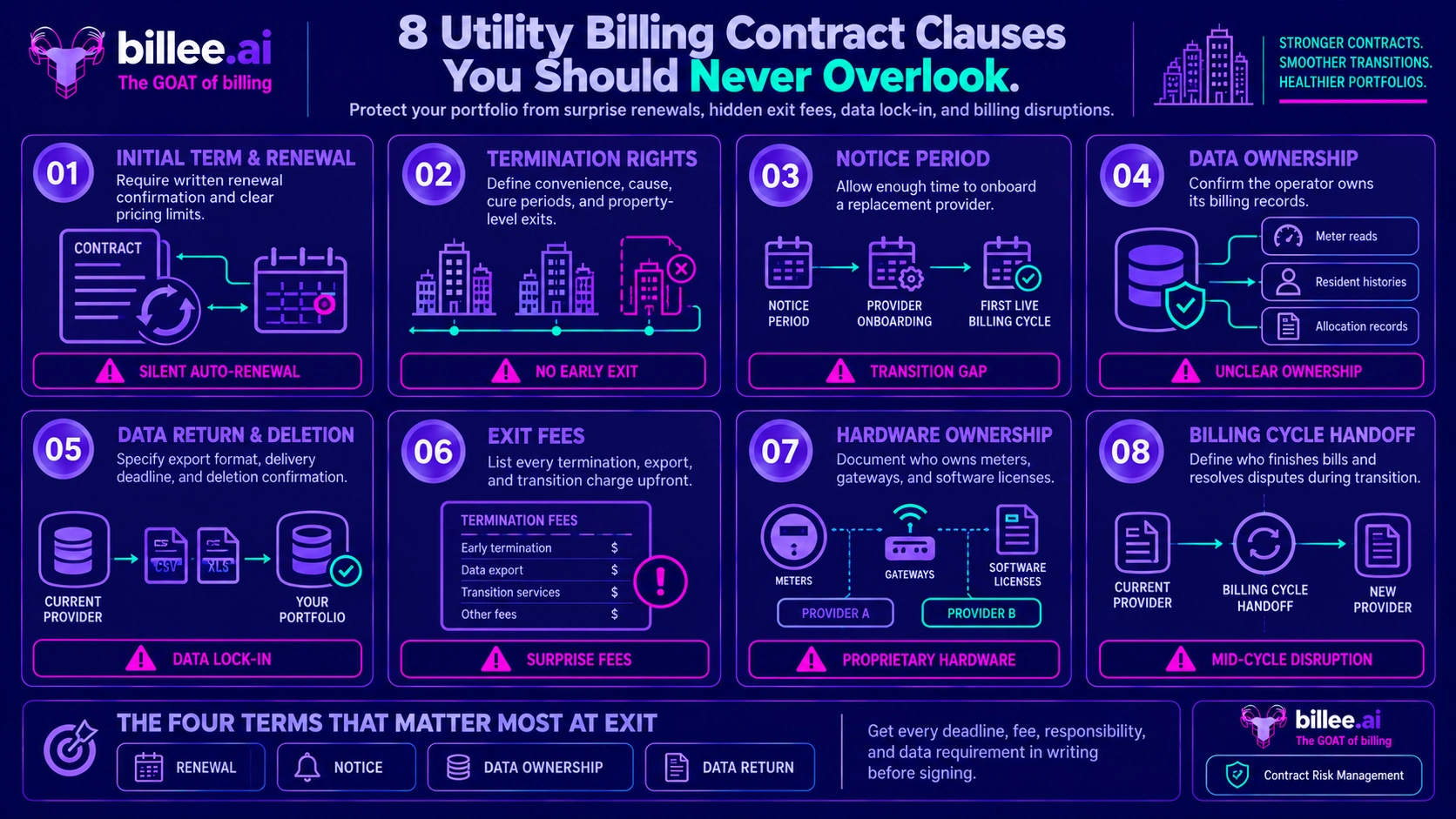
Four terms decide how hard it is to leave a utility billing provider: the renewal clause, the notice period, who owns the billing data, and how that data comes back at exit. Billee Technologies, Inc. returns a full billing history export as a standard offboarding step. Get every term, including format and timing, in writing before you sign.
The per-unit rate gets the attention. The exit clauses decide what the relationship costs when it ends. Below are eight clauses, each with what to ask for, what the public record shows and sample language for your counsel to adapt. For the buying stage, start with Billee's ten questions to ask a utility billing company. Nothing here is legal advice. Have your own counsel review the final agreement.
Key takeaways
- Treat renewal as a decision you make, not one that happens to you. Put the non-renewal deadline on the calendar the day you sign.
- Public agreements vary widely. A Housing Authority of the County of San Bernardino (HACSB) RFP set three years plus two extension options; the Mountain House Community Services District agreement ran 60 months.
- Write down who owns the data, what comes back, in what format, by when and at what price. "Reasonably satisfactory" is not a format.
- Add a no-fee exit for any property you sell.
- Make your notice period at least as long as a replacement needs to go live. Billee's own standard implementation takes 45 days.
The eight clauses at a glance
#ClauseGet thisRed flag1Initial term and renewalA fixed term; renewal by written confirmation, or a written reminder before any auto-renewalSilent auto-renewal into a long renewal term2TerminationExit for cause with a cure period; a way to exit single propertiesNo exit right before the term ends3Notice and the replacement clockNotice at least as long as a successor needs to go liveNotice too short for any realistic transition4Data ownershipA written statement that the records are yours, with a broad definitionSilence, or a right for the provider to reuse your data5Data return and deletionNamed format, full term, deadline, no fee, written deletion confirmation"A format reasonably satisfactory" and no deadline6Exit feesEvery exit charge on a schedule agreed nowFees defined after you give notice7HardwareA schedule of meters, gateways and licenses, with ownersProprietary hardware only the outgoing vendor can read8Cycle in progressAn exit date on a cycle boundary; a named owner for final billsTermination mid-cycle with no handoff
What two public agreements show
No two billing agreements read alike. These two public documents show the spread. Both come from the public sector, so treat them as illustrations of structure, not market norms.
HACSB RFP (2025)Mountain House CSD agreement (2015)What it isA request for proposals for utility billing services (rebid)A signed agreement for facilities operation plus utility billing and collectionTermThree years, with two extension options60 months from July 1, 2016NoticeThe agency committed to 30 days' written notice before adding, deleting or modifying servicesEither party may end it without cause on six months' written notice; the district may cancel the billing portion alone on nine months' notice during the initial termDataThe RFP text does not appear to address data returnRecords and data belong to the district; billing information must be in a format "reasonably satisfactory to transfer to another billing provider"
Notice cuts both ways. Six months of notice protects a provider from being dropped overnight. A customer who wants out should also expect to pay for six more months of service.
Clause by clause
Each clause has an "Ask for" line and, where it helps, sample language to adapt. Brackets mark what you fill in.
1. Initial term and renewal
Ask for: a fixed initial term, a renewal that needs your written confirmation (or at least a written reminder before any automatic renewal), a renewal term no longer than the initial one, and a cap on the price change at renewal.
Billee's guide to outsourcing versus in-house billing tells readers to confirm term length, auto-renewal clauses and early termination penalties before signing. Price at renewal matters as much as the date, and Billee's guide to fees outside the per-unit rate treats renewal as the natural point to revisit fee terms.
Automatic renewal is where a missed date turns into another term. Some states regulate it in business contracts. New York's General Obligations Law §5-903 says a clause that renews a service, maintenance or repair contract for real or personal property cannot be enforced against the customer unless the provider sends a written reminder 15 to 30 days before the date the customer must give notice. It exempts renewal periods of one month or less.
Wisconsin's business-contract statute, Wis. Stat. §134.49, requires an initial disclosure of auto-renewal terms and, where both the initial and renewal terms exceed one year, a reminder notice, according to law-firm summaries from Boardman Clark and Quarles. Both say non-compliance can make the renewal clause unenforceable.
Whether either law reaches a utility billing agreement depends on the contract. Ask counsel, and do not count on a statute to rescue a renewal you forgot to calendar.
Sample language:
This agreement renews only if Owner confirms renewal in writing. Provider will send a renewal reminder to Owner's notice contact between [90] and [60] days before the end of the then-current term. If Owner does not confirm, the agreement ends at the end of the term and Provider will provide the exit support described in Section [number]. Fees at renewal will not increase by more than [percent] over the prior year.
2. Termination: convenience, cause and sale of a property
Ask for: a termination-for-convenience right with a stated notice period and fee (or a clear statement that there is none), termination for cause with written notice and a cure period, and the right to remove a single property.
The Mountain House agreement shows the structure to look for. Either party can leave without cause on six months' notice. For a material breach, the other side gets 60 days to cure, then seven days' written notice. Ask how any early-termination fee is calculated: a flat amount, the remaining fees or a declining schedule. Billee's questions guide lists the notice period and early-termination fees among the items to confirm before signing.
Portfolios change. Properties sell, refinance and get acquired. Mountain House shows a partial exit: the district could cancel the billing portion alone. Your agreement should let you drop one property without a fee when you sell it, and say how a new property joins.
Equipment ownership and related service contracts may not convey with a property, per Billee's acquisition due diligence checklist. For a sale or refinancing, your provider must also hand over the records a lender or buyer will ask for; see Billee's guide to preparing utility cost data for refinancing or disposition.
Sample language:
Owner may remove any property from this agreement without fee on [30] days' written notice if the property is sold, foreclosed or otherwise transferred out of Owner's control. Provider will bill through the end of the billing cycle in progress on the removal date and will deliver the data described in Section [number] for that property.
3. Notice and the replacement clock
Ask for: a notice period that lets you select and onboard a replacement without a gap in billing.
A notice period only helps if it matches how long a replacement takes. Billee's standard implementation takes 45 days. Ask every provider for its timeline on your PMS and property count.
Work backward from the date you want a replacement live: subtract its onboarding time, then the time to run a selection. If your notice period is shorter than that, you either run two providers at once or leave a billing gap. Billee's guide to switching utility billing providers walks through the phases.
4. Data ownership
Ask for: a sentence saying the records belong to you, and a definition broad enough to cover what you need in a dispute, an audit or a sale.
Spell out "billing data": resident account histories, meter reads, allocation calculations and methodology, master utility invoices, statements sent, dispute records and the activity log. The methodology matters because an audit starts there; see Billee's guide to preparing a billing methodology audit. Mountain House's agreement states that records and data belong to the district. Billee's questions guide says the same of billing history: it belongs to the operator, not the billing company.
Ownership is also a compliance point. In Texas, the water submetering and allocation rules put record-keeping on the property owner. Under 16 TAC §24.277, an owner must make records available to residents and the Public Utility Commission: the utility's bills to the owner, the allocation formula or submeter readings, and the totals billed each month. Records are kept for the current year and the previous calendar year (submeter test results until the submeter is retired).
Response deadlines are short: three days if the records sit at the on-site manager's office, 15 days to get copies to the manager if they are kept elsewhere, and 30 days with no on-site manager. If your provider holds those records, the agreement must guarantee timely access, including after you leave. The rule covers water and wastewater in Texas only; Billee's state-by-state guide is the place to start for other states.
Also ask whether the provider may use your data beyond serving you, such as for aggregated benchmarks, and how resident personal information is secured, accessed and deleted.
5. Data return and deletion
Ask for: a complete export in a named format (CSV or Excel, for example), covering the full term, delivered by a stated date at no charge, with help for your next provider and written confirmation when your data is deleted.
Billee's switching guide recommends requesting a full export of billing records in a portable format before the transition is complete. Vague language fails here. Mountain House requires billing information in "a format reasonably satisfactory to transfer to another billing provider," which is hard to enforce. Name the file types, fields, date range and deadline. The HACSB RFP does not appear to address data return at all, a reminder to put it in your own document.
Outside utility billing, the Cloud Standards Customer Council's guide to cloud service agreements offers a model. It calls for "a period of time, and a defined process, for the customer to recover data," provider help with extraction, a typical retention period of one to three months after exit, and written confirmation when data is removed. The 2016 guide covers cloud services generally, so use it as a model, not a utility billing standard.
Sample language:
All billing records and data created under this agreement, including resident account histories, meter reads, allocation calculations and methodology, master utility invoices, statements, dispute records and the activity log, are Owner's property. Within [30] days of Owner's request or of any termination, Provider will deliver a complete export in [CSV or Excel] covering the full term, with a data dictionary, at no charge, and will assist Owner's successor provider with questions about it.
After Owner confirms receipt of the export, or [90] days after termination, whichever comes first, Provider will delete Owner's data from its systems and confirm deletion in writing. Until then, Provider will respond to Owner's records requests within [five] business days.
6. Exit fees
Ask for: every charge that applies at or after exit, on a schedule agreed now.
Exit costs can sit in four places: an early-termination fee, a data export or access fee, a charge for custom reports, and fees the provider keeps on the final invoice. Billee's outsourcing guide notes that a headline rate may not include setup, technology access, data export or processing fees, and its utility billing pricing guide suggests asking for a full breakdown that includes export fees and early termination penalties. Timing matters: Billee's fee guide notes that an API access fee bites hardest when you switch vendors, because a property then has the least room to negotiate it.
7. Hardware and equipment
Ask for: a schedule of every meter, gateway and software license at each property, who owns each item, who can read it, and what happens to it at exit.
Submeters stay in the wall for years. Billee's guide to selecting a submetering vendor says submeter hardware typically stays in place for a decade or more. A new vendor can take over reads without replacing meters if the hardware uses an open data protocol and is still within its accuracy life. If the hardware is proprietary to the outgoing vendor or out of calibration, expect a re-metering conversation.
Properties billed by RUBS have no resident meters, so this clause matters for submetered properties. Check software licenses either way.
8. The billing cycle in progress
Ask for: an effective date that falls on a billing-cycle boundary, a named owner for move-out final bills during the handoff, and a window after exit when the provider still answers questions about cycles it billed.
The worst time to leave is mid-cycle. Billee's questions guide tells readers to confirm what happens to billing in progress if the contract ends mid-cycle. Pick an exit date just after a cycle closes and charges post. Then settle who finalizes move-out bills during the transition.
A resident can question a bill after the provider has gone. The agreement should keep the provider answering on cycles it billed for a stated period, such as [90] days, and should say who holds the records of those cycles.
Five contract mistakes that weaken your hand
- Signing before exit charges are on a schedule. Fees defined later cannot be compared.
- Missing the renewal date. Give the deadline an owner and three calendars.
- Accepting "reasonable" language for data return. Name the format, fields and deadline.
- Forgetting the sale. Without a per-property exit right, a property you sold can keep generating fees.
- Setting notice shorter than a replacement's go-live time. Count backward from the date you need to be live.
How Billee Technologies handles term, exit and data
Billee Technologies pairs a platform with a named, dedicated account team. This table shows what Billee documents on each clause and what to get from Billee in writing.
ClauseWhat Billee documentsGet in writing1. Term and renewalAsk Billee directly; this guide makes no claimInitial term, renewal mechanics, renewal pricing2. TerminationAsk Billee directly; this guide makes no claimNotice, fees, cause and cure, per-property exit3. Notice and replacement clockA 45-day standard implementation for customers moving to BilleeYour notice period and transition support4. Data ownershipBilling history belongs to the operator, per Billee; an activity log records every billing action by your team or Billee'sOwnership language and any data-reuse rights5. Data returnA full billing history export as a standard offboarding stepFormat, fields, delivery date, fee, deletion confirmation6. Exit feesPricing is quoted on requestEvery exit charge on a schedule7. HardwareBillee sources, installs and maintains submetering hardwareWho owns the meters, and who can read them after exit8. Cycle in progressA monthly cycle with defined review and lock stepsEffective date, final bills, post-exit support
Your ledger stays in your PMS
Each month, Billee's team assembles utility data, runs the allocation and generates a preliminary bill. Your administrator reviews it in the portal. Within 1–2 business days of your approval, a biller locks the bill, charges post to the resident ledger in your PMS on the set date, and e-bills go to residents.
The posted charge history therefore lives in your system of record. Billee's Yardi documentation says utility charges live in Yardi's ledger; confirm the same for RealPage and Entrata. See Billee's guides to its Yardi Voyager and Entrata integrations.
What Billee returns at exit
Billee returns a full billing history export as a standard offboarding step, per Billee's own published guidance. Ask Billee to put the format, fields, delivery date and any fee in your agreement.
While you are a customer, the portal lets you switch to any past billing cycle and download the Detail Resident Report or the Itemized Report. An activity log records every billing action by your team or Billee's. Those are the records a dispute or audit needs, so ask that the activity log be part of the export.
A clean cutover in either direction
Pick an exit date after a cycle locks and charges post. Move-out final bills run on their own track: you finalize the bill in the portal, and once it is sent, the charges post to the PMS immediately (documented for Yardi).
If you are moving to Billee, the 45-day standard implementation covers PMS integration, vendor transition, historical data migration, the methodology audit, training and the first billing cycle. Billee's regulatory and compliance support adds access to legal support, not legal advice.
What to ask Billee in writing
The guide makes no claims on these for Billee, and your agreement should settle each one:
- Initial term, renewal mechanics and renewal pricing.
- Notice to terminate for convenience and for cause, any termination fee, and whether you can exit a single property.
- Export format, fields, delivery date and fee; how long Billee keeps your data after exit; written confirmation of deletion.
- Who owns the meters and gateways at each property, and who can read them if you leave.
- Whether Billee may use your data beyond serving you.
- Security and privacy terms for resident data.
Who Billee is not for
- Portfolios under about 300 units, where Billee's full-service model is usually more than the job needs.
- Operators who want to run billing themselves with software alone. Billee's portal exists for review and approval, not self-service operation.
- Properties on a PMS Billee does not list. Billee lists Yardi, RealPage and Entrata, so confirm support first.
FAQ
How long is a typical utility billing contract?
There is no single standard. Public examples include a three-year term with two extension options (the HACSB RFP) and a 60-month term (the Mountain House agreement). Billee's outsourcing guide notes that terms vary by provider, so get the term, renewal and termination terms in writing before you sign.
Can I terminate a utility billing contract early?
Only if the agreement allows it. Look for a termination-for-convenience clause with its notice period and fee, and a for-cause clause with a cure period. The Mountain House agreement lets either party leave without cause on six months' notice.
What is an auto-renewal clause, and how do I avoid being locked in?
An auto-renewal clause extends the contract for another term unless you give notice by a set date. Calendar the date, ask for a written reminder before it and limit the renewal term. Some states, including New York, regulate auto-renewal in certain business service contracts; ask counsel whether yours applies.
Who owns utility billing data?
The agreement should say the property owner does. Without that sentence, you are relying on assumption. In Texas, the water submetering and allocation rules put record-keeping on the owner, so the contract should also guarantee timely access.
What data should a billing provider return when the contract ends?
At minimum: account and billing histories, meter reads, allocation calculations and methodology, invoices, statements, dispute records and the activity log, in a named format by a stated date.
What happens to billing in progress if I switch providers?
Choose an effective date just after a cycle closes and charges post. Then agree who finalizes move-out bills and who answers resident questions about earlier cycles.
Who owns the submeters if I leave?
Ownership depends on how the hardware was purchased and what the agreement says. Ask for an equipment schedule with ownership terms before signing. Hardware that is proprietary to the outgoing vendor means a re-metering conversation if you leave.
Do I need a lawyer to review a utility billing agreement?
Yes. This guide shows what to look for and offers sample language, but it is not legal advice. Have counsel review the final agreement and check the rules in each state where you operate.
Billee handles utility billing, vacant cost recovery and vendor management for multifamily operators who want a dedicated team behind the software. If Billee is on your shortlist, ask for its terms in writing and talk to the team about your portfolio.
Sources
- Housing Authority of the County of San Bernardino, "RFP PC1432: Utility Billing Services (Rebid)," released May 21, 2025, accessed October 2026.
- Mountain House Community Services District, "Agreement: Operation and Maintenance of Water, Wastewater and Stormwater Facilities and Utility Billing Services," September 15, 2015, accessed October 2026.
- New York State Senate, "General Obligations Law §5-903," accessed October 2026.
- Boardman Clark, "Disclosure and Notice Requirements for Wisconsin Autorenewing Contracts," accessed October 2026.
- Quarles & Brady LLP, "Wisconsin's Automatic Renewal Law," accessed October 2026.
- Public Utility Commission of Texas, "16 Texas Administrative Code §24.277: Owner Registration and Records," accessed October 2026.
- Cloud Standards Customer Council, "Public Cloud Service Agreements: What to Expect and What to Negotiate (Version 2.0.1)," August 2016.
Insights and Industry Trends