

Utility Billing Pricing for Property Management Companies
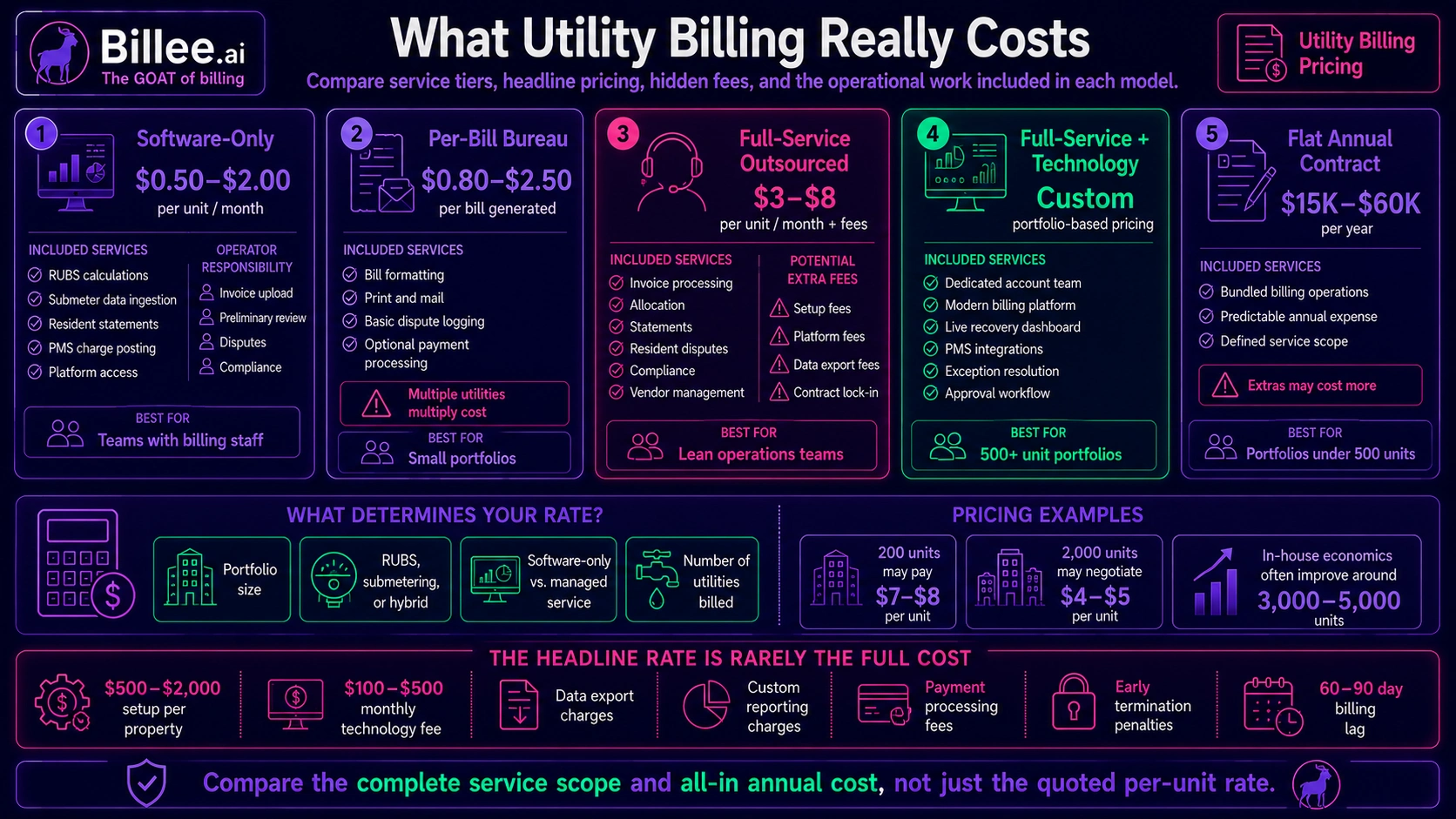
TL;DR: Utility billing pricing for property management companies ranges from $0.50 per unit per month for basic in-house software to $3--$8 per unit per month for outsourced full-service billing. What you pay depends on four variables: portfolio size, billing method (RUBS, submetering, or hybrid), service tier (software-only vs. managed service vs. full-service), and how many utilities are billed. The headline per-unit rate is rarely the full cost -- setup fees, technology access fees, contract lock-in, and billing lag costs add meaningfully to the total. Understanding what each service tier actually includes is the first step to evaluating whether you're getting fair value for what you're paying.
Key Takeaways
- Utility billing software platforms (in-house, operator-run) typically cost $0.50--$2.00 per connection per month. Full-service outsourced billing costs $3--$8 per unit per month in headline fees, not counting setup and ancillary charges.
- The per-bill pricing model used by outsourced billing bureaus typically runs $0.80--$2.50 per bill generated. At monthly billing cycles with high unit counts, this model is comparable to per-unit pricing but adds unpredictability when dispute volumes spike.
- Setup fees of $500--$2,000 per property are common in full-service contracts and represent a meaningful upfront cost for operators adding new properties frequently.
- The economic inflection point -- where in-house software becomes less expensive than outsourcing -- typically falls around 3,000--5,000 units. Below that, outsourcing can be cost-competitive when staff costs are factored in.
- Administrative fees charged to residents for billing services are regulated by state law. California's AB 1248 (effective April 1, 2026) substantially restricts these for most utilities. Texas and Florida permit reasonable fees, with some states capping the amount per unit.
- Full-service + technology providers (team plus software platform) sit above software-only pricing but below pure outsourced services, and they deliver both operational expertise and real-time portfolio visibility.
At-a-Glance: Utility Billing Pricing by Service Tier
| Service Tier | Typical Cost | What's Included | Best For |
|---|---|---|---|
| Software-only (in-house) | $0.50--$2.00/unit/month | Platform access, RUBS/submeter calculation, PMS integration | Operators with billing staff |
| Per-bill bureau | $0.80--$2.50/bill | Bill generation, print/mail, basic dispute logging | Small portfolios without billing staff |
| Full-service outsourced | $3--$8/unit/month + fees | Invoice processing, billing, disputes, compliance, vendor mgmt | Lean teams outsourcing all operations |
| Full-service + technology | Custom pricing | Team + software, real-time dashboard, named account manager | Mid-to-large portfolios (500+ units) |
| Flat-fee annual (small portfolio) | $15,000--$60,000/year | Bundled billing services for smaller unit counts | Portfolios under ~500 units |
What Drives Utility Billing Pricing
Portfolio Size: The Primary Cost Variable
Utility billing pricing scales with unit count. Larger portfolios negotiate lower per-unit rates because fixed costs (account setup, PMS integration, compliance review) are spread across more units. A 200-unit portfolio at a full-service provider might pay $7--$8 per unit per month; a 2,000-unit portfolio with the same provider might negotiate $4--$5 per unit per month.
The inflection point matters: at approximately 3,000--5,000 units, the economics of in-house billing software typically overtake the cost of outsourcing on a pure dollar-per-unit basis, before accounting for staff time. For portfolios below that size without dedicated billing staff, outsourcing can remain cost-competitive even at higher per-unit rates because the alternative is adding a billing function that does not yet exist.
Billing Method: RUBS vs. Submetering vs. Hybrid
The billing method affects pricing because it affects operational complexity. RUBS billing involves no meter data and is computationally simple -- allocate the master bill using a formula. Most software platforms handle RUBS at the base per-unit rate. Submetering requires meter data ingestion, read validation, anomaly detection, and more complex audit trails; pricing for platforms with full submeter support is typically at the higher end of the per-unit range or carries an add-on fee.
Hybrid portfolios (RUBS for some utilities, submetering for others) add configuration complexity. Full-service providers typically price hybrid portfolios at or above submeter rates because of the additional operational steps involved in managing both billing methods across the same property.
Service Tier: What You're Actually Paying For
The same $4 per unit per month can mean very different things depending on the vendor contract. Confirm what is specifically included: invoice processing (does the vendor receive and enter master meter bills, or do you?), allocation calculation (automated or manual?), statement generation (PDF + email or print-and-mail?), resident dispute handling (call center or email support?), PMS charge posting (automated or batch export?), and regulatory compliance monitoring (who tracks state law changes?).
Full-service providers that include all of the above are priced at the higher end. Software-only platforms that automate the calculation but leave invoice entry, dispute handling, and compliance to your team are priced at the lower end. The pricing gap between them is real, but so is the operational work that the lower-priced platform does not do.
Number of Utilities Billed
Most providers price on a per-unit basis regardless of how many utilities are billed at each unit. However, some platforms charge per bill generated, in which case billing three utilities per unit produces three times the per-bill fee. At monthly billing cycles for a 500-unit portfolio billing water, electric, and trash separately, per-bill pricing at $1.50/bill produces $2,250/month -- equivalent to $4.50/unit/month. Verify whether the pricing model is per-unit or per-bill before comparing quotes.
Breaking Down the Pricing Tiers
Software-Only Platforms: $0.50--$2.00/Unit/Month
In-house billing software gives operators a platform to run billing themselves. The software handles RUBS formula calculation, submeter read ingestion, resident statement generation, and charge posting to the PMS. The operator's team manages the billing cycle: entering or uploading invoices, reviewing preliminary billing, and responding to resident disputes.
Entry-level platforms start around $0.50 per unit per month. Full-featured platforms with native PMS integrations (Yardi, RealPage, Entrata), submeter support, and anomaly detection run $1.00--$2.00 per unit per month. Setup fees vary; some platforms charge a one-time onboarding fee per property of $500--$1,000; others include setup in the subscription.
The true cost of software-only billing is per-unit fee plus staff time. A billing coordinator spending 15--20 hours per month per 500 units -- reviewing prelims, catching exceptions, responding to disputes -- is a real operational cost that should be counted alongside the platform fee when comparing models.
Per-Bill Pricing: $0.80--$2.50/Bill
Billing bureaus that print and mail statements often use per-bill pricing. The bureau receives your billing data, generates formatted statements, and mails them. Some bureaus also handle payment processing and dispute logging. This model is most common in small-to-mid portfolios where the volume does not justify a monthly subscription platform.
Per-bill pricing of $0.80--$2.50 is competitive with per-unit pricing for portfolios under 300 units billing one or two utilities. It becomes expensive at larger scale or when multiple utilities are billed separately, because each utility adds a per-bill charge for the same unit.
Full-Service Outsourced Billing: $3--$8/Unit/Month
Full-service outsourced billing is the predominant model for property management companies that do not want to build an internal billing function. The vendor handles the complete billing cycle: invoice receipt and entry, allocation calculation, resident statement generation, dispute handling, and monthly reporting.
Headline pricing is $3--$8 per unit per month, but the all-in cost is typically higher. Setup fees of $500--$2,000 per property are common. Technology platform fees (separate from the per-unit fee, billed as a monthly platform access charge) appear in some contracts. Data export fees -- charges for accessing your own billing data in non-standard formats -- are common in legacy provider contracts. Early termination penalties apply if the operator exits a 1--3 year contract before term.
A 500-unit portfolio at $5/unit/month pays $30,000 per year in per-unit fees before any of those ancillary costs. A 2,000-unit portfolio at $4.50/unit/month pays $108,000 per year. These are material operating expenses that directly offset NOI; evaluating them against the recovery rate the provider delivers is the right analytical frame.
Flat-Fee Annual Pricing: $15,000--$60,000/Year
Some providers -- particularly for small portfolios or portfolios with simple billing configurations -- offer flat annual fees. These are most common in the $15,000--$60,000 range for portfolios under approximately 500 units. Flat-fee pricing creates cost predictability but can be expensive on a per-unit basis at smaller scale and may not include all services (submeter support, dispute handling, or PMS integration may cost extra).
Full-Service + Technology: Custom Pricing
The full-service + technology model -- a named service team plus a modern software platform -- sits between software-only and traditional full-service outsourcing on price, and above both on the combination of expertise and visibility it delivers. Pricing is typically custom-quoted based on portfolio size, billing method mix, and service configuration. For mid-to-large portfolios (500+ units) where recovery rate improvement is the primary goal, the economics of this model typically deliver better outcomes than either software-only or traditional outsourcing.
Hidden Costs That Change the Real Price
Setup and Onboarding Fees
Setup fees are rarely prominently disclosed in initial pricing conversations. For full-service providers, onboarding a new property typically costs $500--$2,000 per property. A property management company adding five properties per year incurs $2,500--$10,000 in annual onboarding fees on top of the per-unit rate.
Technology and Platform Access Fees
Some full-service providers charge a separate monthly platform fee for access to the billing portal, reporting dashboards, or API connections to your PMS. These fees range from $100 to $500 per month per portfolio and appear as a separate line item in the contract rather than being incorporated in the per-unit rate.
Data Export and Custom Reporting Fees
Billing data is yours -- but some contracts restrict how you access it. Requesting data exports in non-standard formats, running custom reports, or pulling audit trails for dispute investigations may trigger per-request charges. This is particularly common with legacy outsourced providers. Confirm data access terms before signing.
Billing Lag and Cash Flow Cost
Full-service outsourced billing typically operates on 60--90 day cycles from invoice receipt to resident billing. The cost of this lag is real: if a 500-unit portfolio generates $50,000/month in utility recoveries and bills are consistently 60 days late, the property is effectively providing the billing company a $100,000 interest-free float at all times. In a higher-rate environment, the cost of that float adds meaningfully to the all-in cost of outsourcing.
Administrative Fees: What Operators Can Charge Residents
How Admin Fees Work
Administrative fees charged to residents for utility billing services are separate from the per-unit cost the operator pays the billing provider. Most state utility regulations permit a reasonable administrative fee on top of the actual utility charge -- typically $2--$10 per unit per billing cycle. These fees are disclosed in the lease addendum and help operators offset the cost of the billing program.
State-by-State Restrictions
State law governs whether operators can charge administrative fees for utility billing, and the rules vary significantly. Texas permits a reasonable administrative fee; some jurisdictions cap it. Florida permits fees. New York prohibits administrative fees on submetered utility charges in most jurisdictions. California's AB 1248 (effective April 1, 2026) substantially restricts administrative fees for most utilities.
Maryland is considering SB 130, which if enacted would cap administrative fees on water submetering at $1/unit/month. For operators in regulated markets, confirming the current administrative fee rules before building billing economics is essential -- a fee structure that makes economic sense under today's rules may not survive a regulatory change.
The Billing Economics Framework
The right way to think about billing program economics: (annual utility spend × recovery rate) minus (billing program cost + administrative fee revenue). The goal is maximum recovery net of program cost. A program that charges $5/unit/month but achieves 90% recovery produces better net economics than a program that charges $1/unit/month but achieves 75% recovery, if the portfolio spends more than approximately $80/unit/month on utilities.
Run this calculation with your actual utility spend and your current (or projected) recovery rate before selecting a pricing tier.
Pricing What Matters: Recovery Rate, Not Just Per-Unit Fee (Billee)
The per-unit fee is the wrong primary variable for evaluating utility billing programs. The right question is: what net recovery does this program deliver per dollar of program cost?
Billee's Billing & Recovery Engine delivers 80--95% recovery as a benchmark (below 80% flags a problem requiring investigation), backed by a dedicated account team that handles the complete billing cycle plus a modern dashboard giving operators real-time visibility into recovery by property. The Billee account team does the operational work -- managing invoice processing, RUBS and submeter allocation, exceptions, and PMS posting -- while operators retain full visibility and approval authority over every billing cycle.
For operators who have been paying full-service rates and accepting below-80% recovery in return, the combination of professional team expertise and real-time dashboard accountability changes the value equation. A billing program that recovers 88% instead of 73% on $1,000,000 in annual utility spend is worth $150,000 more in NOI every year -- which is multiples of what any reasonable billing program costs.
For multifamily operators ready to evaluate what a properly structured billing program should cost and deliver, the Billee team is the starting point.
Frequently Asked Questions
How much does utility billing cost per unit per month for multifamily properties? Software-only in-house billing platforms cost $0.50--$2.00 per unit per month. Outsourced full-service billing costs $3--$8 per unit per month in headline fees, plus setup fees, technology fees, and ancillary charges. The all-in cost for outsourcing at a 500-unit property at $5/unit exceeds $30,000 per year before ancillary fees. Full-service + technology models (team plus platform) are priced between these tiers and quoted based on portfolio configuration.
What is a per-bill pricing model for utility billing? Per-bill pricing charges the operator for each resident bill generated, typically $0.80--$2.50 per bill. A 500-unit property billing monthly generates 500 bills per billing cycle per utility. If three utilities are billed separately (water, electric, trash), that is 1,500 bills per cycle. At $1.50/bill, that is $2,250/month -- equivalent to $4.50/unit/month. Per-bill pricing is common with billing bureaus and print-and-mail vendors.
What fees should I ask about before signing a utility billing contract? Ask for a full breakdown of: the per-unit or per-bill rate, setup/onboarding fees per property, monthly platform or technology access fees, data export or custom reporting fees, payment processing fees (who pays these -- the property or the resident?), and early termination penalties. The all-in cost is consistently higher than the headline per-unit rate.
Can property managers charge residents for utility billing services? It depends on state law. Most states permit a reasonable administrative fee disclosed in the lease addendum. Texas and Florida allow fees; some states cap the amount per unit. New York prohibits fees on submetered charges. California's AB 1248 (effective April 1, 2026) substantially restricts administrative fees for most utility billing arrangements. Always verify current state rules before setting resident fee structures.
What does a full-service utility billing provider actually include? A full-service provider handles: receiving and processing master meter invoices from utility providers, calculating resident allocation (RUBS formula or submeter reads), generating resident statements, posting charges to PMS ledgers, handling resident billing disputes, and providing a monthly billing summary. Whether dispute call centers, PMS auto-posting, and regulatory compliance tracking are included varies by provider and contract tier -- always confirm in writing.
Is there a minimum unit count for utility billing programs? Most software-only platforms have no meaningful minimum (some have a monthly minimum fee equivalent to 50--100 units). Full-service outsourced providers typically have minimum contract sizes, most commonly around 100--200 units, and minimum monthly fees that apply regardless of unit count. Full-service + technology providers like Billee are generally suited to portfolios of 500+ units where the value of a dedicated team is most significant.
How does billing program cost compare to recovery revenue? For a 500-unit portfolio spending $100,000/year on utilities with a 70% recovery rate: residents pay $70,000; the property nets $30,000 in unrecovered costs. A billing program at $5/unit/month costs $30,000/year. If the program improves recovery to 88%, residents pay $88,000; the property saves an additional $18,000 in utility costs -- net savings after program cost of $18,000 - $30,000 = -$12,000. At the same portfolio with $200,000/year utility spend: recovery improvement from 70% to 88% generates $36,000 in additional recovery, net savings after program cost of $6,000. The math always favors programs at higher utility spend per unit.
What is the right pricing model for a growing multifamily portfolio? Growing portfolios benefit from pricing models that scale predictably without requiring contract renegotiation for each property addition. Per-unit subscription models absorb growth automatically. Flat-fee contracts may require amendment when unit counts cross a threshold. Per-bill models scale with volume but can create budget unpredictability when dispute volumes spike. Confirm that whichever pricing model you choose allows new property additions without material contract changes.
Sources
- Vitality IO. "In-House vs. Outsourced Utility Billing: The Real Cost Comparison." January 2026. https://vitality.io/blog/in-house-vs-outsourced-utility-billing
- Bynry. "Utility Billing Services 2026: A Buyer's Guide." June 2026. https://www.bynry.com/blog/utility-billing-services
- Baselane. "Best Property Management Utility Billing Software 2026." Accessed July 2026. https://www.baselane.com/resources/property-management-billing-utility-software
- Baselane. "Best Utility Bill Management Software for Landlords in 2026." Accessed July 2026. https://www.baselane.com/resources/utility-bill-management-software-for-landlords
- Entrata. "2026 Legislative Roundup: New Fee, Utility Billing, and Tenant Protection Laws Property Managers Should Know." Accessed July 2026. https://www.entrata.com/blog/2026-legislative-roundup-new-fee-utility-billing-and-tenant-protection-laws-property-managers-should-know
- Utility Ranger. "Complete Reference: RUBS Software, In-House Utility Billing & Multifamily Cost Recovery." Accessed July 2026. https://utilityranger.com/guide
- Bynry. "Utility Billing Multifamily Software: How It Works." June 2026. https://www.bynry.com/blog/utility-billing-multifamily-software
- Zego. "Utility Billing for Multifamily Explained." Accessed July 2026. https://www.gozego.com/articles/utility-billing-for-multifamily-explained/
- MRI Software. "5 Multifamily Utility Cost Recovery Strategies." Accessed July 2026. https://www.mrisoftware.com/blog/5-multifamily-utility-cost-recovery-strategies/
- Synergy Utility Billing. "Outsourcing Utility Billing for Property Management Firms." Accessed July 2026. https://www.synergyutilitybilling.com/outsourcing-utility-billing-for-property-management-firms/
- AmCoBi. "Selecting an Effective Multifamily Utility Billing Services Provider." Accessed July 2026. https://amcobi.com/select-billing-provider/
- Livable. "Should You Handle Utility Billing In-House or Outsource It?" February 2026. https://blog.livable.com/should-you-handle-utility-billing-in-house-or-outsource-it-a-decision-framework-for-property-managers
- Holland & Knight. "Existing Colorado Multifamily Housing Developments Can Continue Using RUBS Under New Law." April 2026. https://www.hklaw.com/en/insights/publications/2026/04/existing-colorado-multifamily-housing-developments-can-continue
- Simple Sub Water. "The Complete Apartment Water Submetering Guide." Accessed July 2026. https://www.simplesubwater.com/resources/the-complete-apartment-water-submetering-guide
Insights and Industry Trends


Explore more insights