

How to Switch Utility Billing Providers Without Disrupting Residents
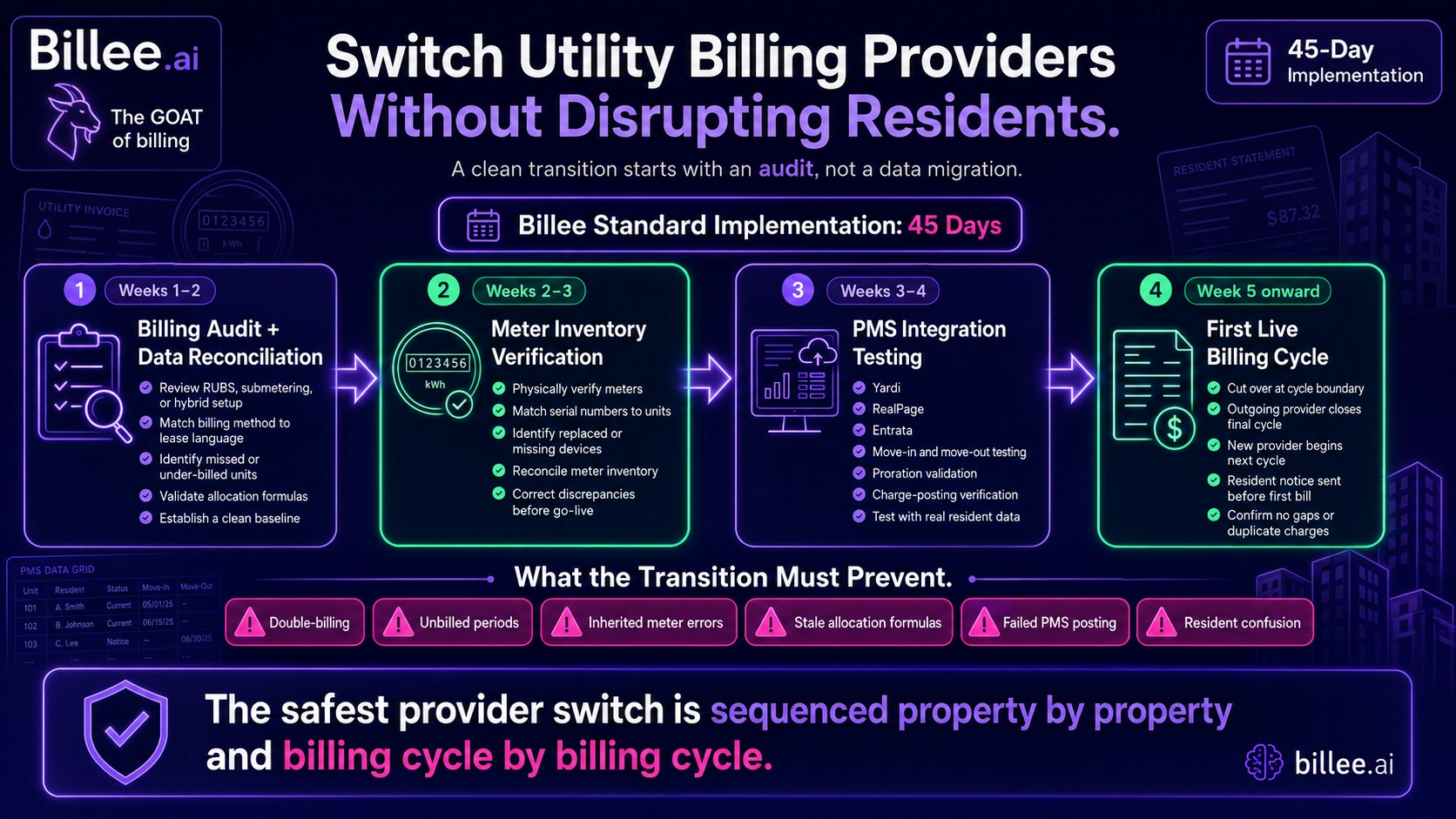
Switching utility billing providers is less disruptive than most multifamily operators expect, provided the transition is sequenced correctly. The real risks are billing gaps between the old and new provider, data migration errors in meter inventory and allocation formulas, and resident confusion during the handoff. A structured transition starting with a billing audit, not a data migration, eliminates most of these risks before they affect a single billing cycle. Billee's standard implementation runs 45 days and covers the full process: audit, data migration, PMS integration, and resident communication.
Key takeaways:
- The transition audit comes first, before any data migration begins
- Billing gaps happen when two providers run simultaneously; a staggered, property-by-property approach prevents this
- Resident communication should happen at billing cycle transition, not at contract signing
- The new provider should complete a meter audit before going live, not after
- PMS integration must be tested with real resident data before the first live billing cycle runs
Why Most Operators Delay Switching (and Why the Risk Is Lower Than They Think)
The real risks vs. the perceived ones
The fear most operators have is that switching billing providers will disrupt residents mid-lease: confused bills, missed charges, or a gap where nobody bills anyone. That fear is understandable but mostly misplaced. Resident disruption during a provider switch is almost always a symptom of poor handoff planning, not an unavoidable feature of the transition itself.
The actual risks are narrower: billing gaps caused by overlapping provider timelines, meter inventory discrepancies the new provider inherits from the old one, and allocation formulas that were never documented and cannot be cleanly transferred. All three are preventable with the right sequencing.
What a bad handoff looks like
A bad transition skips the audit phase and moves straight to data migration. The incoming provider imports a meter list that has not been physically verified, inherits allocation formulas that were set up years ago and never updated for unit-mix changes, and runs their first billing cycle on data they cannot fully stand behind.
The result is not always an immediate billing error. Sometimes it takes two or three cycles for the inherited problems to surface, and by then the new provider is pointing at the old provider's data and the operator is caught in the middle.
The Four-Phase Transition Process
Phase 1: Billing audit and data reconciliation (weeks 1–2)
Before any data moves, the incoming provider should audit the existing billing setup. That means reviewing the current billing methodology (RUBS, submetering, or hybrid) and validating that it matches the allocation method documented in leases, and identifying any units that are systematically under-billed or missed entirely.
This audit phase surfaces problems that belong to the old provider and gives the incoming provider a clean baseline. Skipping it means inheriting those problems without knowing they exist.
Phase 2: Meter inventory verification (weeks 2–3)
For submetered properties, the incoming provider should conduct a physical meter audit before going live. Meter inventories drift over time: units get renovated, meters get replaced without the billing system being updated, and serial numbers get mismatched. According to Synergy Utility Billing, most transition problems trace back to poor data quality rather than the transition process itself.
A physical audit catches these discrepancies before they become billing errors.
Phase 3: PMS integration testing (weeks 3–4)
The billing provider needs to integrate with the property management system (Yardi Voyager, RealPage, Entrata, or equivalent) before going live. That integration needs to be tested with real resident data, not sample records. Move-in and move-out processing, proration logic, and charge posting all need to be validated against the actual property.
Testing with sample data and then discovering issues on the first live billing cycle is one of the most common transition failures.
Phase 4: First live billing cycle (week 5 onward)
The first live cycle should overlap with the outgoing provider's last cycle by design, not by accident. Agree in advance on which provider bills for which period, confirm that the cut-over date aligns with a billing cycle boundary rather than the middle of a month, and verify that all prior-cycle charges from the outgoing provider have cleared before the first new-provider bill goes to residents.
Resident Communication During the Switch
What to tell residents and when
Residents do not need to know about the transition at contract signing. They need to know before their first bill arrives from the new provider. A short, clear notice explaining that utility billing is being handled by a new company, that their charges are calculated the same way, and that contact information for billing questions has changed is sufficient.
Sending that notice a few days before the first new bill goes out prevents the most common resident complaint: receiving an unfamiliar bill with no context.
Common mistakes that cause resident confusion
The two most common communication mistakes are notifying residents too early (before the transition is confirmed, which generates questions that cannot be answered yet) and not notifying them at all (which generates calls when residents receive a bill from an unfamiliar company).
A single clear notice, timed to the first billing cycle under the new provider, handles both.
How to Handle In-Flight Billing Cycles
Which provider bills the current cycle
Establish this in writing before the transition begins. The cleanest approach is for the outgoing provider to bill through the end of their last complete cycle and for the incoming provider to start billing from the first day of the next cycle. Trying to split a billing cycle between two providers creates reconciliation problems that can take months to resolve.
How to avoid double-billing and billing gaps
Double-billing happens when the outgoing provider sends a final bill that overlaps with the incoming provider's first bill. Billing gaps happen when neither provider covers a period because each assumes the other is handling it. Both are preventable by agreeing on a specific cutover date tied to a cycle boundary and confirming that date in both providers' systems before either sends a final or first bill.
Red Flags in a Provider's Onboarding Plan
A provider who skips the audit phase and moves straight to data migration is a red flag. So is a provider who cannot confirm which specific team member will manage the transition or who cannot give a clear answer on how they handle meter discrepancies discovered after go-live.
The best providers can walk you through their transition process step by step before you sign anything. If they cannot, the transition plan does not exist yet. You will be the one who discovers that.
How Billee Handles the Transition
The billing audit that comes before data migration
Billee's implementation process starts with a diagnostic review of the existing billing setup: methodology, meter inventory, allocation formulas, and PMS data. That review happens before any migration begins. Problems with the prior provider's data are identified and resolved before they can be inherited.
What the 45-day implementation includes
Billee's standard implementation timeline is 45 days. That covers the billing audit, meter inventory reconciliation (for submetered properties), PMS integration with Yardi, RealPage, or Entrata, billing configuration testing, resident communication, and training for the on-site team. The Billee account team handles the transition process; operators stay focused on operations.
Frequently Asked Questions
How long does it take to switch utility billing providers? A well-managed transition takes 30–60 days. Billee's standard implementation runs 45 days, which includes billing audit, PMS integration, testing, and the first live billing cycle. Transitions that skip the audit phase can appear faster but tend to surface problems in the first two or three cycles after go-live.
Will residents notice the switch? Residents will see a different company name on their billing statement and contact information for a new billing support line. If the billing methodology stays the same, charges should be consistent with what residents have been paying. The transition is noticeable but not disruptive when communicated clearly before the first new bill arrives.
What happens to billing during the transition? The outgoing provider handles billing through the end of their last agreed cycle. The incoming provider takes over from the first day of the next cycle. There should be no gap in billing and no period where both providers are billing simultaneously.
Do I need to notify residents when I switch providers? Yes. Most state utility billing disclosure requirements and lease agreements require that residents be informed of changes to billing administration. Beyond compliance, notification prevents resident confusion when an unfamiliar billing company sends the first statement.
Can I switch providers mid-lease? Yes. A provider switch does not require lease renewals or amendments in most cases, as long as the billing methodology stays the same. If the switch involves changing from an owner-paid utility model to resident billing, that typically requires lease language review and advance notice requirements that vary by state.
What if my current provider won't release billing history? Billing history belongs to the operator, not the billing company. Request a full export of billing records in a portable format (CSV or Excel) before the transition is complete. If a provider resists, review the data portability terms in your contract. Most contracts specify what data is returned to the operator at termination.
Billee handles the full transition: audit, data migration, PMS integration, resident communication, and first billing cycle, in a standard 45-day implementation. See how it works for portfolios like yours.
Sources
- Synergy Utility Billing, "How to Switch Utility Billing Providers," accessed July 2026.
- Anchor Utility, "2026 Utility Management Trends in Multifamily," 2026.
- Synergy Utility Billing, "6 Signs Your Utility Billing System Isn't Working," accessed July 2026.
Insights and Industry Trends


Explore more insights