
How to Recover Utility Costs from Vacant Units
TL;DR: Vacant units quietly drain 3 to 7 percent of recoverable utility revenue from a typical multifamily portfolio. The fix is a Vacant Cost Recovery (VCR) program that continuously matches occupancy data against actual meter usage, flags anomalies before they become losses, and assigns a real person, not just a dashboard, to act on each exception. Billee's VCR engine is built to do exactly this end-to-end across your portfolio.
Quick answer
Recovering utility costs from vacant units requires three things working together: real-time visibility into which units are vacant, real-time visibility into which units are still drawing utilities, and a workflow that closes the gap between the two before the cost hits your P&L. Most multifamily operators have the first piece (occupancy data lives in the PMS) but rely on monthly utility bills to discover the second. That means losses are caught 30 to 60 days after they happen, if at all.
A modern Vacant Cost Recovery program continuously monitors meter activity against occupancy status, surfaces exceptions within days rather than months, and routes those exceptions to a dedicated account team who takes action. Restoring meter reads. Correcting move-out billing. Recovering charges that belong to the prior resident. Stopping the leak going forward.
Key takeaways
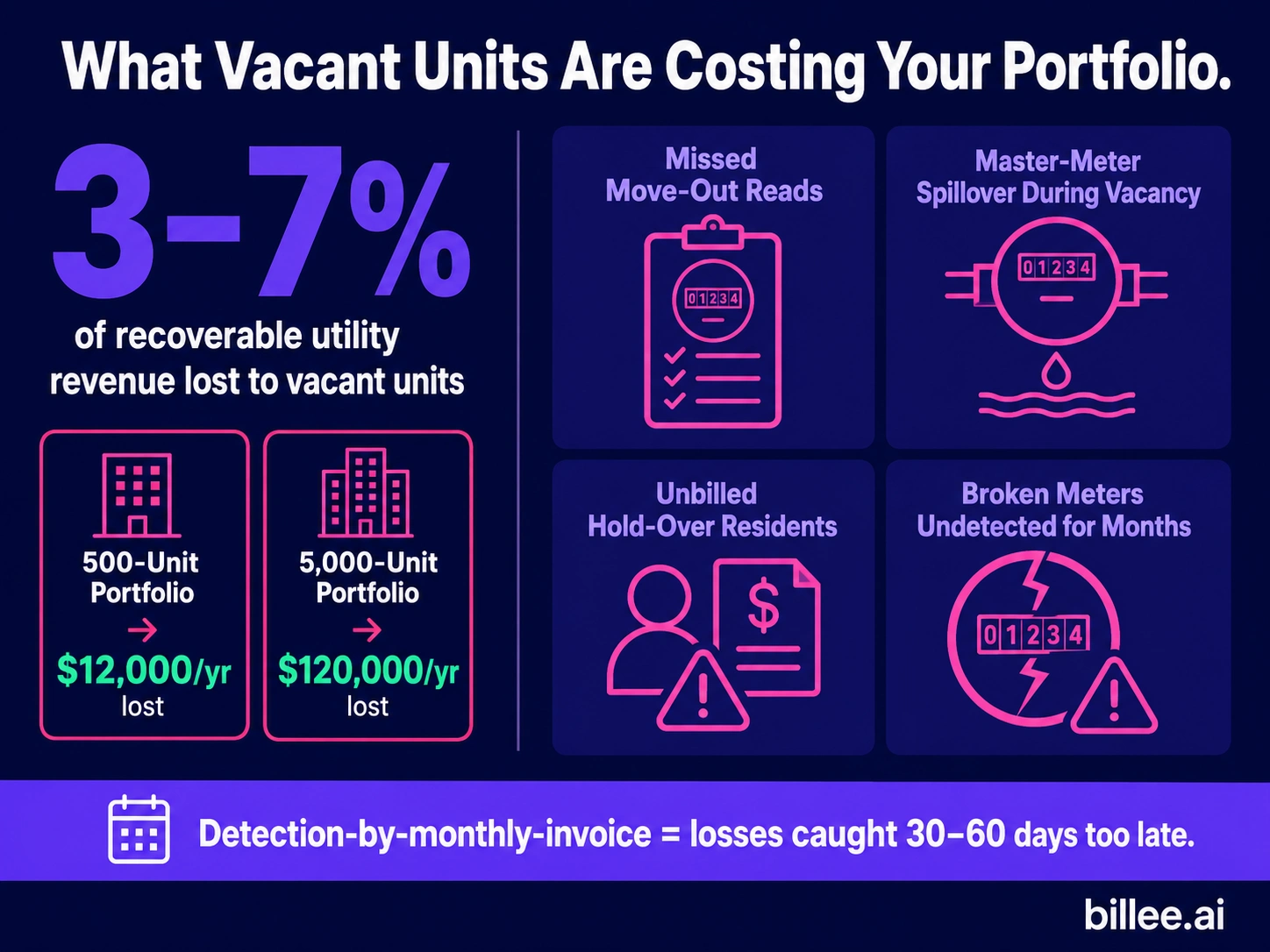
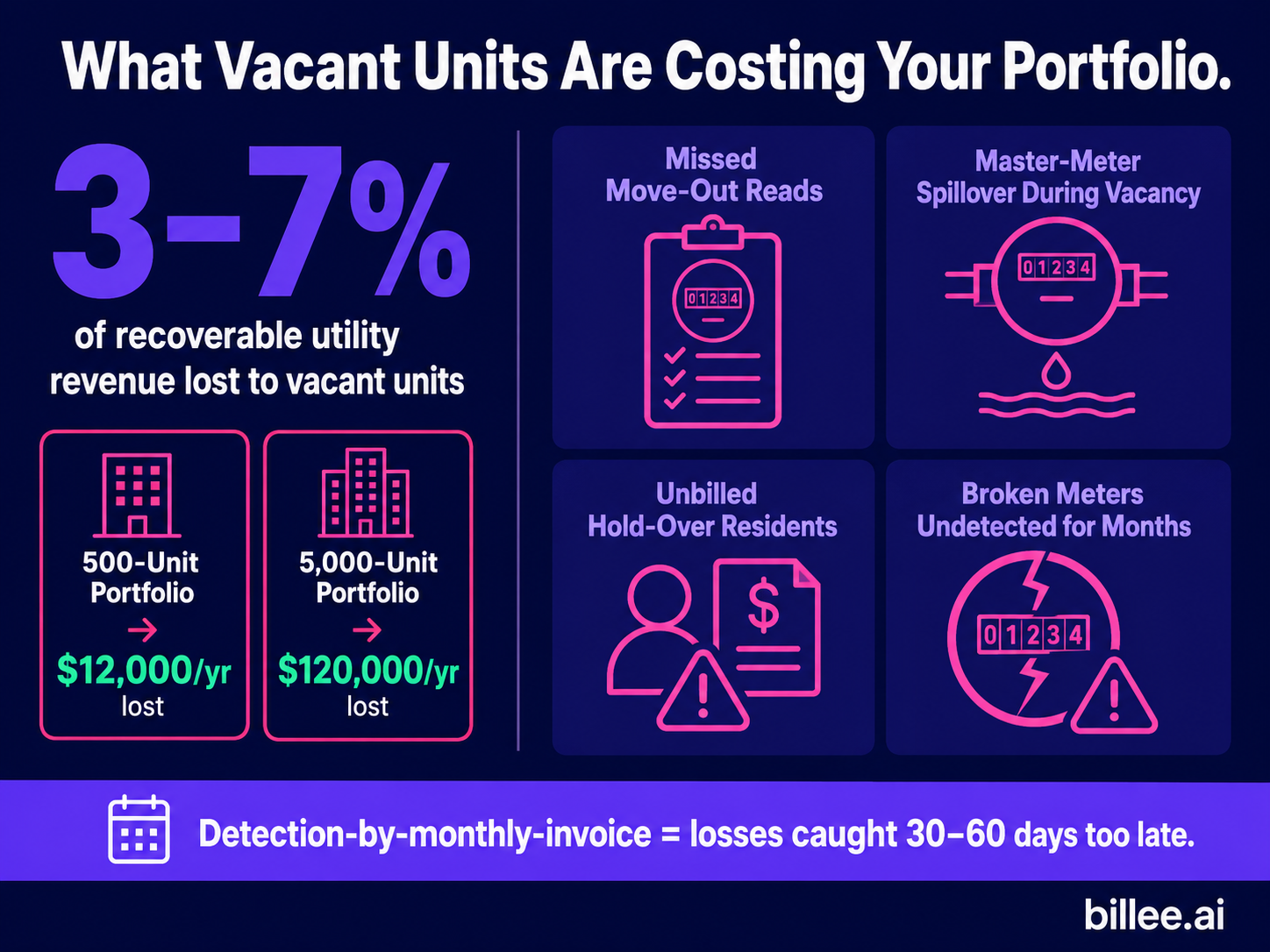
Vacant units typically leak 3 to 7 percent of recoverable utility revenue from a multifamily portfolio per industry estimates. That gap is a direct NOI hit.
The losses come from four sources: missed move-out reads, master-meter usage during vacancy, unbilled hold-over residents, and broken meters that go undetected for months.
Detection-by-monthly-invoice is the root cause. By the time a bill arrives, the recovery window is mostly closed, especially for hold-over residents who have already left the property.
A real VCR program combines four operational components running together: continuous meter monitoring, occupancy sync, threshold-based alerting, and human follow-through.
Operators who run VCR as a managed service rather than a dashboard recover materially more. The recovery happens at the action step, not the detection step, and dashboards do not staff the action step.
Why this matters for multifamily operators
Every dollar of utility cost that should have been billed to a resident and was not is a dollar that hits your NOI directly. For a 500-unit portfolio with average utility recovery of $40 per unit per month, a 5 percent leakage rate is $12,000 a year. Across a 5,000-unit portfolio, it is $120,000. That is before counting compliance exposure from improperly allocated charges.
The problem compounds in three ways. First, vacancy is highest during the most expensive billing months (summer cooling, winter heating), so the dollar value of each missed unit is larger than the average. Second, the same operational pattern that causes vacant-unit leakage (slow move-out processing, manual meter reads, monthly invoice review) also causes broader billing errors that suppress overall recovery rates. Third, when investors ask for a defensible recovery rate during refinancing or sale, "we think we capture most of it" does not survive due diligence.
Vacant Cost Recovery is not an accounting cleanup project. It is an ongoing operational discipline that protects NOI every month.
How to solve it
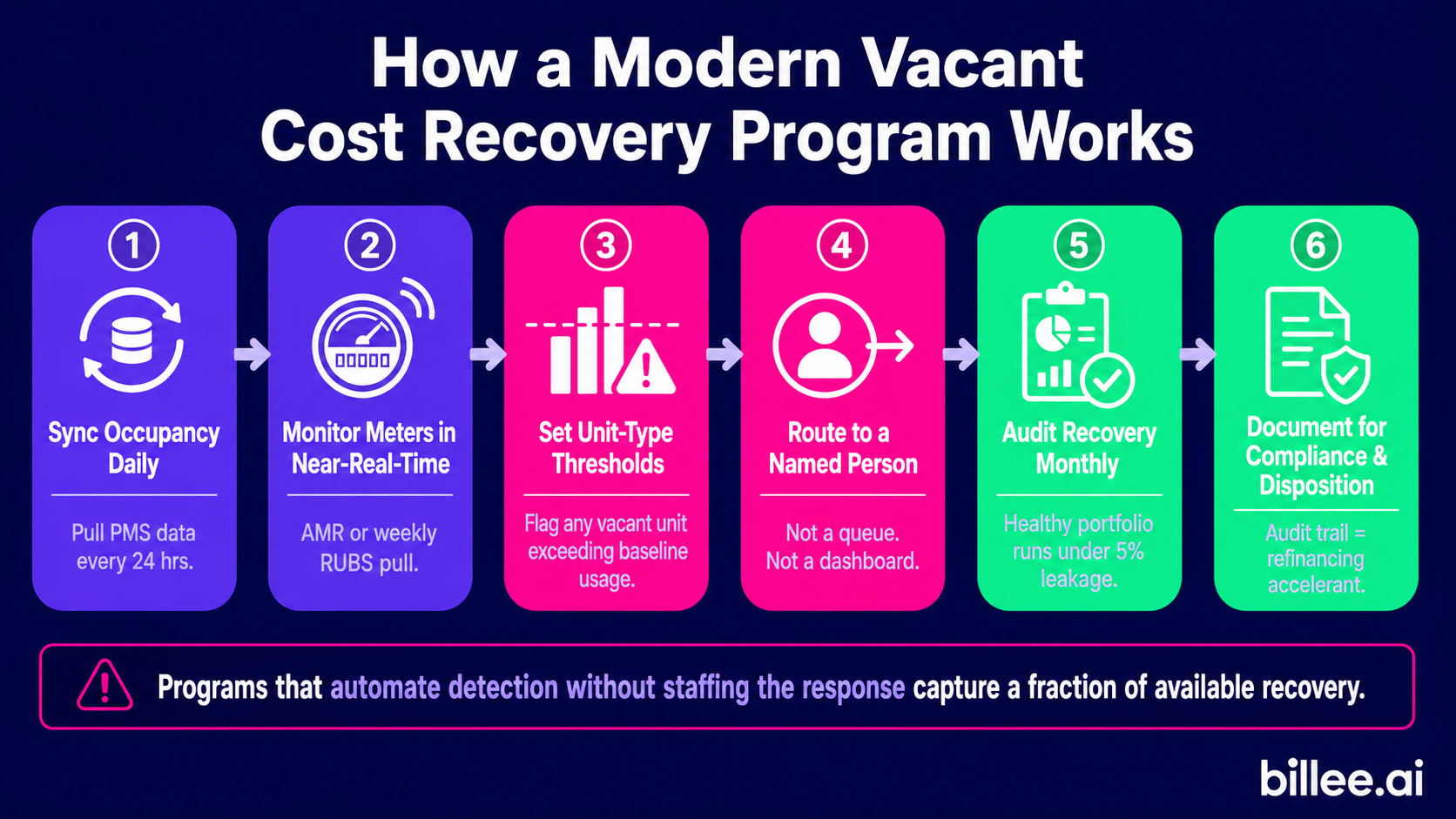
Here is the workflow that closes the gap. Operators can build this in-house if they have the systems and the staffing. Most bring in a partner because the work is continuous, exception-heavy, and does not scale linearly with portfolio size.
1. Sync occupancy data daily, not monthly
Pull occupancy status from your PMS (Yardi, RealPage, Entrata) into your utility billing system every day. Monthly sync is the most common configuration and the most common source of failure. A unit that moves out on day 3 of the month should not be billed as occupied for the remaining 28 days.
2. Monitor meter activity in near-real-time
Every unit meter, submetered or master-allocated, should be read on a cadence short enough to catch anomalies within days. AMR (automated meter reading) hardware enables daily or hourly reads. RUBS-based portfolios should pull master meter consumption against unit-by-unit occupancy at least weekly.
3. Set usage thresholds that flag vacancy anomalies
A vacant unit should be drawing baseline utilities only. Minimal electricity for refrigerators left running. The HVAC set to vacant-unit conservation mode. No water. When a flagged-vacant unit exceeds a defined threshold (for example, more than 50 kWh in a billing cycle, or any measurable water usage), the system should generate an exception within the same week.
4. Route exceptions to a person, not a queue
This is where most VCR programs fail. A dashboard alert that nobody owns is a future write-off. Every exception should be routed to a named team member, internal or at a vendor, whose job is to investigate, take corrective action, and close the loop. "Corrective action" means contacting the prior resident if the move-out date was wrong, generating a corrected bill if the unit was occupied longer than recorded, dispatching maintenance if there is a leak or HVAC malfunction, or auditing the meter if the reads look implausible.
5. Audit recovery monthly
Every month, compare what was billed against what was used. The delta between master-meter consumption and the sum of billed unit usage is your effective leakage rate. A healthy portfolio runs under 5 percent. Anything above 8 percent indicates the program needs work.
6. Document for compliance and disposition
Keep the audit trail. State PUCs require defensible billing methodologies. Texas PUC Chapter 24 is the most prescriptive. Investors will ask for documented recovery rates during refinancing or sale. A VCR program with a clean paper trail is also a refinancing accelerant.
Common mistakes
Relying on monthly invoices to discover leaks. By the time the bill arrives, the recovery window is closed.
Treating VCR as a software problem. Dashboards surface the issue. People close it. Programs that automate detection without staffing the response capture a fraction of the available recovery.
Not syncing occupancy data frequently enough. Daily sync is the floor; weekly is too slow for a meaningful program.
Generic usage thresholds across the portfolio. A 600 sqft studio and a 1,400 sqft three-bedroom have different vacant-baseline usage. Thresholds should be calibrated by unit type and climate zone.
No quarterly methodology review. Resident behavior, utility rate structures, and regulatory rules change. A VCR program set up two years ago and never revisited is leaking somewhere it did not before.
Skipping move-out audits. The single highest-yield VCR action is catching a move-out meter read that was missed or wrong. Audit every move-out in the first 30 days post-departure.
When to handle this in-house versus bring in a partner
Running a VCR program in-house works when three things are true: you have an internal team with both PMS expertise and utility billing expertise, you have AMR hardware deployed across the portfolio, and you have the operational bandwidth to investigate exceptions weekly. For most operators below the top-25 by unit count, at least one of these conditions does not hold.
A partner is the right answer when the work is continuous, the exceptions are high-volume relative to staff capacity, or the portfolio is geographically distributed across multiple utility jurisdictions. The trade-off is finding a partner who actually staffs the work instead of selling you a dashboard with an alert feature.
A reasonable decision framework:
1. Is your effective utility recovery rate above 90 percent? If yes, in-house is likely working.
2. Are vacant-unit exceptions being investigated within 7 days? If no, the in-house workflow is the bottleneck.
3. Is utility billing eating more than 0.25 FTE per 500 units of operations capacity? If yes, the workload has outgrown in-house.
4. Is the team able to defend the recovery rate to investors with documentation? If no, the documentation gap is a partner gap.
How Billee can help
Billee's Vacant Cost Recovery engine continuously monitors meter activity against occupancy data across your portfolio. When a vacant unit shows usage above the configured threshold, the exception is routed to your dedicated Billee account team. The team then takes the action. Chasing the move-out correction. Generating the corrected bill. Dispatching for a broken meter. Recovering the charges from the prior resident.
The difference between Billee and a dashboard-only VCR tool is the team. Billee operates a white-glove service model where every operator has a named account manager. Implementations typically go live within 45 days (per Billee's standard implementation timeline), including integration with Yardi, RealPage, or Entrata.
FAQ
What is Vacant Cost Recovery (VCR) in multifamily?
Vacant Cost Recovery is the practice of identifying and recovering utility costs that were incurred while a unit was vacant. The usual causes are missed move-out reads, master-meter spillover, broken meters, or hold-over residents who were not billed correctly.
How much utility revenue do multifamily operators typically lose from vacant units?
Most multifamily portfolios leak 3 to 7 percent of recoverable utility revenue to vacant units. For a 500-unit portfolio, that is typically $10,000 to $25,000 a year in missed NOI.
Can I run VCR in-house?
In-house VCR is workable for operators with strong internal utility billing expertise, AMR hardware deployed across the portfolio, and weekly bandwidth to investigate exceptions. Below those thresholds, a managed service typically recovers more.
Does VCR require submetering?
No. VCR works in both submetered and RUBS-billed portfolios. RUBS portfolios use master-meter consumption against occupancy data to detect leakage at the portfolio level. Submetered portfolios can pinpoint individual units.
How quickly does a VCR program show results?
Most operators see measurable recovery within the first full billing cycle (30 to 45 days). Full program optimization, including threshold calibration by unit type and climate zone, typically takes 90 to 120 days.
Is recovering vacant-unit utility costs legal?
Yes, when done within the rules of your state's public utility commission and disclosed correctly to residents. Texas PUC Chapter 24, California Civil Code §1954.201–204, and similar frameworks govern how charges can be allocated. A properly run VCR program documents methodology for compliance defense.
How does Billee's VCR compare to dashboards from other utility billing providers?
The distinction is action, not visibility. Most VCR tools surface exceptions on a dashboard and send an email alert. Billee's VCR engine surfaces exceptions and routes them to a named account team who takes the corrective action. Chasing the move-out correction. Generating the bill. Dispatching for hardware issues.
What does VCR cost?
VCR is typically priced as a per-unit-per-month service fee, often bundled with broader utility management. The fee is materially smaller than the recovery it captures in a properly run portfolio. Most operators see a 4x to 8x payback in the first year (per Billee's customer-data analysis of typical portfolios).
Billee handles Vacant Cost Recovery for multifamily operators who want the recovery without staffing the exception workflow themselves. The team takes the action. The platform makes the work visible. Talk to the team.
Sources
1. Simple Sub Water, "RUBS vs. Submetering: Financial Impact on NOI, Costs and Tenant Satisfaction," accessed 2026.
2. Public Utility Commission of Texas, "Texas PUC (Chapter 24, Substantive Rules Applicable to Water and Sewer Service Providers)," accessed 2026.
3. California Legislative Information, "California Civil Code §1954.201–204," accessed 2026.
Insights and Industry Trends