

The Utility Billing Fees That Don't Show Up in the Per-Unit Rate
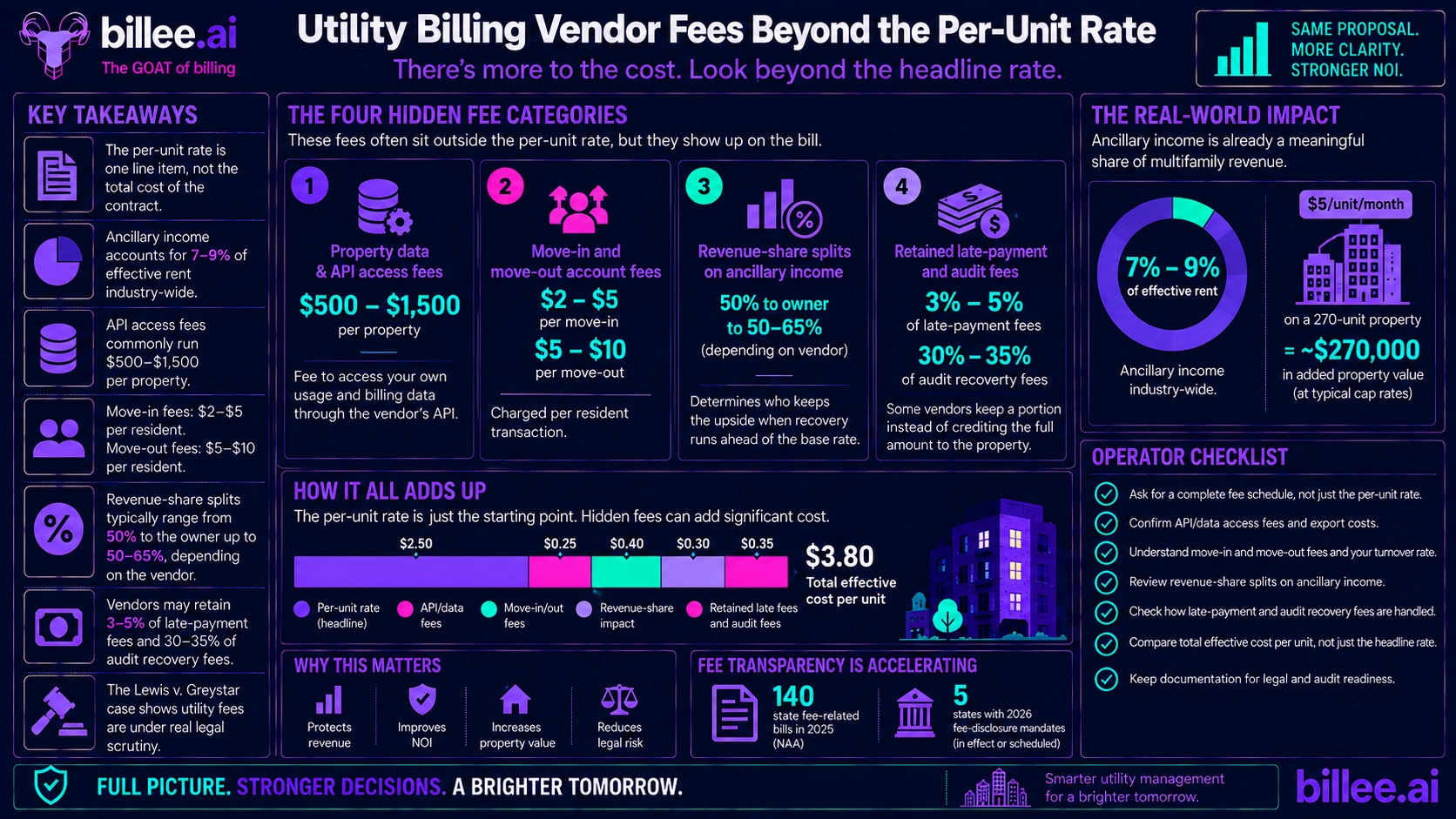
Every utility billing vendor proposal leads with the same number: a per-unit, per-month rate. It's the easiest figure to compare across proposals, so it's the one operators anchor on. It's also only one line item. A recent look at Billee's own portfolio economics model, built from a real 36-property, 10,000-unit Texas portfolio, shows that more than a third of the actual monthly savings between vendors comes from four fee categories that never appear next to the headline rate at all: property data and API access fees, move-in and move-out account fees, revenue-share splits on ancillary billing income, and retained late-payment or audit-recovery fees. None of them show up when two per-unit rates are compared side by side. All of them show up on the bill, eventually.
This is a companion piece to Billee's Utility Billing Outsourcing vs. In-House guide, which already covers setup fees, platform and technology access charges, and data export fees in detail. This piece deliberately covers different ground: the fee categories that live inside an ongoing contract, not the ones charged at signing.
Quick answer
The per-unit rate quoted during vendor selection rarely reflects the full cost of a utility billing contract. Four categories commonly sit outside it: a fee to access the property's own usage and billing data through an API, per-transaction fees charged at resident move-in and move-out, the percentage split on ancillary billing revenue the vendor keeps versus passes to the owner, and fees the vendor retains from late payments or from a sales-tax or utility-rate audit rather than crediting back in full. None of these are illegal or even unusual. They're just easy to miss when the comparison stops at the headline rate.
Key takeaways
- The per-unit rate quoted by a utility billing vendor is one line item, not the total cost of the contract.
- Ancillary income already accounts for 7 to 9 percent of effective rent industry-wide, so a fee a vendor retains instead of passing to the owner is effectively ancillary income the property never captures.
- A property data or API access fee, commonly $500 to $1,500 per property, can apply just to pull a property's own usage and billing history out of a vendor's system.
- Move-in and move-out account fees ($2 to $5 and $5 to $10 per resident, respectively) are charged per transaction, so a property's actual turnover rate directly multiplies this cost in a way the flat per-unit rate never reflects.
- Revenue-share splits on ancillary billing income determine who keeps the upside when recovery runs ahead of the base rate; a common range runs from 50 percent to the owner up to 50 to 65 percent, depending on the vendor.
- Some vendors retain the late-payment fee assessed on a delinquent resident's balance (commonly 3 to 5 percent) rather than crediting it to the property, and can keep 30 to 35 percent of any savings identified in a sales-tax exemption or utility-rate audit as their own fee.
- At least one class-action suit, Lewis v. Greystar California Inc., has specifically targeted a monthly utility administrative fee as an undisclosed charge, a sign that fee structures like these are drawing real legal scrutiny, not just internal audit attention.
Why this matters
Ancillary income is already a meaningful share of multifamily revenue. Industry data puts it at 7 to 9 percent of effective rent, and the valuation math behind that is straightforward: a $5-per-unit-per-month fee on a 270-unit property adds roughly $270,000 in property value at typical cap rates, according to ResMan's own modeling of ancillary fee programs. Utility billing administration is one line inside that broader ancillary income category, and the same math applies whether the fee flows to the owner or is retained by a vendor before it ever reaches the property's books.
That's the real issue with the four categories covered here. They aren't fees charged to residents that operators then have to explain; they're fees the vendor keeps from revenue that would otherwise flow to the property. A $0.15 API access charge or a retained late-payment fee doesn't show up as a line item an operator negotiates against, because it's rarely presented as part of the rate conversation at all. It shows up later, in a contract review, an invoice audit, or a vendor transition, by which point it's already been paid for months or years.
The legal environment around fee transparency has also caught up to some of this. Lewis v. Greystar California Inc. specifically challenged a monthly utility administrative fee as an undisclosed charge, and it's one of a growing number of suits and regulatory actions targeting fee structures in multifamily billing generally. An operator that can't clearly explain every fee a vendor is charging, or retaining, is exposed to more than a bad rate. It's exposed to the same disclosure risk that's already produced litigation elsewhere in the industry.
The four fee categories that don't show up in the per-unit rate
Property data and API access fees. Some vendors charge separately, commonly $500 to $1,500 per property, just to provide API access to a property's own usage history, billing records, and account data. This isn't a fee for a new service; it's a fee to retrieve data the property already generated. It matters most at the exact moment an operator needs it least: when evaluating a vendor switch, building internal reporting, or responding to an audit request, and discovering that pulling the property's own historical data comes with its own bill.
Move-in and move-out account fees. These are charged per transaction rather than per unit per month, commonly $2 to $5 at move-in and $5 to $10 at move-out. Because they scale with turnover rather than unit count, they hit high-turnover properties disproportionately hard in a way a flat per-unit comparison completely hides. Consider a 300-unit property at a 40 percent annual turnover rate, the baseline Billee's own portfolio economics model uses: that's 120 move-ins and 120 move-outs a year. At the midpoint of each range ($3.50 and $7.50), that's $420 in move-in fees and $900 in move-out fees annually, or $1,320 a year at a single property that a flat per-unit rate comparison never surfaces. A property with above-average turnover pays proportionally more, and a property with below-average turnover pays less, but neither number shows up anywhere in the initial rate proposal.
Revenue-share splits on ancillary billing income. When a utility billing program includes ancillary recovery, such as vacant cost recovery, the vendor and the owner split that revenue by an agreed percentage. A common structure runs 50 percent to the owner against a 50 to 65 percent range depending on the vendor, meaning two properties with identical underlying recovery can see meaningfully different owner proceeds based on the split alone. This is a term that's easy to accept during onboarding and easy to forget to revisit later.
Late-payment fee retention and audit-recovery capture. A resident's late-payment fee, commonly 3 to 5 percent of the balance, can either flow back to the property or be kept by the vendor as its own revenue line, and contracts rarely state this plainly on the first page. Separately, when a vendor performs a sales-tax exemption review or a utility-rate audit and identifies savings, some retain 30 to 35 percent of those savings as their fee, meaning the property recovers only a fraction of money that was already legally its own before the audit even started.
How it adds up on a real portfolio
Billee's own portfolio economics model, built against the RET LP portfolio's actual contract terms and market benchmarks, breaks the comparison down line by line:
| Line item | Billee | Market rate providers | Billee savings, per unit/month |
|---|---|---|---|
| Service admin fee | $4.25 | $5-$8 | $0.75 |
| Ancillary (VCR) revenue share | 50-65% to owner | 50% to owner | $0.11 |
| Property data API access fee | No fee | $500-$1.5k per property | $0.15 |
| Move-in account fee | No fee | $2-$5 per resident | $0.07 |
| Move-out (final bill) fee | No fee | $5-$10 per resident | $0.17 |
| Setup/conversion fee | $250-$500 | $500-$1k | $0.09 |
| Audit compliance recovery target | +$0.33 | Standard | $0.33 |
| Late-payment fee retention | No fee | 3-5% fee | $0.17 |
| Net total savings | $1.84 |
The setup and conversion line is covered in more depth in Billee's outsourcing-vs-in-house guide. The four categories this piece focuses on, API access, move-in fees, move-out fees, and the ancillary revenue split, together with late-payment retention, account for $0.67 of the full $1.84 per-unit, per-month figure. That's just over a third of the total net savings, coming entirely from categories that never appear when a proposal's headline rate is compared against another. Applied across the RET LP portfolio's 10,000 units, that $0.67 alone is roughly $80,400 a year, which at a 6% cap rate represents about $1.34 million in added asset value, separate from whatever the base per-unit rate difference is worth on its own.
When these terms actually get negotiated
Most of these four categories get set once, at initial contract signing, and are rarely revisited for the life of the relationship. That's partly inertia and partly negotiating position: a vendor has little incentive to reopen a favorable revenue-share split or fee schedule once it's in place, and an operator focused on the headline per-unit rate at renewal time may not think to ask about the other four categories again either.
Contract renewal, not the resident's lease renewal but the vendor services agreement itself, is the natural point to revisit all four. That's also typically when a vendor is most willing to negotiate, since the alternative is a competitive re-bid. An operator that only renegotiates the per-unit rate at renewal, and leaves the API access fee, the revenue-share split, and the fee retention terms untouched, is leaving the larger share of the available savings on the table, since those categories, combined, made up more than a third of the total recovery in the RET LP portfolio's own numbers.
What to ask a vendor before signing
- Does the quoted per-unit rate include or exclude API and data-export access to the property's own usage and billing history?
- What are the exact move-in and move-out account fees per resident, and are they itemized on an invoice or buried in a broader service charge?
- What percentage of ancillary billing revenue, including vacant cost recovery, does the vendor retain versus pass through to the owner?
- Does the vendor keep resident late-payment fees, or are they credited back to the property?
- If the vendor performs a sales-tax exemption review or a utility-rate audit, what percentage of any identified savings does it keep as its own fee?
- Is there a cost to export the property's own historical billing and usage data if the relationship ends?
- Are all of the above spelled out in the contract itself, or only in a separate fee schedule that isn't part of the standard proposal?
Common mistakes
- Comparing only the headline per-unit rate across vendor proposals. The rate is the easiest number to compare, which is exactly why it's the one that gets compared, while the other four categories go unasked.
- Assuming a "no setup fee" vendor has nothing else built into the contract. Waiving a setup fee costs a vendor little if API access, move-in/move-out fees, or revenue-share terms make up the difference elsewhere.
- Not asking what percentage of ancillary billing revenue the vendor retains. A revenue-share term that isn't renegotiated at renewal quietly compounds over the life of the contract.
- Treating late-payment fees as the vendor's by default. Many contracts allow this to be negotiated back to the property; it's rarely offered without being asked for directly.
- Discovering the data export fee only when trying to leave. The API access fee is most expensive precisely at the moment of switching vendors, when a property has the least room to negotiate it away.
- Failing to scale move-in and move-out fee estimates by actual turnover. A flat estimate based on unit count understates the real annual cost at any property with above-average turnover.
What eliminating these fees is worth
Applied at the RET LP portfolio's own scale, the four categories covered here, excluding the base rate difference and the setup and audit-compliance lines, account for $0.67 of the portfolio's $1.84 net per-unit, per-month recovery, or roughly $80,400 a year across 10,000 units. At a 6% cap rate, that's approximately $1.34 million in added asset value on top of the base rate savings and the setup-fee savings covered separately. The full $220,800 net annual NOI impact Billee's model identified across the portfolio includes all eight line items together, but more than a third of it came from fee categories that were never part of the headline rate comparison at all.
How Billee can help
Billee's Regulatory & Compliance service reviews existing vendor contracts line by line, including the fee categories that don't show up in a headline rate comparison, and identifies where a portfolio is paying for API access, move-in and move-out transactions, or a weaker revenue split than its scale should command. It's the same underlying economics model that identified $220,500 in annual savings across five properties in the RET LP portfolio audit.
FAQ
Does the per-unit rate a vendor quotes include everything I'll actually pay?
Usually not in full. The headline rate typically covers the base billing service, while API access, transaction-based fees, revenue-share terms, and fee retention are set separately, often in a fee schedule that isn't part of the initial proposal.
What is a property data or API access fee, and why would I be charged for my own data?
It's a fee some vendors charge to provide programmatic access to a property's own usage and billing history, commonly $500 to $1,500 per property. It's framed as a technology or integration charge, but the underlying data belongs to the property regardless of who charges to retrieve it.
How much do move-in and move-out account fees typically cost?
Commonly $2 to $5 per resident at move-in and $5 to $10 at move-out. Because these are charged per transaction, the real annual cost scales with a property's turnover rate rather than its unit count.
What is a revenue-share split, and why does the percentage matter?
It's the agreed division of ancillary billing revenue, such as vacant cost recovery, between the vendor and the owner. A less favorable split means the owner captures a smaller share of the same underlying recovery, even when the base billing service performs identically.
Does the utility billing vendor keep late-payment fees, or does the property?
It depends on the contract, and many vendors default to keeping them unless the property negotiates otherwise. This is commonly 3 to 5 percent of a delinquent balance.
What percentage of a sales-tax or rate-audit recovery does the vendor typically keep?
A common range is 30 to 35 percent of identified savings, meaning the property recovers roughly two-thirds or less of money that was already legally its own before the audit began.
How much of the RET LP portfolio's total savings came specifically from these fee categories?
Roughly $0.67 of the $1.84 net per-unit, per-month savings, or about a third of the total, came from API access, move-in and move-out fees, the ancillary revenue split, and late-payment retention combined.
How does this differ from the setup and technology fees covered in Billee's outsourcing-vs-in-house article?
That article covers costs charged at onboarding: setup fees, platform access charges, and data export fees during a vendor transition. This piece covers fees that recur or apply throughout the life of an active contract, independent of onboarding.
When is the right time to renegotiate these terms if I'm already under contract?
Vendor services agreement renewal is the natural checkpoint, the same way lease renewal is the natural checkpoint for resident-facing fee changes. Waiting for a full re-bid to revisit these terms usually means leaving savings on the table for another full contract term.
Are these fee categories disclosed upfront, or do I have to ask?
They're rarely presented alongside the headline per-unit rate. Most appear in a separate fee schedule or in the body of the master services agreement, which is why they're easy to miss during a rate-focused comparison.
Related reading
- Utility Billing Outsourcing vs. In-House for Multifamily Operators: the companion piece covering setup, platform, and data-export fees at onboarding.
- How to Add or Raise a Utility Fee Without Breaching Existing Leases: the resident-facing side of fee changes, versus the vendor-facing fees covered here.
- The Utility Fee Most Multifamily Operators Forget to Charge: another fee gap identified in the same portfolio audit.
If a vendor contract hasn't been checked for these four fee categories recently, it's worth a line-by-line read before the next renewal. Talk to the team.
Sources
- ResMan, "Property Management: Leveraging Resident Fees as Ancillary Income," 2026.
- Entrata, "The True Cost of Hidden Fees in Multifamily Housing," 2026.
- Multifamily & Affordable Housing Business, "Owners Embrace Ancillary Income, Despite Risk," 2026.
Insights and Industry Trends


Explore more insights