
How to Select a Submetering Vendor for Multifamily Buildings
Choosing a submetering vendor comes down to six factors: metering accuracy and calibration, hardware type, regulatory compliance support, integration with your billing and PMS software, installation and maintenance support, and total cost of ownership. Weigh a vendor against all six before signing, not just the per-meter price. Billee handles hardware sourcing, installation coordination, and ongoing calibration directly for operators who want submetering vendor management off their plate entirely.
Key takeaways
- Metering accuracy and calibration determine whether your bills hold up when a resident disputes a charge.
- Remote-read hardware (AMR/AMI) and manual walk-read meters carry different upfront costs and different ongoing labor costs.
- A vendor operating across state lines needs to support every state's disclosure and testing requirements, not just the ones in your home market.
- Meter data is only useful if it flows into your PMS without someone re-entering it by hand.
- Total cost of ownership includes calibration cadence, software fees, and hardware replacement cycles, not just the initial quote.
- Billee sources, installs, and maintains submetering hardware directly as part of Hardware & Maintenance Support.
Quick answer: what to evaluate before signing a submetering vendor contract
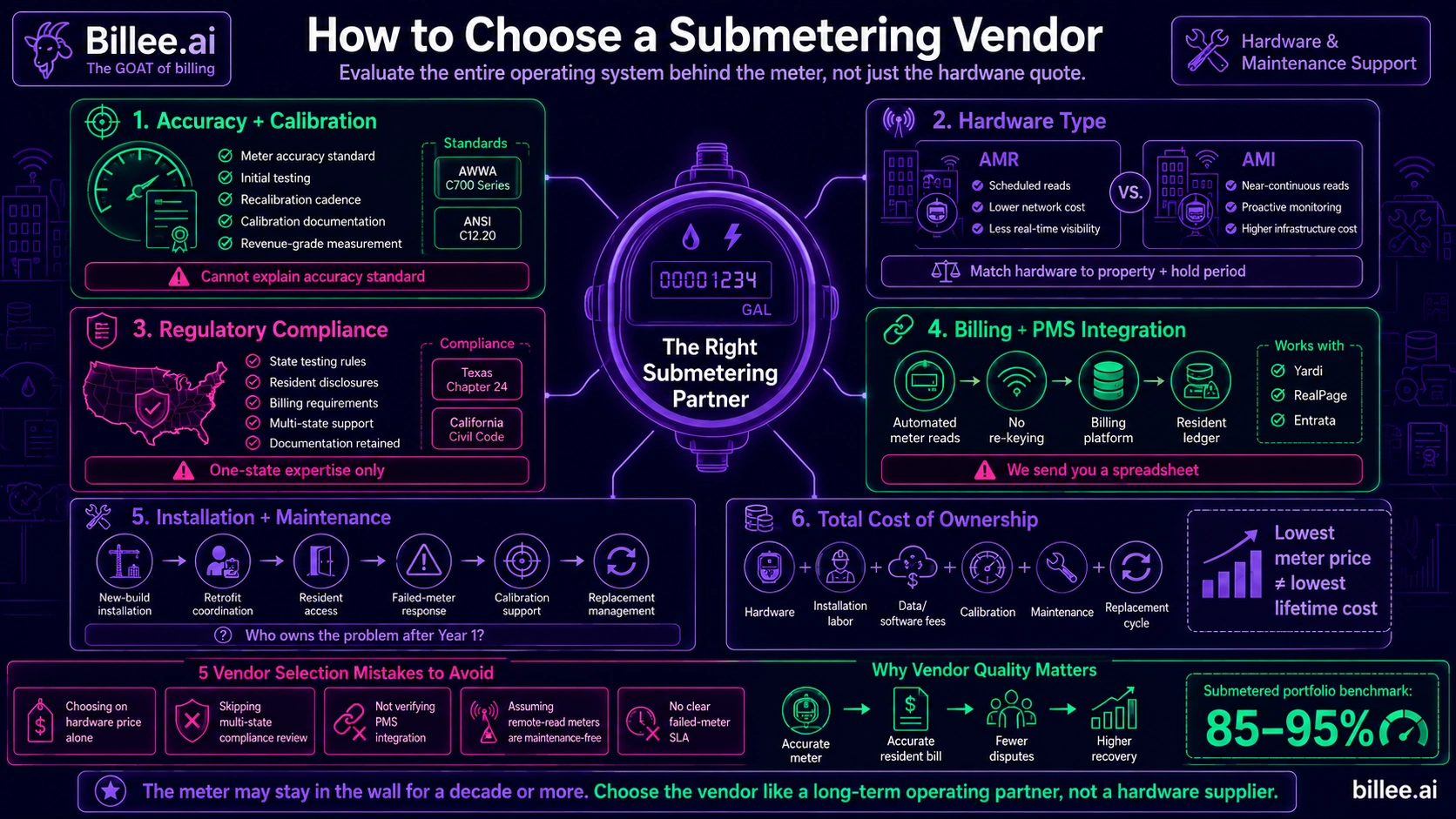
Evaluate a submetering vendor on six criteria: metering accuracy and calibration standard, hardware type, regulatory compliance support, billing software integration, installation and maintenance support, and total cost of ownership. A vendor strong on hardware but weak on integration leaves your billing team doing manual data entry every month. A vendor cheap on install but vague on calibration produces meter reads that do not survive a resident dispute.
Treat the decision like hiring a long-term partner, not buying a fixture. Submeter hardware typically stays in the wall for a decade or more, so the relationship outlasts most other property contracts you sign.
At a glance: the six-point vendor checklist
Use this as a scorecard when you're comparing quotes side by side.
| Criterion | What to ask the vendor | Why it matters |
|---|---|---|
| Metering accuracy and calibration | Which standard does your hardware meet, and how often is it recalibrated after install? | Determines whether bills hold up when a resident disputes a charge |
| Hardware type | Remote-read (AMR/AMI) or manual walk-read? | Shifts cost between upfront hardware and ongoing labor |
| Regulatory compliance | Does your hardware and reporting meet the rules in every state we operate in? | Non-compliant billing creates legal and resident-dispute exposure |
| Billing and PMS integration | How do meter reads reach our PMS (Yardi, RealPage, Entrata)? | Determines whether your team re-enters data by hand every month |
| Installation and maintenance support | Who handles a broken meter or failed calibration after year one? | Determines who owns repairs once the install is done |
| Total cost of ownership | What are the installation, calibration, software, and replacement costs, in writing? | The hardware quote is the smallest number in the real cost |
Why the vendor choice matters for multifamily operators
The cost of getting submetering wrong
A bad vendor choice shows up as bad data: missed reads, meters that drift out of calibration, or hardware mismatched to the utility type at a property. Each of those turns into a resident billing dispute, a redo install, or both. Billee's guide to how submetering works covers what accurate submetering looks like once it is running; vendor selection determines whether you get there on the first try.
How vendor quality affects your recovery rate
Recovery rate, the share of billable utility costs you actually collect, is directly downstream of meter accuracy. Billee's own data shows submetered properties typically capturing 85 to 95 percent of billable utility costs, well above the 70 to 85 percent typical for RUBS-billed properties. A vendor with loose calibration practices or unreliable remote reads will pull a property toward the bottom of whatever range its billing method allows.
Regulatory exposure when compliance is not built in from day one
States regulate submetering directly, and the rules are not uniform. Texas's framework, Chapter 24 of the Public Utility Commission of Texas's substantive rules, sets specific requirements for submetered and master-metered service in multifamily properties. California imposes its own disclosure obligations under Civil Code Sections 1954.201 through 1954.204. A vendor that has not built compliance into its hardware and reporting for every state you operate in is pushing that risk back onto you.
How to evaluate a submetering vendor
Metering accuracy and calibration standards
Ask how the vendor calibrates and tests meters, and how often. Water meters in the multifamily industry are commonly tested against American Water Works Association C700-series standards for cold-water and turbine-type meters. Electric submeters used for resident billing are commonly built to ANSI C12.20 accuracy classes, which define the 0.1, 0.2, and 0.5 percent accuracy tiers used in revenue-grade metering. A vendor who cannot say which standard their hardware meets, or how often it gets recalibrated after install, has not earned the contract yet.
Hardware type: remote-read (AMR/AMI) versus manual walk-read
Remote-read hardware costs more upfront but removes the labor and error risk of walking every unit each billing cycle. AMR (automated meter reading) transmits data on a scheduled basis; AMI (advanced metering infrastructure) transmits on a near-continuous basis. Manual walk-read meters cost less to install but shift ongoing labor and read-error risk onto your team or the vendor's field staff every month. Match the hardware type to how long you plan to hold the property.
State and local regulatory compliance support
Confirm the vendor's hardware and billing reports meet the disclosure and testing rules in every state where you operate, not just the vendor's home state. This matters most for portfolios spread across multiple states, where compliance with Texas's rules does not automatically mean compliance with California's.
Integration with your billing and PMS software
Meter data is only useful if it reaches your billing system without someone retyping it. Ask exactly how reads flow from the vendor's hardware into your property management software, whether that is Yardi, RealPage, or Entrata. A vendor whose answer is "we send a spreadsheet" is asking your team to do the integration work themselves.
Installation timeline and ongoing maintenance support
New-build installs and retrofit installs on occupied properties are different jobs with different timelines and different resident-disruption profiles. Ask specifically who handles a broken meter or a failed calibration after year one; vendors who disappear after the install leave you managing repairs yourself.
Total cost of ownership, not just the hardware quote
The hardware quote is the smallest number in the real cost. Installation labor, calibration cadence, software or data fees, and the eventual replacement cycle all belong in the comparison. Ask every vendor for these figures in writing, since a low hardware price with expensive ongoing calibration fees can cost more over the meter's life than a higher quote with calibration included.
Common mistakes operators make when choosing a submetering vendor
- Choosing a vendor on hardware price alone, without pricing in installation labor, calibration, and software fees.
- Skipping a compliance check for portfolios that span multiple states.
- Not confirming PMS integration before signing, then discovering meter data has to be entered by hand every month.
- Assuming remote-read hardware is maintenance-free once it is installed.
- Signing a contract without a clear answer on who handles a failed meter after year one.
Handling submetering in-house versus bringing in a managed partner
When in-house vendor management works
In-house vendor management works best for single-market portfolios where facilities staff already manage vendor relationships and have the bandwidth to track calibration schedules and compliance requirements directly.
When a managed-service model makes more sense
A managed-service model fits multi-state portfolios, portfolios without dedicated facilities staff, or owners who want one accountable point of contact instead of coordinating installers property by property. Utility vendor management covers this trade-off for utility vendors generally, not just submetering hardware.
How Billee helps with submetering vendor selection
Billee's Hardware & Maintenance Support product handles submetering vendor selection, procurement, and installation coordination directly, so your team does not have to evaluate hardware vendors from scratch. The Billee team manages calibration schedules and replacement for the life of the hardware, not just the install. What is the Billee service? covers how this pairs with Meter Monitoring & Proactive Alerts once meters are live.
FAQ
What does a submetering vendor typically cost per unit?
Submetering costs vary by utility type, hardware choice (remote-read versus manual-read), and whether the install is new-build or retrofit. Get property-specific quotes rather than relying on a portfolio-wide average, since the variables above move the number significantly.
Is submetering legal in every state?
Submetering is legal in most states, but the rules for accuracy, testing, and resident disclosure vary by state. Texas and California both have specific statutory frameworks, and multi-state portfolios need a vendor who can support each state's requirements at once.
How long does submetering installation take for an existing property?
Retrofit installation timelines depend on unit count, access, and whether residents need to be present for the install. Ask vendors for a property-specific timeline instead of relying on an industry-wide average.
What's the difference between AMR and AMI submetering?
AMR (automated meter reading) transmits meter data on a scheduled basis, typically a drive-by or fixed-network read. AMI (advanced metering infrastructure) transmits data on a near-continuous basis, giving operators more real-time visibility into usage.
Can I switch submetering vendors without re-metering the property?
Sometimes. If the existing hardware uses an open data protocol and is still within its accuracy life, a new vendor may take over reads and billing without replacing meters. If the hardware is proprietary to the outgoing vendor or out of calibration, expect a re-metering conversation.
Does Billee install submetering hardware?
Yes. Billee's Hardware & Maintenance Support product covers procurement, installation coordination, and ongoing calibration and replacement for submetering infrastructure.
How often should submeters be calibrated or replaced?
Calibration cadence depends on the meter type and manufacturer specification. Ask any vendor for their specific calibration schedule and how they document it, since billing accuracy depends directly on that schedule being followed.
What happens if a submeter fails or gives an inaccurate read?
A failed or drifting meter should trigger a vendor response that includes investigating the read, correcting any affected resident bills, and repairing or replacing the hardware. Ask prospective vendors how they detect failures in the first place, since undetected failures are where most billing disputes originate.
If choosing and managing submetering hardware is more than your team wants to take on, Billee runs vendor selection, installation, and calibration as part of Hardware & Maintenance Support. Talk to the team about your portfolio.
Sources
- Public Utility Commission of Texas, "Water and Sewer Substantive Rules, Chapter 24," updated 2024.
- California Legislative Information, "Civil Code Section 1954.201," accessed 2026.
- American Water Works Association, "AWWA Comment Period on 10 Meter Standards (C700, C701, C702, and others)," accessed 2026.
- American National Standards Institute, "ANSI C12.20-2015: Electricity Meters, 0.1, 0.2, and 0.5 Accuracy Classes," accessed 2026.
Insights and Industry Trends