

Utility Billing Outsourcing vs. In-House for Multifamily Operators
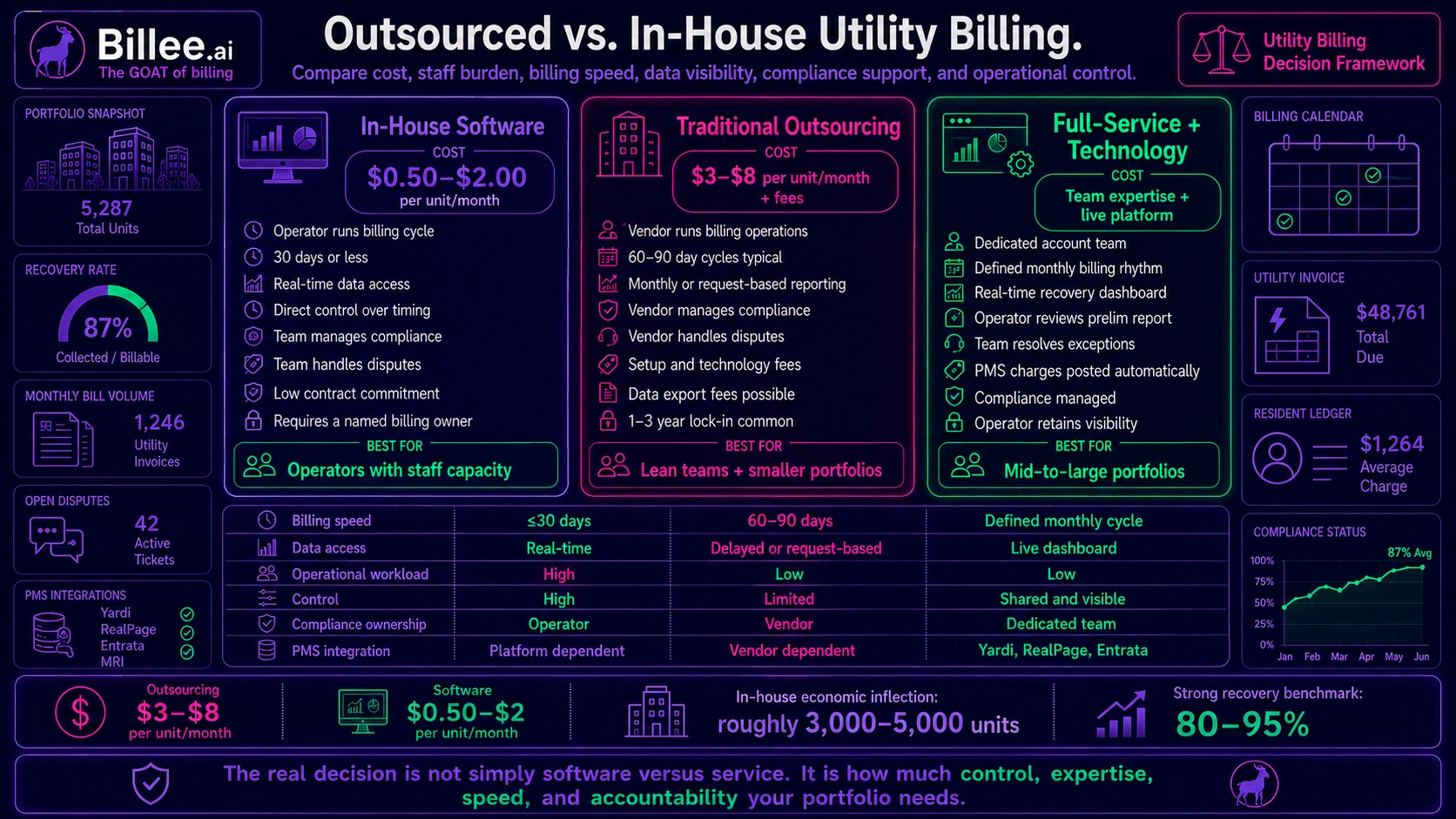
TL;DR: Whether to outsource utility billing or manage it in-house depends on portfolio size, staff capacity, billing complexity, and how much operational control you want to keep. Outsourced full-service billing typically costs $3--$8 per unit per month and offloads compliance, dispute handling, and invoice processing to a third party. In-house billing software runs $0.50--$2 per unit per month and keeps billing cycles, data, and recovery rates under direct operator control. A third option -- full-service billing backed by modern technology -- delivers the expertise of outsourcing with the visibility and control operators get from in-house platforms.
Key Takeaways
- Outsourced full-service billing costs $3--$8 per unit per month in headline fees, but total cost is typically higher once setup fees ($500--$2,000 per property), technology fees, data export fees, and contract lock-in are counted.
- In-house billing software runs $0.50--$2.00 per connection per month and is no longer technically complex -- modern platforms handle RUBS, submetering, and hybrid configurations with PMS integrations built in.
- Outsourced billing vendors typically operate on 60--90 day billing cycles; in-house billing shortens that cycle to 30 days or less, improving cash flow and recovery rate visibility.
- More than one-third of multifamily property managers still handle utility billing fully in-house (Zego 2026 Multifamily Revenue Operations Report), suggesting significant variation in how operators approach this decision.
- The financial inflection point where in-house software becomes more economical than outsourcing typically falls around 3,000--5,000 units; below that threshold, the math often favors outsourcing for operators without dedicated billing staff.
- A third model -- full-service billing backed by modern technology (team plus platform) -- eliminates the tradeoff between expertise and control that makes this decision difficult.
At-a-Glance: Outsourcing vs. In-House vs. Full-Service + Technology
| Factor | In-House Software | Outsourced Service | Full-Service + Technology |
|---|---|---|---|
| Per-unit cost | $0.50--$2.00/month | $3--$8/month (+fees) | Contact for pricing |
| Billing cycle speed | 30 days or less | 60--90 days typical | Defined monthly rhythm |
| Data access | Real-time | Request-based (delays) | Real-time dashboard |
| Compliance handling | Operator manages | Vendor manages | Team manages |
| Dispute handling | Operator manages | Vendor manages | Team manages |
| PMS integration | Varies by platform | Varies by vendor | Native (Yardi, RealPage, Entrata) |
| Contract flexibility | Low commitment | 1--3 year lock-in typical | Varies |
| Best for | Operators with billing staff | Lean teams, smaller portfolios | Mid-to-large portfolios |
What Each Model Actually Means
In-House Billing Software
In-house billing means your team uses a software platform to run the billing cycle. The platform automates invoice ingestion, RUBS or submeter allocation, resident statement generation, and charge posting to your PMS. Your staff controls the timeline, reviews billing before it goes out, and owns the relationship with the resident.
The "too complex to handle in-house" perception was accurate a decade ago. Modern in-house platforms handle RUBS formulas, submetering reads, hybrid configurations, and regulatory compliance tooling without requiring billing specialists on staff. Pricing starts around $0.50 per unit per month for basic platforms and rises to $2.00 per unit for full-featured tools with PMS integrations.
The key requirement: your team needs to own the billing cycle. Someone needs to review preliminary reports, catch exceptions, manage vendor invoice discrepancies, and respond to resident disputes. For operators with a dedicated billing coordinator -- or who are willing to create one -- in-house software delivers the best combination of cost and control.
Outsourced Full-Service Billing
Outsourced billing transfers the operational work to a third-party provider. The vendor ingests utility invoices, runs billing calculations, generates statements, handles dispute calls, and provides a monthly summary report. The property management company approves and collects; the vendor does the operational work.
The advertised cost is $3--$8 per unit per month, but the all-in cost is typically higher. Setup fees of $500--$2,000 per property are common. Technology fees (platform access charges) and data export fees appear in fine-print contract terms. Processing fees on late payments are often passed to the property rather than the resident. Contract terms run 1--3 years with auto-renewal clauses and early termination penalties.
At a 500-unit property, $5 per unit per month is $30,000+ per year in per-unit fees alone -- before setup, technology, and processing charges. The full-cost number is almost always higher than the headline rate.
The timing gap is also a real cost. Most outsourced vendors operate on 60--90 day billing cycles: the time between when utility invoices arrive and when resident bills go out. Every month of delay is a month of cash the property is fronting to the utility provider. In-house operators cut that cycle to 30 days or less.
Full-Service + Technology (The Third Model)
A third model -- less common but growing -- pairs a dedicated service team with a modern software platform. The operator gets a named account team that handles billing operations, vendor management, exceptions, and disputes -- the expertise of outsourcing -- plus a real-time dashboard with direct access to recovery rate data, billing cycle status, and portfolio analytics.
This model costs more than software-only but eliminates the control trade-off that makes pure outsourcing uncomfortable for larger operators. It is especially suited to portfolios above approximately 500 units, where the combination of team expertise and platform visibility delivers recovery rates and operational outcomes that neither pure software nor traditional outsourcing reliably achieves.
When In-House Billing Makes Sense
Your Team Has the Capacity to Own It
In-house billing works when someone on your team owns it. That does not require a dedicated billing department -- a property accountant, regional manager, or operations coordinator who can own the monthly billing cycle and respond to exceptions within 24--48 hours is sufficient for a portfolio of one to five properties.
The risk with in-house billing is key-person dependency. If billing knowledge lives in one person and that person leaves, the institutional knowledge leaves with them. Operators considering in-house software should build process documentation alongside the platform, so that the billing workflow survives staff transitions.
You Prioritize Real-Time Data and Billing Control
In-house billing gives operators direct access to billing data as it happens. Recovery rate by property, billing cycle status, resident payment rates, and exception flags are visible in real time -- not summarized in a monthly PDF from a vendor. Operators who track NOI performance at the property level need this visibility to catch problems when they are still correctable.
In-house billing also means you set the billing cycle. Bills go out when your workflow is ready, not on a vendor's schedule. For operators managing cash flow tightly across a portfolio, controlling the timing of billing cycles is a meaningful operational advantage.
Your Portfolio Has Manageable Complexity
In-house billing is most appropriate when billing configuration is relatively stable: consistent RUBS formulas, a known set of utility accounts, and minimal unit-mix changes month over month. Portfolios with significant submeter infrastructure, frequent utility account transitions, or complex hybrid billing configurations require more ongoing management than a lean in-house team can efficiently deliver without a dedicated billing specialist.
When Outsourcing Makes Sense
Your Team Is Already Stretched Thin
For on-site and regional teams juggling leasing, renewals, maintenance coordination, and delinquency management, adding utility billing to the workload creates real operational risk. A billing cycle that requires 10--20 hours per property per month of staff time is a meaningful burden when that time would otherwise go to resident retention or lease-up.
Outsourcing transfers the operational billing work off your team's plate. Your staff approves billing before it goes out and handles resident questions, but the invoice processing, calculation, statement generation, and dispute investigation are handled externally. For portfolios where staff bandwidth is genuinely constrained, this tradeoff can be worth the higher per-unit cost.
Compliance Complexity Exceeds Your Team's Bandwidth
Utility billing compliance -- RUBS formula requirements, submeter operator licensing, administrative fee caps, disclosure timing, state-specific regulations -- varies by jurisdiction and changes as state legislatures act. California's AB 1248 (effective April 1, 2026) substantially revised RUBS allowances. Colorado's HB26-1013 (March 2026) added four conditions for RUBS compliance. Texas PUC Chapter 24 governs dispute timelines.
Outsourced billing vendors with active regulatory teams track these changes across jurisdictions. For operators with properties in multiple states, or for operators in markets with active regulatory environments, access to current compliance expertise is a meaningful part of what the per-unit fee buys.
You Are in a Growth Phase and Need a Scalable Infrastructure
What works at 200 units often breaks at 2,000. Operators in active acquisition or development mode who are adding 200--500 units per year benefit from billing infrastructure that scales without requiring internal hires or platform migrations. Outsourced billing absorbs property additions within existing contract terms; in-house platforms require configuration for each new property and additional staff capacity as volume grows.
True Cost Comparison: The Math You Need to Run
The Five-Year Total Cost of Outsourcing
For a 500-unit portfolio at a typical outsourced rate of $5/unit/month, the visible cost is $30,000 per year. Over five years: $150,000. Add two property onboarding fees at $1,500 each ($3,000), estimated technology and processing fees ($6,000 over five years), and the total approaches $160,000 before early termination penalties or data export fees.
The hidden cost that rarely appears in this calculation: the cash flow impact of a 60--90 day billing lag. A portfolio generating $40,000 per month in utility recoveries but receiving payment 60--90 days after the billing cycle closes is effectively providing the outsourced vendor a $40,000--$80,000 interest-free loan at all times. The cost of that float is real, particularly in a higher-rate environment.
The Five-Year Total Cost of In-House Software
At $1.00/unit/month, a 500-unit portfolio pays $6,000/year in software fees. Over five years: $30,000. Add a one-time setup cost, staff time for billing operations (roughly 15--20 hours per month across the portfolio at a blended rate), and a modest allowance for training and process documentation. Total five-year cost: approximately $50,000--$70,000 for a well-configured in-house operation.
The savings over outsourcing -- $90,000--$110,000 over five years on a 500-unit portfolio -- are real. But so is the organizational investment required to realize them. In-house billing at this scale requires a committed billing owner and a documented, repeatable process. Without those, error rates rise and the savings are offset by uncollected charges, disputes, and staff time in reactive mode.
Five Questions That Clarify the Decision
Operators who approach this decision through a framework rather than cost alone consistently make better choices for their specific portfolio.
Question 1: How much is under-recovery costing us today? Calculate your current annual utility spend, your estimated recovery rate, and the gap. If recovery is below 80% and the gap represents $50,000+ per year in uncollected utility charges, fixing recovery is the priority -- and either model can address it with the right implementation.
Question 2: Do we have a person who can own billing? Name the person. If you cannot name one, in-house billing will drift toward inconsistency. The person needs to own the prelim review, exception resolution, and PMS charge reconciliation monthly.
Question 3: Are billing errors common in our portfolio today? Review the last 12 months of billing adjustments, write-offs, and resident disputes. If errors are routine, the current process is broken. Automation -- whether in-house software or outsourced processing -- will improve accuracy, but in-house software gives faster feedback loops.
Question 4: Will our portfolio double in the next two years? Growth phases favor scalable infrastructure. If you expect to acquire 500 more units in the next 24 months, the billing infrastructure you choose now needs to absorb that growth without requiring a full platform migration.
Question 5: What does direct access to billing data mean for our NOI management? If your asset managers review recovery rate by property monthly and act on variance, real-time dashboard access is a meaningful operational tool. If billing is viewed as administrative back-office work rather than a financial performance lever, the data visibility advantage of in-house platforms matters less.
The Full-Service + Technology Model -- Eliminating the Tradeoff (Billee)
The conventional framing of "outsource or in-house" presents a false choice: control vs. expertise. The full-service + technology model eliminates it.
Billee's Billing & Recovery Engine combines automated billing software with a dedicated account team that does the operational work. Operators get the expert team that outsourcing is supposed to provide -- managing invoice processing, RUBS and submeter allocation, PMS integration, exception resolution, and compliance -- plus the real-time portfolio dashboard that in-house operators have. Every customer has a named account team member responsible for outcomes.
Billee's monthly billing cycle runs on a defined rhythm: Billee generates a preliminary billing report and flags exceptions for the operator to review. The operator reviews and approves or requests corrections (1--2 business day SLA). Charges push to PMS ledgers on the predetermined date. Recovery rate is tracked against Billee's benchmark (80--95% = strong; below 80% = problem flagged). No monthly-PDF-and-wait; recovery data is live.
For multifamily portfolios of meaningful scale looking to move beyond the software-vs.-service tradeoff, the Billee team is the starting point.
Frequently Asked Questions
What is the difference between utility billing outsourcing and in-house billing software? Outsourcing transfers billing operations to a third-party vendor who handles invoice processing, calculations, statement generation, and disputes. In-house billing software gives your team the platform to run billing yourselves, with automation doing the calculation and formatting work. The primary tradeoffs are cost (software is typically 75--85% cheaper per unit), speed (in-house cycles run faster), and staff burden (outsourcing reduces workload on your team).
How much does outsourced utility billing cost for multifamily properties? Full-service outsourced billing is typically priced at $3--$8 per unit per month in headline fees. Add setup fees of $500--$2,000 per property, technology access fees, and payment processing fees, and the all-in annual cost for a 500-unit portfolio at $5/unit exceeds $30,000 before ancillary charges. Request a full cost breakdown -- not just the per-unit rate -- before signing.
Can small property management companies handle utility billing in-house? Yes, with the right software platform. Modern in-house billing software automates RUBS allocation, PMS integration, and statement generation, reducing the manual work to a monthly review and approval cycle. The key requirement is a designated billing owner on your team. For portfolios under 300 units with limited staff, outsourcing often makes more operational sense.
How long does it take to switch from outsourced to in-house billing? Most in-house software platforms can be configured and operational in 4--8 weeks for a single property. Portfolio-level migrations -- transitioning multiple properties simultaneously -- typically run 6--12 weeks depending on PMS integration complexity and data migration requirements. Switching from an outsourced vendor mid-contract may trigger early termination fees; review contract terms before initiating a transition.
What happens to resident disputes when billing is handled in-house? In-house billing places dispute handling with your team. Modern billing platforms provide dispute documentation tools and audit-ready records of billing calculations, which support faster dispute resolution. Outsourced providers typically operate resident call centers, which reduces your team's direct dispute workload but can create delays when disputes require investigation by the billing team.
What is a full-service utility billing provider? A full-service utility billing provider handles all operational aspects of the billing cycle -- invoice processing, charge allocation, statement generation, resident disputes, and compliance monitoring -- on behalf of the property management company. The property company approves billing and collects charges but does not run day-to-day billing operations. Prices range from $3--$8/unit/month plus ancillary fees.
Is outsourced utility billing worth the cost for larger portfolios? For portfolios above 500 units, the per-unit cost differential between outsourcing ($3--$8) and in-house software ($0.50--$2.00) becomes increasingly significant. A 1,000-unit portfolio at $5/unit vs. $1/unit is $48,000 per year in cost difference. At that scale, the case for bringing billing in-house -- or switching to a full-service + technology model that delivers comparable expertise at better economics -- becomes compelling for most operators.
What should I ask an outsourced billing vendor before signing? Ask for a full cost breakdown including setup fees, technology fees, processing fees, and data export fees -- not just the per-unit headline rate. Ask for the standard billing cycle timeline (how many days from invoice receipt to resident bill delivery). Confirm the contract term length and early termination policy. Ask for a reference from a portfolio similar in size and PMS configuration to yours. Confirm the SLA for dispute investigation and response.
Sources
- Vitality IO. "In-House vs. Outsourced Utility Billing: The Real Cost Comparison." January 2026. https://vitality.io/blog/in-house-vs-outsourced-utility-billing
- Livable. "Should You Handle Utility Billing In-House or Outsource It? A Decision Framework for Property Managers." February 2026. https://blog.livable.com/should-you-handle-utility-billing-in-house-or-outsource-it-a-decision-framework-for-property-managers
- Bynry. "Utility Billing Services 2026: A Buyer's Guide." June 2026. https://www.bynry.com/blog/utility-billing-services
- Synergy Utility Billing. "Outsourcing Utility Billing for Property Management Firms." Accessed July 2026. https://www.synergyutilitybilling.com/outsourcing-utility-billing-for-property-management-firms/
- Synergy Utility Billing. "Outsourcing Multifamily Utility Billing -- 5 Operational Benefits." Accessed July 2026. https://www.synergyutilitybilling.com/operational-benefits-outsourcing-multifamily-utility-billing/
- Banyan Utility. "Why Outsourcing Should Be The Go-To Strategy for Multifamily Housing Operators." Accessed July 2026. https://banyanutility.com/why-outsourcing-should-be-the-go-to-strategy-for-multifamily-housing-operators/
- Zego. "Utility Billing for Multifamily Explained." Accessed July 2026. https://www.gozego.com/articles/utility-billing-for-multifamily-explained/
- Baselane. "Best Property Management Utility Billing Software 2026." Accessed July 2026. https://www.baselane.com/resources/property-management-billing-utility-software
- AmCoBi. "Selecting an Effective Multifamily Utility Billing Services Provider." Accessed July 2026. https://amcobi.com/select-billing-provider/
- Utility Ranger. "Complete Reference: RUBS Software, In-House Utility Billing & Multifamily Cost Recovery." Accessed July 2026. https://utilityranger.com/guide
- Bynry. "Utility Billing Multifamily Software: How It Works." June 2026. https://www.bynry.com/blog/utility-billing-multifamily-software
- Entrata. "2026 Legislative Roundup: New Fee, Utility Billing, and Tenant Protection Laws Property Managers Should Know." Accessed July 2026. https://www.entrata.com/blog/2026-legislative-roundup-new-fee-utility-billing-and-tenant-protection-laws-property-managers-should-know
- Holland & Knight. "Existing Colorado Multifamily Housing Developments Can Continue Using RUBS Under New Law." April 2026. https://www.hklaw.com/en/insights/publications/2026/04/existing-colorado-multifamily-housing-developments-can-continue
- MRI Software. "5 Multifamily Utility Cost Recovery Strategies." Accessed July 2026. https://www.mrisoftware.com/blog/5-multifamily-utility-cost-recovery-strategies/
Insights and Industry Trends


Explore more insights