

What Questions to Ask Before Signing with a Utility Billing Company
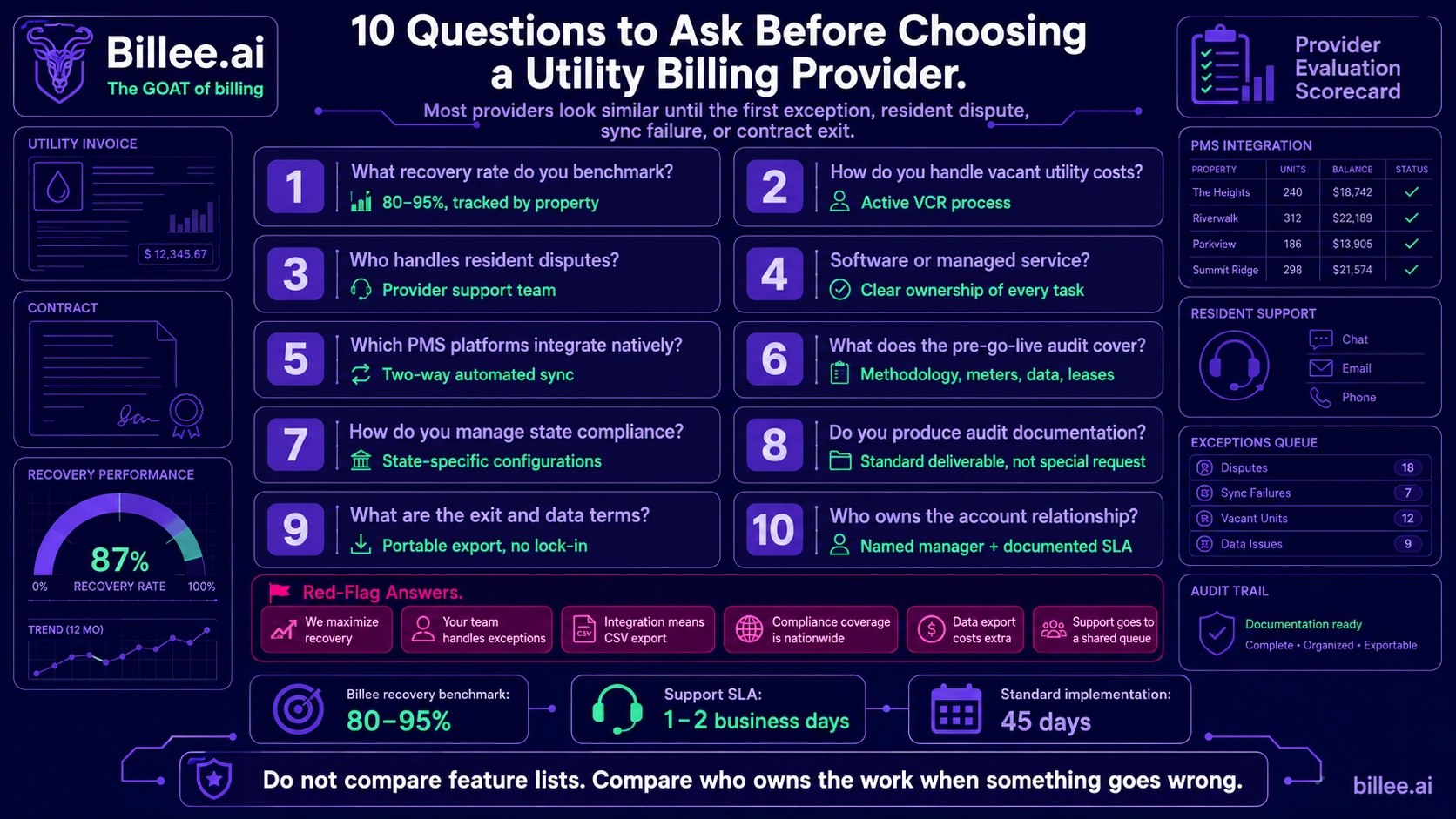
Most utility billing companies look similar on the surface. They offer RUBS, submetering support, and PMS integration. The differences show up in how they handle billing exceptions, who residents call when they dispute a charge, what happens when a sync fails between the billing system and your PMS, and what your options are if you want to leave. These ten questions are designed to surface those differences before you sign a contract, not after your first billing cycle goes wrong.
Ten questions to ask every provider before signing:
- What is your effective recovery rate benchmark and how do you measure it?
- How do you handle vacant unit utility costs?
- Who handles resident billing disputes: your team or theirs?
- Is this software we operate ourselves or a managed service?
- Which PMS platforms do you integrate with natively?
- What does your pre-go-live billing audit cover?
- Which states do you cover and how do you track regulatory changes?
- Do you produce billing methodology documentation for audits and due diligence?
- What are the exit terms and what happens to our billing data if we leave?
- Who is our named account contact and what is your response SLA?
Questions About Methodology and Recovery
How do you calculate effective recovery, and what benchmark should I expect?
Effective recovery rate is the percentage of total utility costs a property bills back to residents in a given cycle. Ask any provider you are evaluating how they define and measure this number, and what benchmark they hold themselves to across their portfolio.
A provider who cannot give you a specific benchmark, or who gives a vague answer about "maximizing recovery" without a number, is telling you something. Good providers track recovery at the property level and can tell you exactly when a property falls below threshold and what they do about it. Billee's portfolio benchmark is 80–95% effective recovery, tracked on the customer dashboard, and below 80% triggers a methodology review by the account team.
How do you handle vacant unit utility costs?
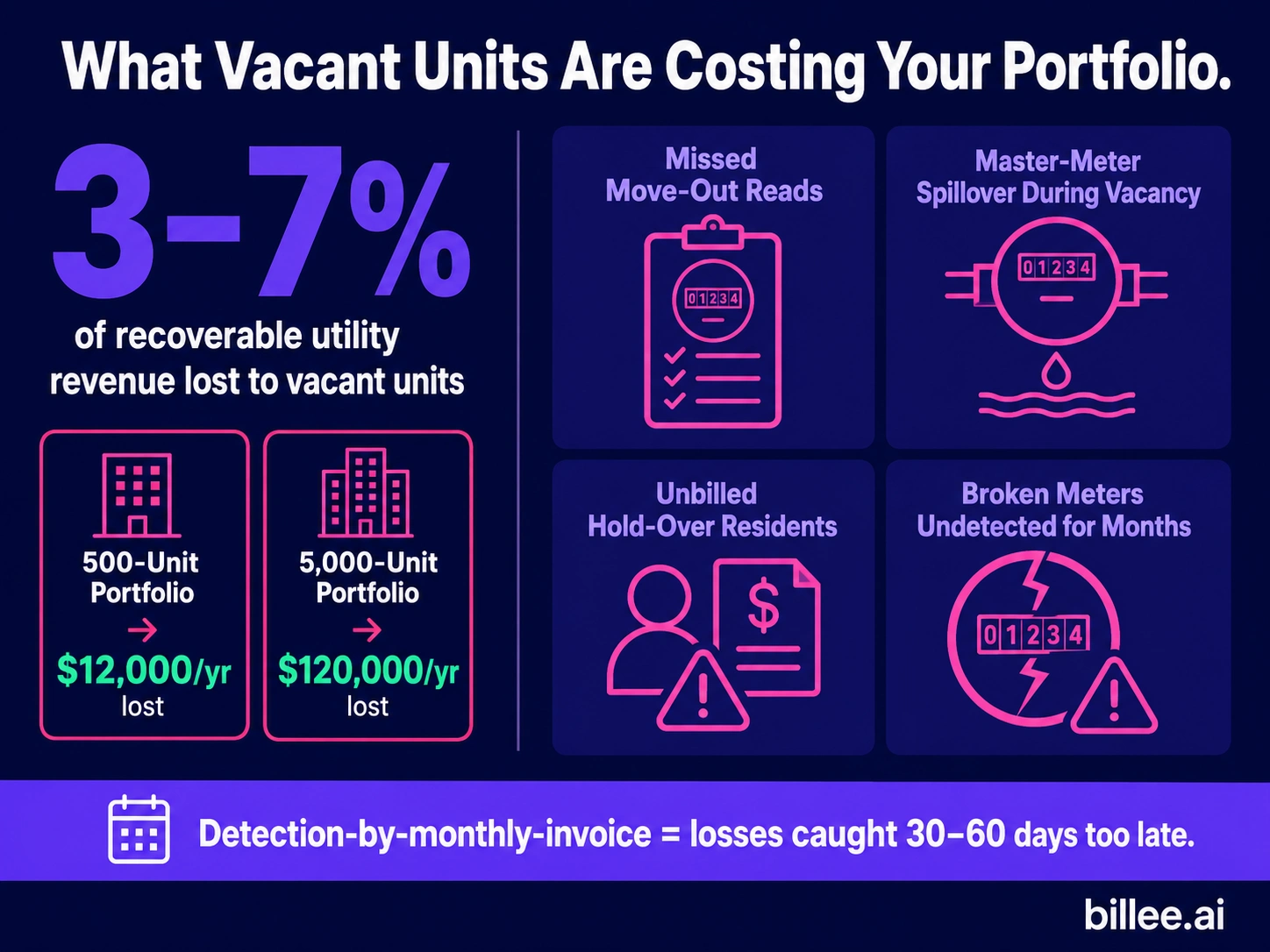
Vacant units are the single largest driver of recovery gaps in multifamily utility billing. When a unit sits empty, its utility costs are real but unrecoverable from a resident. The question is whether the provider has a systematic process for identifying, flagging, and (where applicable) recovering those costs.
Ask whether the provider tracks vacant unit costs separately, whether they offer a Vacant Cost Recovery service, and how they calculate the cost of vacancy to the portfolio. A provider without a specific answer to this question is treating vacant unit costs as a fixed loss rather than a recoverable one.
What happens when utility costs rise faster than your allocation formula?
RUBS formulas that were configured two or three years ago may not reflect current utility rates, unit-mix changes, or occupancy patterns. Ask the provider how often allocation formulas are reviewed and updated, and who initiates that review: them or you.
Providers who require the operator to request a formula review put the compliance burden back on the property management team. Providers who monitor and flag formula drift proactively are delivering the managed service the contract implies.
Questions About Service Model and Support
Is this software I operate myself or a managed service?
This is the most important structural question to ask before signing anything. Some utility billing providers sell software with a self-service model: you get the platform, you configure the billing, you manage exceptions, and you handle resident questions. Others operate as a managed service: a dedicated team runs the billing cycle, handles exceptions, and manages resident communications on your behalf.
The distinction matters for both staffing and accountability. A software-only model adds operational work to your team. A managed service transfers that work to the provider's team. Before signing, be clear about which model you are buying.
| Software model | Managed service | |
|---|---|---|
| Who runs the billing cycle | Your team | Provider's team |
| Who handles exceptions | Your team | Provider's team |
| Who answers resident billing calls | Your team | Provider's team |
| Account contact | Shared support queue | Named account manager |
| Best for | Operators who want control and have internal capacity | Operators who want outcomes without adding headcount |
Who handles resident billing disputes?
This question reveals more about a provider's service model than almost any other. When a resident calls with a question about their utility bill, who picks up the phone: your team or the provider's team?
Providers who route resident calls to your team are delivering a billing platform, not a billing service. Providers with a dedicated resident support line, separate from property manager support, are absorbing one of the most time-intensive parts of utility billing operations. Ask for the specific phone number and hours. Billee maintains a dedicated resident support line at (214) 983-8060, staffed Monday through Friday, 9 am to 5 pm CST.
Who is our named account contact and what is your response SLA?
A shared support queue is not an account team. Ask for the name and title of the person who will be responsible for your portfolio, and ask what the documented response time is for billing questions, report regeneration requests, and exception flags.
The answer tells you whether the provider has scaled their service model or just their customer count. Billee's documented SLA across all support workflows is 1–2 business days, and every customer has a named account manager.
Questions About PMS Integration
Which PMS platforms do you integrate with natively, and what does that mean in practice?
"Integration" is one of the most overloaded words in property management software. Ask specifically: does the integration sync resident data automatically, or does it require a manual export? Does it post utility charges back to resident ledgers in the PMS, or does it only sync in one direction? How often does the sync run?
The practical minimum for a functional integration is daily automatic sync of resident, unit, and lease data from the PMS to the billing system, and automatic posting of utility charges back to resident ledgers at billing cycle finalization. Ask for both and confirm both.
What does a sync failure look like and how is it caught?
PMS integrations fail occasionally. A resident who moved in yesterday does not appear in the billing system. A charge that should have posted to Yardi ledgers did not. Ask the provider how these failures are detected and how quickly they are resolved.
Providers who rely on the operator to notice and report sync failures are shifting a quality control responsibility onto your team. Providers who monitor integration health proactively and flag failures before the billing cycle closes are doing what a managed service is supposed to do.
Questions About Compliance and Documentation
Which states do you cover and how do you track regulatory changes?
Utility billing regulation varies significantly by state. Texas PUC Chapter 24, California Civil Code section 1954.201 through 1954.204, and the equivalent frameworks in Florida, Illinois, and other states each have their own disclosure requirements, methodology restrictions, and metering rules. Ask the provider which states they have active compliance coverage for and how they track and implement regulatory changes.
A provider who covers "all states" but cannot name a single specific regulatory framework is describing aspiration, not capability.
Do you produce billing methodology documentation for audits and due diligence?
When a lender underwrites a refinancing, when a buyer conducts due diligence on an acquisition, or when a regulatory body audits a property's utility billing practices, they will ask for documentation: what billing methodology is in use, how it was configured, and what it has produced. Ask the provider whether they generate that documentation as a standard deliverable or whether it requires a special request.
Operators who cannot produce a clear billing methodology audit trail on demand are taking on documentation risk that shows up at the worst possible time: mid-transaction.
Questions About Contract and Data Portability
What are the exit terms?
Read the exit clause before signing. Specific things to confirm: what is the notice period required to terminate, whether there are early termination fees and how they are calculated, and what happens to billing in progress if the contract ends mid-cycle.
Providers with long notice periods and significant early termination fees are structuring the contract to make switching expensive. That is worth knowing before you sign, not after you decide you want to leave.
What happens to our billing data if we leave?
Billing history belongs to the operator, not the billing company. Before signing, confirm in writing that you will receive a full export of all billing records in a portable format (CSV or Excel) at the end of the contract, at no additional charge, within a defined timeframe.
Providers who resist this question, delay the answer, or charge a data export fee are signaling that your data is part of their retention strategy.
The Question Most Operators Forget to Ask
What does your implementation actually include, and what do we have to do ourselves?
Every provider will tell you their implementation is smooth and their team handles everything. Ask for the specific list of what is included, what tasks are on you, and what the implementation timeline covers step by step.
The answer will tell you whether the 45-day implementation they quoted assumes your team has already done the meter audit, the PMS data cleanup, and the AR code mapping in your property management system. Those are not small tasks. Providers who include them in their implementation scope are doing the work. Providers who list them as operator prerequisites are billing you for a go-live their team is not actually setting up.
How Billee Answers These Questions
Billee operates as a managed service, not a software platform operators run themselves. Every customer has a named account manager and a dedicated resident support line. The billing audit is included in the 45-day implementation, not listed as a prerequisite.
Billee's Regulatory & Compliance product covers billing methodology audits against state PUC rules, with documentation designed to meet lender and HFA audit standards. And when you want to leave, your data is yours: Billee returns a full billing history export as a standard offboarding step.
Frequently Asked Questions
What is the difference between a utility billing company and utility billing software? A utility billing company operates the billing process on your behalf: running the cycle, handling exceptions, managing resident communications, and maintaining compliance. Utility billing software is a tool your team uses to do those things yourselves. Most contracts in the market are some combination of both; the question is where the line sits and who is accountable for outcomes on each side of it.
How do I evaluate a utility billing company's recovery rate claims? Ask for the benchmark they hold their own portfolio to, how they define recovery rate, and what they do when a property falls below it. Recovery rate claims that are not tied to a specific benchmark, a measurement methodology, and a response process are marketing, not performance data.
What should a utility billing contract include? At minimum: a clear definition of what services are included, the response SLA for billing support, the exit notice period and any early termination terms, and a data portability provision specifying that billing history is returned to the operator at contract end in a portable format.
How long should a utility billing implementation take? A full implementation covering billing audit, meter reconciliation, PMS integration, testing, and the first live billing cycle typically takes 30–60 days. Billee's standard timeline is 45 days. Implementations that close faster than 30 days are usually skipping steps, most often the billing audit and integration testing phases.
What does a good SLA look like for utility billing support? A 1–2 business day response time for billing questions, report regeneration requests, and exception flags is a reasonable baseline. Ask whether the SLA applies to a shared support queue or to a named account manager, and what happens if the SLA is missed.
If you are evaluating utility billing providers, Billee is worth a conversation. Talk to the team.
Sources
- American Apartment Owners Association, "How to Bill Tenants for Utilities the Smart Way," accessed July 2026.
- MRI Software, "5 Multifamily Utility Cost Recovery Strategies," accessed July 2026.
Insights and Industry Trends


Explore more insights