
How RUBS Rules Vary by State: A Multifamily Operator's Compliance Guide
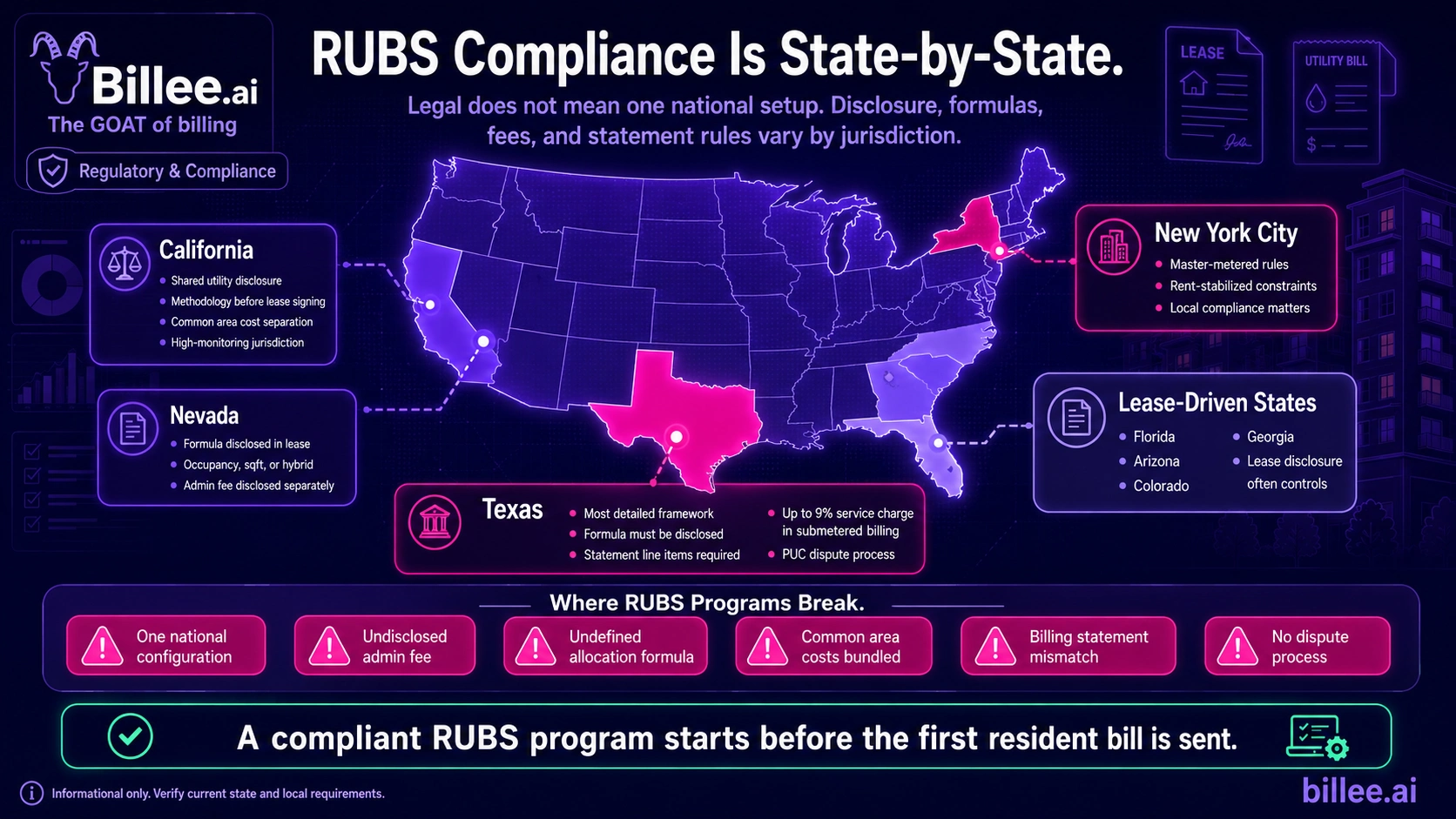
Ratio Utility Billing System (RUBS) is legal in every state except Connecticut, where the state Supreme Court ruled it illegal outright for residential multiunit properties in 2024. Among the other 49 states, compliance requirements differ enough that a billing setup correct for a Texas portfolio may be incomplete for a California, Nevada, or Colorado property. A small group of states, including Texas, California, Nevada, Colorado, and Arizona, have enacted detailed statutory or regulatory rules governing disclosure language, allowable allocation formulas, and administrative fee limits. Most other states have no RUBS-specific statute, which means enforceability depends entirely on the lease addendum and the operator's compliance with general landlord-tenant and consumer protection law. Operators running multi-state portfolios without a state-by-state configuration carry billing dispute exposure and lease enforceability risk that compounds across every property where the billing setup does not match local requirements. Billee's Regulatory & Compliance product configures RUBS methodology, disclosure language, and administrative fee structure to match each state's requirements from the day a property is enrolled.
Key Takeaways
RUBS is legal in 49 states. Connecticut is the sole exception: its state Supreme Court ruled RUBS illegal outright for residential multiunit properties in 2024. Among the states where RUBS remains legal, "legal" does not mean "unregulated": Texas, California, Nevada, Colorado, New York, and a growing number of states impose specific disclosure requirements, formula restrictions, or fee caps that must be built into the billing configuration before the first invoice is sent.
Texas has one of the most detailed RUBS frameworks in the country. The Texas Utilities Code, Chapter 184, requires the allocation method to be disclosed in writing in the rental agreement and caps the resident's per-unit charge at no more than the rate the utility itself charges the property owner, with no markup allowed.
California requires written disclosure of the RUBS allocation methodology before the lease is signed. California Civil Code Section 1940.9 mandates disclosure of any shared utility arrangement, and the California PUC regulates master-metered residential properties separately from submetered ones.
In states with no RUBS-specific statute, including Florida, enforceability depends on the lease. An undisclosed administrative fee or an undefined allocation formula is contestable in any state; in states with active tenant advocacy or strong consumer protection statutes, the exposure is material. Arizona and Georgia, both once assumed to be no-statute states, in fact regulate RUBS directly: Arizona by statute for all utility types, Georgia for water and wastewater specifically.
Administrative fee limits exist in several regulated states: Texas caps the utility charge itself at no markup over the provider's rate, and Arizona limits the administrative fee to the landlord's actual administrative costs. Elsewhere, a fee limit is often implied by disclosure requirements rather than stated as a hard cap. Billing an administrative fee that is not itemized separately in the billing statement, or not disclosed in the lease, creates class action exposure in any state with a private right of action under its consumer protection statute.
Billee configures RUBS programs to each state's requirements at setup and monitors for regulatory changes that affect the billing configuration.
What RUBS Is and Why State Law Matters
RUBS allocates a property's master-metered utility costs to individual residents using a formula rather than individual metering. The formula typically weights costs by number of occupants, unit square footage, or a hybrid of both. Residents pay a proportional share of the total utility cost for the property rather than a direct meter reading for their unit.
The legal framework matters because RUBS involves allocating a shared cost, not billing for a measured individual consumption. State legislatures and utility commissions have approached this differently: some have enacted specific rules that define the permissible mechanics, others defer entirely to lease contract law, and a few have layered in consumer protection obligations that apply even when no RUBS-specific statute exists.
The most common source of RUBS legal exposure is not the formula itself. It is the gap between what the lease discloses and what the billing statement actually charges.
For a portfolio operating in multiple states, a single national RUBS configuration creates compliance risk at every property where that configuration does not match the state's requirements. The fix is not more complex billing software; it is a state-by-state setup that reflects the disclosure requirements, formula restrictions, and fee rules of each jurisdiction.
States With Explicit RUBS Regulation
A minority of states have enacted specific RUBS statutes or PUC rules. These states require operators to follow defined procedures; deviation creates enforceable legal exposure, not just a dispute risk.
Texas: A Detailed Metering and Allocation Framework
Texas Utilities Code Chapter 184, "Electric and Water Metering," governs submetering and cost allocation for apartments and mobile home parks, covering both individually submetered properties and RUBS-style formula allocation where a property remains master-metered.
Section 184.052 requires the rental agreement to include a clear written description of the method used to compute the allocation, along with a statement of average monthly bills. Section 184.014 sets a core cost limit for electric submetering: an owner may not charge a resident more per kilowatt-hour than the utility itself charges the property owner, and the chapter applies a parallel cost structure to water metering and allocation.
Operators with Texas properties who import a standard national RUBS configuration without a Texas-specific review risk both an inaccurate allocation disclosure and a utility charge that exceeds what Chapter 184 permits.
California: PUC Oversight and Formula Disclosure
California Civil Code Section 1940.9 requires landlords to disclose any shared utility arrangement before the lease is signed. For RUBS properties, this means the allocation methodology, the formula variables, and the calculation method must be in writing and provided to the resident prior to execution.
The California Public Utilities Commission regulates master-metered residential properties under a separate framework from submetered properties. For master-metered buildings using RUBS, the PUC requires that common area utility costs be separated from resident-allocated costs; bundling building-wide common area electricity into the resident RUBS allocation without separation violates the PUC's cost allocation rules.
California has also seen significant legislative activity affecting utility billing since 2020, including bills that have expanded submetering requirements and tightened disclosure obligations. Operators with California properties should treat the state as a high-monitoring jurisdiction: the regulatory posture has been moving toward greater resident protection, not less.
Nevada: Disclosure Required for Pass-Through Utility Fees
Nevada Revised Statutes Section 118A.200 governs how a landlord may bill a tenant for utilities in a rental agreement. It requires rent disclosures to show a single total figure that includes any mandatory fees, and it permits a separate monthly utility fee only with specific written disclosure: an asterisked note when the utility company cannot contract directly with the tenant for the individual unit, or a clear statement that the unit is on a master-metered water system before charging for it.
The statute does not use the term "ratio utility billing" or set out allocation-formula mechanics the way Texas or Colorado do, and it does not set a numeric administrative fee cap. The operative protection is the disclosure requirement itself: an undisclosed utility fee is not enforceable. Properties in Las Vegas, Henderson, and Reno make up the bulk of Nevada's multifamily RUBS volume, and operators should confirm lease disclosures track NRS 118A.200's specific language rather than a generic addendum.
New York: NYC Rules Apply Inside the City
New York State has no statewide RUBS statute. Inside New York City, however, the New York Public Service Commission's rules for master-metered buildings create a distinct compliance environment. Larger NYC multifamily buildings are subject to submetering requirements, and the use of RUBS in rent-stabilized units is constrained by Rent Stabilization Code provisions that limit utility passthroughs.
Outside New York City, the state's general landlord-tenant law governs. Operators with properties in upstate New York, Long Island, or Westchester operate in a standard lease-contract environment, with no RUBS-specific statute but full exposure to New York's consumer protection law (General Business Law Section 349) if billing practices are deceptive or undisclosed.
Connecticut: RUBS Is Banned Outright
Connecticut is the one state where RUBS is not just regulated, it is prohibited. In Northland Investment Corporation v. Public Utilities Regulatory Authority, 349 Conn. 35 (2024), the Connecticut Supreme Court held that ratio utility billing for residential multiunit properties violates Connecticut General Statutes Section 16-262e(c), which requires landlords to bear utility costs unless the unit is individually metered. There is no exception for residential properties, and no legislative fix is needed to change it: the ruling is binding as a matter of statutory interpretation.
The court found that allocating costs by formula, square footage or occupancy among them, does not satisfy the statute's individual-metering requirement and leaves residents with an unpredictable payment obligation the law does not permit. Two methods remain compliant in Connecticut: building anticipated utility costs into a fixed base rent, or installing individual submeters with PURA approval and billing residents for actual measured consumption. Operators with Connecticut properties currently running RUBS should treat this as an active compliance gap, not a future risk. Pullman & Comley's analysis of the ruling recommends transitioning before the next lease renewal cycle.
Colorado: Explicit Rules Since March 2026
Colorado no longer belongs among the no-statute states. HB 26-1013, signed March 26, 2026, codified four conditions for legal RUBS: aggregate resident charges cannot exceed the utility provider's actual bill, no markups or administrative fees can be added above actual cost, common area utility costs must be excluded from the resident allocation, and the allocation method must be disclosed in the lease.
New multifamily construction with building permits filed on or after July 1, 2027 must use direct metering or submetering instead of RUBS. Operators with existing Colorado properties should confirm their lease addenda and common area deduction methodology meet the four conditions before the next renewal cycle. Billee's full breakdown of the Colorado rules covers each requirement in detail.
Arizona: Ratio Utility Billing Is Explicitly Regulated
Arizona is a high-growth multifamily market, with Phoenix and Tucson among the fastest-growing metros in the country for apartment construction, and state law addresses RUBS directly. Arizona Revised Statutes Section 33-1314.01, titled "Utility charges; submetering; ratio utility billing; allocation," names and regulates the practice by statute.
The rental agreement must disclose which utility services are billed separately and the administrative fee amount. That fee is limited to the landlord's actual administrative costs only, with no additional markup. The law permits several allocation methodologies, including per-tenant, square-footage, and fixture-count formulas, and requires 90 days' written notice before RUBS billing starts on an existing tenancy.
Arizona also builds in a tenant dispute process: a resident must first object in writing to the landlord, and may file a civil complaint in justice court if the dispute isn't resolved. Maricopa County small claims courts see a steady volume of RUBS disputes, most commonly when the billing statement doesn't match what the lease addendum described.
Georgia: Regulated for Water and Wastewater
Georgia law permits owners of qualifying multi-unit residential buildings to bill tenants for water and wastewater using an "economic allocation methodology," the state's statutory term for RUBS-style allocation. For buildings permitted on or after July 1, 2012, using this methodology (or individual submetering) is mandatory rather than optional.
The statute requires tenant disclosure before the lease is signed and caps total tenant charges at the owner's actual water and wastewater cost plus a reasonable administrative fee. This coverage is limited to water and wastewater specifically. Electric and gas allocation in Georgia still fall to the state's general consumer protection law, the Fair Business Practices Act, which applies to billing practices that are deceptive or misleading.
Atlanta accounts for the large majority of Georgia's multifamily RUBS activity. Operators there should confirm water/wastewater billing follows the statutory allocation and disclosure requirements, while treating electric and gas allocation with the same lease-addendum discipline required in states with no utility-specific statute at all.
States With No RUBS-Specific Statute
The majority of U.S. states have enacted no RUBS-specific legislation. "No statute" does not mean no risk. In these states, the lease addendum is the entire compliance framework, and the operator's exposure to billing disputes and consumer protection claims depends on what that addendum says and how closely the billing program follows it.
Florida: High Volume, Lease-Governed
Florida has one of the largest multifamily markets in the country and significant RUBS usage, particularly in the Orlando, Tampa, Miami, and Jacksonville metros. The Florida Residential Landlord and Tenant Act (Chapter 83, Florida Statutes) governs the landlord-tenant relationship but contains no RUBS-specific provisions.
Enforceability depends on the lease addendum. Operators who clearly define the allocation formula, the variables used, the billing period, and the administrative fee in the addendum operate in a defensible position. The most common Florida dispute pattern involves common area costs: residents challenge RUBS bills that include electricity for amenities, hallways, or exterior lighting without prior disclosure that those costs are included in the allocation.
The Four Elements Every RUBS Disclosure Must Include
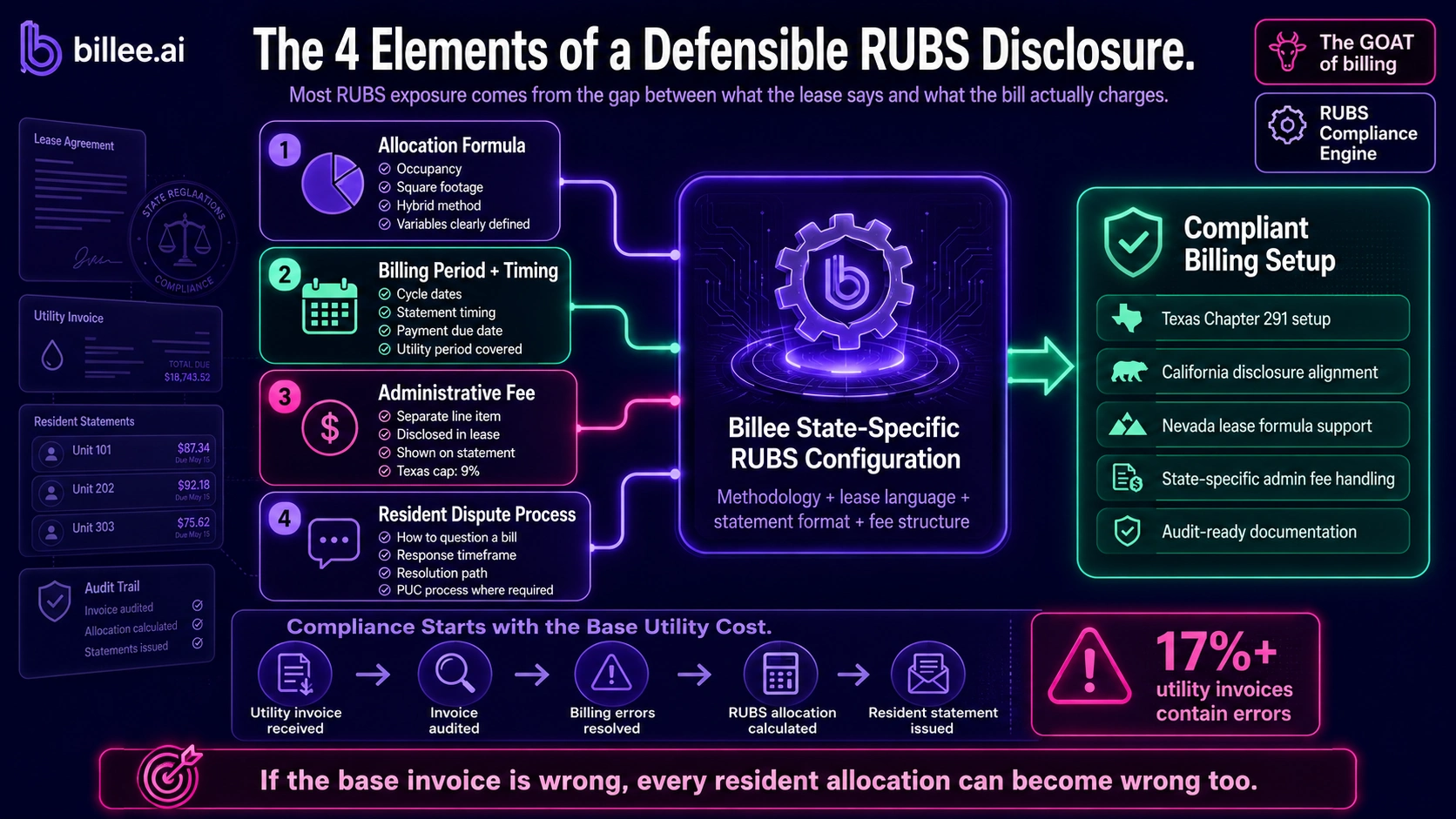
Regardless of state, four elements appear in every legally defensible RUBS lease addendum.
The allocation formula and the variables used. The addendum must state whether costs are allocated by occupant count, square footage, or a hybrid method, and must define how each variable is measured. "Occupants" should be defined (does it include children, leaseholders only, all registered occupants?). Square footage should reference the specific unit measurement on record.
The billing period and timing. The addendum must specify the billing cycle, when statements are issued, and when payment is due. Billing statements issued significantly after the utility period they cover are a common dispute trigger; a clear billing timeline in the addendum makes late issuance a breach of the addendum rather than a surprise to the resident.
The administrative fee, itemized separately. The fee must appear as a distinct line item in both the addendum and the billing statement. Burying an administrative fee inside the utility allocation is the single most common basis for RUBS legal challenges. A fee that the resident cannot see and verify as separate from the utility cost is functionally hidden, which creates consumer protection exposure in every state.
The resident's right to dispute and the process for doing so. The addendum should state how a resident can question a billing statement, the timeframe for operator response, and the resolution process. Arizona's statute specifies the dispute pathway directly: written objection to the landlord, then a civil complaint in justice court if unresolved. In states without a statutory process, defining this in the lease prevents the operator from facing an undefined dispute process when a challenge arrives.
How RUBS Billing Errors Create Compliance Risk
A billing error in a RUBS program is not just an AP problem; it is a compliance problem. If the allocation formula uses an incorrect occupant count, the resulting bill does not reflect the lease addendum's disclosed methodology. If the base utility cost contains an invoicing error that inflates the total before allocation, every resident in the building receives an overbill simultaneously.
At ENGIE Impact's documented rate of at least 17% of utility invoices containing a billing error, a RUBS property processing master-metered utility invoices as the basis for resident charges is regularly starting from an incorrect base figure. The invoice audit step that catches billing errors before payment is also the step that protects the integrity of the RUBS allocation. An error caught before the base utility cost is allocated prevents a compounding compliance problem; an error that posts to the ledger creates an overbilling condition across all residents simultaneously.
How Billee Manages State-Specific RUBS Compliance
Billee's Regulatory & Compliance product configures the RUBS allocation formula, lease disclosure language, billing statement format, and administrative fee structure to match the requirements of each state where a property operates. A Texas property gets a Chapter 184-compliant setup; a California property gets a Civil Code 1940.9-compliant disclosure and a cost separation that keeps common area charges out of the resident allocation.
The configuration happens at enrollment, not after a dispute surfaces. Billee monitors state-level regulatory activity and updates configurations when rule changes take effect. For multi-state portfolios, this means the compliance baseline across the portfolio stays current without the operator tracking each state's legislative session independently.
Billee's utility vendor management platform and AP automation workflow also ensure that the base utility cost used in each RUBS calculation is audited before allocation: billing errors are caught before they compound across the resident base.
Implementation takes 45 days. Vendor onboarding, state-specific configuration, and PMS integration are handled by the Billee team.
Billee configures RUBS programs to each state's regulatory requirements from enrollment forward, with no retroactive compliance scramble when a dispute arrives. See how it works for your portfolio.
FAQ: State RUBS Rules for Multifamily Operators
Is RUBS legal in all 50 states?
No. Connecticut is the one state where RUBS is illegal outright for residential multiunit properties, following the state Supreme Court's 2024 ruling in Northland Investment Corporation v. Public Utilities Regulatory Authority. In the other 49 states, RUBS is legal, though the regulatory framework governing how it must be implemented varies: disclosure requirements, allowable allocation formulas, administrative fee caps, and billing statement format requirements differ significantly between states that have enacted RUBS-specific statutes (Texas, California, Nevada, Colorado, Arizona) and states where lease contract law governs.
Is RUBS banned in any state?
Yes, in Connecticut. The Connecticut Supreme Court ruled in 2024 that ratio utility billing for residential multiunit properties violates Connecticut General Statutes Section 16-262e(c), which requires landlords to absorb utility costs unless a unit is individually metered. Compliant alternatives in Connecticut are building utility costs into a fixed base rent or installing PURA-approved submeters.
What are the RUBS rules in Texas?
Texas Utilities Code Chapter 184 is the governing statute. Texas requires the rental agreement to disclose the allocation method in writing along with a statement of average monthly bills, and it caps the per-unit utility charge at no more than the rate the utility itself charges the property owner, with no markup. Texas is one of the more detailed RUBS-adjacent regulatory frameworks in the country, alongside Colorado, Arizona, and Virginia.
What does California require for RUBS billing?
California Civil Code Section 1940.9 requires disclosure of any shared utility arrangement before the lease is signed. The allocation methodology and formula must be in writing and provided to the resident prior to lease execution. The California PUC requires that common area utility costs be separated from resident-allocated costs in master-metered buildings. California has seen increasing legislative activity on utility billing since 2020; operators should treat it as a high-monitoring jurisdiction.
Can I charge an administrative fee on top of RUBS?
Yes in most states, but the fee must be disclosed separately in both the lease addendum and the billing statement. A handful of states set a hard limit: Arizona restricts the fee to the landlord's actual administrative costs, and Texas caps the underlying utility charge itself at no markup over the provider's rate. Where no statutory cap exists, an undisclosed fee or a fee bundled into the utility allocation without itemization still creates consumer protection exposure and, in many states, a basis for lease enforceability challenges. The fee must appear as a distinct line item every time.
What goes in a RUBS lease addendum?
Every defensible RUBS addendum includes four elements: the allocation formula and its variables (occupant count, square footage, or hybrid, with each term defined); the billing period and payment timing; the administrative fee stated as a separate line with its calculation method; and the resident's right to dispute a billing statement and the process for doing so. In Texas, the statute specifies additional required language; in all other states, these four elements are the minimum for enforceability.
Sources
Pullman & Comley, "Connecticut Landlords Beware: RUB Billing Is Illegal in Multiunit Properties," accessed August 2026.
Colorado General Assembly, "HB 26-1013 Ratio Utility Billing Systems," signed March 26, 2026.
Texas Legislature, "Utilities Code, Chapter 184: Electric and Water Metering," accessed August 2026.
California Legislative Information, "Civil Code Section 1940.9," accessed July 2026.
Nevada Legislature, "Nevada Revised Statutes, Chapter 118A: Landlord and Tenant," accessed August 2026.
Arizona Legislature, "Arizona Revised Statutes Section 33-1314.01," accessed August 2026.
Georgia General Assembly, "Georgia Code Section 12-5-180.1," accessed August 2026.
National Multifamily Housing Council, "Utility Management Resource Center," accessed July 2026.
Zego, "The Top 3 Utility Accounts Payable Mistakes Multifamily Companies Make," 2025. (Cites ENGIE Impact audit finding: at least 17% of utility invoices contain a billing error.)
Insights and Industry Trends