

What Is Billee's Regulatory & Compliance Support?
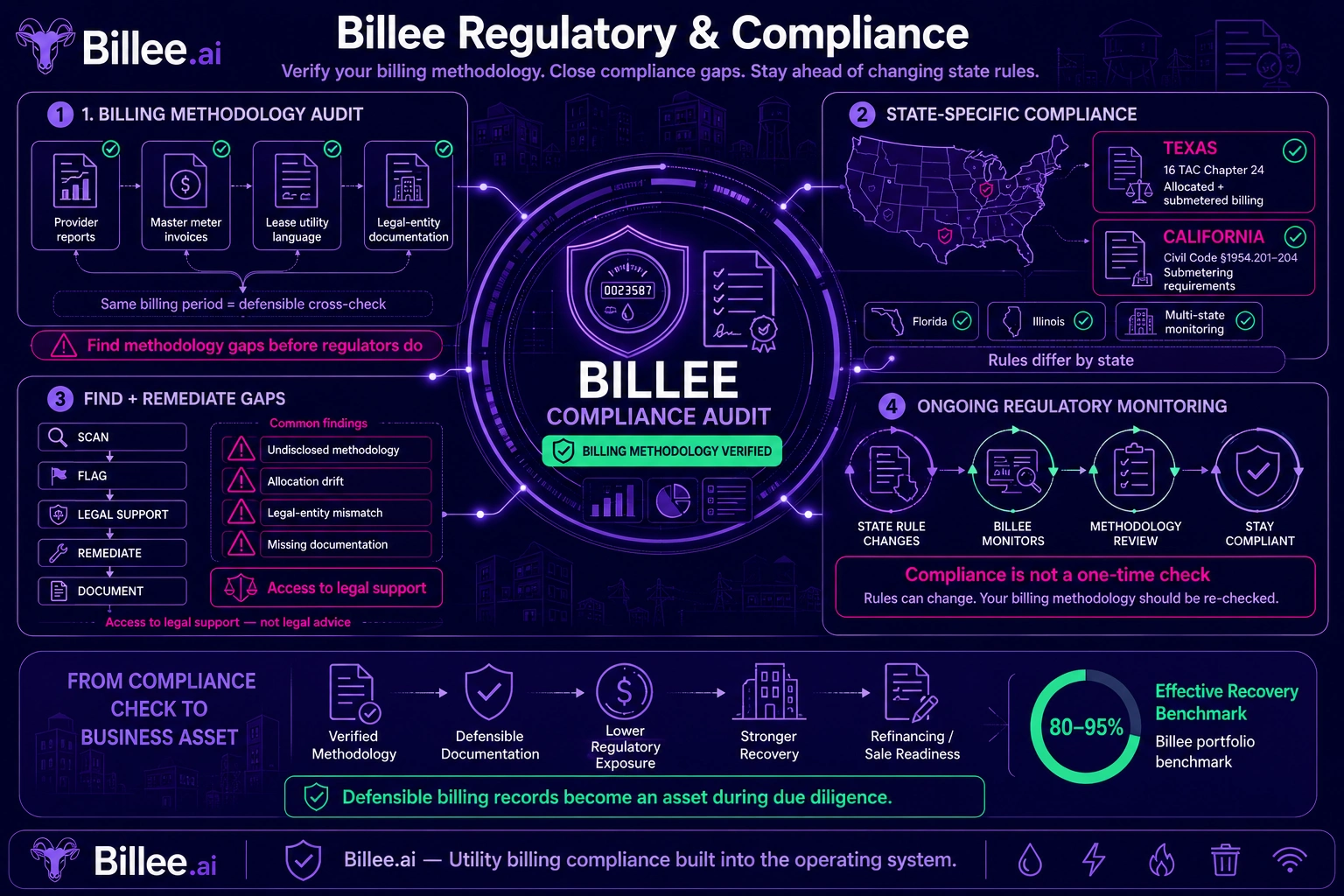
Billee's Regulatory & Compliance support pairs a billing methodology audit with access to legal support, so multifamily operators can maximize utility cost recovery without stepping outside what state law allows. Billee audits how each property in a portfolio allocates and bills utility costs, flags anything undisclosed, undocumented, or non-compliant, and gives operators access to legal support to fix it. Ongoing monitoring tracks state and PUC rule changes so a compliant methodology today doesn't quietly become non-compliant later.
Key takeaways
- Billee's Regulatory & Compliance support combines a billing methodology audit with access to legal support. It is access to legal support, not legal advice.
- The audit reviews provider reports, master meter invoices, lease language, and legal-entity documentation, all from the same billing period.
- Texas (16 TAC Chapter 24) and California (Civil Code §1954.201–1954.204) have the most prescriptive state frameworks governing allocated and submetered billing.
- Regulatory monitoring continues after the initial audit, since state rules change often enough that a compliant methodology can drift out of compliance within a year.
- Defensible billing documentation becomes an asset at refinancing or sale, not just a compliance requirement.
The problem this solves
State Public Utility Commissions regulate how multifamily operators allocate and bill utility costs back to residents, and the rules are not the same from state to state. Texas has the most prescriptive framework, 16 TAC Chapter 24, administered by the Public Utility Commission of Texas. California governs submetering specifically under Civil Code §1954.201–1954.204.
Operators billing across multiple states carry real exposure when a methodology is wrong, undisclosed, or undocumented. PUC inquiries, resident complaints, and regulatory fines all trace back to the same root cause: a billing methodology nobody has recently checked. For the full state-by-state legislative picture, see Utility Management Compliance for Multifamily Properties.
Billee's Regulatory & Compliance support exists to close the gap between what a portfolio is actually billing and what state law allows.
How Billee's regulatory & compliance support works
Billee audits each property's current billing methodology against state rules, not just once at onboarding but as an ongoing part of the service.
The audit reviews four categories of documentation: current billing provider reports, master meter invoices, lease agreements with utility billing language, and the property's legal entity documentation. All four need to cover the same billing period for the audit to cross-reference cleanly. For the complete document checklist and how to assemble it, see How to Prepare a Billing Methodology Audit.
The audit surfaces methodology gaps, allocation drift, and legal-entity mismatches between master invoices and property ownership. A mismatch between the legal name on a master invoice and the property's actual ownership entity is a common, easy-to-miss compliance exposure.
Once gaps are flagged, Billee provides access to a legal support team to help remediate them. This is access to legal support, not legal advice. Billee is not a law firm, and operators with complex legal questions should still involve their own counsel.
Regulatory monitoring continues after the initial audit. State rules change often enough that a compliant methodology today can drift out of compliance within a year, so Billee tracks changes on an ongoing basis rather than treating compliance as a one-time check.
What's included
| Included | What it means |
|---|---|
| Billing methodology audit | Reviews provider reports, master meter invoices, lease language, and legal-entity documentation against the same billing period to find gaps |
| Access to legal support | A legal support team helps interpret and remediate flagged issues (access to legal support, not legal advice) |
| Ongoing regulatory monitoring | Tracks state and PUC rule changes so a compliant methodology doesn't quietly drift out of compliance |
| Recovery guidance within legal limits | Confidence to push recovery rates toward the legal maximum instead of conservatively under-billing |
Outcomes you can expect
A completed audit produces defensible billing methodology documentation, the kind of record lenders and buyers request during refinancing or disposition due diligence. See Preparing Utility Cost Data for Refinancing or Disposition for what that diligence package typically requires.
Beyond the transaction case, a documented methodology reduces exposure to regulatory fines and resident complaints, since both usually stem from an allocation approach nobody can clearly explain. Audits also typically reveal a gap between current recovery and Billee's 80–95% effective recovery benchmark (Billee's standard portfolio benchmark), which operators can close once the methodology itself is fixed.
How this fits with your existing team and systems
Regulatory & Compliance is a service, not a software integration. It does not require an API connection or a data feed the way meter monitoring or invoice automation do. Instead, it plugs into whatever legal and property management structure an operator already has.
The audit works alongside in-house or outside counsel rather than replacing them. Billee's legal support team focuses on the utility-billing-specific compliance question and hands off anything outside that scope. The same billing methodology the audit verifies is also the input Billee's Meter Monitoring and billing recovery systems rely on, so getting it right compounds across every other Billee service running on a portfolio.
Who this is for
Operators billing in multiple states, especially Texas, California, Florida, and Illinois, face the most exposure from state-to-state rule differences. Affordable and LIHTC operators with HUD utility allowance constraints face a related but distinct set of rules, covered in Utility Billing Compliance for Affordable Housing.
Operators preparing for a sale, where defensible billing methodology matters in diligence, are also a strong fit. So is anyone who has already received a resident complaint or PUC inquiry about billing and wants to know exactly where the exposure sits.
FAQ
Does Billee provide legal advice? Billee does not provide legal advice. Billee provides access to a legal support team that helps interpret and remediate compliance gaps, but operators with complex legal questions should still involve their own counsel.
What does a Billee regulatory compliance audit actually check? The audit reviews current billing provider reports, master meter invoices, lease agreements, and the property's legal entity documentation, all from the same billing period. It looks for methodology gaps, allocation drift, and legal-entity mismatches between master invoices and ownership.
Which states does Billee's compliance support cover? Billee supports operators in any state, with particular depth in the states with the most prescriptive rules: Texas (16 TAC Chapter 24), California (Civil Code §1954.201–1954.204), Florida, and Illinois.
How often is a portfolio re-audited or monitored for regulatory changes? Monitoring is ongoing rather than a one-time check. Portfolios are also re-audited whenever a state rule changes, a refinancing or sale is underway, or a resident complaint or PUC inquiry raises a new question.
What happens if the audit finds a compliance gap? Billee surfaces the specific gap, such as an undisclosed methodology or a legal-entity mismatch, and provides access to legal support to help remediate it. The property's billing is then documented against the corrected methodology going forward.
Is Regulatory & Compliance available on its own, or only as part of full-service billing? Regulatory & Compliance is one of Billee's core service components and is typically delivered alongside full-service billing management, where the audit plugs directly into the same account team already reviewing a portfolio. Operators should confirm current packaging with the Billee team.
How does this help at refinancing or sale? The audit produces documented, defensible billing methodology records, which is exactly what lenders and buyers request during due diligence. That documentation can prevent the negotiating leverage or reserve requirements that gaps in utility records otherwise create.
Billee audits billing methodology against state PUC rules and gives operators access to legal support to close the gaps. Talk to the team.
Sources
- Texas Public Utility Commission, "Registration of Submetered or Allocated Utility Service," accessed August 2026.
- California Legislative Information, "Civil Code Section 1954.201," accessed August 2026.
Insights and Industry Trends


Explore more insights