

Billee + Entrata: How the Integration Works
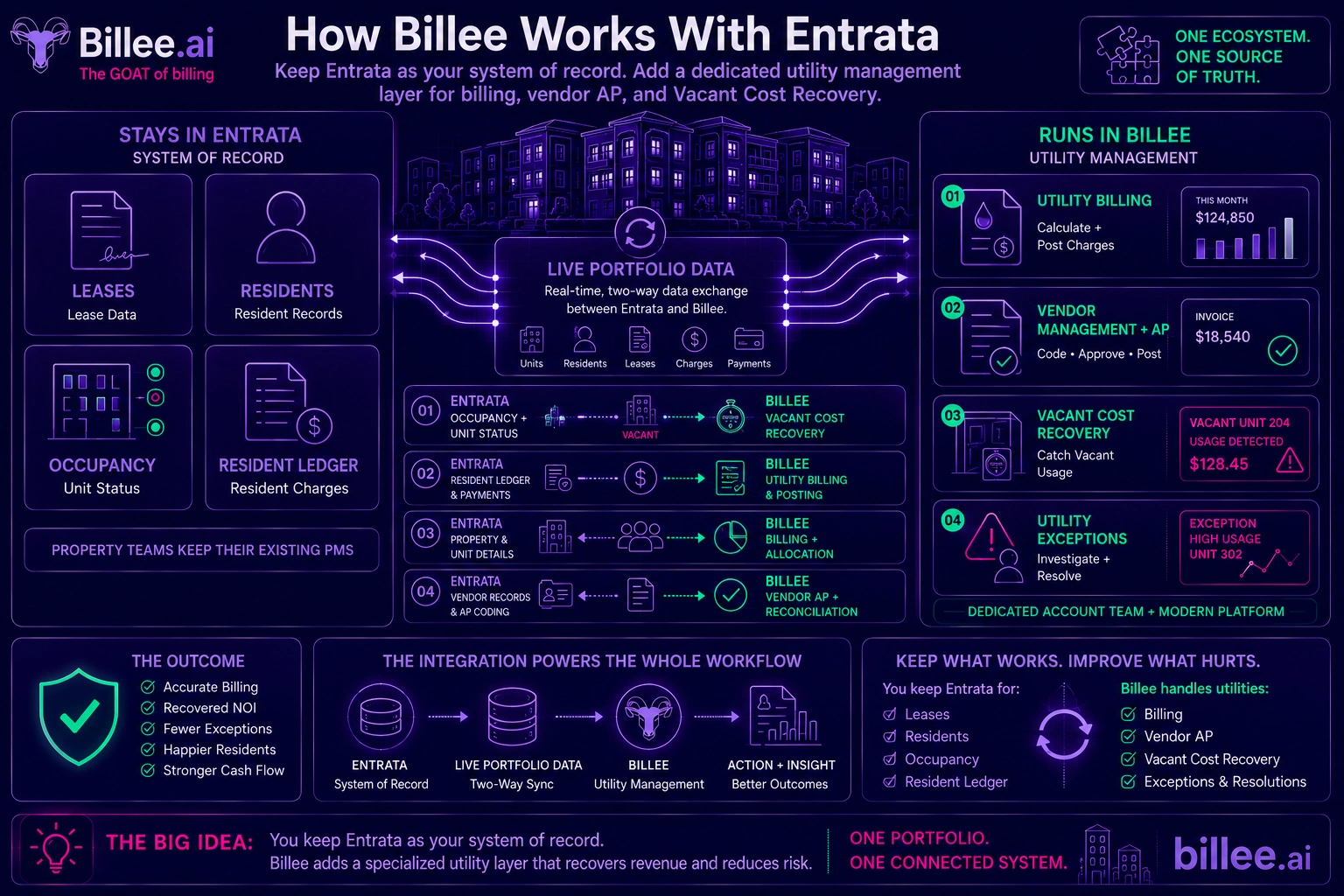
Billee integrates with Entrata so utility billing and vendor management run on live portfolio data without adding a second system for property teams to manage. Entrata stays the system of record for leases, residents, and occupancy. Billee layers on top to handle utility billing, vendor invoices, and Vacant Cost Recovery, with implementation typically live in 45 days.
Key takeaways
- Entrata stays the system of record for leases, residents, and the resident ledger. Billee runs utility billing, vendor management, and Vacant Cost Recovery on top of it.
- Billee's Utility Vendor Management + AP Integrations product includes native AP integration with Entrata, so coded invoices post back without manual re-entry.
- Billee's Vacant Cost Recovery engine pulls occupancy data directly from Entrata to catch vacant-unit utility usage before it turns into a surprise invoice.
- Implementation typically takes 45 days from kickoff to live billing, Billee's standard timeline, including Entrata-side configuration.
- Residents keep seeing utility charges through the same Entrata resident ledger they already use.
What the integration includes
- Vendor AP integration. Utility vendor invoices route into Billee, get coded and approved, and post back to Entrata through Billee's Utility Vendor Management product, which includes native AP integration with Entrata.
- Occupancy and vacancy monitoring. Entrata's occupancy and unit-status data feeds Billee's Vacant Cost Recovery engine on an ongoing basis, so a vacant unit is monitored against actual meter usage instead of surfacing weeks later on an invoice.
- Resident utility billing. Utility charges calculated by Billee flow back into the resident ledger in Entrata, so residents see one set of charges from the property they already know.
- Historical data migration. Prior billing and vendor history migrates into Billee during implementation, so the team is not starting from a blank slate on day one.
How it works
- Entrata remains the system of record for leases, resident data, and occupancy status throughout the relationship.
- Billee reads occupancy and unit-status data from Entrata on an ongoing basis, so Vacant Cost Recovery always has current information about which units are vacant.
- Utility vendor invoices route into Billee, where they are coded, approved, and posted back to Entrata through the AP integration.
- Utility charges calculated by Billee post back into the resident ledger in Entrata, so billing shows up in the system the team and residents already use.
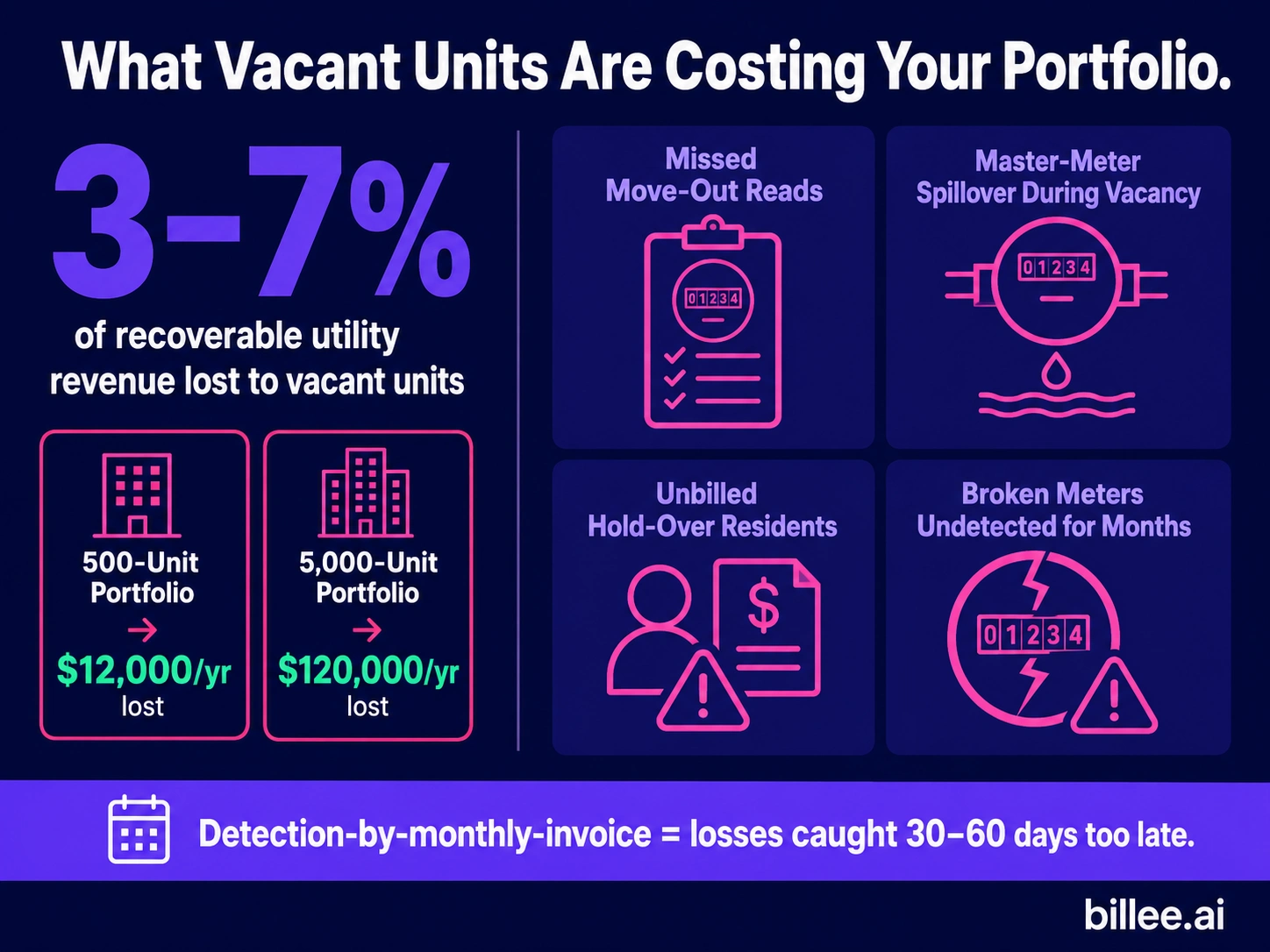
Occupancy data from Entrata is what makes Vacant Cost Recovery effective on that portfolio. A vacant unit that keeps drawing water or electricity is easy to miss until an invoice arrives weeks later. Billee estimates vacant units typically drain 3 to 7 percent of recoverable utility revenue from a multifamily portfolio, and closing that gap depends on catching the usage the same week it happens.
When occupancy status and meter activity stop matching, Billee's engine generates an exception and routes it to a named account team member, not just a dashboard alert. For more on how this kind of leakage adds up across a portfolio, see Top Multifamily Utility Management Mistakes to Avoid.
Setup and timeline
Implementation typically takes 45 days from kickoff to live billing, Billee's standard timeline across PMS platforms. For an Entrata portfolio, that includes Entrata-side configuration, a vendor transition where Billee takes over utility vendor relationships directly, historical data migration, an audit of current RUBS formulas and allocation logic, and training for property and regional teams.
Most of that work sits with the Billee team, not the operator's. A named Billee project manager runs the timeline. The operator's side is limited to providing Entrata access and historical data, approving resident communication templates, and one weekly check-in call while implementation is underway.
What stays in Entrata vs. what moves to Billee
| Stays in Entrata | Moves to Billee |
|---|---|
| Leasing, resident ledger, and system of record | Utility vendor relationships, invoicing, and AP coding |
| Occupancy and unit-status tracking | Vacant-unit utility monitoring (Vacant Cost Recovery) |
| Resident communications and portal | Utility billing calculation and resident utility charges |
| Property-level accounting outside of utilities | Utility vendor escalations, disputes, and transitions |
Where Entrata's own utility tools fit in
Billee does not duplicate Entrata's own utility-adjacent tools. The two products operate at different layers, which matters since Entrata sells tools of its own in this space.
Entrata's Utility Expense Management processes vendor utility invoices into Entrata's AP system and enters consumption data into ENERGY STAR Portfolio Manager. Entrata positions it as a supplementary service that reduces back-office data entry, not a full utility billing replacement. Entrata's ResidentUtility consolidates rent, utilities, and fees into a single resident statement and handles payment collection.
Neither calculates RUBS allocations, runs a dedicated Vacant Cost Recovery program, or hands vendor escalations to a named account team the way Billee does. Operators who use Entrata's native tools alongside Billee typically keep Entrata's tools for AP data entry support and resident payment consolidation, and rely on Billee for utility allocation, recovery, and the vendor relationship itself.
Common questions from Entrata users
Operators moving utility billing onto Billee while staying on Entrata tend to ask a few questions before they sign. Common ones: does the switch change how residents log into their portal (no), can a portfolio transition property by property rather than all at once (yes), and does Billee need ongoing IT involvement from the operator's team once the integration is live (no, the Billee account team manages the connection).
A named Billee project manager scopes property-by-property sequencing as part of the 45-day plan, so a multi-property portfolio does not need to go live everywhere on the same date.
How to get started
Getting started begins with a conversation about the current Entrata setup and utility vendor relationships. From there, Billee's implementation team scopes the PMS configuration, vendor transition, and historical data migration, and sets a go-live date, typically 45 days out. Billee's full-service model is built for portfolios of roughly 500 units and up; operators with smaller portfolios often find the dedicated-team model more than they need.
FAQ
Does Billee integrate with Entrata?
Billee integrates with Entrata for vendor AP, resident utility billing, and occupancy-based Vacant Cost Recovery. Implementation typically completes within 45 days, including Entrata-side configuration.
Does switching to Billee mean switching away from Entrata?
Switching to Billee does not mean leaving Entrata. Entrata stays the property management system and the system of record for leases and the resident ledger, and Billee runs utility billing and vendor management on top of it.
How long does implementation take for an Entrata portfolio?
Most Billee implementations go live in 45 days from kickoff, Billee's standard timeline, including Entrata configuration, vendor transition, and historical data migration.
What happens to our existing utility vendor contracts when we switch to Billee?
Billee's implementation team takes over vendor relationships directly from the prior provider or in-house team, so operators are not managing that handoff themselves.
Do residents notice the switch to Billee?
Most residents experience little disruption. Resident-facing communication is templated and handled by the Billee team, and utility charges continue to appear through the resident ledger in Entrata.
Does Billee replace Entrata's own utility management tools, or work alongside them?
Billee works alongside Entrata's native tools rather than replacing them. Entrata's Utility Expense Management handles vendor invoice data entry and ResidentUtility consolidates resident bill payments. Billee runs utility allocation, Vacant Cost Recovery, and the vendor relationship itself, backed by a dedicated account team.
Who handles a utility vendor escalation after we switch to Billee?
A dedicated Billee account team handles vendor escalations, disputes, and credential management directly, so on-site and regional teams are not chasing vendors.
What portfolio size does Billee work best for?
Billee's full-service model fits portfolios of roughly 500 units and up. Smaller portfolios, generally under 300 units, often find the dedicated-team model more than they need.
Billee integrates with Entrata for utility billing, vendor management, and Vacant Cost Recovery, and the implementation team handles the Entrata-side configuration during the 45-day rollout. See the integration in action.
Sources
- Entrata, "Utility Expense Management," accessed 2026.
- Entrata, "ResidentUtility," accessed 2026.
Insights and Industry Trends


Explore more insights