
Utility Billing Due Diligence Checklist for Multifamily Acquisitions
Buying a multifamily property means inheriting whatever utility billing methodology, vendor relationships, and metering infrastructure the seller leaves behind, usually undocumented. A general due diligence checklist treats utility billing as a single line item. It deserves its own review, because it directly affects post-close NOI, legal exposure, and how quickly a new owner can start recovering costs. This checklist covers what to request, what to review, and what to do in the first billing cycle after closing.
Key Takeaways
- General due diligence checklists give utility billing one line item, not a dedicated review, according to DoorLoop's multifamily due diligence guide.
- Even trailing-twelve-month (T12) underwriting reviews, the standard tool for financial due diligence, typically give utility income and expense no dedicated scrutiny, according to MSA Data Insights.
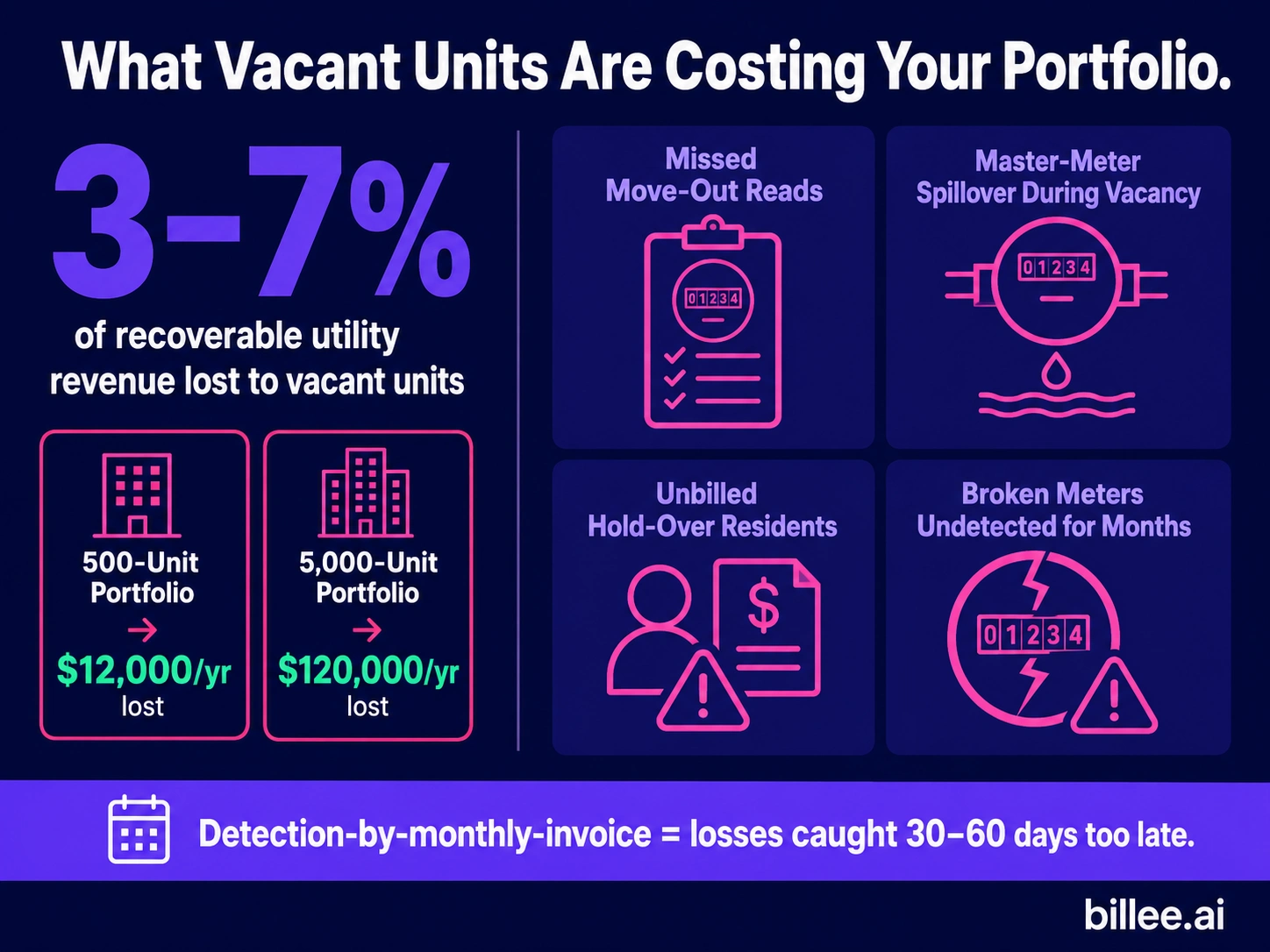
- A vacant multifamily unit can leak an estimated 3-7% of recoverable utility revenue if nobody is monitoring it, per Billee's own portfolio benchmarking. That exposure transfers to the buyer on day one.
- Utility charges are commonly treated as arrears items at closing, with the buyer covering usage the seller has not yet been billed for, under federal Closing Disclosure practice, according to LegalClarity.
- An inherited RUBS or submetering methodology that was compliant under the seller's ownership is not automatically compliant, or even fully documented, for the buyer.
Why Utility Billing Due Diligence Matters for Acquisitions
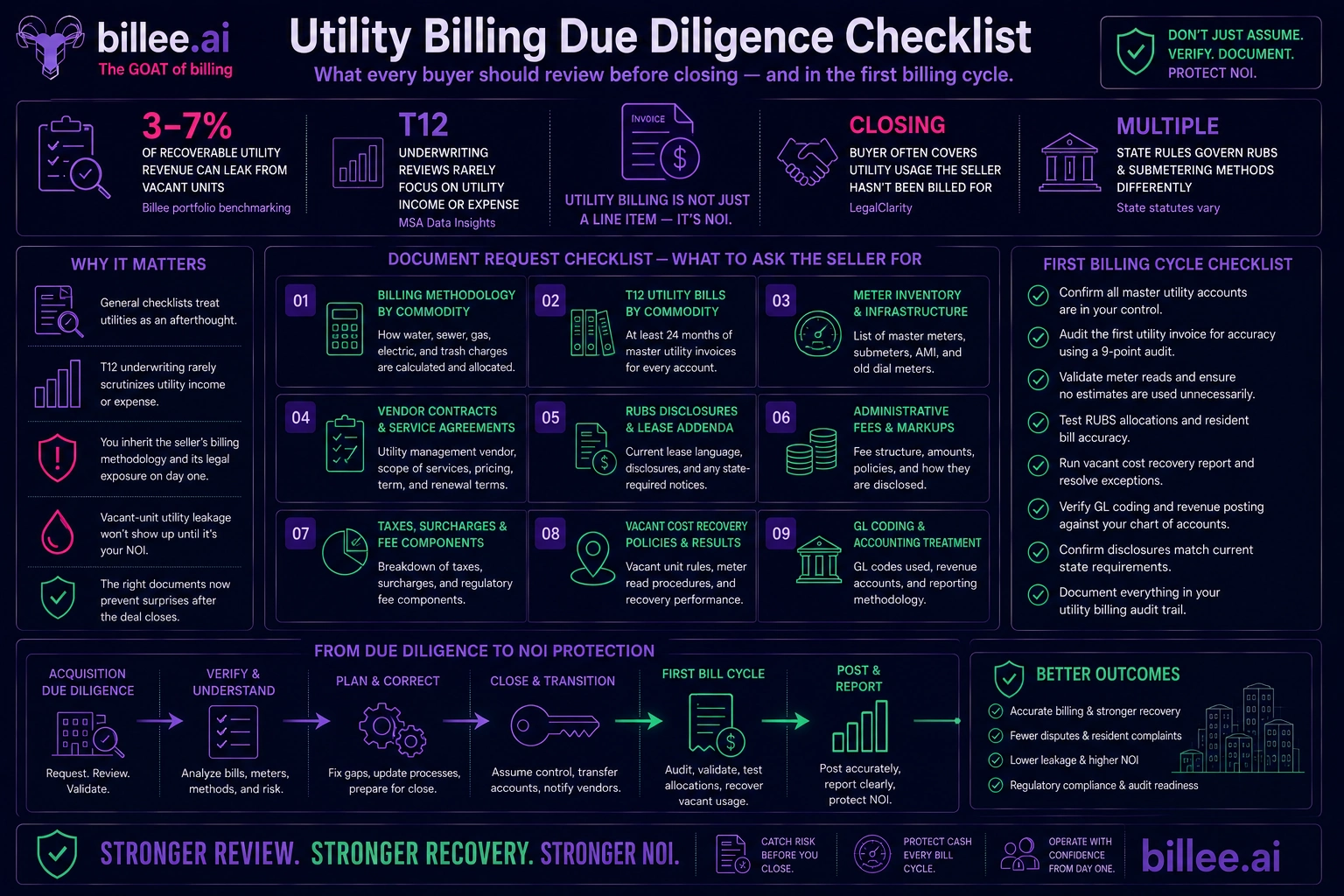
General due diligence checklists treat utilities as an afterthought
Most multifamily due diligence templates organize the review into a handful of broad categories: financial, physical, legal, and tenant. Utility billing typically appears as a single bullet inside the financial category, described as "utility bill analysis," and the guidance usually stops at pulling 12 to 24 months of bills to check for spikes or leaks, according to DoorLoop's due diligence checklist. That is a reasonable start, but it doesn't address the methodology itself: how charges are calculated, whether the calculation is documented, or whether it complies with state law.
Even T12 underwriting reviews skip utility line items
The trailing-twelve-month (T12) statement is the primary financial due diligence tool buyers use to underwrite a deal. A T12 explainer from MSA Data Insights walks through the expense categories institutional buyers scrutinize most closely: repairs and maintenance, payroll, insurance, and property taxes. Utility income or expense isn't among them. The same resource makes a point worth borrowing for utilities specifically: "The annual total is what the seller wants you to read. The monthly view is what tells you what's actually happening."
You inherit the seller's billing methodology and its legal exposure on day one
Utility billing methodology, particularly Ratio Utility Billing Systems (RUBS) and submetering, is regulated at the state level. Texas governs submetering and allocation billing under Public Utility Commission Chapter 24. California sets consumer protections for utility billing under Civil Code Sections 1954.201 through 1954.204, and other states, including Florida and Illinois, have their own frameworks. A buyer who closes without confirming that the seller's methodology is still compliant inherits any exposure it created, often without realizing it until a resident complaint or an audit surfaces the issue.
Vacant-unit utility exposure doesn't surface until it's your NOI
Vacant units are typically billed to the ownership entity rather than a resident, which means nobody is watching those charges closely unless someone is specifically monitoring vacant-unit cost recovery. Based on Billee's own portfolio benchmarking, vacant units can quietly account for an estimated 3-7% of a property's recoverable utility revenue. That's exposure the seller's numbers may not reflect accurately, and that the buyer starts absorbing the moment the deal closes.
The Acquisition Utility Billing Due Diligence Checklist
Document request phase: what to ask the seller for before you bid
Requesting the right documents early gives a buyer's team time to actually review them before the deal timeline compresses. At minimum, request:
- Billing methodology breakdown by commodity. A document showing exactly how water, sewer, gas, electric, and trash charges are calculated and allocated to residents, whether by RUBS formula, submeter reads, or a flat fee.
- Resident allocation charges reports. Most billing providers generate a named report showing exactly what each resident was billed and why. Ask for it by name if you know the vendor: Yardi Utility Expense System (YES) produces an "Allocation Charges Report," and Conservice produces a "Summary of Utilities Billed-QC Report" alongside "Synergy Bill Details with DNA Links."
- Twelve to twenty-four months of master meter invoices. This is the standard window per general due diligence guidance. If the seller cannot produce a full 24 months, request at minimum the most recent three months so the current billing pattern can be verified against what is reflected in the T12.
- Lease agreements and utility addendums. Confirm what the lease actually discloses to residents about how utilities are billed, since a mismatch between the lease language and the actual billing practice is itself a compliance flag.
- The property's W9 and legal entity name. Compare this against the name on the master utility account and billing provider invoices. A mismatch between the legal entity that owns the property and the entity the utility account is registered to is an underrated red flag, often signaling an unrecorded prior transfer or a billing relationship that was never properly updated.
- Submeter health reports and rent roll, where available. These are optional but useful for cross-checking occupancy against what the billing data shows.
Financial review phase: pressure-testing the utility lines in the T12
Once the documents are in hand, reconcile the monthly detail against the T12 summary rather than accepting the annual total at face value. Look for months where recovered utility revenue drops without a corresponding drop in occupancy, since that pattern often points to vacant-unit leakage, a billing gap during a provider transition, or uncollected resident balances written off rather than pursued. A material, recurring gap between what the property paid its utility providers and what it recovered from residents is the clearest sign of an underperforming billing and recovery program, and worth flagging before the deal closes rather than after.
Physical and metering review phase: confirming what's actually installed
Walk the physical infrastructure, or have a third party confirm it, rather than relying on the seller's description alone. Confirm whether the property is master-metered, individually metered, or submetered, and if submetered, whether the technology is AMI (automated, remotely read) or AMR/manual read, since that affects both billing accuracy and the cost of any future upgrade. Also confirm whether the submetering equipment itself is owned by the property, leased from a vendor, or tied to a service contract that doesn't automatically transfer with the sale. That question belongs in the purchase and sale agreement, raised with legal counsel before closing rather than discovered after.
Regulatory and legal review phase: confirming the inherited methodology still holds up
Confirm the property's billing methodology against the utility billing regulations of the state it sits in, since a method that was compliant when the seller implemented it isn't automatically compliant today, particularly in states that have updated submetering or RUBS rules in recent years. This is also where the legal entity name and W9 comparison from the document request phase gets resolved: any mismatch should be explained and documented before closing, not left for the buyer's team to chase down afterward. Reviewing methodology for compliance is a documentation and process check, not a substitute for advice from qualified legal counsel in that state.
Closing mechanics: prorations, deposits, and final meter reads
Utility charges are typically handled as arrears items at closing, meaning the buyer commonly ends up paying for usage the seller hasn't yet been billed for, a practice specifically flagged as a buyer adjustment item under federal Closing Disclosure rules, according to LegalClarity. Unpaid water and sewer charges deserve particular attention, since in many jurisdictions they can attach as a lien against the property rather than following the prior owner personally. LegalClarity's guide to transferring utilities at closing recommends scheduling a final meter reading for closing day, with time-stamped photos as backup if the provider issues an estimated bill instead. Deposits on file with utility providers are typically refunded to the seller rather than transferred to the buyer, so plan to open new accounts rather than assume continuity.
Post-close transition phase: auditing and re-baselining within the first billing cycle
Closing is the start of the review, not the end of it. In the first billing cycle after close, reconcile actual resident billing against what the pre-close documentation described, confirm the master utility accounts have been transferred into the new ownership entity's name, and re-establish vacant-unit monitoring immediately rather than waiting for the next full audit cycle. Resolve any gap between what due diligence found and what that first cycle actually produces quickly, while the seller's team is still easy to reach.
Common Due Diligence Mistakes
- Treating utility bill review as a spreadsheet exercise. Pulling 12 months of invoices and eyeballing them for spikes catches obvious problems but misses methodology and compliance issues entirely.
- Accepting the seller's annual utility recovery total without checking monthly detail. An annual number can mask months of vacant-unit leakage or uncollected balances.
- Skipping the legal entity name check. A mismatched W9 or account name is easy to overlook and can point to an unresolved billing relationship from a prior transfer.
- Assuming the current billing methodology is compliant because it's been in place for years. State regulations on RUBS and submetering change, and a legacy methodology may not have been updated.
- Not confirming who owns the submetering equipment. Without this in the purchase agreement, a buyer can be surprised by a vendor contract that doesn't automatically convey.
- Waiting until after closing to plan for new utility accounts and deposits. Deposits generally do not transfer, and gaps in service continuity are avoidable with two to four weeks of advance planning.
At a Glance: Pre-Close vs. Post-Close Utility Billing Tasks
| Pre-Close | Post-Close |
|---|---|
| Request billing methodology breakdown and allocation reports | Confirm master accounts transferred to new ownership entity |
| Pull 12-24 months of master meter invoices | Reconcile first billing cycle against pre-close documentation |
| Compare legal entity name against W9 and utility accounts | Re-establish vacant-unit cost recovery monitoring |
| Confirm state regulatory compliance of current methodology | Resolve any methodology gaps identified during diligence |
| Clarify submetering equipment ownership in the purchase agreement | Set up new utility accounts and deposits under buyer's entity |
| Schedule final meter readings and photos for closing day | Audit resident allocation charges against lease disclosures |
When to Handle This In-House vs. Bring in a Partner
A single-property acquisition with a straightforward RUBS methodology and a responsive seller can often be reviewed in-house, provided someone owns the document request checklist and the state regulatory check specifically. Portfolio acquisitions, properties with mixed metering types, or deals with a compressed closing timeline are where bringing in a billing methodology specialist tends to pay for itself, since reviewing multiple properties' allocation reports and compliance status in parallel is the kind of work that benefits from a dedicated process rather than competing for an acquisitions team's attention.
How Billee Can Help
Billee runs the same kind of billing methodology audit described in this checklist as part of its standard due diligence process, reviewing methodology breakdowns, allocation reports, master meter invoices, and lease documentation to produce a defensible picture of a property's utility billing before a transaction closes. For buyers concerned about vacant-unit exposure specifically, Billee's Vacant Cost Recovery program is built to catch the leakage this checklist flags in the "why it matters" section above. Billee's Regulatory Compliance support helps confirm a property's billing methodology against the applicable state framework, and Utility Vendor Management handles the practical work of transitioning vendor relationships and account credentials into a new ownership entity's name after closing.
FAQ
What utility documents should I request before buying a multifamily property? Request a billing methodology breakdown by commodity, resident allocation charges reports from the billing provider, 12-24 months of master meter invoices, lease agreements with utility addendums, and the property's W9 and legal entity name for comparison against the utility accounts on file.
Do utility bills get prorated at closing? Yes. Utility charges are commonly treated as arrears items, since the final bill for the period around closing usually has not been issued yet. The buyer typically covers usage from the closing date forward, and this is flagged as a standard buyer adjustment item under federal Closing Disclosure practice.
Am I responsible for the seller's unpaid utility bills? Not directly, but unpaid water and sewer charges can attach as a lien against the property in many jurisdictions, which is why confirming the accounts are current, and scheduling a final meter reading for closing day, matters during due diligence.
How do I know if the RUBS methodology I'm inheriting is still legal? Compare the current methodology against the applicable state framework, such as Texas PUC Chapter 24 or California Civil Code Sections 1954.201-1954.204, since regulations can change after a methodology was first implemented. This is a documentation and process check, not a substitute for advice from qualified legal counsel in that state.
Should I audit utility billing before or after closing? Both. Document review and methodology verification belong in pre-close due diligence, but the audit should continue into the first billing cycle after closing to confirm the transition actually produced what the pre-close documentation described.
Who typically owns submetering equipment when a property is sold? It depends on how the seller originally installed it, whether owned outright, financed, or contracted through a third-party submetering vendor. Because equipment ownership and any related service contract may not automatically convey with the property, it should be addressed directly in the purchase and sale agreement.
Does Billee help with utility billing due diligence for acquisitions? Yes. Billee's billing methodology audit process covers the same document review described in this checklist, and its Vacant Cost Recovery, Regulatory Compliance, and Utility Vendor Management programs support the exposure areas this checklist is built to catch.
Buying a property means buying its utility billing history, whether or not that history was ever documented. Talk to Billee about running a billing methodology audit before your next acquisition closes.
Sources
- DoorLoop, "Multifamily Due Diligence Checklist."
- MSA Data Insights, "What Is a T12? Trailing Twelve Months in Multifamily Underwriting."
- LegalClarity, "Real Estate Proration: What It Is and How to Calculate It."
- LegalClarity, "How to Transfer Utilities From Seller to Buyer at Closing."
Insights and Industry Trends