
When to Re-Bid Your Utility Billing Vendor (With a Scorecard)
Re-bid your utility billing vendor when a trigger fires, not when the term ends. Score the incumbent every quarter on accuracy, recovery, timeliness, responsiveness, compliance and integration health. Then renew, renegotiate or re-bid, working back from your notice deadline. Billee Technologies, Inc. tracks recovery against an 80–95% benchmark and assigns a named account team, so its performance is easy to score.
Most operators renew a utility billing vendor the way people renew a gym membership: by not deciding. The agreement rolls over, the fees creep, and nobody can say whether the vendor earned another term. Below are six triggers that justify a re-bid, a weighted scorecard to grade the incumbent, and a calendar that starts before the notice date. Nothing here is legal advice. Your contract, and your counsel, decide what notice you owe.
Key takeaways
- Make renewal a decision with a deadline. Gilbert, Arizona stopped renewing vendor contracts by default once it began scoring vendors.
- Events start a re-bid as often as dates do: an acquisition, a PMS change, a rule change, a run of weak scores or fee creep.
- Score six service criteria on a 0–5 scale and score fees on their own sheet. Define a 5 before you open the data.
- Count back from the notice deadline, not the term end. Under the example assumptions below, the review starts about seven months out.
- A re-bid is not a verdict. The incumbent can win, and a strong score earns you a better renewal conversation.
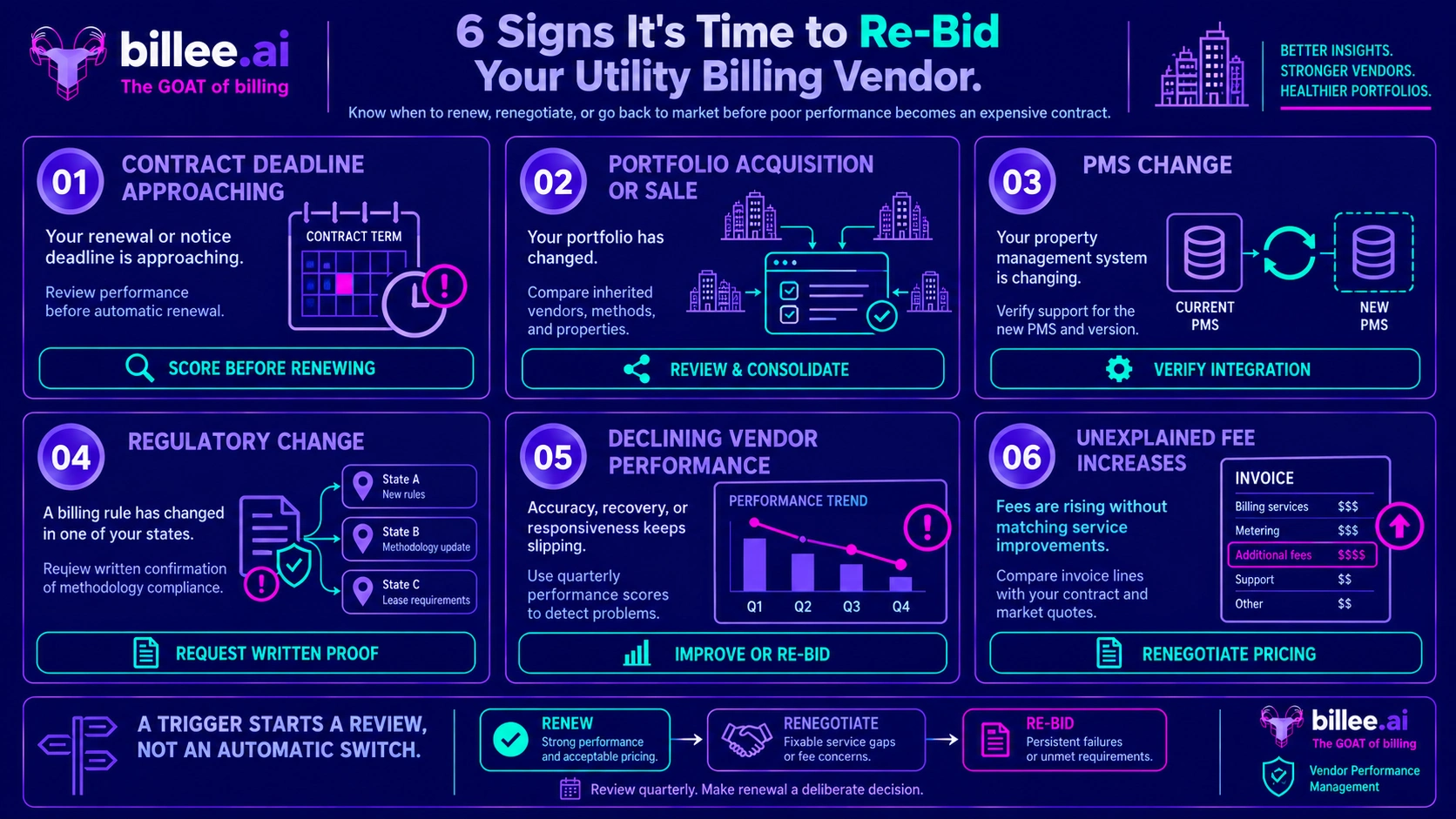
The six triggers at a glance
#TriggerWhat to checkDefault move1Term or notice date approachingThe notice window in the contractScore the vendor and decide before the notice date2Acquisition or saleWhich vendors and methods you now runCompare property by property, then consolidate or re-bid3PMS changeWhether the vendor supports the new system and versionGet support in writing; re-bid if it cannot4Rule change in a state you billWhether the method and disclosures still complyAsk for a written answer; re-bid if it is vague5Low scoresWeighted score and floor rule (below)Improvement plan, then re-bid6Fee creepInvoice lines against the contract and market quotesRenegotiate; re-bid if the vendor will not move
Why renewing by default costs more than it looks
Gilbert, Arizona is a useful mirror. The town's procurement team found that contracts were often renewed by default, without regard to a vendor's previous track record. It built a vendor evaluation system, and contracts are no longer renewed by default.
Each quarter the town evaluates 25 percent of its contracts, so every contract is reviewed at least once a year. To date it has decided not to renew three contracts based on the evaluation data, according to the 2021 case write-up from the Harvard Kennedy School Government Performance Lab.
Procurement offices treat renewal as a checkpoint. A Louisiana state procurement presentation on contract renewals has staff review the file approximately four months before a contract ends, on contracts bid for one-year terms. They look at the bid file, agency feedback on vendor performance and market price reports. They also ask the vendor for a discount: "We always want to ask for a discount, even if the market analysis shows an increase in price."
The Louisiana Legislative Auditor's contracting best practices add a needs assessment before any renewal and a contract manager "with the authority and knowledge to monitor the contract." You are not a state agency. The habit still transfers: review before the date, bring evidence and ask for something.
Work backward from the notice date
The term end is not your deadline. The notice date is. Miss it and an auto-renewal can start a new term, so count back from it. Billee's guide to utility billing contract terms explains how to set a notice period that matches how long a replacement takes.
Here is a worked example. The numbers are assumptions, not benchmarks. Swap in your own notice window, portfolio size and each bidder's implementation time.
Days before term endMilestone210Start the review: pull scorecard evidence and confirm the notice terms165Issue the RFP105Award and sign (60 days from RFP to award is an assumption)90Deliver notice to the incumbent (assumes a 90-day notice window)45Latest start for the new vendor's implementation (Billee's standard is 45 days; ask each bidder)0Old term ends on a cycle boundary and the new vendor bills
Under those assumptions you start about seven months out. For a public reference point, the Housing Authority of the County of San Bernardino (HACSB) RFP gave bidders 28 days, from release on May 21, 2025 to proposals due June 18. A longer notice window, more properties or a slower implementation all push your start date earlier.
Six triggers that justify a re-bid
A date is only one reason to look. Each of these six events should start a review.
1. The term or notice date is approaching. The default trigger, and the one most often missed. Put the notice deadline on three calendars the day you sign.
2. You bought or sold properties. An acquisition can leave you with several vendors and several methods. Billee's guide to consolidating utility billing vendors after an acquisition walks through deciding property by property. For a deal in progress, Billee's acquisition due diligence checklist covers what to inherit and what to ask the seller.
3. Your PMS changed, or will. Support differs by system and version. Get the list in writing, and treat "coming soon" as a no.
4. A rule changed where you bill. Billing rules vary by state and keep moving. Billee's state-by-state guide shows how far they spread. Ask the vendor how its method meets the new rule, in writing. A vague answer is a score.
5. The scorecard keeps coming back low. Set the trigger in advance. The decision bands below show one way to do it.
6. Fees creep. Charges appear that the contract does not list, or the rate climbs faster than the service improves. Billee's guide to fees outside the per-unit rate treats renewal as the natural moment to revisit fee terms.
The incumbent scorecard
A scorecard turns a feeling ("they have gotten slow") into a record you can act on. Build it before you open the data, or the data will shape the criteria.
Harvard's Evaluation Scorecards guide offers three rules worth borrowing. Give each criterion a weight out of 100. Write down what a strong response looks like for each criterion in advance. Score price separately from quality, which the guide says can help minimize bias. Billee's RFP template uses the same 0–5 scale, so the incumbent and any bidder are graded on one ruler.
CriterionWeightWhat a 5 looks likeEvidence to pullBilling accuracy and disputes25Few corrections after statements go out; disputes close fast and trace to a causeDispute log, correction requests per cycleRecovery performance20Recovery at or above your target and trending up; gaps explainedEffective recovery by property, month over monthCycle timeliness15Every cycle closes and posts on the calendarPrelim date, approval date, ledger post dateResponsiveness and account management15A named contact; questions answered inside the committed windowTicket or email log against the contract's service levelsCompliance and documentation15Methodology, lease alignment and the state rule shown on requestA written answer to a compliance question you askPMS integration health10Charges post correctly; sync errors are rare and fixed fastSync error log, ledger posting exceptions, manual fixes
The weights are our illustrative starting point, not an industry standard. Change them to fit your portfolio. A community with heavy turnover might weight final bills and responsiveness higher.
Scoring and decision bands
Score each criterion from 0 to 5. Multiply each score by its weight, add the results and divide by 100. The answer is a number from 0 to 5. Fees get their own sheet: compare every invoice line with the contract and with current quotes.
Weighted scoreMove4.0 or higherRenew, and use the score to negotiate3.0 to 3.9Renew only with a written improvement plan and a re-score next quarterBelow 3.0Re-bid
Add one floor rule: any criterion at 1 or below for two straight quarters triggers a re-bid, whatever the total. A vendor that shines everywhere except accuracy is still failing at the thing residents see. These bands are illustrative.
Here is an invented example. The incumbent scores 3 on accuracy, 4 on recovery, 5 on timeliness, 2 on responsiveness, 3 on compliance and 4 on integration. The math is (3×25 + 4×20 + 5×15 + 2×15 + 3×15 + 4×10) ÷ 100 = 3.45. That lands in the middle band: renew only with a plan, and responsiveness goes at the top of it.
Collect the evidence
Pull evidence from records you already hold: past-cycle statements, your dispute log, the vendor's ticket or email history and your PMS ledger. Compare each against the contract's service levels. If you cannot pull a number, the gap is itself a reporting score.
Score every quarter, and name one owner. Harvard's contract-management training says "Regular check-ins can be the most effective contract management activity!" It also cites results-driven contracting criteria that call for engaging contractors at least quarterly. Two people scoring separately, then averaging, beats one person's memory.
Renew, renegotiate or re-bid
Renew when the score is 4.0 or higher and fees match the contract. Ask for something anyway, as the Louisiana office does. A clean score is a good reason to request a fee cap or a firmer response commitment.
Renegotiate when the score sits in the middle band, or when a trigger fires but the service is sound. Put the improvement plan in writing with dates and owners. Use the contract terms guide above to ask for a renewal reminder, a cap on fee changes and better exit terms.
Re-bid when the score falls below 3.0, a floor rule trips, or a trigger such as a PMS change is something the vendor cannot meet. Invite the incumbent to bid. The incumbent knows your portfolio, and a fair process shows you the market. The RFP template covers the nine sections to send bidders.
A re-bid is a process, not an accusation. The HACSB solicitation is titled "Utility Billing Services (Rebid)," a public example of an agency going back to market. Its text does not say why. Weigh the cost of switching, which includes a transition, a cycle to hand off and a notice to residents. Put it on the page next to the cost of staying.
Re-bid without breaking a billing cycle
- Hold a signed replacement before you give notice, unless your contract says otherwise. Ask counsel.
- Set the exit date just after a cycle locks and charges post, so no cycle is split between two vendors.
- Ask for the data export early, in a named format with a delivery date.
- Tell residents once. Check your lease addendum language first; Billee's guide to RUBS lease addendum requirements is the place to start.
Billee's guide to switching utility billing providers covers the phases of a move, so this guide does not repeat them.
Five scorecard mistakes
- Scoring on gut. Define a 5 and a 1 for every criterion before you look at the evidence.
- Skipping the baseline. Without a starting point, a slow decline looks like normal.
- Grading the incumbent's actuals against bidders' promises. Actuals lose to promises every time. Ask bidders for references and proof.
- Using only the vendor's own reports. Cross-check with your PMS ledger and dispute log.
- Ignoring the cost of switching. A better vendor can still be a worse choice this year.
How Billee Technologies is built to be scored
Billee Technologies pairs a platform with a named, dedicated account team. Your administrator reviews and approves each cycle in the portal while Billee's team does the billing work. That split leaves a record, and a scorecard feeds on records.
Where each criterion shows up
CriterionWhat Billee documentsWhere you see itAccuracy and disputesA preliminary bill with Biller Highlights; administrator review and comments before anything posts; locked-bill corrections handled in 1–2 business daysPortal comments, correction requests, activity logRecovery performanceEffective recovery measured against an 80–95% benchmarkCustomer dashboardCycle timelinessPrelim, review, approval, lock within 1–2 business days, then posting on the set dateCycle status and the past-cycle viewResponsiveness and account managementA named, dedicated account team; a 1–2 business-day standard on team-handled actions; owner reporting and quarterly business reviewsComment replies, review meetingsCompliance and documentationA structured billing audit; regulatory and compliance support that includes access to legal support, not legal adviceAudit findings, written answersPMS integration healthCharges post to the PMS resident ledger; Yardi, RealPage and Entrata are listedYour ledger; Billee's Yardi Voyager and Entrata guides
Recovery: a benchmark you can test
Billee surfaces effective recovery on the customer dashboard and measures it against an 80–95% benchmark. Below 80% signals a problem: vacant units, hardware issues, or undercharging from the allocation method. The range is Billee's own framework, not an industry standard. Billee's guide to what 80–95% effective recovery means explains it in practice, so you can test any vendor against your own numbers.
Vacant units are one source of the gap. Billee's Vacant Cost Recovery watches meter activity against PMS occupancy data and routes exceptions to a named team member. Billee's guide to recovering costs from vacant units shows what to ask any vendor to do.
The audit as a baseline
If you are unsure what your incumbent really recovers, start with an audit. Billee's audit reviews four sets of documents covering the same billing period: provider reports, master invoices, leases, and the property's W-9 and legal entity name. It looks for methodology gaps, allocation drift, reconciliation problems, legal-entity mismatches and lease language gaps. It also documents the gap between current recovery and the benchmark. Billee's guide to preparing a billing methodology audit lists what to gather.
Service you can time
Team-handled actions follow a 1–2 business-day standard: biller replies to prelim comments, report regeneration after a PMS resync, final bill issue reviews, locked-bill corrections and flagged exceptions. Those are the dates and replies your responsiveness score should check against. Billee's team also provides owner reporting and quarterly business reviews.
If Billee is a bidder
Score Billee on the same sheet as everyone else. Ask for references on your PMS, a dated plan (Billee's standard implementation takes 45 days) and written answers on the terms this guide makes no claim about:
- Initial term, renewal mechanics and renewal pricing.
- Notice to terminate, any termination fee and whether you can exit a single property.
- Export format, fields, delivery date and fee at exit.
- Response commitments, in the agreement and not only in a deck.
Who Billee is not for
- Portfolios under about 300 units, where Billee's full-service model is usually more than the job needs.
- Operators who want to run billing themselves with software alone. Billee's portal exists for review and approval, not self-service operation.
- Properties on a PMS Billee does not list. Billee lists Yardi, RealPage and Entrata, so confirm support first.
FAQ
How often should I review my utility billing vendor?
Quarterly. Gilbert, Arizona reviews every contract at least once a year, and Harvard's contract-management training cites criteria that call for engaging contractors at least quarterly. A quarterly score gives you a trend before the notice date arrives.
When should I start a re-bid?
Count back from the notice deadline. In the example above, with a 90-day notice window and 60 days from RFP to award, the review starts about seven months before the term ends. Your dates will differ.
Can I re-bid in the middle of a term?
Only if the agreement lets you leave or you wait for the term to end. Check the termination-for-convenience and for-cause clauses with counsel before you start, and see the contract terms guide for what to look for.
What is a good dispute rate?
No industry standard is cited here. Set your own baseline in the first quarter, measure disputes as a share of bills sent, and watch the trend. A rising line is the signal.
Should the incumbent be allowed to bid?
Usually yes. The incumbent knows your portfolio and a fair contest shows you the market. Score its bid on the same 0–5 scale as everyone else, and add its track record from your scorecard.
Will switching disrupt billing?
Only if the handoff is sloppy. Exit just after a cycle locks, settle who bills the cycle in progress, and send residents one notice. Billee's standard implementation takes 45 days.
What if the vendor scores well but the price is high?
Renegotiate. Score fees on their own sheet, compare them with current quotes and ask for a cap. A strong quality score is a reason to keep the vendor, not to accept any price.
Billee handles utility billing, vacant cost recovery and vendor management for multifamily operators who want a dedicated team behind the software. If a re-bid is on your calendar, talk to the team about your portfolio.
Sources
- Harvard Kennedy School Government Performance Lab, "Project Feature: Evaluating Vendor Performance for Critical Resident Services in Gilbert, AZ," 2021.
- Louisiana Division of Administration, "Contract Renewals (presentation)," undated, accessed October 2026.
- Louisiana Legislative Auditor, "Best Practices: Contracting," last updated April 2019.
- Housing Authority of the County of San Bernardino, "RFP PC1432: Utility Billing Services (Rebid)," released May 21, 2025, accessed October 2026.
- Harvard Kennedy School Government Performance Lab, Procurement Excellence Network, "Evaluation Scorecards," 2023.
- Harvard Kennedy School Government Performance Lab, Procurement Excellence Network, "Actively Managing Contracts to Improve Results," training, February 1, 2023.
Insights and Industry Trends