
How to Consolidate Utility Billing Vendors After a Multifamily Acquisition
You usually don't need to switch everything at once. Inventory what you inherited, decide property by property whether to consolidate, keep or phase out each billing setup, then sequence the moves around contract end dates and billing cycles. Billee Technologies, Inc. runs a 45-day standard implementation with a named project manager, covering PMS integration, vendor transition and historical data migration.
Closing day is the easy part. Then you open the billing files. This guide is for owners, asset managers, and operations leaders who bought one or more properties and now have several billing setups to sort out. It covers how to decide, how to sequence the work, and how Billee handles an acquired portfolio.
Key takeaways
- An acquisition hands you someone else's billing: their provider, their formulas, their lease language, and their vendor accounts.
- Inventory first. You cannot decide what to keep until you know what each property runs on.
- Consolidating is not automatic. A contract with time left, a PMS your target provider doesn't support, or a small total portfolio can each justify keeping a vendor for now.
- Protect the vendor accounts in the first 30 days. Billee's invoice guide calls the 60–90 days after closing the highest-risk window for utility invoices.
- Billee Technologies fits portfolios of roughly 500 units and up on Yardi, RealPage, or Entrata. It is not built for small ones.
Consolidate, keep or phase out? A quick guide
One vendor usually makes consistency easier: one method, one monthly cycle, one set of reports. But the right answer is property by property. Use this table as a starting point, not a rule.
If the inherited setup...Lean towardWhyHas no written methodology, or you can't reproduce its numbersConsolidate firstA billing method you can't document is hard to defend in a resident dispute, an audit, or a refinance.Sits well below your recovery targetConsolidate earlyBillee's own benchmark treats an effective recovery rate below 80% as a signal to check vacant units, hardware, or the allocation method. That benchmark is Billee's, not an industry standard.Has a contract with time leftPhaseConfirm the termination terms in writing, then move the property when the term ends or when waiting costs more than leaving.Runs on a PMS your target provider doesn't supportKeep for nowGet supported systems in writing. Billee integrates with Yardi, RealPage, and Entrata.Leaves you with a small total portfolio (under about 300 units)Lighter software may fitBy Billee's guidance, a dedicated team is usually more than the job needs at that size.Sits in a state with specific rules, or has unusual lease languageAudit, then decideRules differ by state, so check the method against the lease and local rules before you change it.
Step 1: Inventory what you inherited
Start with one sheet. For each property, capture:
- Who bills today: an outside provider, the seller's in-house team, or a PMS add-on.
- The PMS and version: this decides which providers can take the property.
- The methodology: the calculation method for each utility, plus the resident allocation charges report.
- The leases: the standard lease language and every version in use.
- The master utility accounts: whose name is on each, who holds the logins, and where invoices are going.
- The contract: term, termination notice, fees, and who owns the data and any submeter hardware.
- The state: rules differ, so note which apply.
Billee's audit checklist asks for four documents: the current provider's methodology breakdown and resident allocation charges report, the master meter invoices that match them (the most recent three months if you are unsure which apply), the lease agreements, and the property's W-9 and legal entity name. All of them need to cover the same billing period. Billee uses the W-9 to compare master invoice account names with the property's legal name, which it calls a common source of misallocation and compliance exposure.
For the pre-close side of this work, see Billee's acquisition due diligence checklist.
Step 2: Decide property by property
When keeping a vendor is the right call
Consolidation has a cost: a migration, resident notices, and a new monthly cycle for your team. If an inherited setup is documented, compliant, and under contract, nothing says it has to move on day one.
Run it, track it against your other properties, and move it when the contract ends or the numbers say it is time. Just don't leave a second vendor in place by default. Ask each one for its methodology in writing and compare how each bills the same utility.
The mixed-PMS problem
Acquisitions often bring a different PMS. Billee integrates with Yardi (Voyager 7S or higher, and Breeze), RealPage, and Entrata. It does not list AppFolio, ResMan, Buildium, Rent Manager, or Vantaca.
A property on one of those systems needs a different answer: keep its current vendor, choose a provider that supports both systems, or plan a PMS move.
Providers differ here. UtilityPro's site names nine PMS integrations, and Vitality names Entrata, Yardi, ResMan, and Rent Manager integrations. Get the list in writing, by system and version. For a side-by-side of how the main providers describe themselves, see Billee's guide to utility billing companies for large portfolios.
Check the contract before you commit
Before you terminate anything, confirm four things in writing:
- The notice period and any exit fees.
- Who owns the historical data, and how you can export it.
- Who owns any submeter hardware. Billee's acquisition guide warns that a vendor contract may not convey with the property unless the purchase agreement says so.
- Which provider bills the cycle in progress. Billee's switching guide says to settle this in writing so the outgoing provider's final bill never overlaps the incoming provider's first.
For a longer list, see Billee's questions to ask a utility billing company.
Step 3: Sequence the moves
Move in waves, not all at once. Billee's switching guide recommends a staggered, property-by-property approach, because billing gaps happen when two providers run at the same time. The sequence below is a suggestion, not a Billee benchmark. Adjust it to your contract end dates.
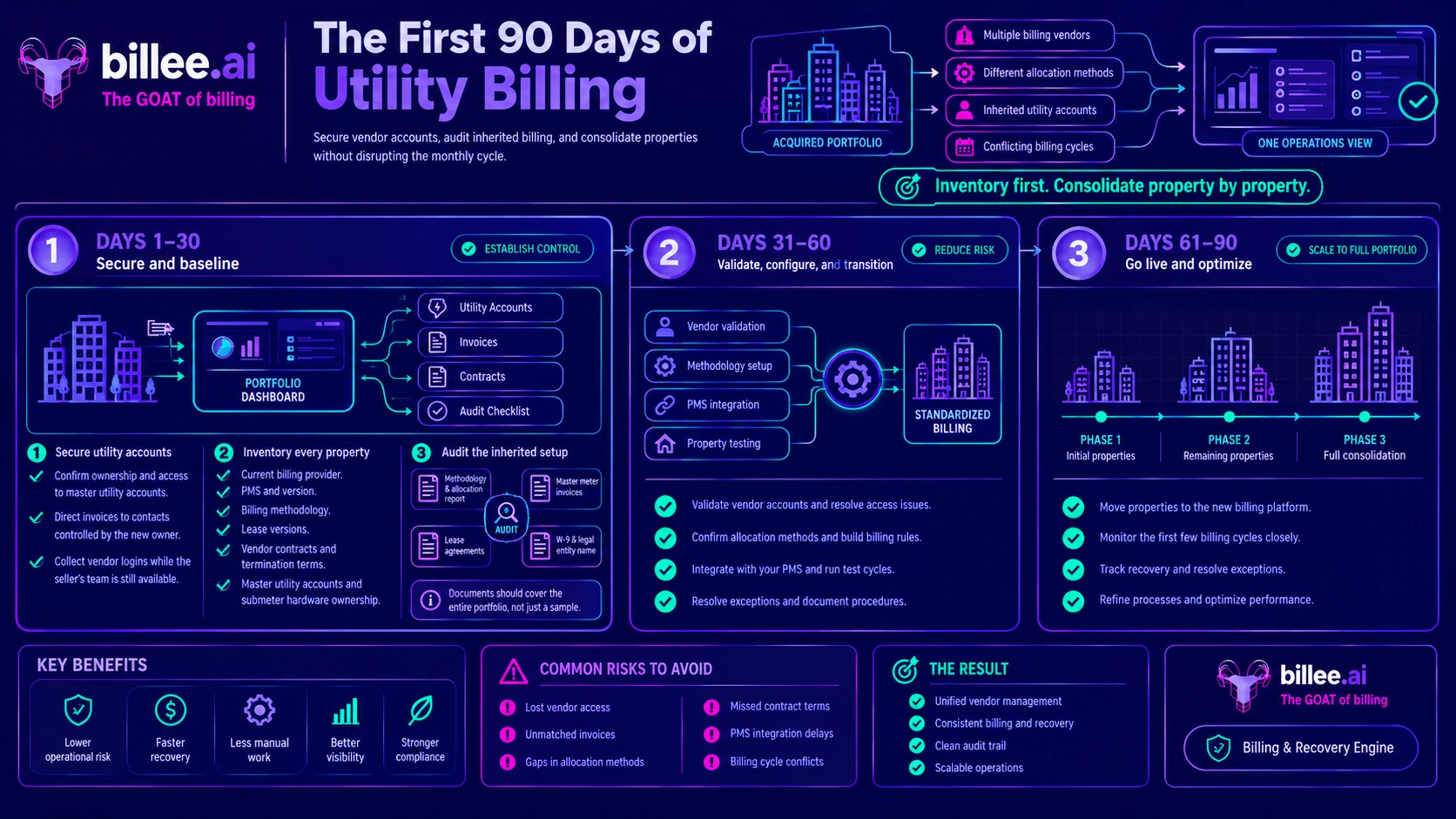
Days 1–30: secure and baseline.
- Confirm every master utility account is under the new owner's control and that invoices go to a contact you control.
- Collect vendor logins from the seller's team while they are still easy to reach.
- Pull the inventory documents and run the audit.
- Restart vacant-unit monitoring right away.
Billee's invoice guide says the 60–90 days after closing are the highest-risk window for invoice management: accounts go unpaid, late fees build up, and service can be disrupted before the incoming team has access. A 2016 Zego article on acquisition tech to-dos makes a similar point. It notes that utility transfer can be complicated when ownership changes and advises giving vendors as much advance warning as possible before new systems go live.
Days 31–60: run a pilot. Pick one property on a supported PMS with a clear methodology and move it first. Run one full cycle, including the handoff of the cycle in progress, and fix what you learn before you scale.
Days 61–90: move the rest, in groups. Move properties as contracts end and the pilot proves out. Properties that stay put get a review date.
Provider timelines differ. Billee's standard implementation takes 45 days and is led by a named project manager. Ask any provider how its timeline applies when you are moving several properties.
Step 4: Harmonize the methodology without a resident backlash
Different formulas at different properties are hard to defend in a resident dispute, an audit, or a refinance. One documented standard is the goal. Getting there is a lease question as much as a billing question.
Check three things before you change a method:
- What each lease says. Look at how utilities are allocated in every version in use.
- What your state requires. Rules vary, and Billee's state-by-state guide shows how much. In Colorado, for example, Otten Johnson's summary of HB25-1090 says landlords that split utilities by RUBS can comply by clearly disclosing how they calculate charges to prospective and existing tenants.
- When the change can take effect. Billee's guide on adding or raising a utility fee recommends applying changes at lease renewal, because a lease is a contract and fees generally need consent or an existing clause to change mid-term. Test the same logic for a method change, and have your own counsel confirm it for your state.
How Billee handles an acquired portfolio
Billee Technologies pairs a platform with a named, dedicated team. Your people review and approve. Billee's team does the billing work, including the transition.
It starts with an audit
Billee's audit reviews the documents above. It looks for methodology gaps by utility, allocation drift (RUBS formulas that have not kept pace with unit-mix changes), master meter and unit-level reconciliation problems, legal-entity mismatches between master invoices and ownership, and lease language gaps that limit what you can recover. Billee's switching guide puts that audit before any data migration begins.
A 45-day implementation with a named project manager
Billee's standard implementation takes 45 days. It covers PMS integration, vendor transition, historical data migration, the methodology audit, training, and the first billing cycle.
During implementation your team approves resident communication templates, provides PMS access and historical data, and joins one weekly check-in call, per Billee. Billee describes most transitions as invisible to residents beyond a one-time notice of who their billing provider is.
Vendor accounts and invoices
Billee's utility vendor management takes over vendor relationships. Invoices flow into the platform and are coded and approved through AP integrations with Yardi, RealPage, and Entrata. The team handles vendor escalations, disputes, transitions, and credential management.
In the portal, a Monthly Overview tab lists the statements due each month, and a Vendor Breakdown tab shows every vendor and account enrolled.
Newly acquired Yardi properties
For a property added to your Yardi instance, Billee describes four steps: the property structure syncs from Yardi to Billee, current residents are imported, utility services are mapped to the right AR codes, and the first billing cycle is scheduled.
One cycle, one standard
Every property then runs the same monthly cycle. Billee assembles utility data, runs the allocation, and generates a preliminary bill for each property. Your billing administrator reviews it in the portal alongside Biller Highlights, the team's notes on exceptions. Questions go in comments, and the biller replies within 1–2 business days, per Billee's standard.
When you approve, charges post to the PMS resident ledger on the set date and e-bills go to residents. A property picker lets multi-property administrators move between properties, and an activity log records every billing action by the property team or Billee.
Vacant units and documentation
Billee's Vacant Cost Recovery watches meter activity against PMS occupancy data. When a unit marked vacant keeps drawing usage past a set threshold, the exception goes to a named team member who investigates and recovers the charge.
Billee's audit also supports refinancing and disposition due diligence, and the activity log gives you a record of who did what and when.
Who you work with
Every Billee customer has a named, dedicated account team plus specialists. Team-handled actions follow a 1–2 business-day standard. Billee quotes pricing on request.
Who Billee is not for
Billee is not the right fit for:
- Portfolios under about 300 units, where a dedicated team is usually more than the job needs, per Billee's guidance.
- Properties on a PMS other than Yardi, RealPage, or Entrata. Billee does not list AppFolio, ResMan, Buildium, Rent Manager, or Vantaca, so confirm with the team before you shortlist it.
- Teams that want rent payments bundled with utility billing. Billee does not sell rent payments.
- Teams that want to run billing themselves with software alone.
Six questions to ask any provider about an acquired portfolio
- Which PMS systems and versions do you support? Get the list in writing, and ask what happens to a property on a system you don't support.
- What does implementation cover, and how does your timeline apply to several properties? Ask for it in writing.
- Who takes over the utility vendor accounts and logins? Ask who handles the cycle in progress at handoff.
- How do you review an inherited methodology before you replace it? Ask what you receive in writing.
- What happens to my historical data, and can I export it? Ask this before you sign, not at exit.
- Who is my named contact, and what response time will you commit to? Get both in writing.
FAQ
Should I consolidate utility billing vendors right after closing?
Not necessarily in the first week. Use the first 30 days to secure the vendor accounts, collect logins, and audit what each property runs. Consolidating can then follow property by property, as contracts end and the first moves prove out.
Is it okay to run more than one utility billing vendor?
Yes, for a while. The cost is several methodologies, report formats, and monthly cycles to manage. Ask each vendor for its methodology in writing, compare how each bills the same utility, and set a review date for every property that stays put.
How long does it take to consolidate billing across acquired properties?
It depends on your contract end dates and how many properties you move. Billee's standard implementation takes 45 days with a named project manager. Other providers differ, so ask each for a written timeline for your portfolio.
What if an acquired property is on a different PMS?
Check the provider's supported systems first. Billee integrates with Yardi (Voyager 7S or higher, and Breeze), RealPage, and Entrata, and does not list AppFolio, ResMan, Buildium, Rent Manager, or Vantaca. For a property on another system, keep its current vendor, find a provider that supports both systems, or plan a PMS move.
Do residents need to be told when the billing provider changes?
Yes. Billee's switching guide says to notify residents, and warns against doing it too early or not at all. Billee describes most transitions as invisible to residents beyond a one-time notice of who their billing provider is.
What should I audit first in an acquired portfolio?
Start with the methodology breakdown and the resident allocation charges report for each property. Then add the matching master meter invoices, the leases, and the W-9 and legal entity name. Billee's checklist requires all of them to cover the same billing period.
Can I change the allocation method on acquired properties right away?
Check the lease and your state's rules first. Rules differ by state, and a lease is a contract. Billee's guidance on fees is to apply changes at renewal, and you should have your own counsel confirm the approach for your state.
How does Billee handle utility vendor accounts after an acquisition?
Billee takes over the vendor relationships. Invoices flow into the platform and are coded and approved through AP integrations with Yardi, RealPage, and Entrata. The team handles vendor escalations, disputes, transitions, and credential management.
If you've just closed on a portfolio and need one billing standard across it, Billee is worth a conversation. Talk to the team about your portfolio.
Sources
- UtilityPro, "Utility Billing for Multifamily and Commercial Properties (home page)," accessed October 2026.
- Vitality, "Utility Billing Software," accessed October 2026.
- Zego, "Top 5 Tech To-Dos During a Multifamily Property Acquisition," published June 21, 2016, accessed October 2026.
- Otten Johnson Robinson Neff + Ragonetti PC, "HB25-1090: Colorado's Residential Landlords Must Eliminate Junk Fees in 2026, Including CAM Charges," published September 24, 2025, accessed October 2026.
Insights and Industry Trends