

What 80–95% Effective Recovery Actually Means in Practice
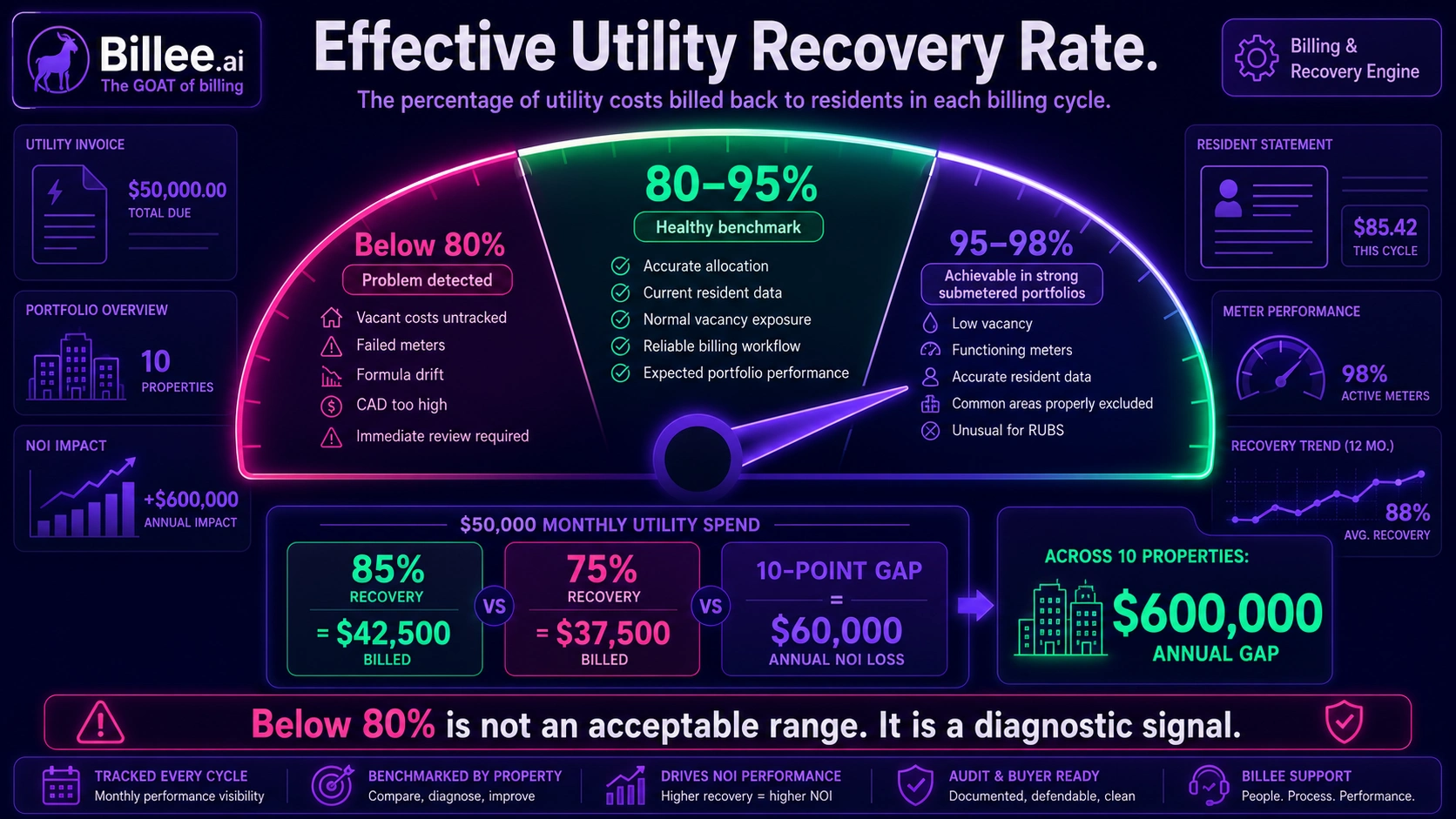
Effective recovery rate is the percentage of total utility costs a property bills back to residents in a given cycle. An 80–95% recovery rate is the benchmark for healthy multifamily utility billing: it reflects accurate allocation, current resident data, and no significant gaps from vacant units or billing errors. Below 80% is a signal that something is wrong, not a normal operating range. Above 95% is achievable in well-run submetered portfolios with low vacancy. Understanding what this number actually measures, and what moves it in either direction, is the starting point for managing utility recovery as a business metric rather than a billing afterthought.
At a glance:
- 80–95% effective recovery = healthy portfolio performance
- Below 80% = indicates a specific, diagnosable problem (not a benchmark to accept)
- Above 95% = achievable with submetering and low vacancy; should not be assumed for RUBS portfolios
- The four causes of below-80% recovery: vacant units absorbing unbilled costs, hardware or meter failures, allocation formula drift, and CAD deduction increases
- Recovery rate is a lagging indicator; the right system surfaces it before the billing cycle closes, not after
What Effective Recovery Rate Actually Measures
Effective recovery rate divides what was billed to residents by what was actually paid to utility vendors for the same period. If a property paid $40,000 to utility vendors in a given month and billed residents $34,000, the recovery rate is 85%. The remaining $15,000 represents costs the operator absorbed directly.
That gap is not always avoidable. Some portion of utility costs genuinely belongs to the operator: common area electricity, hallway lighting, irrigation, office space, and leasing areas are owner expenses by design. The question is whether the unrecovered costs are intentional (owner-paid utilities as part of the rent structure) or unintentional (residents who should have been billed but weren't, vacant units that went untracked, formulas that drifted out of alignment with actual costs).
Effective recovery measures recoverable revenue, not total utility spend. A property can have a 90% recovery rate and still be leaving money on the table if its recovery rate was 93% the previous year. The number matters most as a trend, not just a snapshot.
The 80–95% Benchmark Explained
The 80–95% range reflects what is consistently achievable in a well-run multifamily utility billing program, accounting for intentional owner-paid costs and normal operational variability. Portfolios in this range typically have current allocation formulas, accurate resident data synchronized with their PMS, and a process for flagging vacant unit costs each cycle.
Falling below 80% is not a rounding difference. A portfolio with 1,000 units paying $50 per unit in monthly utility costs has a $50,000 monthly utility bill. At 85% recovery, residents pay $42,500. At 75% recovery, residents pay $37,500. The 10-percentage-point gap is $5,000 per month, or $60,000 per year, flowing from the property's NOI directly into absorbed utility expense. Across a 10-property portfolio, that gap is $600,000 annually.
The 80% floor is a diagnostic threshold, not an acceptable steady state. When a portfolio drops below 80%, the right response is a methodology review, not a shrug.
The Four Causes of Below-80% Recovery
Vacant Unit Cost Absorption
The most common driver of low recovery is vacant units. When a unit sits empty between a move-out and a move-in, it still consumes utilities: HVAC running, water flowing for maintenance, electricity on for inspections. Those costs are real and appear on the master meter bill, but there is no resident to bill.
In RUBS portfolios, vacant unit costs are absorbed into the formula and dilute the per-occupied-unit allocation, which reduces billed amounts across the entire property. In submetered portfolios, vacant unit consumption is unbilled unless the operator has a specific Vacant Cost Recovery process. Either way, high vacancy with no cost-recovery mechanism is the fastest route to a below-80% recovery rate.
Hardware and Meter Failures
In submetered properties, a failed submeter means the unit is consuming utility services that are never measured or billed. A single failed meter on a high-usage unit can drop a property's recovery rate by several percentage points in a single billing cycle. Multiple failed meters, especially if they go undetected for several cycles, compound the gap.
Meter failures are not always visible to the billing system. A meter that stops transmitting reads does not generate an error; it generates silence. The billing system receives no data and cannot bill what it cannot measure. Proactive meter monitoring is what catches this before the billing cycle closes.
Allocation Formula Drift
RUBS formulas are configured at implementation based on the property's unit mix, occupancy patterns, and utility cost structure at that time. As unit mix changes, as occupancy fluctuates, and as utility rates shift, formulas that were accurate in year one become less accurate over time. Formula drift is gradual and cumulative, which makes it easy to miss on a month-by-month basis and easy to see only in hindsight when recovery rates have been slowly declining for six months.
Formulas that were never configured for the current unit mix, or that were copied from a similar property without adjustment, can cause systematic undercharging that looks like a billing system quirk but is actually a configuration error.
CAD Deduction Increases
A common area deduction (CAD) subtracts the estimated or metered common area utility consumption from the total before allocating costs to residents. If the CAD is too large, relative to actual common area consumption, the pool of costs available for allocation to residents shrinks, and recovery rate falls.
CAD increases happen when a property adds common area amenities, when a building maintenance issue drives up common area consumption, or when the CAD was estimated conservatively at implementation and was never revisited. A CAD that accounts for 30% of total utility costs at a property with modest common areas is leaving recoverable revenue on the table.
What a Recovery Rate Above 95% Means
Recovery rates above 95% are achievable but require specific conditions: submetering (which removes common area consumption from the resident billing pool more cleanly than RUBS), low vacancy, accurate meter reads, and current resident data. Submetered portfolios with under 5% vacancy and functioning meters can reach 95–98% recovery.
A RUBS portfolio above 95% is unusual and warrants scrutiny. RUBS by design absorbs some costs into the common area structure. A very high recovery rate on a RUBS portfolio may indicate that common area deductions are too small, which creates compliance risk in regulated states and may exceed what residents can reasonably be billed relative to actual common area costs.
Recovery rate is not a number to maximize without context. The goal is accurate recovery: billing what is legitimately recoverable, documented correctly, and compliant with the property's billing methodology.
How to Monitor Recovery Rate Effectively
A recovery rate reviewed quarterly is historical data. A recovery rate reviewed at the billing cycle prelim stage is still actionable. The difference is whether the billing team surfaces the number with enough time to investigate gaps before charges are posted to resident ledgers.
The practical workflow: the billing system generates a preliminary report before the cycle closes. The recovery rate by property is visible at that stage. Properties below the benchmark get a flag that prompts a specific investigation before the charges are locked and posted. If a property drops from 88% to 74% between cycles, the cause is identifiable and correctable at the prelim stage rather than discovered after the billing cycle is complete and charges have already been posted.
This is the operational difference between recovery rate as a reporting metric and recovery rate as a management tool.
How Billee Tracks and Maintains Recovery Rate
Billee's Billing & Recovery Engine surfaces recovery rate by property on the customer dashboard, updated each billing cycle. The 80–95% range is the benchmark Billee holds its own portfolio management to; below 80% at any property triggers a methodology review by the account team, not just a note in the report.
The monthly billing cycle includes a preliminary report with Biller Highlights: exception notes from the Billee team flagging anything that could affect recovery before the cycle closes. This includes vacant unit flags, meter read anomalies, and formula-level issues the team identified during invoice processing. Customers review the prelim, approve or request changes, and the charges post to resident ledgers only after the cycle is approved and locked.
Billee's Vacant Cost Recovery service runs alongside the standard billing cycle, tracking vacant unit costs and flagging recoverable amounts each cycle. PMS integration with Yardi Voyager, RealPage, and Entrata keeps resident and unit data current daily, so move-outs and move-ins are reflected in the billing run without manual updates.
Implementation takes 45 days, including the billing audit, PMS integration setup, and formula configuration for each property in the portfolio.
Frequently Asked Questions
What is a good effective recovery rate for multifamily utility billing? The healthy benchmark for multifamily utility billing is 80–95% effective recovery per billing cycle. Below 80% indicates a specific, diagnosable problem: vacant unit cost absorption, meter failures, allocation formula drift, or CAD deduction issues. Above 95% is achievable in well-run submetered portfolios with low vacancy.
What does effective recovery rate measure? Effective recovery rate measures the percentage of total utility costs billed to vendors that are recovered through resident billing in a given cycle. A property that paid $50,000 to utility vendors and billed residents $43,000 has an 86% recovery rate. The remaining $7,000 represents costs absorbed by the operator, either intentionally (owner-paid utilities) or unintentionally (billing gaps from vacant units, meter failures, or formula errors).
Why does utility recovery rate drop below 80%? The four most common causes are: vacant units with no cost-recovery mechanism, failed submeters that stop transmitting reads, allocation formulas that have drifted out of alignment with the current unit mix and utility rate structure, and common area deductions that are set too high relative to actual common area consumption.
What is a CAD deduction in utility billing? A common area deduction (CAD) is the amount subtracted from total utility costs before those costs are allocated to residents. It represents utility consumption attributable to common areas: hallways, lobbies, amenity spaces, and property office. If the CAD is larger than actual common area consumption, the recoverable pool shrinks and recovery rate falls.
How often should I review my utility recovery rate? Recovery rate should be reviewed at each billing cycle, not quarterly. The most actionable moment to identify and address a recovery gap is during the preliminary billing report, before charges are locked and posted. Quarterly reviews surface historical gaps; cycle-level reviews allow corrections before the billing run closes.
Can a recovery rate be too high? In RUBS portfolios, very high recovery rates (above 95%) can indicate that common area deductions are too small relative to actual common area consumption. This can create compliance risk in states with specific billing disclosure requirements and may mean residents are being allocated more than their proportionate share. In submetered portfolios, 95–98% recovery is achievable and appropriate if common area consumption is accurately excluded from the billing pool.
What should trigger a billing methodology review? A drop below 80% effective recovery in any billing cycle should trigger an immediate review. Additional triggers include a sustained decline of more than 5 percentage points over three consecutive cycles, a significant change in vacancy rate, the addition of new common area amenities, or a utility rate increase that changes the relationship between allocated charges and actual costs.
Billee's Billing & Recovery Engine tracks recovery rate at the property level every billing cycle, with below-80% flags prompting a team-led methodology review rather than a wait-and-see approach. See how the recovery engine works for your portfolio.
Sources
- Billee Technologies, Billing & Recovery Engine customer training decks (recovery rate benchmark: 80–95%, below 80% triggers review), January 2026.
- National Multifamily Housing Council, "Utility Expense Management in Multifamily Housing," accessed July 2026.
Insights and Industry Trends


Explore more insights