
Utility Billing RFP Template for Multifamily: Sections, Sample Language and Scoring
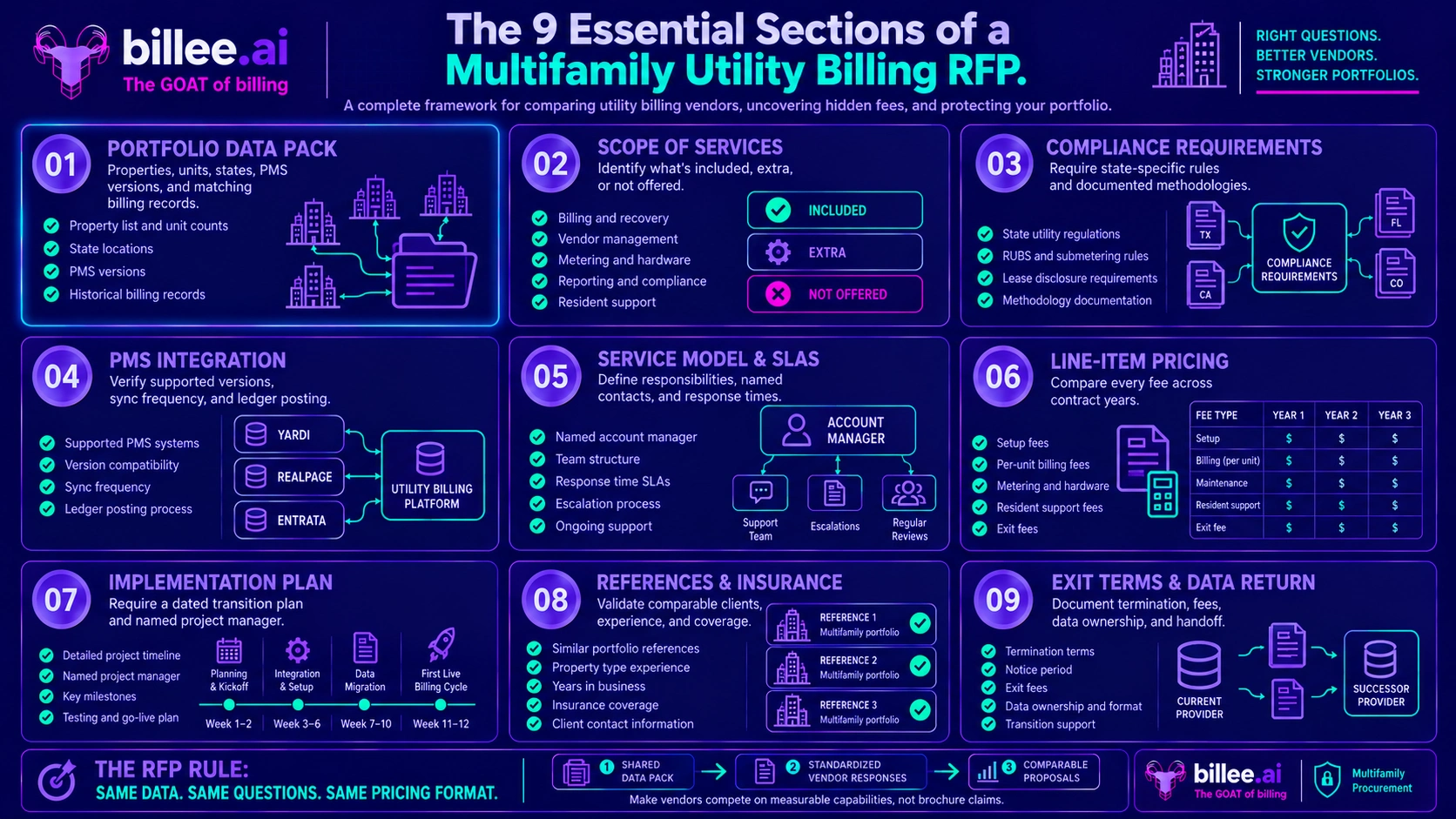
A utility billing RFP for multifamily should cover nine things: portfolio data, scope, compliance, PMS integration, service levels, line-item pricing, transition, references and exit terms. Send every bidder the same data pack, make them price every fee line, and score proposals before demos. Billee Technologies, Inc. runs a 45-day standard implementation with a named project manager.
A weak RFP asks for a per-unit rate and a brochure. Every bid comes back in a different shape, and the comparison turns into guesswork. This template gives owners, asset managers and operations leaders the sections, copy-ready language, a pricing sheet and a scoring plan to prevent that. It is a starting point, not legal advice. Have your own counsel review the final document.
Key takeaways
- Make every bidder answer the same questions in the same format, so proposals are comparable.
- Send one data pack to every bidder, all covering the same billing period. Billee's audit checklist sets the same rule.
- Price every fee line. The Housing Authority of the County of San Bernardino (HACSB) asked bidders in its 2025 RFP to price seven fee lines across five contract years.
- Set the scoring plan first: score independently, keep price separate from quality, and hold demos until after scoring.
- Put exit terms and data return in the RFP, not just the contract.
The nine sections at a glance
#SectionWhat to ask forThe trap it closes1Portfolio profile and data packProperties, units, states, PMS, four documentsBidders pricing different portfolios2Scope of servicesEach service marked included, extra or not offeredServices missing from the base fee3ComplianceThe rule your method follows in each stateCompliance risk handed back to you4PMS integration and dataVersions, sync cadence, failure handling, data ownershipAn "integration" that is really a manual export5Service model and SLAsWho runs the cycle, who answers residents, response timesSoftware you end up operating yourself6Pricing sheetEvery fee on its own line, by contract yearA low rate that hides other fees7Implementation and transitionDated plan, named project manager, your workloadSurprise effort and billing gaps8References and insuranceComparable clients, insurance, backgroundClaims nobody can verify9Exit termsTerm, notice, exit fees, data return, hardwareLock-in you discover on the way out
Settle six things before you write
- Software-only or full-service? The two are priced and scored differently. See Billee's guide to outsourcing vs. in-house utility billing.
- RUBS, submetering or a hybrid? Name the method for each property. See RUBS vs. submetering.
- Which properties and states? Rules differ by state, as Billee's state-by-state guide shows.
- Which PMS and version? Make support for yours a pass/fail item.
- Who holds the vendor accounts? Decide who owns the master utility accounts and pays the invoices. See managing utility invoices across a large portfolio.
- Who scores? A workable panel is three to five evaluators (operations, finance and your PMS administrator) plus one decision owner.
The template: nine sections with sample language
Each section has an "ask for" line and sample language to paste into your RFP. Brackets mark what you fill in.
1. Portfolio profile and bidder data pack
Ask for: nothing yet. This section is what you give bidders. List each property with its units, state, PMS and version, current provider and allocation method for each utility.
Then attach the data pack. Billee's audit checklist asks for four document categories, all covering the same billing period:
- Current provider reports: the methodology breakdown by utility and the resident allocation charges report.
- Master meter invoices matching those reports (the most recent three months if you are unsure which apply).
- Leases: every version with utility billing language.
- The property's W-9 and legal entity name. Billee checks them against master invoice account names; mismatches are a common source of misallocation and compliance exposure, per Billee.
For the full workflow, see Billee's guide to preparing a billing methodology audit.
Sample language:
Appendix A lists [number] properties totaling [number] units in [states], each on [PMS and version]. For each property, bidders receive the methodology breakdown, resident allocation charges report, master utility invoices, lease forms, and W-9 and legal entity name for the same billing period. Proposals must be based on these documents.
2. Scope of services
Ask for: every service marked included, available for an extra fee, or not offered, plus any the bidder subcontracts.
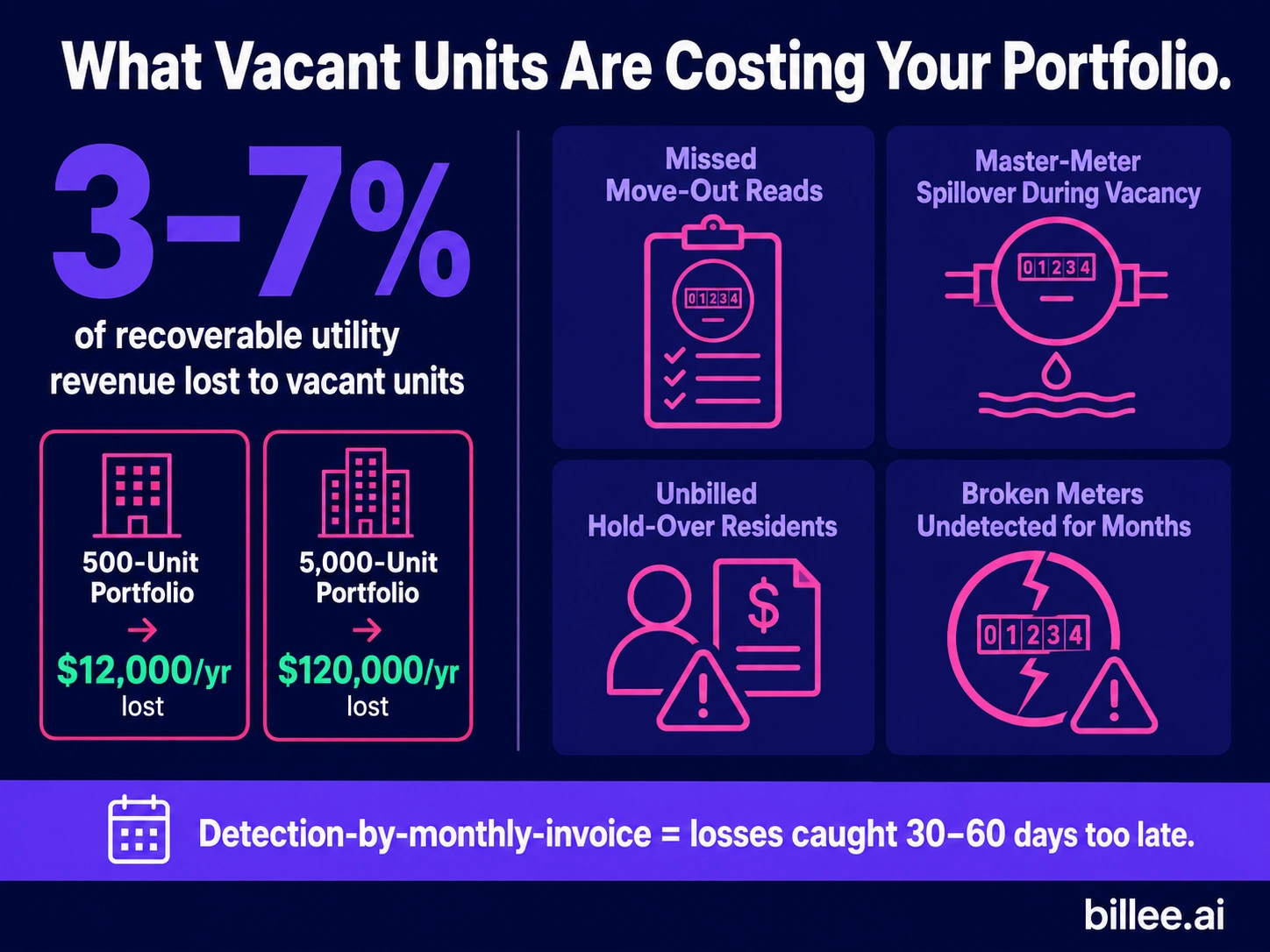
The HACSB RFP shows how specific scope can get. Vacant-unit and common-area reconciliation, a rate audit or tariff analysis, and ENERGY STAR Portfolio Manager data management sat alongside basic billing. Name each item you need, vacant units included. Billee's guide to recovering utility costs from vacant units shows what to ask for.
Sample language:
For each service, state whether it is included in the base fee, available for an additional fee, or not offered: (1) monthly resident billing for [utilities]; (2) utility invoice intake, coding and approval; (3) vacant-unit cost recovery; (4) move-out final bills; (5) resident billing support; (6) reporting; (7) rate or tariff review. Identify any service you subcontract.
3. Compliance and legal
Ask for: the rule, not the reassurance. "We are compliant" tells you very little. Naming the rule followed in each state tells you something.
Also ask who tracks rule changes and what documentation you get for an audit or a resident dispute. Check the answers against your leases; Billee's guide to RUBS lease addendum requirements covers that side.
Sample language:
For each state in Appendix A, identify the statute, regulation or rule your billing methodology follows. State who tracks changes to those rules and what documentation you provide for an audit, a resident dispute or a lender request.
4. PMS integration and data
Ask for: supported systems and versions, what syncs in each direction and how often, whether charges post to the resident ledger automatically, how failed syncs are handled, and who owns the data.
A daily automatic sync with ledger posting is a different product from a manual export, though both get called "integration." Billee's guides to its Yardi Voyager and Entrata integrations show the detail worth asking for.
Sample language:
List each PMS and version you support. For [PMS and version], describe what data flows in each direction, how often, and whether charges post to the resident ledger automatically. Describe how a failed sync is detected and resolved. State who owns billing data created under this agreement, and the format and timeframe for returning it on request or at termination.
5. Service model and SLAs
Ask for: who performs each step of the monthly cycle, who answers resident billing calls, who your named contacts are, and written response times.
If your team ends up working exceptions and fielding resident calls, you bought software. Billee's questions to ask a utility billing company includes a side-by-side of the two models.
Sample language:
Identify who performs each step of the monthly billing cycle and who answers resident billing questions. Name the account contact for our portfolio. State your written response-time commitment for billing questions, report regeneration, final bill issues and corrections.
6. Line-item pricing sheet
Ask for: every fee on its own line, by contract year, on a sheet you provide.
The HACSB proposal form did this. It listed seven fee lines (move-in, move-out, meter maintenance, billing, late, vacant recovery and NSF), each priced across five contract years, and the RFP required "All fees for services to be stated clearly, including any set up and one-time fees if applicable."
Use a table like this, and do not let bidders reformat it:
Fee lineBasisYear 1Year 2Year 3One-time setup and implementationFlat or per propertyMonthly billing feePer unit per monthMove-in and move-out feesPer transactionMeter maintenance and repairPer visit or per meterVacant-unit recovery feePercent or flatLate-payment and NSF feesWho keeps themProperty data or API access feePer propertyRevenue share on ancillary billing incomePercent to ownerRate or tariff audit feePercent of savings or flatData export fee at terminationFlat
Billee's guide to fees that don't show up in the per-unit rate explains why several of these lines belong here. Run every bid through the same scenario (your units, turnover and vacancy) and compare total cost over the term, not the monthly rate.
Sample language:
Complete Appendix B in full, pricing every fee on its own line by contract year, including setup, data access and exit fees. Fees not listed in Appendix B may not be charged during the term. State who retains late-payment fees and any revenue earned on ancillary billing income.
7. Implementation and transition
Ask for: a dated plan from signature to the first live billing cycle, a named project manager, what your team must do and by when, and who bills the cycle in progress at handoff.
The HACSB RFP asked for a proposed schedule and an estimate of the time needed to begin services. Also ask how vendor accounts, historical data and resident notices are handled. Billee's switching guide walks through the phases.
Sample language:
Provide a week-by-week plan from signature to first live billing cycle for [number] properties. Identify the project manager, and list what you need from our team and when. Describe how vendor accounts and historical data transition, who bills the cycle in progress at handoff, and how residents are notified.
8. References, financials and insurance
Ask for: references from clients of comparable size on your PMS, insurance certificates and company background. Include one reference who moved to the bidder from your current provider.
The HACSB RFP required five references. Set insurance limits with your own counsel and risk manager, and do not copy another organization's numbers.
Sample language:
Provide [five] references for clients of comparable size on [PMS], with contact name, units billed and billing start date, including at least one client that moved to you from [current provider]. Provide insurance certificates meeting Appendix C and a company overview covering ownership, years in business and the team serving our portfolio.
9. Exit terms
Ask for: the term and renewals, notice to terminate for convenience and for cause, exit fees, the format and timeline for returning your data, help handing off to the next provider, and who owns any meters or hardware.
The HACSB RFP set a three-year term with two extension options, and it committed the agency to 30 days' written notice before adding, deleting or modifying services. The RFP text does not appear to address data return. Yours should.
Sample language:
State the initial term, renewal terms, and the notice required to terminate for convenience and for cause. List any termination fee. Describe the format and timeframe in which you will return all billing data, and the support you provide a successor provider. State who owns any meters or hardware at our properties.
How to score proposals
Build the scorecard before the first proposal arrives. One written after you have seen the bids tends to bend toward the bid you like.
- Use a 0–5 scale and define every point. Responsive's guide to RFP evaluation criteria calls 0–5 a common scale and says to define each point so evaluators score consistently.
- Score alone first, then compare. Responsive says individual scoring works best because group sessions often skew toward the loudest voices. Harvard's Evaluation Scorecards guide points to averaging individual scores rather than requiring full consensus.
- Score price separately. Harvard's Government Performance Lab says separating technical and price scoring can help minimize bias.
- Make two items pass/fail. Your PMS must be supported, and data return must be in writing.
- Make the weights add up to 100.
For a public-sector reference point, the HACSB RFP weighted firm experience 35 points, firm capacity 35, cost 25 and ownership certification 5, out of 100. A private owner may not use the last criterion.
Below is our own starting point for the quality scorecard. It is illustrative, not an industry standard.
CriterionWeightWhat a 5 looks likeScope and service model25Every service in section 2 included or priced; named team; written response timesPMS integration and data20Your PMS supported; automatic ledger posting; failed syncs caughtCompliance and methodology20A named rule for each state; documented methodologyImplementation and transition15Dated plan; named project manager; light workload for youReferences and background10Comparable clients on your PMS who take your call; insurance in placeExit terms and data return10Clear notice, no surprise exit fees, data returned in a usable format
Score price on its own scorecard from the pricing sheet, then combine the two at a ratio you set in advance, such as 70/30 quality to price. The ratio is your call.
Run the process so the scores hold up
- Publish the schedule up front. The HACSB RFP was released May 21, 2025, took questions until June 4 and set proposals due June 18, a 28-day window. Treat that window as a reference point, not a rule.
- Share every answer with every bidder. Send each Q&A response to all bidders so none gets an edge.
- Score the written proposals first. Demos come second, for the top two or three.
- Call references before you decide. Ask about the transition, billing accuracy and how disputes were handled.
- Get final pricing and terms in writing. Have counsel review them before you sign.
Five RFP mistakes that cost operators money
- Comparing only the per-unit rate. Fees outside the headline rate can change which bid is cheapest.
- Giving bidders different data. If the portfolios differ, the prices are not comparable.
- Accepting "we are compliant" without the rule. Make bidders name the rule for each state.
- Treating exit terms as a contract detail. By contract stage, you have already chosen.
- Scoring after the demo. A strong demo can override a weak written answer unless the scores are already locked.
How Billee Technologies answers this template
Billee Technologies pairs a platform with a named, dedicated team. Your people review and approve; Billee's team does the billing work. This table maps Billee's documented methodology to the nine sections.
Template sectionWhat Billee documents1. Data packIts audit asks for the same four document categories, all covering one billing period2. ScopeSeven products, sold individually or as one platform, including Billing & Recovery Engine, Vacant Cost Recovery and utility vendor management with AP integrations3. ComplianceBilling methodology audits and access to legal support (access to legal support, not legal advice)4. PMS and dataYardi Voyager (7S or higher), Yardi Breeze, RealPage and Entrata; Yardi data syncs daily, with an on-demand Sync PMS button in the portal5. Service modelA named, dedicated account team and a 1–2 business-day standard for team-handled actions6. PricingQuoted on request7. ImplementationA 45-day standard with a named project manager8. References and insuranceAsk Billee directly; this guide makes no claims about either9. Exit termsAsk Billee directly; this guide makes no claims about term, termination or data return
It starts with an audit
Billee's audit looks for methodology gaps by utility, allocation drift (RUBS formulas that have not kept pace with unit-mix changes), master meter and unit-level reconciliation problems, legal-entity mismatches and lease language that limits what you can recover.
Billee's regulatory and compliance support adds access to legal support, not legal advice.
The monthly cycle you would be scoring
Each month, Billee assembles utility data, runs the allocation and generates a preliminary bill for each property. Your billing administrator reviews it in the portal alongside Biller Highlights, the team's notes on exceptions. Questions go in comments, and the biller replies within 1–2 business days.
When you approve, a biller locks the bill within 1–2 business days. Charges post to the PMS resident ledger on the set date, and e-bills go to residents. An activity log records every billing action by the property team or Billee.
The dashboard shows recovery performance. Billee's own benchmark is 80–95% effective recovery, and below 80% signals a problem such as vacant units, hardware issues or undercharging. That benchmark is Billee's, not an industry standard. See what 80–95% effective recovery means.
Implementation and vendor accounts
Billee's standard implementation takes 45 days. It covers PMS integration, vendor transition, historical data migration, the methodology audit, training and the first billing cycle.
Your team approves resident communication templates, provides PMS access and historical data, and joins one weekly check-in call, per Billee. Ask any bidder, Billee included, how its timeline applies to your PMS and number of properties.
Billee's utility vendor management takes over vendor relationships, with invoices coded and approved through AP integrations with Yardi, RealPage and Entrata. Billee's vacant cost recovery routes exceptions on units marked vacant to a named team member who investigates and recovers the charge.
What to ask Billee in writing
The guide makes no claims on these for Billee, and your RFP should not let any bidder skip them:
- Customer references on your PMS and at your size.
- Security documentation and certifications.
- Insurance certificates.
- Contract term, termination notice and exit fees.
- Data return format and timeline.
- Pricing on your Appendix B sheet. Billee quotes pricing on request.
Who Billee is not for
- Portfolios under about 300 units, where Billee's full-service model is usually more than the job needs.
- Operators who want to run billing themselves with software alone. Billee's portal exists for review and approval, not self-service operation.
- Properties on a PMS Billee does not list. Billee lists Yardi, RealPage and Entrata, so confirm support before you send an RFP.
FAQ
Do I need an RFP to choose a utility billing company?
Not always. An RFP fits when several providers are credible and the contract is large enough to justify the work. For a handful of properties, a data pack, a pricing sheet and written questions can do the same job.
What should a utility billing RFP for multifamily include?
Nine sections: portfolio profile and data pack, scope, compliance, PMS integration and data, service levels, a line-item pricing sheet, implementation and transition, references and insurance, and exit terms.
What documents should I send utility billing bidders?
Send the same set to every bidder, all covering the same billing period. Billee's audit checklist asks for the current provider's methodology breakdown and allocation charges report, matching master meter invoices, lease forms, and the property's W-9 and legal entity name.
How should I structure pricing in a utility billing RFP?
Give bidders a sheet that requires every fee on its own line, by contract year, including setup, data access and exit fees. Then compare total cost for your own unit count, turnover and vacancy.
How do I score utility billing proposals?
Score each proposal independently on a 0–5 scale, average the scores, and score price on a separate scorecard. Set weights and pass/fail items before proposals arrive.
How long should bidders get to respond to a utility billing RFP?
There is no standard window. The housing authority example allowed 28 days from release to proposals due, with a questions deadline two weeks in. A multi-property portfolio may need longer.
Can I run an RFP for a single property?
You can, but a shorter process often fits. Send the data pack and pricing sheet, and ask the questions in sections 5 and 9. Billee notes that its full-service model is usually more than the job needs under about 300 units.
Which contract terms should a utility billing RFP flag?
Flag the initial term and renewals, termination notice, exit fees, price escalators, data return format and timeline, hardware ownership, and who bills the cycle in progress at handoff. Ask Billee and every other bidder to answer each in writing.
Billee handles utility billing, vacant cost recovery and vendor management for multifamily operators who want a dedicated team behind the software. If Billee belongs on your shortlist, talk to the team about your portfolio.
Sources
- Housing Authority of the County of San Bernardino, "RFP PC1432: Utility Billing Services (Rebid)," released May 21, 2025, accessed October 2026.
- Responsive, "A guide to RFP evaluation criteria: Basics, tips, and examples," updated May 12, 2026.
- Harvard Kennedy School Government Performance Lab, Procurement Excellence Network, "Evaluation Scorecards," 2023.
Insights and Industry Trends