
RUBS vs Submetering: Which Is Right for Your Property
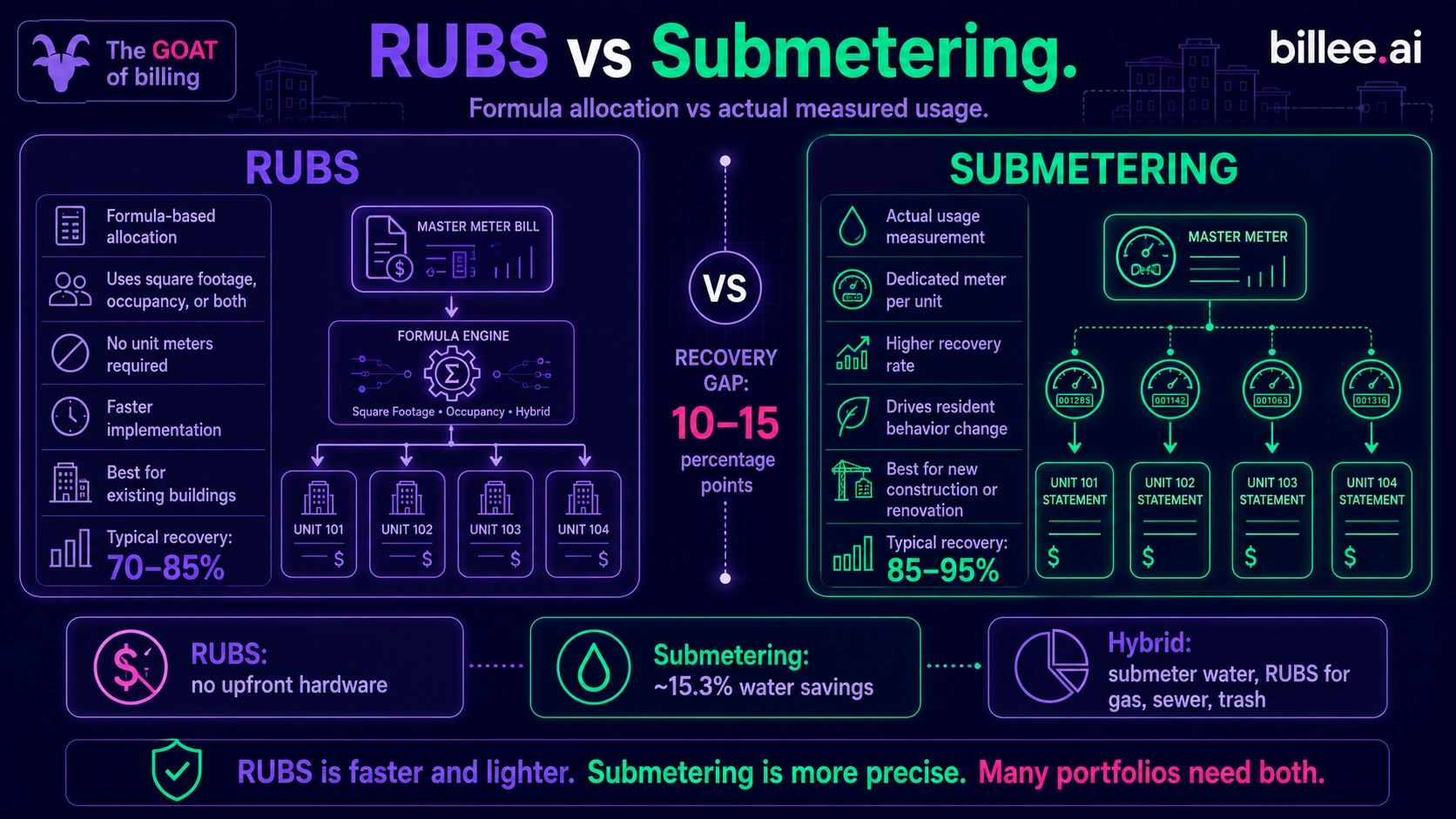
TL;DR: RUBS allocates a master-meter utility bill to residents using a formula (square footage, occupancy, or both); submetering measures each unit's actual usage with individual meters. RUBS recovers 70 to 85 percent of utility costs; submetering achieves 85 to 95 percent. Submetering also produces measurable resident behavior change (roughly 15.3 percent water savings in a two-year EPA study), while RUBS does not. The right choice depends on whether the property already has unit meters, the capital appetite for retrofitting, the operator's state regulatory exposure, and whether resident behavior change matters as much as recovery rate.
RUBS is the right choice for existing buildings without unit meters, multi-state portfolios where the operator wants methodology consistency, and operators who need to move quickly. Submetering is the right choice for new construction, properties undergoing major renovation, portfolios where resident behavior change matters as much as recovery rate, and states where regulatory rules favor direct measurement.
Many operators run both. The most common modern pattern is to submeter water (the highest-impact utility for behavior change and recovery) and use RUBS for gas, sewer, and trash. That hybrid often produces the best blended recovery rate without the full capital cost of submetering every utility.
Key takeaways
RUBS uses a formula; submetering uses physical measurement. RUBS allocates master-meter costs across units based on square footage, occupancy, or both. Submetering reads each unit's actual usage from a dedicated meter.
Recovery rates differ by ~10 to 15 percentage points. RUBS typically lands at 70 to 85 percent of recoverable utility costs. Submetering reaches 85 to 95 percent. The gap reflects the inherent difference between formula allocation and direct measurement.
Submetering produces resident behavior change; RUBS does not. A two-year EPA study found roughly 15.3 percent water savings, or about 21.8 gallons per unit per day, after submetering. RUBS produces no comparable change because residents have no individual usage feedback loop.
Submetering requires upfront capital; RUBS does not. Hardware, installation, and ongoing maintenance per unit can be material at portfolio scale. For an existing 200-unit property without submeters in place, the retrofit cost often makes the RUBS-versus-submetering math tilt back toward RUBS until the next capital cycle.
State regulatory rules vary for both, but more so for RUBS. Connecticut prohibits RUBS for residential multifamily entirely. California treats RUBS as part of rent for rent-control purposes. Texas is the most permissive. Submetering is more uniformly accepted because the methodology is physical measurement rather than formula allocation.
What RUBS is
Ratio Utility Billing System (RUBS) takes a property's master-meter utility bill, subtracts a Common Area Deduction for non-resident usage, and allocates the remainder across resident units using a defined formula. The most common modern approach is hybrid: square footage weighted with occupancy, so a 600 sqft studio with two residents pays meaningfully more than a 1,200 sqft one-bedroom with one resident.
The methodology does not measure individual unit usage. The methodology assumes that a defensible formula produces a fair allocation across the portfolio, and that the property's master meter captures the ground truth on total consumption. For a deeper walkthrough of how the allocation math runs, see How RUBS Allocates Utility Costs in Multifamily Properties.
RUBS fits properties where unit-level submeters do not exist and where the cost of installing them is hard to justify. RUBS also fits multi-state portfolios where the operator wants one methodology framework across geographies, since the formula travels.
What submetering is
Submetering installs a dedicated meter on each unit for one or more utilities (most commonly water, sometimes electricity or gas). Each meter reads the unit's actual usage, and the resident is billed for what they used.
Submetering produces the closest possible analog to a single-family utility experience: the resident sees a bill that reflects their actual consumption. That direct feedback loop is what drives the behavior change effect that RUBS cannot match.
Submetering fits new construction (where the meters get installed during build at low marginal cost), properties undergoing major renovation, and existing properties where the recovery-rate uplift and behavior-change effect justify the retrofit capital. Submetering also fits states with rules that favor or require direct measurement.
Side-by-side comparison
DimensionRUBSSubmeteringTypical recovery rate70 to 85%85 to 95%Resident behavior changeNone~15% water savings (per EPA)Upfront capitalNoneHardware and installation per unitOngoing operating costMethodology review, billing serviceHardware maintenance, meter reads, billing serviceImplementation timelineDays to weeksMonths (especially retrofits)Regulatory complexityHigher; varies meaningfully by stateLower; physical measurement is broadly acceptedResident perceptionLess direct; allocation-basedDirect; usage-basedBest fitExisting buildings; no submeters in place; multi-state portfoliosNew construction; renovation; behavior-change priority
The cost comparison
Three cost categories matter when comparing the two methodologies.
Upfront capital. RUBS requires none. Submetering requires hardware and installation per unit. The per-unit cost varies by utility (water submeters cost less than electricity submeters), property age (older buildings often need plumbing modifications), and whether the install happens during construction or as a retrofit. New-construction installs sit at the low end of the range; full retrofits in older buildings sit at the high end. Operators should budget separately for the meters, the install labor, and any required plumbing or electrical work.
Ongoing operating cost. Both methodologies have monthly costs. RUBS is mostly billing service cost (per-unit-per-month, paid to the billing provider). Submetering adds hardware maintenance, periodic meter calibration, and meter reads (manual or automated). Properties with automated meter reading (AMR) hardware have higher upfront capital but lower ongoing read costs.
Recovery rate as effective cost. This is the dimension operators often miss. The 10-to-15 percentage point recovery gap between RUBS and submetering is real money. For a 1,000-unit portfolio with $40 per unit per month in utility costs, a 10-point recovery gap is $48,000 a year. Across a decade, that is roughly $480,000 of recoverable revenue that RUBS leaves on the table relative to submetering.
The net cost comparison depends on the per-unit retrofit cost and the per-unit recovery uplift. Properties where the retrofit pays back inside 5 to 7 years usually move to submetering during the next capital cycle. Properties where the payback extends beyond 10 years usually stay on RUBS.
Behavior change: the differentiator submetering owns
The most important non-financial difference between the two is behavior change. A two-year EPA submetering study found roughly 15.3 percent water savings, or about 21.8 gallons per unit per day, after properties moved to submetering. The savings come from residents adjusting consumption when they see their actual usage on a bill.
RUBS produces no comparable effect. A RUBS-billed resident sees an allocated charge based on the property's total usage and a formula. There is no individual feedback loop, so there is no incentive to change individual behavior.
For operators with sustainability goals, ESG reporting obligations, or properties in water-stressed regions, the behavior change effect is part of the case for submetering even when the pure recovery math is close. The ESG reporting tied to submetered consumption data is also materially more credible than ESG reporting derived from RUBS allocation, which can matter for institutional owners.
Regulatory complexity by state
State Public Utility Commission rules govern both methodologies, but RUBS attracts more regulatory complexity because formula allocation is more contested than physical measurement.
Texas. Most permissive RUBS framework in the country, governed by Texas PUC Chapter 24. Both methodologies are widely used; the framework gives operators clear rules to follow.
California. Submetering is governed by California Civil Code §1954.201–204. RUBS is permitted but treated as part of rent for rent-control purposes, which constrains its use in rent-controlled jurisdictions. Some municipalities have ruled RUBS inconsistent with local rent control.
Connecticut. RUBS is prohibited for residential multifamily entirely. Submetering is the only compliant allocation methodology in the state.
Colorado. HB1090 (2026) added explicit disclosure and methodology documentation requirements that apply to both, with stricter framing around RUBS.
Florida, Illinois, others. Each has its own framework. The common thread across states with active rules: transparent line-item charges on resident bills, documented methodology, and explicit lease disclosure are minimum standards regardless of which methodology the property uses.
For multi-state operators, the state-by-state regulatory map is part of the methodology decision. A portfolio that spans Texas, California, and Connecticut cannot use one methodology framework; submetering is the only legal option in Connecticut, while either is fine in Texas.
The hybrid approach most operators settle on
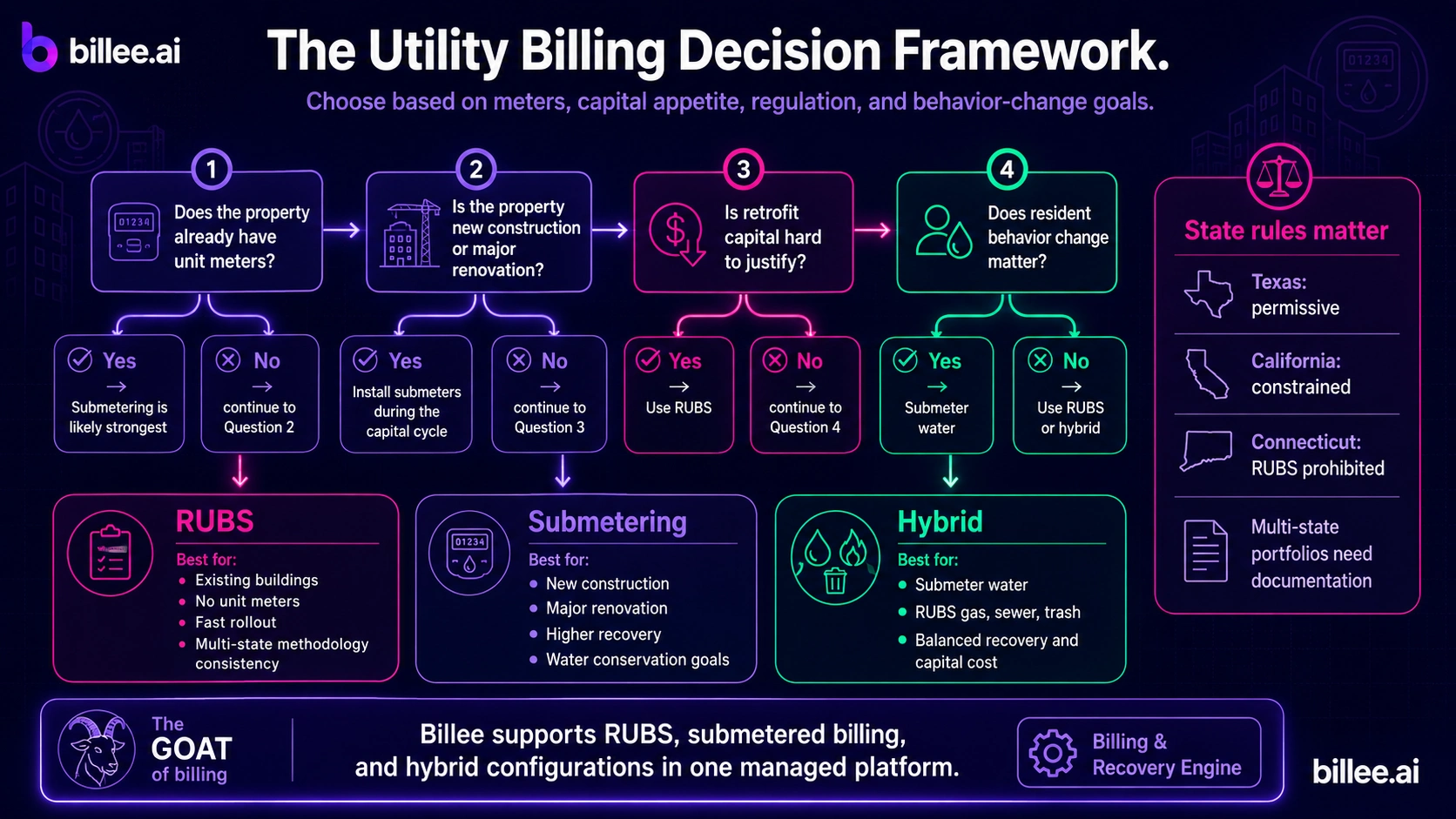
Few large portfolios run pure RUBS or pure submetering across every utility. The most common modern pattern is to submeter water (the highest-impact utility for both recovery and behavior change) and use RUBS for gas, sewer, and trash.
The logic is straightforward. Water submetering captures the bulk of the behavior-change benefit. The retrofit cost for water is lower than for electricity in most building stocks. The recovery uplift on water alone is meaningful enough to justify the capital in many portfolios. Meanwhile, RUBS handles the smaller utility lines where the retrofit math does not work.
The hybrid approach also lets operators phase capital investment. Submeter water at the next major capital cycle; revisit gas or electricity when their own capital case turns positive.
How Billee handles both
Billee operates RUBS billing as part of the Billing & Recovery Engine, with allocation, charge posting, and resident billing handled by the platform, and methodology reviews and CAD calibration handled by the dedicated account team. The portfolio benchmark on the customer dashboard is 80 to 95 percent effective recovery, per Billee's standard portfolio benchmark.
Billee also supports submetered portfolios, hybrid configurations, and meter-monitoring workflows. The platform pulls submeter reads, reconciles against master-meter consumption, and surfaces hardware issues (broken meters, anomalous reads) for the team to act on. Properties moving from RUBS to submetering during a renovation cycle can transition without changing billing providers.
Implementation completes in 45 days, per Billee's standard implementation timeline, including PMS integration with Yardi Voyager, Yardi Breeze, RealPage, or Entrata. For operators evaluating whether their portfolio should switch methodologies, the billing methodology audit is the first step.
FAQ
What is the main difference between RUBS and submetering?
RUBS allocates a master-meter bill across resident units using a formula (typically square footage, occupancy, or both). Submetering installs an individual meter on each unit and bills residents for their actual measured usage. RUBS is formula-based; submetering is measurement-based.
Which method recovers more utility revenue?
Submetering recovers 85 to 95 percent of recoverable utility costs; RUBS recovers 70 to 85 percent. The 10 to 15 percentage point gap reflects the inherent difference between formula allocation and direct measurement.
Does submetering actually change resident behavior?
Yes. A two-year EPA submetering study found roughly 15.3 percent water savings, or about 21.8 gallons per unit per day, after submetering. The change comes from the individual feedback loop residents get when they see actual usage on their bill. RUBS produces no comparable effect because the resident sees an allocated share, not a measured usage.
Is submetering legal in every state?
Yes. Submetering is broadly accepted across states because it is direct physical measurement. The specific rules vary (California has detailed submetering requirements under Civil Code §1954.201–204; other states have lighter frameworks), but no state prohibits submetering the way Connecticut prohibits RUBS for residential multifamily.
How long does it take to install submetering in an existing property?
Months for a full retrofit, especially in older buildings that need plumbing or electrical modifications. New construction installs are measured in weeks because the meters go in during build. RUBS implementations, by contrast, are days to weeks because there is no hardware involved.
Can a property switch from RUBS to submetering?
Yes, and many do during major renovation or capital cycles. The transition requires hardware installation, resident communication, methodology documentation update, and a billing-provider configuration change. Properties already using a billing platform that supports both methodologies (Billee, Conservice, others) can transition without changing providers.
What is the hybrid approach to multifamily utility billing?
The hybrid approach submeters one or two utilities (typically water) and uses RUBS for the remainder (gas, sewer, trash). The logic is to capture the highest-impact behavior change and recovery uplift through submetering while avoiding the retrofit cost on lower-impact utilities. Most large modern portfolios settle on some version of this pattern.
Billee handles RUBS billing, submetered billing, and hybrid configurations for multifamily operators who want accurate allocation, current methodology, and a clean audit trail without operating the system themselves. Talk to the team.
Sources
1. Simple Sub Water, "RUBS vs. Submetering: Financial Impact on NOI, Costs and Tenant Satisfaction," accessed 2026.
2. Public Utility Commission of Texas, "Texas PUC (Chapter 24, Substantive Rules Applicable to Water and Sewer Service Providers)," accessed 2026.
3. California Legislative Information, "California Civil Code §1954.201–204," accessed 2026.
4. Dune Labs, "Things You Need to Know About RUBS Regulations Across States," November 7, 2022.
Insights and Industry Trends