
Managing Utility Invoices Across a Large Multifamily Portfolio
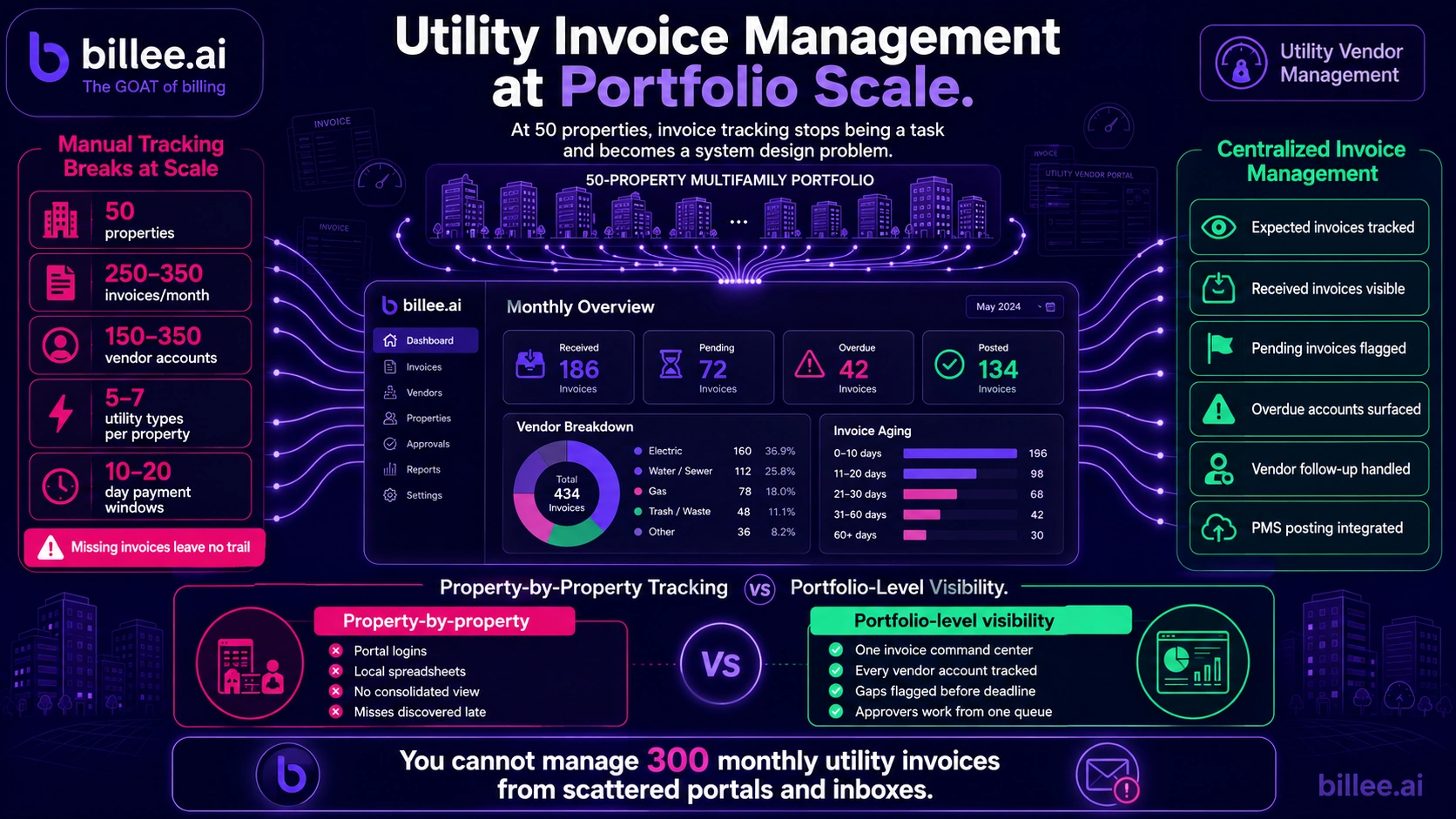
Managing utility invoices across a large multifamily portfolio is a tracking and visibility problem before it is a processing problem. A 50-property portfolio generates 250–350 utility invoices per month from vendors on different billing cycles, different portals, and different payment windows. Without a centralized system, some invoices will always be missing, late, or unreviewed, not because of poor execution, but because the volume exceeds what any manual tracking approach can reliably handle. Billee's Utility Vendor Management product centralizes invoice receipt, auditing, and AP posting for multifamily portfolios at any scale, giving operators a single view of every enrolled vendor and every invoice across the portfolio.
Key Takeaways
A 50-property multifamily portfolio generates 250–350 utility invoices per month from 150–350 active vendor accounts, each on its own billing cycle.
The missing invoice problem is structurally different from the erroneous invoice problem: errors show up in the ledger, but invoices that never arrived leave no trace until the account goes overdue.
Most operators managing 20+ properties cannot confirm they are receiving 100% of expected invoices each month; the tracking doesn't exist at the portfolio level.
At least 17% of utility invoices contain a billing error, according to ENGIE Impact, meaning a 50-property portfolio receives roughly 40–60 incorrect invoices per month that require follow-up.
Utility late fees run at the equivalent of 12–36% annual interest at many providers. Across 300 invoices per month, even a 3% miss rate generates consistent, compounding fee exposure.
Billee tracks every enrolled utility vendor and invoice in a centralized portal, so operators see what has been received, what is pending, and what is overdue, without logging into individual vendor portals.
How Many Invoices a Large Portfolio Actually Generates
The starting point for understanding the invoice management challenge is volume. Most operators underestimate how many utility invoices their portfolio produces each month.
A single multifamily property typically involves water (often municipal), electric, natural gas, trash collection, telecom, stormwater, and irrigation. That is 5–7 utility types per property, each with its own account, its own billing cycle, and its own portal. A 20-property portfolio carries 60–100+ active utility vendor accounts. A 50-property portfolio may carry 200–350.
Each of those accounts generates at least one invoice per month, often more. Some vendors bill mid-month. Some bill quarterly. Some issue corrected invoices after the original. At 50 properties, a property manager responsible for even 3–5 properties is individually tracking 15–35 invoices per month while managing everything else their job requires.
At this volume, the question is not whether some invoices get missed. The question is how many, and whether the system surfaces the misses before they become overdue accounts or erroneous payments.
The Missing Invoice Problem
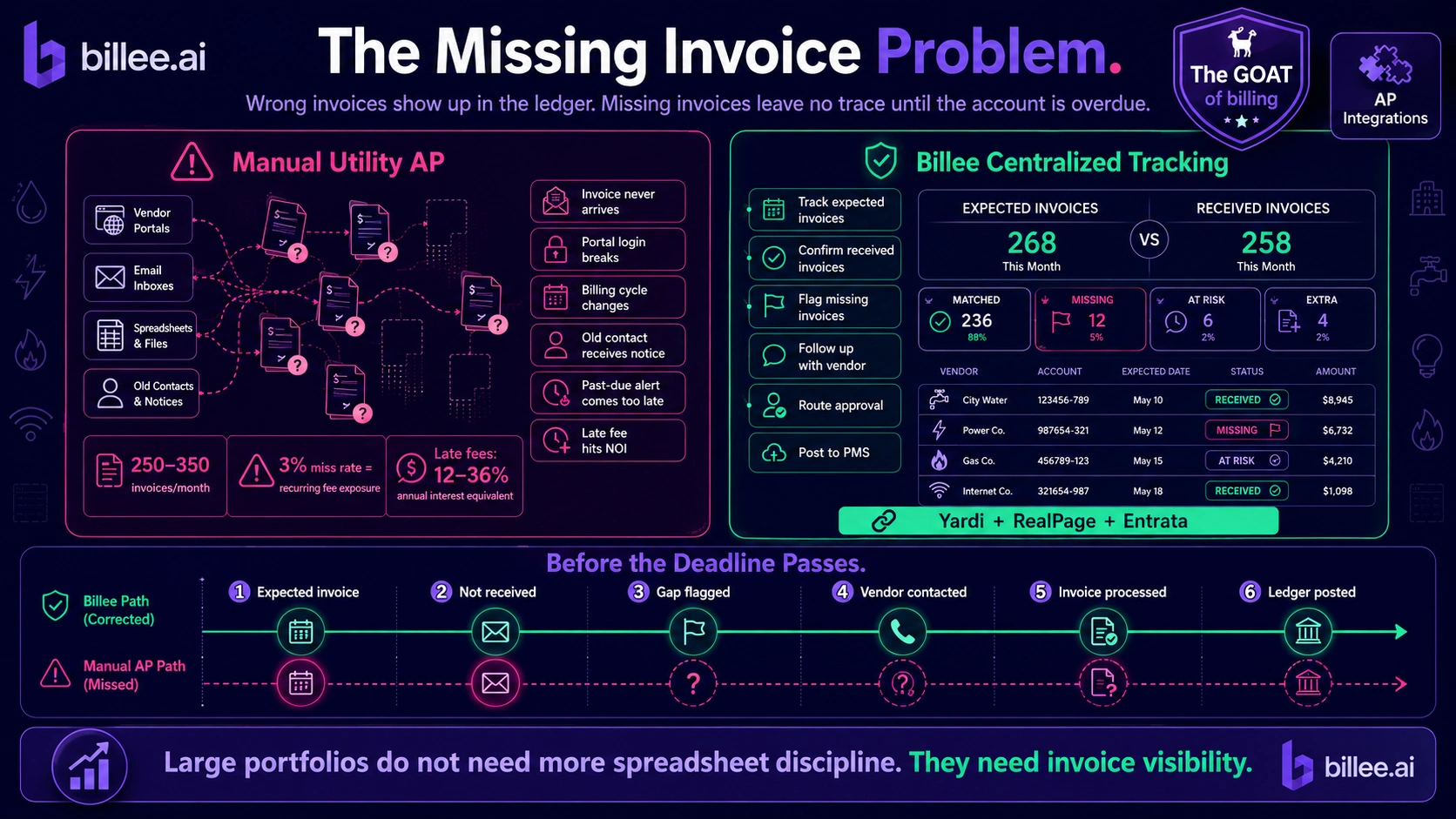
The erroneous invoice problem is visible: the wrong amount shows up in the ledger, a GL coding error appears in the month-end report, a duplicate payment gets caught in reconciliation. These problems leave a trail.
The missing invoice problem is invisible. When a vendor fails to send an invoice (because of a portal issue, a billing cycle gap, or an account configuration error), nothing appears in the system to indicate a problem exists. No flag, no alert, no entry. The account simply goes unpaid until the vendor issues a late notice or the operator happens to notice the gap.
Across 60–100 vendor accounts, missing invoices are structural, not exceptional. Billing cycle mismatches, account changes, and portal login disruptions create gaps that recur every month. In a manual operation, those gaps are discovered reactively, after a late fee has already been assessed or a service disruption has occurred.
A centralized invoice management system tracks expected invoices against received invoices. When a vendor account goes a billing cycle without an invoice, the system flags the gap before the deadline passes.
Why Tracking Shifts from a Task to a System at Scale
Invoice tracking at 5 properties is a task. Invoice tracking at 50 properties is a system design problem.
At small portfolio sizes, a single property manager can hold the mental model of what invoices are expected, from which vendors, and when. Missing invoices surface because the manager notices the absence. This works until the portfolio grows beyond what one person can track.
At 20+ properties (and certainly at 50+), no individual has visibility across all vendor accounts simultaneously. Property-level managers know their properties. Regional managers see some subset. But the portfolio-level view of what has been received, what is pending, and what is overdue typically does not exist in a consolidated form.
As Quadient's research on accounts payable documents, AP automation saves more than 70% of the time teams spend on accounts payable. The time savings are significant, but the more important operational shift is structural: automation creates portfolio-level visibility that manual tracking cannot produce regardless of staff hours invested.
Payment Window Math at 300 Invoices Per Month
Payment windows on utility invoices are short. Unlike contractor invoices with net-30 or net-60 terms, most utility bills carry payment windows of 10–20 days. Some municipal water bills have windows as short as 7 days. On 300 invoices per month, those windows are always expiring somewhere in the portfolio.
A manual tracking operation does not run into trouble on the invoices that arrive on time and get processed promptly. It runs into trouble on the tail: the invoice that arrived two days before the due date, the invoice that went to last month's property manager's inbox, the invoice that didn't arrive at all until a past-due notice triggered the chase.
According to Zego's analysis of utility accounts payable practices, many utility providers assess late fees equivalent to 12%, 18%, 24%, or 36% annual interest. On a $4,000 invoice paid 15 days late under a 24% annual rate, the fee is approximately $40. Across a 50-property portfolio paying 300 invoices per month, even a 3% late rate (nine invoices) generates steady, recurring fee exposure that compounds invisibly across the portfolio.
Late fees at scale are not the result of disorganization. They are the predictable output of a tracking system that cannot process 300 invoices per month without gaps.
Portfolio-Level Visibility vs. Property-by-Property Management
The defining operational gap in large portfolio utility invoice management is the difference between portfolio-level visibility and property-by-property management.
Property-by-property management means each property's invoices are tracked at the property level: the property manager or a site-level accounting contact monitors their accounts, logs into their portals, and handles their AP workflow. This model works well for small portfolios. As portfolio size grows, it creates a distributed system where no one person has full visibility, and the aggregate picture exists only when someone manually assembles it.
Portfolio-level visibility means every enrolled vendor account, every invoice received, every payment status, and every gap is accessible in a single interface. The operator does not need to log into 60 portals to understand the current state of their utility AP.
Billee's customer portal at app.billee.ai provides this view directly. The Monthly Overview tab shows every statement due in the current billing period. The Vendor Breakdown tab shows every enrolled vendor and account across the portfolio. Both are accessible without logging into individual vendor portals, and both update as invoices are received and processed.
How Billee Manages Utility Invoices Across a Large Portfolio
Billee handles the full invoice management workflow on behalf of the property team, scaled to portfolios of any size.
Invoices from enrolled utility vendors flow into the Billee platform as they are issued. The Billee team reviews each invoice for errors, assigns the correct GL code per property configuration, routes it for approval, and posts it to Yardi, RealPage, or Entrata through the native AP integration. When an expected invoice does not arrive, the team follows up with the vendor before the payment deadline passes.
The property team's role is approval and oversight, not tracking. Instead of monitoring 200+ vendor portals, approvers work from a single queue inside the Billee platform. Vendor escalations, billing disputes, and missing invoice follow-ups are handled by the Billee account team directly.
For portfolios that have recently grown through acquisition, Billee manages vendor account transitions as part of onboarding. Credentials are centralized and documented, so invoice management continuity does not depend on which staff members were in place before the acquisition closed. The full utility vendor management process and the underlying AP automation mechanics are documented separately for operators who want more detail on how each component works.
Implementation takes 45 days. Vendor onboarding, portal access setup, PMS configuration, and historical data migration are handled by the Billee team.
FAQ: Managing Utility Invoices Across a Large Portfolio
How many utility invoices does a 50-property multifamily portfolio generate per month?
A 50-property multifamily portfolio typically generates 250–350 utility invoices per month, based on 5–7 utility vendors per property and the billing cycles of water, electric, gas, trash, telecom, stormwater, and irrigation accounts. That figure grows as properties add utility types and as vendors issue corrected or supplemental invoices.
What is the missing invoice problem in utility AP?
The missing invoice problem occurs when a vendor fails to issue an invoice for a billing period and no system flags the absence. Unlike an erroneous invoice, which leaves a trail in the ledger, a missing invoice leaves no record until the vendor issues a past-due notice or the account is flagged for nonpayment. At large portfolio scale, missing invoices are a recurring, structural issue rather than an occasional exception.
How do you get portfolio-level visibility across 200+ utility vendor accounts?
Portfolio-level visibility requires a centralized system that tracks every enrolled vendor account, every invoice received, and every payment status in one interface. Manual tracking at the property level cannot produce this view without someone manually aggregating data from dozens of portals and spreadsheets. Platforms like Billee centralize this view automatically, updating as invoices are received and processed.
Why do utility late fees accumulate even in well-run portfolios?
Utility late fees accumulate because manual invoice tracking cannot reliably process 200–300+ invoices per month without gaps, and utility payment windows are short (typically 10–20 days). The late fees are not caused by inattention. They are caused by a tracking system that wasn't built for that volume. Centralizing invoice receipt and processing eliminates the tracking gaps that produce missed deadlines.
What happens to utility invoice management during a property acquisition?
During and after an acquisition, utility vendor accounts often remain in the previous owner's name, credentials may be held by departing staff, and invoices may continue going to old contacts. The 60–90 days post-close is the highest-risk window for invoice management: accounts go unpaid, late fees accumulate, and service disruptions can occur before the incoming team establishes access. Billee centralizes vendor credentials and manages account transfers as part of implementation, maintaining invoice continuity through ownership changes.
Does Billee work for portfolios of different sizes?
Billee is built for mid-market to enterprise multifamily portfolios, typically 500 units and above. The value of centralized invoice management compounds with portfolio scale: the larger the portfolio, the larger the gap between what manual tracking can handle and what a centralized system can produce. Portfolios under roughly 300 units typically find that Billee's full-service model is more than their scale requires.
Billee manages utility invoice tracking, auditing, and AP posting for multifamily portfolios at any scale. See how it works for your portfolio.
Sources
Zego, "The Top 3 Utility Accounts Payable Mistakes Multifamily Companies Make," 2025. (Cites ENGIE Impact audit finding: at least 17% of utility invoices contain an error; documents late fee rates of 12–36% annual interest equivalent.)
Quadient, "Accounts Payable Automation by the Numbers: 10 Statistics to Know," September 2024.
Insights and Industry Trends