
Utility Billing Implementation Timeline: The First 90 Days
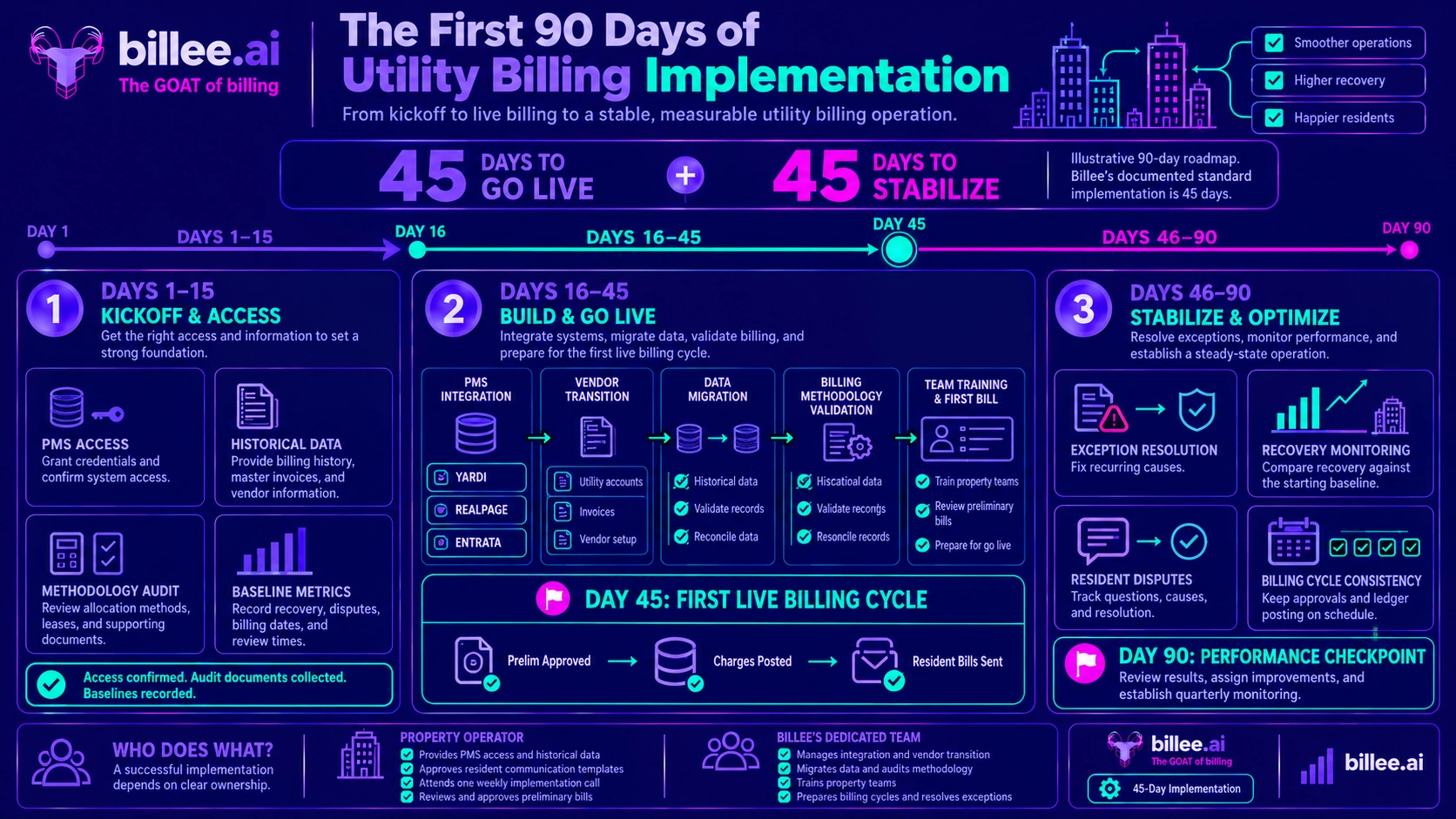
A utility billing implementation runs in two halves: about 45 days to go live, then roughly 45 days of stabilization while the first cycles prove the setup. This guide lays out the first 90 days with owners, checkpoints and exit criteria. Billee Technologies, Inc. runs a 45-day standard implementation, and the operator's part is three tasks plus one weekly call.
Go-live is not the finish line. It is the day real bills reach real residents, and the next 45 days decide whether the setup holds. Below is a calendar for the whole 90, who owns what in each stretch, and a day-90 checkpoint you can set up on day 1. Billee's documented standard is a 45-day total, not a day-by-day schedule, so the day ranges here are an illustrative plan and are labeled that way.
Key takeaways
- Think in two halves: build and go live (about 45 days in Billee's standard), then stabilize while the first cycles prove the setup.
- Your inputs set the clock: PMS access, historical data and approval of resident communication templates.
- Write down baselines before day 1. Without a starting point, day 90 has nothing to compare against.
- Do not judge the program at day 30. Billee reports first measurable vacant-unit recovery within 30–45 days and full optimization in 90–120.
- Hold a day-90 review with the numbers you set on day 1, then keep reviewing every quarter.
The 90 days at a glance
The phases below are an illustrative plan. The 45-day total and the operator's three tasks come from Billee; the day ranges inside it are ours.
PhaseDaysGoalYou ownYour provider ownsDone whenBefore day 1–Settle the inputsSigned agreement, PMS access owner, lease status, baselinesA named project manager and a dated planBoth sides can name the datesKickoff and access1–15Open the doorsPMS credentials, master invoices, historical dataKickoff, data intake, audit startAccess works and baselines are written downBuild and go live16–45Configure, migrate, train, billResident template approval, weekly callIntegration, vendor transition, data migration, methodology audit, trainingFirst cycle reviewed and approvedStabilize46–90Tighten the cyclePrompt reviews, dispute log, check-insException fixes, replies inside the committed windowDay-90 review passesDay-90 review90Decide what to adjustReview the numbersReporting and a business reviewWritten actions with owners and dates
What an implementation actually covers
An implementation is not a software switch-on. It is six jobs: connect the PMS, take over the utility vendor accounts, migrate the history, audit the billing methodology, train the property and regional teams, and run the first billing cycle. Billee's 45-day standard names those six. Ask any provider to name its own, by date.
Billee's guide to switching utility billing providers covers the mechanics of a move between providers. This guide is the calendar view: who does what, when, and what "working" looks like on day 90.
Before day 1: settle the inputs
Most schedule risk is decided before kickoff. Five items are worth closing first.
- The agreement. Term, notice, data return and exit fees. Billee's guide to utility billing contract terms lists what to settle.
- Who owns PMS access. One named person who can grant credentials fast.
- Where the master invoices go. Name the contact and the account list for every property.
- Whether your leases support the method. Rules vary by state; start with Billee's state-by-state guide and its guide to RUBS lease addendum requirements. Moving from owner-paid utilities? Billee's transition guide covers lease timing.
- A dated plan from the provider. The Housing Authority of the County of San Bernardino (HACSB) RFP told proposers to "Provide an estimate of the time that will be required to begin Utility Billing Services" and to submit a proposed schedule. Ask the same, in writing. Billee's RFP template includes sample language for it, and the ten questions to ask a utility billing company cover the rest.
Then write down your baselines: recovery rate by property, disputes in the last quarter, cycle close dates and how long reviews take. Harvard's contract-management training tells teams to "Review baseline data and key performance measures or metrics to lay the foundation for future performance tracking." You will need these on day 90.
Days 1–15: kickoff and access
Run a real kickoff. The same Harvard training defines a kickoff meeting as "a formal contract launch with your vendor to align on key outcomes." Agree on who the project manager is, who approves what, and how fast each side replies.
Open the doors. Grant PMS credentials, hand over master invoice access and vendor logins, and send historical data. Slow access is the cheapest delay to avoid.
Gather the audit documents. Billee's audit asks for four sets of documents covering the same billing period: the current provider's reports, master invoices, leases, and the property's W-9 and legal entity name. The same four make a good checklist for any provider. Billee's guide to preparing a billing methodology audit explains what each one reveals.
Start the weekly call. One recurring slot, same attendees. Billee's standard asks the operator for one weekly check-in call during implementation.
Checkpoint: access works, documents are in hand and baselines are written down.
Days 16–45: build, migrate, test, go live
Five work streams run side by side.
- PMS integration. The provider connects to your PMS, syncs property structure and residents, and maps utility charges to your charge codes. Test with real units.
- Vendor transition. Utility vendor accounts and invoices move into the new provider's process. Confirm who receives each invoice.
- Historical data migration. Past billing history moves over. Spot-check a few units against your records.
- Methodology audit. The provider reviews formulas, submeter configuration and allocation logic against your leases.
- Training. Your property and regional teams learn the review and approval steps before the first cycle.
Resident communication runs alongside. Your job is to approve the templates quickly. Residents usually need one clear notice of who their billing provider is, issued early enough that the first statement is not a surprise.
Moving several properties? Stage them in waves. Billee's guide to consolidating billing vendors after an acquisition shows one way to sequence them.
Checkpoint: the PMS test passes, history reconciles on a sample, templates are approved and the first preliminary bill exists.
The first live cycle, line by line
The first cycle almost always produces exceptions. Billee's own transition guide lists the usual suspects: occupancy data that does not match the allocation formula, wrong unit square footage, meter reads that fail validation and PMS posting errors. Review the preliminary bill before anyone else sees a statement.
Check these on the first prelim:
- Occupancy and unit counts match the PMS.
- Square footage and unit mix match the allocation formula.
- Meter reads are present and plausible for every submetered unit.
- Vacant units and common areas are treated as your methodology says.
- Move-ins and move-outs mid-cycle are handled, and final bills are queued.
- Charges map to the right codes.
After approval, confirm the charges that posted to the resident ledger match the approved bill, and that e-bills went out. Then keep a log: every question, its cause and how it closed.
Checkpoint: the cycle locks, charges post on the set date, and every exception has a cause on file.
Days 46–90: stabilize
Cycles two and three are where the setup proves itself. Depending on your calendar, the second half holds one to two more full cycles. The goal is a quieter prelim each time.
Shrink the exceptions. The same exception twice means a cause nobody fixed. Find it.
Approve promptly and handle final bills early. Billee's practice guidance for customers is to review highlights first, approve prelims promptly and generate final bills as soon as move-outs appear.
Read the log for patterns. A cluster of resident questions about one property usually points to a lease, formula or meter problem.
Check recovery against a benchmark. Billee measures effective recovery against an 80–95% range and treats anything below 80% as a problem to investigate (vacant units, hardware or the allocation method). The range is Billee's own framework, not an industry standard. Billee's guide to what 80–95% effective recovery means explains it in practice.
Be patient with vacant units. Billee reports first measurable vacant-unit recovery within 30–45 days (one full billing cycle) and full optimization, including threshold calibration by unit type and climate zone, in 90–120 days. At day 90 the program is mid-tune. Billee's guide to recovering costs from vacant units shows what to expect, and its Vacant Cost Recovery page describes the service.
Checkpoint: two clean cycles in a row, a short log with closed items, and recovery moving toward your target.
The day-90 checkpoint
Hold the review on paper. Compare day 90 with the baselines you wrote before day 1. The thresholds below use only figures Billee documents.
CheckOn trackLook closerRecoveryInside the 80–95% range, or a documented path toward itBelow 80%: check vacant units, hardware and the allocation methodCycle rhythmPrelim reviewed, approved, locked and posted on the calendarCycles slipping past the set post dateResponse timesComments and corrections answered within 1–2 business daysReplies running past the committed windowExceptionsFewer each cycle, each with a causeThe same exception every cycleDisputesLogged with a cause and closedNo log, or no one reading it for patternsPMS ledgerPosted charges match the approved billPosting mismatchesReportingYou can pull past cycles and itemized detail when askedReports arrive late or on request only
No industry dispute-rate target is cited here. Set your own from the first cycles and watch the trend. Reporting is worth writing into the scope: the HACSB RFP required "detailed monthly usage reporting" and "monthly detailed reports for vacant units," plus 24/7 website access to usage and billing reports.
Close the review with written actions, owners and dates. Treat the day-90 numbers as the first row of your quarterly vendor review.
Five ways the first 90 days go wrong
- Access arrives late. PMS credentials and invoice access stall the whole plan.
- The history is messy. Gaps in meter reads or unit data surface in the first prelim.
- The lease and the method disagree. Catch it in the audit, not in a resident's email.
- Templates sit unapproved. Resident notices wait on you.
- Judging too early. Vacant-unit recovery takes a cycle to show and months to tune.
How Billee Technologies runs the first 90 days
Billee Technologies pairs a platform with a named, dedicated account team. Your people review and approve. Billee's team does the work, including the implementation.
The 45-day standard
Billee's standard implementation takes 45 days from kickoff to live billing. It covers PMS integration across Yardi, RealPage and Entrata, vendor transition, historical data migration, the methodology audit, training for property and regional teams, and the first billing cycle.
Billee attributes the pace to four things: a dedicated team doing the heavy lifting, standardized playbooks for the common PMS platforms, vendor transitions handled directly with utility providers, and project management from a named project manager.
Who does what
OperatorBilleeKickoff to go-liveApproves brand voice and resident communication templates; provides PMS access and historical data; joins one weekly check-in callRuns PMS integration, vendor transition, data migration, the methodology audit and training; manages the project through a named PMResidentsApproves the noticeHandles templated communication; most transitions are invisible to residents beyond a one-time notice of who their billing provider isPlatformsConfirms system and versionLists Yardi, RealPage and Entrata; see the Yardi Voyager and Entrata guides
For Yardi, Billee documents Voyager 7S or higher, daily sync with an on-demand sync button, and the same 45-day standard. Complex charge-code mappings can run longer, so ask about yours.
The monthly cycle from the first bill on
Each month Billee assembles utility data, runs the allocation and generates a preliminary bill. Your billing administrator gets an email, opens the portal and reviews per-resident detail alongside Biller Highlights, the team's notes on exceptions. Comments get a reply within 1–2 business days. If you need fresher PMS data, a new report request triggers a resync and a new prelim, also within 1–2 business days.
When you approve, a biller locks the bill within 1–2 business days. Charges post to the PMS resident ledger on the set date, e-bills go to residents and a completion email confirms the cycle. Move-outs run on their own track: you finalize a bill in the portal, and the charges post when it is sent. Billee's regulatory and compliance support adds access to legal support, not legal advice.
What the team does after go-live
Every customer has a named, dedicated account team. Team-handled actions follow a 1–2 business-day standard: comment replies on a prelim, report regeneration after a resync, final bill issue reviews, locked-bill corrections and flagged exceptions. The team also provides owner reporting and quarterly business reviews. The portal lets you open any past cycle, download the Detail Resident Report or Itemized Report and read an activity log of every billing action by your team or Billee's.
Billee's Vacant Cost Recovery watches meter activity against PMS occupancy data. When a unit marked vacant keeps drawing usage past a set threshold, the exception goes to a named team member who investigates and recovers the charge. Expect first measurable results within 30–45 days and full optimization in 90–120.
What to ask Billee for in writing
The 45-day total and the operator's tasks are the documented standard. Ask for the day-by-day detail in writing:
- A dated plan from signature to your first locked cycle, with the name of your project manager.
- Your cutover date and who bills the cycle in progress.
- The date of your first business review.
- How the timeline applies if you are moving several properties.
Who Billee is not for
- Portfolios under about 300 units, where Billee's full-service model is usually more than the job needs.
- Operators who want to run billing themselves with software alone. Billee's portal exists for review and approval, not self-service operation.
- Properties on a PMS Billee does not list. Billee lists Yardi, RealPage and Entrata, so confirm support first.
FAQ
How long does a utility billing implementation take?
Billee's standard is 45 days from kickoff to live billing. Other providers differ, so ask each one for a dated plan. Complex charge-code mappings can run longer.
What does the operator need to provide?
PMS access, historical data and approval of resident communication templates, plus one weekly check-in call during implementation, per Billee.
What do residents receive?
Billee describes a one-time notice of who their billing provider is, using templates you approve. Lease and disclosure rules vary by state, so check your addenda first.
When will recovery show up?
Billee reports first measurable vacant-unit recovery within 30–45 days, one full billing cycle, and full optimization in 90–120 days. Judge overall recovery over several cycles against your own baseline.
What happens to the billing cycle in progress?
Plan the cutover just after a cycle locks and charges post, and agree in writing who bills the cycle in progress and who finalizes move-out bills.
What if I am moving several properties at once?
Stage them in waves and ask the provider how its timeline applies to your property count. Billee's standard is 45 days per implementation.
Does this work with Yardi, RealPage and Entrata?
Billee lists all three. For Yardi, Billee documents Voyager 7S or higher and the 45-day standard. Confirm the details for RealPage and Entrata with the team.
Billee handles utility billing, vacant cost recovery and vendor management for multifamily operators who want a dedicated team behind the software. If an implementation is on your calendar, talk to the team about your portfolio.
Sources
- Housing Authority of the County of San Bernardino, "RFP PC1432: Utility Billing Services (Rebid)," released May 21, 2025, accessed October 2026.
- Harvard Kennedy School Government Performance Lab, Procurement Excellence Network, "Actively Managing Contracts to Improve Results," training, February 1, 2023.
Insights and Industry Trends