

How to Transition from Owner-Paid to Resident-Billed Utilities
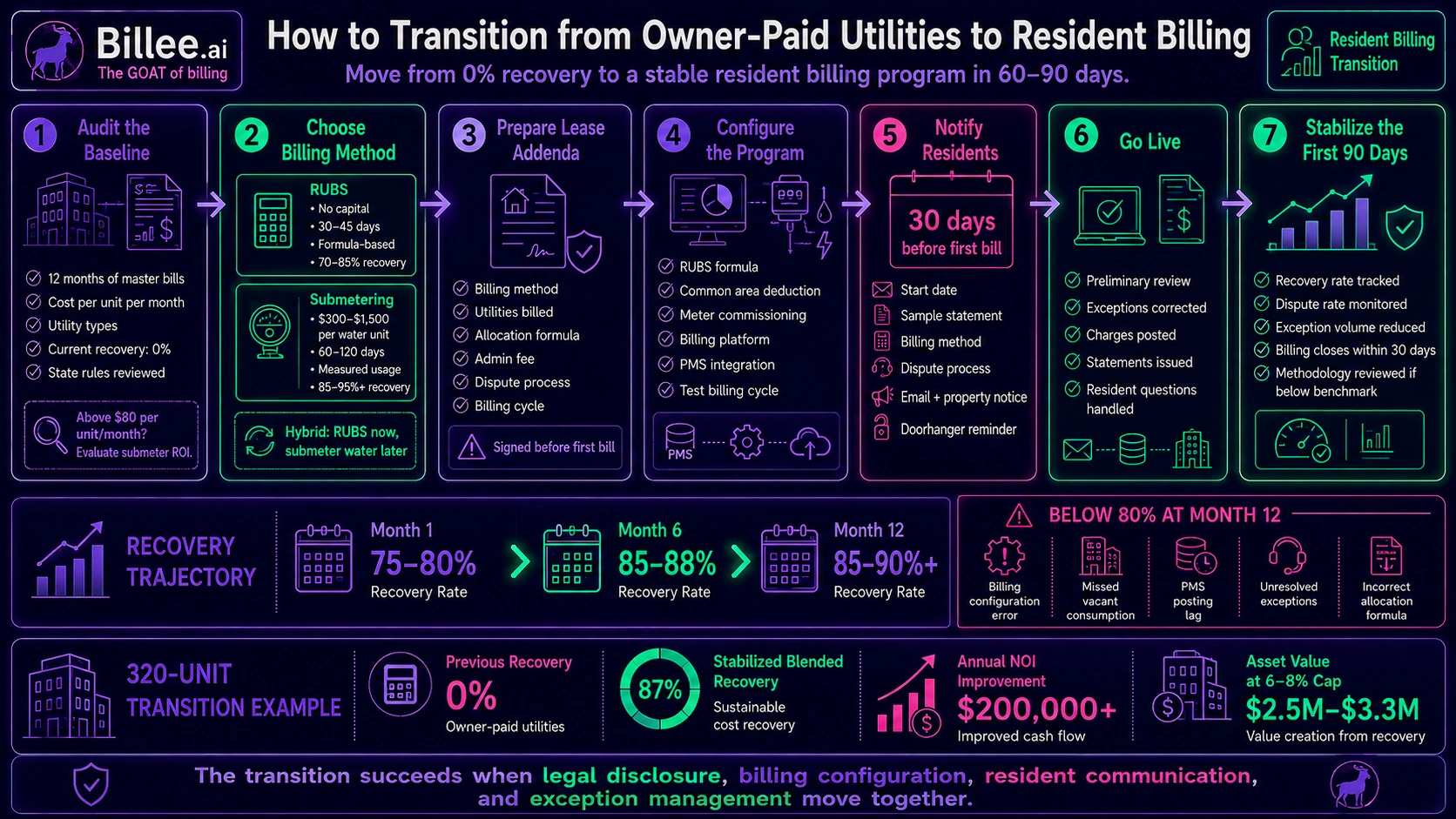
Transitioning from owner-paid utilities to resident billing takes 60–90 days from decision to first bill. The fastest path is RUBS, which requires no capital and goes live in 30–45 days. Submetering delivers higher recovery but requires 60–120 days for installation and commissioning. Either way, the critical steps are the same: select a billing method, prepare signed lease addenda, configure your billing platform, notify residents 30 days before the first bill, and stabilize through the first 90 days. A 320-unit property moving from 0% recovery to 87% blended recovery typically improves NOI by $200,000 or more annually.
Key takeaways:
- RUBS launches in 30–45 days with zero capital outlay; submetering requires 60–120 days and $300–$1,500 per unit for water
- Signed lease addenda must be in place before the first bill; retroactive billing without signed addenda is unenforceable in most states
- California's AB 1248 introduced proposed restrictions on new RUBS implementations; verify current requirements with local counsel before committing to a billing method
- A 30-day advance notice to residents, explaining the billing method, start date, and dispute process, reduces first-cycle dispute rates
- Recovery rates typically start at 75–80% in month one and stabilize at 85–88% by month six as exceptions are resolved
- Below 80% recovery at month 12 signals a structural problem: billing configuration errors, lag, or unresolved exceptions
RUBS vs. Submetering: At a Glance
| Factor | RUBS | Submetering |
|---|---|---|
| Capital required | None | $300–$1,500/unit (water); $250–$500/unit (electric) |
| Time to first bill | 30–45 days | 60–120 days |
| Recovery rate | 70–85% | 85–95%+ |
| Consumption reduction | 5–15% | 15–40% per EPA WaterSense |
| Resident charge basis | Allocated (formula-based) | Individual (metered) |
| Regulatory risk | Higher in some states | Lower (measurement-based) |
Audit Your Baseline Before Choosing a Billing Method
Know your utility spend per unit before selecting RUBS or submetering. The math changes substantially above $80 per unit per month in shared utility costs.
Pull 12 months of master meter bills by utility and calculate your current cost per unit per month. Above $80/unit/month, submetering ROI typically pays back in under three years at current installation costs of $300–$1,500 per unit for water. Below that threshold, RUBS is often sufficient and avoids the capital outlay entirely.
State law determines what you can implement. California's AB 1248 introduced proposed restrictions on RUBS billing for most utilities; the bill's status has been subject to revision, and operators should verify current requirements with local counsel before proceeding. Colorado's HB 1303 affects new RUBS implementations in that state. Texas, Florida, and Arizona are generally permissive for both RUBS and submetering. Confirm your jurisdiction's rules before committing to either method.
Prepare Lease Language First
Billing without signed lease addenda is the single most common legal exposure in a billing transition. In most states, billing residents for utilities without a signed disclosure addendum is unenforceable.
The addendum must disclose, at minimum: the billing method (RUBS formula or individual submeter), which utilities are billed, the admin fee amount if any, the dispute process, and the billing cycle.
For RUBS, the addendum should state the allocation base (occupants, square footage, or a hybrid), how the master bill is apportioned, and any common area deduction (CAD) methodology applied.
For submetering, it should state meter ownership, the read schedule, the leak notification procedure, and whether estimated or actual reads are used before full first-read billing.
New residents sign the addendum at lease signing. For existing residents on owner-paid utilities, plan a staggered rollout tied to lease renewals over 6–12 months. Properties that implement billing mid-lease without a signed addendum face consistent fair housing complaints and collection risk.
Select and Configure Your Billing Method
RUBS Setup: 30–45 Days
RUBS can be live in 30 days. The work is configuration and documentation, not hardware.
First, choose your allocation base. Occupancy is the most common; square footage adds complexity but may be more defensible in states that scrutinize RUBS formulas. Second, configure the formula in your billing platform. Third, test with one month of actual master bills before go-live. Fourth, confirm PMS integration so charges post automatically.
Submetering Installation: 60–120 Days
Submetering requires site assessment, procurement, installation, and commissioning. Budget 8–16 weeks.
Weeks 1–2: Site assessment and plumbing or electrical survey. Weeks 3–6: Meter procurement and scheduling. Weeks 7–10: Installation. Water installation requires unit-level shutoffs; electric installation requires panel access. Weeks 11–12: Commissioning, data validation, and test reads. Week 13 onward: billing program go-live.
Capital cost ranges from $300–$1,500 per unit for water submetering and $250–$500 per unit for electric, depending on building configuration. Ultrasonic meters, the current standard for multifamily water submetering, deliver accuracy of ±0.5–1% and service lives of 15–25 years with no moving parts to replace.
Hybrid Approach: RUBS First, Submeter Later
Many operators start RUBS immediately for all utilities while submetering is installed for water. Recovery begins from month one. Submetered water billing then adds individual consumption incentives from month three or four, which is where the 15–40% water reduction documented by the EPA's WaterSense program typically becomes visible.
Communicate With Residents Before the First Bill
A 30-day advance notice, stating the start date, billing method, a sample bill, and the dispute process, cuts first-cycle disputes significantly. Residents who object to utility charges almost always object because they were surprised, not because they consider the charge unfair.
Deliver the notice by email and posted property notice. For the first billing date, a doorhanger reinforces the written communication residents received in advance.
The most common first-bill complaints break down into three categories. "I didn't know about this" is addressed by the advance notice. "This formula seems unfair" is addressed by a clear addendum disclosure. "My bill is higher than my neighbor's" is addressed in submetering by individual meter data and in RUBS by disclosure of the allocation formula and occupancy-based allocation logic.
Go Live and Stabilize the First 90 Days
The first billing cycle almost always produces exceptions. Plan for them.
Common first-cycle exceptions include occupancy data mismatches in the allocation formula, incorrect unit square footage, meter read validation failures, and PMS posting errors. Professional billing programs catch these in a preliminary review before statements go out. Self-managed programs typically catch them in disputes after statements go out.
Recovery rates start at 75–80% in month one and reach 85–88% by month six as exceptions are resolved and the billing cycle is dialed in. By month 12, a well-configured program shows 85–90%+ blended recovery, a dispute rate below 3% of bills generated, and billing cycles consistently closing within 30 days of master bill receipt.
Track three numbers as leading indicators of program health: recovery rate by property, dispute rate, and exception volume. Below 80% recovery at month 12 is a signal that something structural needs review.
What Professional Billing Management Delivers Through the Transition
Professional billing management reduces time-to-stable-recovery because exceptions are caught upstream, before statements create disputes. Billee handles the full transition: lease addendum review, billing configuration, resident communication templates, go-live support, and first-90-day stabilization.
Billee's portfolio benchmark is 80–95% effective recovery, tracked on the customer dashboard. Recovery below 80% triggers a methodology review. The standard Billee implementation timeline is 45 days, including vendor transitions, PMS integration, and historical data migration.
Operators moving from 0% recovery on absorbed utilities to a full billing program benefit most from managed support during the transition. The first billing cycle is the highest-risk period, and a professional program takes that operational burden off the operator.
Talk to the Billee team about your transition.
Frequently Asked Questions
How long does it take to transition from owner-paid to resident-billed utilities?
RUBS programs go live in 30–45 days from configuration to first bill. Submetering requires 60–120 days for installation and commissioning before billing can begin. A hybrid approach, starting RUBS immediately while submetering is installed for water, allows recovery to begin in month one.
Do I need to amend existing leases before billing residents for utilities?
Yes. Signed lease addenda must be in place before the first utility bill goes out. In most states, billing residents for utilities without a signed disclosure is unenforceable. For existing residents on owner-paid utilities, plan a staggered rollout tied to lease renewals.
Can I implement RUBS mid-lease without resident consent?
In most states, implementing utility billing mid-lease without a signed addendum creates legal exposure. Some states permit mid-lease implementation with proper notice; others require addenda at renewal only. Confirm with local counsel before attempting mid-lease implementation.
What states restrict RUBS billing in 2026?
California introduced AB 1248, which proposed restrictions on new RUBS implementations for most utilities; verify its current status with local counsel before proceeding. Colorado's HB 1303 affects new RUBS implementations. Texas, Florida, and Arizona are generally permissive. The regulatory landscape for utility billing is evolving rapidly; consult your state apartment association or local counsel before committing to a method.
How do I handle residents who refuse to pay utility bills after the transition?
Utility billing obligations backed by signed lease addenda are enforceable in the same way as rent obligations. The process for non-payment follows your state's landlord-tenant law for lease defaults. Professional billing programs include delinquency reporting so operators can track utility non-payment alongside rent balances.
What recovery rate should I expect in the first year?
Month-one recovery typically runs 75–80% as exceptions are identified and resolved. By month six, most programs reach 85–88% blended recovery. A well-configured program reaches 85–90%+ by month 12. Billee's portfolio benchmark is 80–95% effective recovery, with below-80% recovery triggering a methodology review.
What's the difference between RUBS and submetering for a transition?
RUBS allocates master utility costs to residents using a formula based on occupancy or square footage, with no meters required. Recovery rates run 70–85%. Submetering installs individual meters and bills each resident for their measured consumption, with recovery rates of 85–95%+. RUBS is faster and requires no capital; submetering produces higher recovery and individual per-unit charges that are more defensible in disputes.
How does the transition to resident billing affect property value?
Utility billing recovery converts previously absorbed operating costs to revenue, increasing NOI directly. At a 6–8% cap rate, a property recovering $200,000 annually in previously absorbed utility costs adds approximately $2.5–$3.3 million in assessed asset value.
Billee handles RUBS billing, submetering integration, and the full transition from owner-paid utilities to resident billing for multifamily operators who want the recovery without the overhead. See how it works for portfolios like yours.
Sources
- U.S. Environmental Protection Agency, "WaterSense: Multifamily Submetering," accessed 2026.
- California Legislative Information, "AB 1248: Hiring of Real Property: Fees and Charges," 2025–2026 Regular Session.
- Entrata, "Compliance Update: Legislative Update," 2026.
- Zego (Global Payments), "Utility Billing for Multifamily Explained," accessed 2026.
- Vitality IO, "Benefits of Water Submetering for Multifamily," accessed 2026.
- Simple Sub Water, "The Complete Apartment Water Submetering Guide," accessed 2026.
- Apartment Association of Greater Los Angeles, "2026's New State Housing Laws," 2026.
Insights and Industry Trends


Explore more insights