
What Is Multifamily Utility Management?
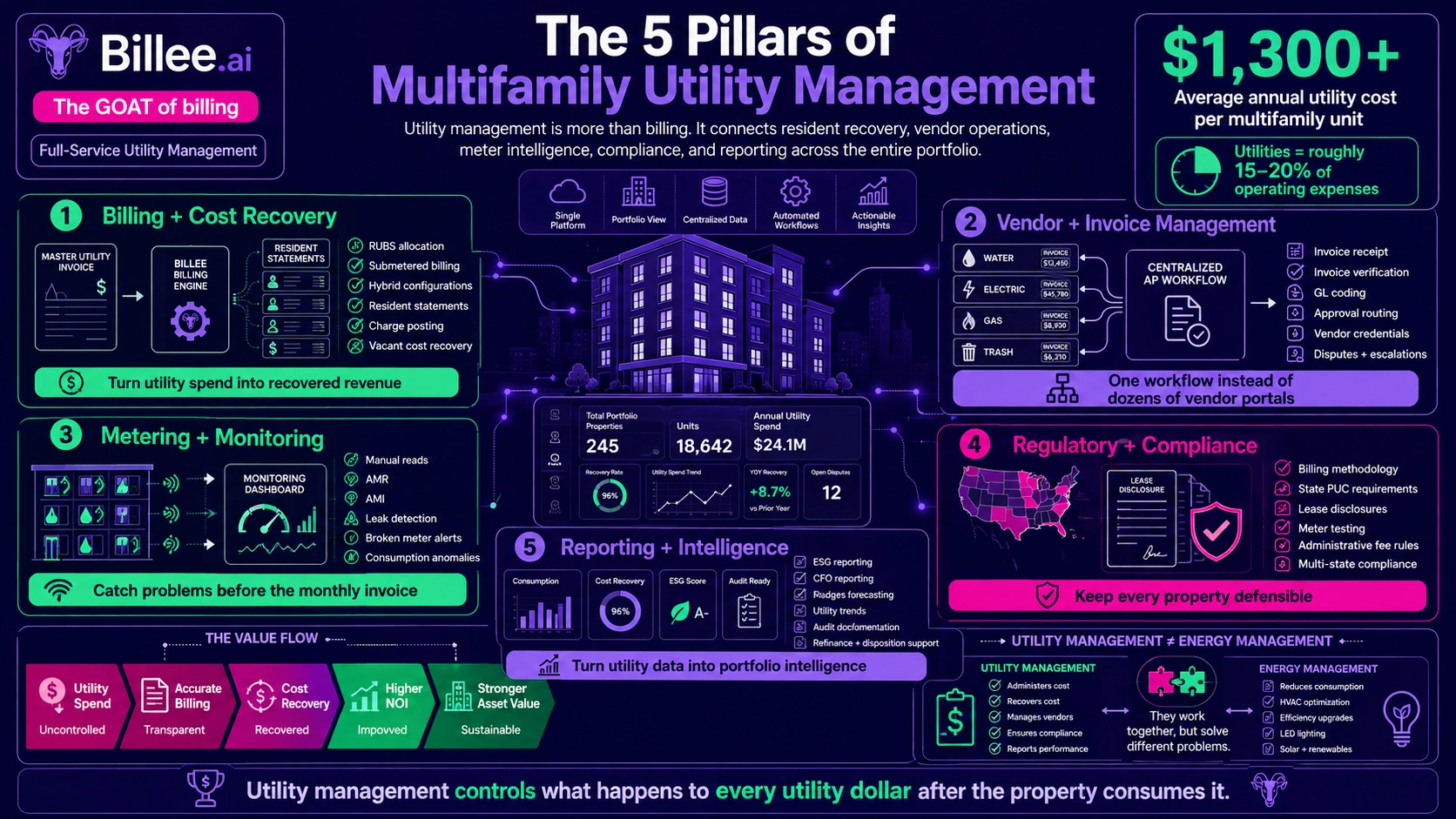
Multifamily utility management is the operational function that covers utility billing, vendor and invoice management, meter monitoring, regulatory compliance, and cost recovery across a portfolio. It typically costs multifamily properties more than $1,300 per unit per year, making it one of the largest controllable expense lines an operator manages. Operators run it in-house, through software-only platforms, or through full-service managed providers such as Billee.
Key takeaways
- Multifamily utility management covers five core functions: billing and cost recovery, vendor and invoice management, metering and monitoring, regulatory compliance, and reporting.
- Utilities cost the average multifamily property more than $1,300 per unit per year, per NAA's 2026 Income/Expense IQ research, and that figure has climbed further with 2026 rate increases.
- Utilities represent a significant, non-moderating share of multifamily operating expenses.
- Operators can run utility management in-house, through software-only platforms, or through full-service managed providers.
- Utility management is distinct from energy management: one recovers and administers cost, the other reduces consumption.
- Billee runs utility management as a hybrid of dedicated team and modern platform, covering all five core functions.
What multifamily utility management covers
Multifamily utility management is the set of operational functions that determine how a property bills residents for utilities, manages the vendors and invoices behind those utilities, tracks meter data, stays compliant with state regulation, and reports on all of it. Five functions make up the core of the discipline.
| Function | What it covers |
|---|---|
| Billing and cost recovery | Allocating utility costs to residents through RUBS, submetering, direct billing, flat-fee, or utility-inclusive models |
| Vendor and invoice management | Receiving, coding, and approving utility invoices; managing vendor relationships and credentials |
| Metering and monitoring | Reading meters (manual, AMR, or AMI) and catching leaks, broken hardware, or anomalies |
| Regulatory and compliance management | Meeting state PUC disclosure, testing, and billing-methodology rules |
| Reporting | Turning consumption data into ESG, CFO, budget, and audit-ready reports |
Utility billing and cost recovery
Billing and cost recovery is the function most people mean when they say "utility management." A property has to decide how it allocates the cost of water, electric, gas, trash, and other utilities across its residents: RUBS allocates a master-metered bill by formula, submetering measures and bills each unit's actual consumption, and some properties use direct billing, a flat monthly fee, or fold utilities into rent entirely. The method a property chooses determines how much of its utility spend it actually recovers from residents rather than absorbs as an operating cost.
Utility vendor and invoice management
Every property works with a long list of utility vendors, water, electric, gas, trash, and sometimes more, and each one sends invoices on its own schedule through its own portal. Utility vendor management covers receiving those invoices, coding them to the right general ledger accounts, routing them for approval, and managing the vendor relationship itself, including credential handling and dispute resolution. Skipping this function does not make it disappear. It just means someone on the property team is doing it manually, one login at a time.
Metering and consumption monitoring
Meters are the source of truth for both billing and building health. Properties read them manually, through automated meter reading (AMR) that transmits on a set schedule, or through advanced metering infrastructure (AMI) that transmits continuously and can flag a consumption spike the same day it happens. The choice between AMR and AMI affects both billing accuracy and how quickly a leak or broken meter gets caught.
Regulatory and compliance management
State Public Utility Commissions regulate how utility costs can be billed back to residents, and the rules are not uniform. Texas and California both have detailed statutory frameworks; most other states rely on lease-addendum disclosure instead. A multi-state portfolio has to track and document compliance in every jurisdiction it operates in, not only its home state. Utility management compliance for multifamily properties covers the current state-by-state landscape in full.
Reporting: ESG, CFO, and audit-ready data
Utility consumption data is the raw input for several reporting obligations that have nothing to do with the resident bill itself: ESG disclosures to institutional owners and lenders, CFO-level portfolio reporting, budget forecasting, and the utility documentation buyers and lenders request before a refinancing or sale. How multifamily operators build ESG reports from utility data walks through how that reporting actually gets assembled.
Why utility management matters for multifamily operators
Utilities cost the average multifamily property more than $1,300 per unit per year, and that baseline has only climbed with 2026 rate increases across electricity, gas, and water. Multifamily utility management statistics and industry trends covers the full 2026 numbers.
Utilities as a share of operating expenses
Per Billee's analysis of the category, utilities account for roughly 15 to 20 percent of a typical multifamily property's operating expenses, one of the few categories that has not moderated in recent years even as other line items have leveled off. A share that large means small improvements in recovery translate directly into NOI.
What poor utility management costs a portfolio
The cost of neglecting utility management rarely shows up as one dramatic failure. It shows up as a billing error that goes uncaught for months, a vacant unit that keeps drawing water nobody notices, or a RUBS formula that was accurate three renovations ago and has not been touched since. Top multifamily utility management mistakes to avoid covers the ten most common versions of this problem, and the fix for each.
The NOI and asset-value connection
Utility recovery flows directly into NOI, and NOI is what buyers and lenders price a property on. That connection becomes explicit during refinancing or disposition, when buyers and lenders typically request months of utility billing records and expect a defensible methodology behind them. Preparing utility cost data for refinancing or disposition covers what that documentation package needs to include.
How utility management actually works, month to month
Regardless of who runs it, utility management follows roughly the same operational rhythm every billing cycle.
Invoice receipt and vendor management
Utility invoices arrive from every vendor on the property's account list, on whatever schedule that vendor bills. Someone has to receive each one, verify it against the prior cycle, and route it into the workflow before it can be coded or paid.
Allocation and billing calculation
Once invoice and meter data are in hand, the property's billing methodology gets applied, whether that is a RUBS formula, submeter reads, or a flat fee, to calculate what each resident owes for the cycle.
Resident billing and collection
Statements go out to residents, payments come back in, and any disputes or questions about a specific charge get resolved before the next cycle starts.
Reconciliation, audits, and exception handling
The cycle closes with reconciliation: checking billed amounts against actual meter and invoice data, catching exceptions like a vacant unit with usage or a meter that stopped reporting, and correcting anything that is wrong before it repeats next month.
Who handles utility management: in-house, software, or managed service
Operators generally run utility management through one of three models.
Running it in-house
A property team handles vendor relationships, billing calculations, and compliance directly, usually with a spreadsheet or their PMS's native tools. This works when a portfolio is small, single-market, and the team already has bandwidth for it.
Software-only platforms
A platform automates parts of billing and reporting, but the operator's own team still does the operational work: reviewing exceptions, following up with vendors, and staying on top of compliance changes. The software makes the work faster. It does not remove it.
Full-service managed providers
A dedicated team runs the function on the operator's behalf, software included, so the property team reviews and approves rather than operates the system directly.
| Model | Who does the work | Best fit |
|---|---|---|
| In-house | The property or regional team, using spreadsheets or the PMS's native tools | Small, single-market portfolios with existing bandwidth |
| Software-only | The operator's team, using a platform to speed up billing and reporting | Teams that want automation but are comfortable staying hands-on |
| Full-service managed | A dedicated external team, backed by software | Multi-state portfolios, teams without dedicated utility staff, or owners who want one accountable point of contact |
How to decide which model fits
A few questions narrow the decision quickly. How many states does the portfolio operate in, and how much does compliance tracking vary across them? Does the property team have bandwidth to own vendor relationships and billing exceptions, or is that falling to whoever has time that week? Is vacant-unit cost recovery already a known, unaddressed gap? Is utility recovery performance visible at the portfolio level, or only property by property?
Utility management vs. energy management: how they differ
Utility management and energy management get used interchangeably, but they answer different questions. Utility management recovers and administers cost that is already being spent: billing residents accurately, managing vendors, staying compliant. Energy management reduces how much gets consumed in the first place, through HVAC optimization, LED upgrades, solar, and similar measures.
The two work together. A property with efficient equipment still needs accurate billing, and a property with accurate billing still benefits from lower consumption, but they remain distinct disciplines with different levers. Multifamily energy management best practices covers the consumption-reduction side in full.
How Billee approaches multifamily utility management
Billee runs multifamily utility management as a hybrid of dedicated team and modern platform, covering all five functions described above under one relationship rather than five separate vendors. The Billee platform handles billing calculation, meter data, and reporting; the dedicated account team handles vendor relationships, exceptions, compliance, and the work that a dashboard alone cannot finish. Every customer works with a named team, not a ticket queue.
FAQ
What is multifamily utility management?
Multifamily utility management is the operational function that covers utility billing, vendor and invoice management, meter monitoring, regulatory compliance, and reporting for a multifamily property or portfolio.
What's included in a multifamily utility management program?
A complete program includes five functions: billing and cost recovery, vendor and invoice management, metering and consumption monitoring, regulatory compliance, and reporting for ESG, CFO, and audit purposes.
How much do utilities cost multifamily properties on average?
Utilities cost the average multifamily property more than $1,300 per unit per year, and that figure has climbed further with rate increases in 2026.
What's the difference between utility management and energy management?
Utility management recovers and administers cost that is already being spent, through billing, vendor management, and compliance. Energy management reduces how much gets consumed in the first place, through efficiency upgrades and equipment changes.
Should utility management be handled in-house or outsourced?
It depends on portfolio size, multi-state compliance exposure, and whether the property team has bandwidth to own vendor relationships and billing exceptions directly. Smaller, single-market portfolios often manage it in-house; multi-state or short-staffed portfolios more often move to a managed service.
What's the difference between RUBS and submetering?
RUBS allocates a master-metered utility bill across units using a formula, typically based on square footage or occupancy. Submetering measures each unit's actual consumption with individual meters and bills accordingly. Submetering generally recovers a higher share of utility costs; RUBS requires no metering hardware.
How does utility vendor management work?
Utility vendor management covers receiving invoices from every utility vendor on a property's account list, coding and approving them, and managing the vendor relationship itself, including credentials, escalations, and disputes.
Does Billee handle multifamily utility management?
Yes. Billee runs utility billing, vendor management, meter monitoring, compliance, and reporting as one hybrid service, combining a dedicated account team with the Billee platform.
Billee runs utility billing, vendor management, meter monitoring, compliance, and reporting as one hybrid service for multifamily operators who want the whole function handled for them. Talk to the team about your portfolio.
Sources
- National Apartment Association, "From Momentum to Management: Navigating Elevated Costs in a Constrained Operating Environment," 2024 Income/Expense IQ (IREM/BOMA), accessed 2026.
Insights and Industry Trends