
How Multifamily Operators Build ESG Reports from Utility Data
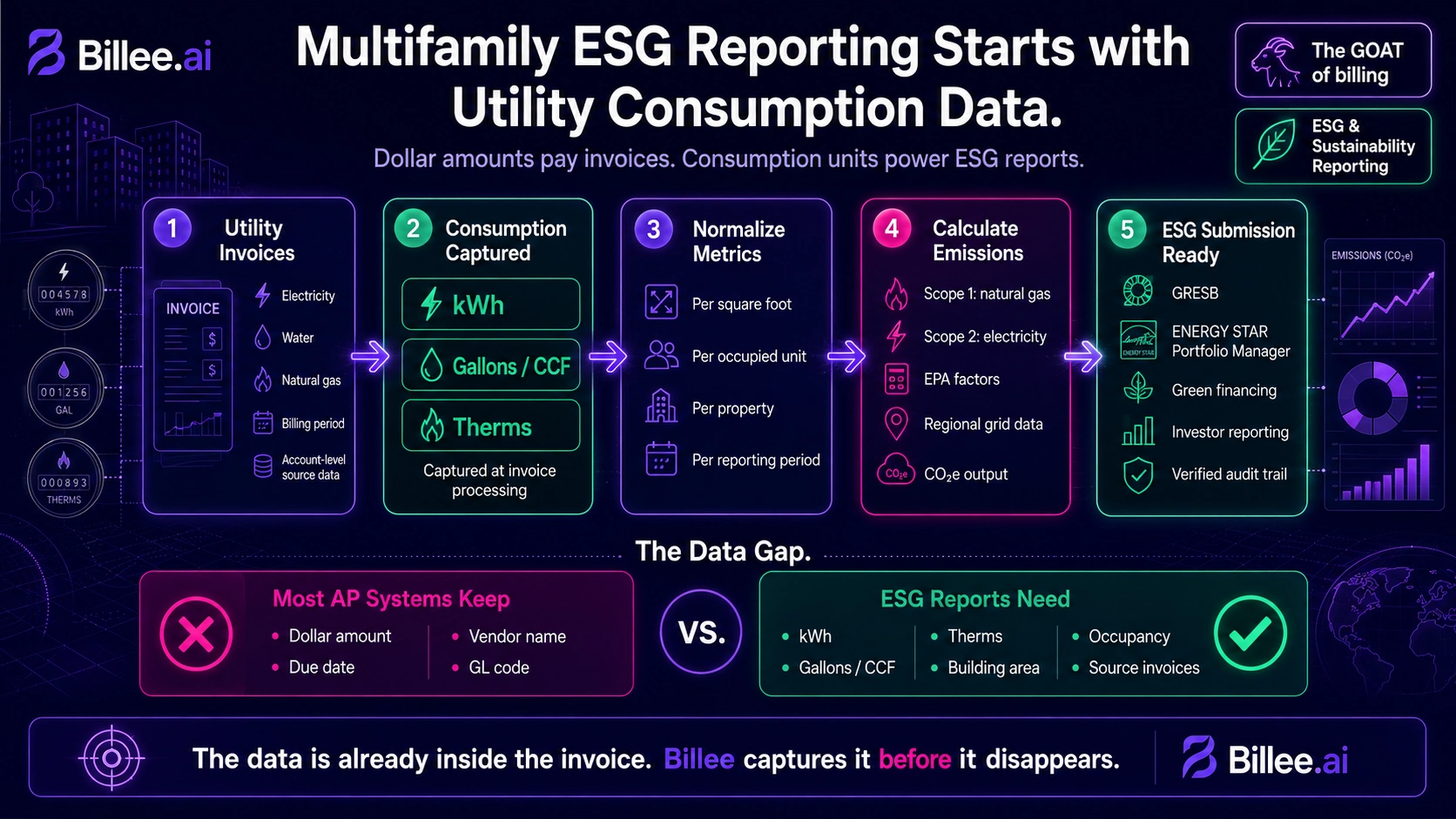
Multifamily ESG reports are built primarily from utility consumption data: electricity (kWh), water (gallons or CCF), and natural gas (therms), plus derived greenhouse gas emissions. The challenge is that most operators manage utility data at the invoice level in dollar amounts, which is what AP needs, rather than at the consumption level, which is what ESG frameworks require. Building an ESG report means extracting consumption data from utility invoices, normalizing it to intensity metrics per unit or per square foot, and mapping it to the reporting framework in use: whether GRESB, ENERGY STAR Portfolio Manager, or a lender's green financing program. Billee's ESG & Sustainability Reporting product captures consumption data from every utility invoice as part of the standard AP workflow, so that data is available for reporting without a separate collection project.
Key Takeaways
ESG reports for multifamily are built from utility consumption data: electricity (kWh), water (gallons or CCF), and natural gas (therms). These figures are embedded in every utility invoice but are not retained by most operators' AP systems, which capture only the dollar amount.
The three most common ESG reporting frameworks for multifamily are GRESB (institutional investors), ENERGY STAR Portfolio Manager (EPA benchmarking and lender requirements), and lender-specific green financing programs such as Fannie Mae Green Rewards and Freddie Mac Green Advantage.
Emissions reporting requires a conversion step: consumption data multiplied by EPA emissions factors produces CO2e (carbon dioxide equivalent). Scope 2 emissions from electricity vary by regional grid and change annually, requiring updated EPA eGRID factors each reporting cycle.
ESG intensity metrics (consumption per square foot per year, water per occupied unit per month) require combining utility consumption data with building area and occupancy data. These three data elements typically live in three different systems and are not automatically combined in any of them.
GRESB and institutional investors increasingly require third-party verified consumption data traceable to source utility invoices. Reports built from estimates, summary statements, or manual aggregations that cannot be reconciled to individual invoices fail verification.
Billee captures consumption data at the invoice level as part of the standard AP audit step, creating a consumption history organized by property, utility type, and period that feeds directly into ENERGY STAR and GRESB submissions.
What ESG Reports Actually Measure and Where the Data Comes From
ESG reports for multifamily real estate center on environmental metrics because they are quantifiable, auditable, and directly tied to operating costs. The three primary inputs are electricity consumption (kWh), water consumption (gallons or CCF), and natural gas consumption (therms). Each figure is embedded in the utility invoice for that account: the invoice includes the units consumed alongside the dollar amount billed.
The problem is that most AP workflows are configured to capture only the dollar amount for GL coding and payment. The consumption figure is present in the invoice but discarded or ignored by the time the invoice reaches the ledger. That gap between what the invoice contains and what the AP system retains is where ESG data collection falls apart for most multifamily operators.
Utility invoices are the primary source document for ESG reporting. The data is there. The question is whether anyone captured it.
The ESG Frameworks Multifamily Operators Report Against
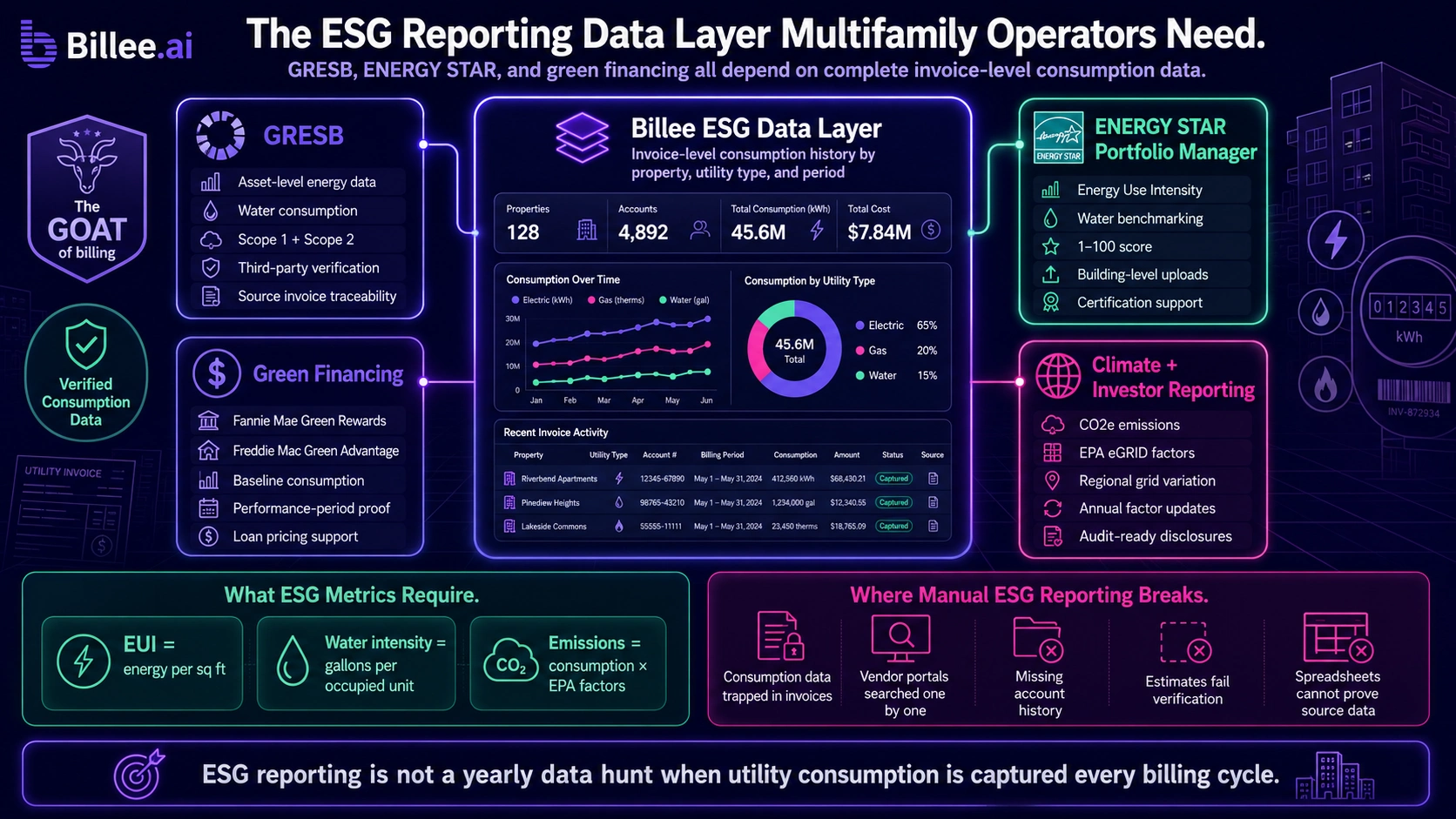
Each framework has different data requirements, different intensity metrics, and different verification standards. Understanding which framework applies is the first step in knowing what data to collect and how to structure it.
GRESB (Global Real Estate Sustainability Benchmark)
GRESB is the dominant ESG reporting framework for institutional real estate. Pension funds, sovereign wealth funds, and real estate investment managers use GRESB scores to evaluate and compare portfolio sustainability performance across their holdings. Participation is voluntary but has become effectively mandatory for operators with institutional capital partners: limited partners increasingly require it as a condition of investment. Per GRESB's 2024 Real Estate Results, more than 2,200 real estate entities participated in the 2024 assessment, representing over $8.8 trillion in gross asset value.
The GRESB Real Estate Assessment requires energy consumption data (kWh and GJ), water consumption (cubic meters), waste diversion, and greenhouse gas emissions (Scope 1 and Scope 2), organized at the asset level. GRESB also scores management practices alongside the performance data, so an operator needs both a consumption data set and documented sustainability policies to score well. Third-party verification of the consumption data is required for a verified GRESB submission.
ENERGY STAR Portfolio Manager
ENERGY STAR Portfolio Manager, managed by the U.S. Environmental Protection Agency, is the most widely used energy benchmarking tool in U.S. multifamily and commercial real estate. Operators upload electricity, gas, and water consumption data by building, and Portfolio Manager generates an Energy Use Intensity (EUI) score and, where applicable, a 1–100 ENERGY STAR score comparing the property to similar buildings nationally.
Fannie Mae and Freddie Mac reference Portfolio Manager scores in their green financing programs. Several cities with building performance standards, including New York, Denver, and Boston, use Portfolio Manager as the compliance reporting mechanism. Properties scoring 75 or above on the 1–100 scale can apply for ENERGY STAR certification, which is increasingly referenced in acquisition marketing and lease negotiations. Multifamily properties of all sizes are eligible to benchmark in Portfolio Manager.
Fannie Mae Green Rewards and Freddie Mac Green Advantage
Both Fannie Mae and Freddie Mac offer reduced-rate financing for multifamily properties that commit to measurable energy or water efficiency improvements. Fannie Mae Green Rewards requires a minimum 25% reduction in energy or water consumption, verified against pre-upgrade baseline utility consumption data. Freddie Mac Green Advantage has similar structure.
In both programs, the utility invoice history is the verification record. Lenders require utility bills covering the baseline period and the performance period to confirm that the committed reduction was achieved. An operator without organized, period-specific consumption records cannot demonstrate compliance and loses access to the improved loan pricing. The same invoice history that supports ESG reporting supports green financing verification.
SEC Climate Disclosure Rules
The SEC's climate disclosure rules, applicable to Large Accelerated Filers, require disclosure of material climate-related risks and Scope 1 and Scope 2 greenhouse gas emissions in annual filings. For multifamily operators that are publicly reporting companies, this creates an obligation to calculate and disclose portfolio-level emissions derived from utility consumption data, with auditor assurance on the emissions figures. Smaller operators and private companies are not yet subject to SEC disclosure rules, but institutional investors increasingly require equivalent disclosure in annual reporting packages regardless of filing status.
The Consumption-Level Data Problem
ESG frameworks require consumption units (kWh, gallons, therms), not dollar amounts. Most multifamily AP systems are configured to capture dollar amounts and due dates, the information needed to process payments. They either do not capture consumption figures or capture them inconsistently across accounts and vendors.
Extracting consumption data after the fact means returning to individual utility vendor portals, locating the original invoice for each account and each billing period, and pulling the consumption figure manually. For a 20-property portfolio with 60 utility accounts, that is 720 invoice lookups per year of reporting history. This is why operators who attempt ESG reporting without a consumption-tracking system typically start late, report incomplete data, or hire a consultant who performs the same portal-lookup work at hourly rates.
The consumption data problem is also a completeness problem. A GRESB submission or a Fannie Mae Green Rewards application requires complete coverage across all metered accounts for the reporting period. Gaps (accounts that changed vendors, properties acquired mid-year, invoices processed outside the normal workflow) produce an incomplete data set that cannot be verified and undermines the submission.
Calculating Scope 1 and Scope 2 Emissions
Once consumption data is in hand, greenhouse gas emissions are calculated in two steps using published EPA factors.
Scope 1 emissions come from direct combustion of natural gas on-site. Per the EPA's GHG Emission Factors Hub, natural gas combustion produces approximately 53.06 kg CO2e per MMBtu, or roughly 5.5 kg CO2e per therm. Multiplying total natural gas consumption in therms by this factor produces the Scope 1 emissions figure for the property or portfolio.
Scope 2 emissions come from purchased electricity. kWh consumed is multiplied by the regional grid emission factor from the EPA eGRID database, which publishes factors by grid subregion. These factors vary significantly by geography: an operator in the Pacific Northwest, where the grid is predominantly hydroelectric, has Scope 2 emissions roughly one-tenth of an equivalent operator in a coal-heavy Midwest grid region for identical electricity consumption. eGRID factors update annually; the correct factor for a given reporting year must match the year of consumption, not the year of reporting.
The emissions calculation is straightforward once the consumption data exists. The challenge is not the math; it is having the kWh and therms figures organized by property and period before the calculation can begin.
ESG Intensity Metrics: EUI, Water Intensity, and Why Per-Unit Matters
Total consumption figures track a portfolio's absolute footprint but are not directly comparable across properties of different sizes or occupancy levels. ESG frameworks use intensity metrics to normalize for scale.
Energy Use Intensity (EUI) is the primary energy metric: total site energy consumption in kBtu divided by gross floor area in square feet, expressed as kBtu/sq ft/year. ENERGY STAR benchmarks multifamily EUI against comparable building types nationally; a lower EUI score relative to peers indicates a more efficient building. Water intensity is typically expressed as gallons per occupied unit per month, normalizing for both building size and occupancy.
Calculating these metrics requires combining three data elements: utility consumption data from invoices, building gross floor area from property records, and occupancy data from the PMS. None of the three systems that hold these elements (utility vendor portals, property records, and the PMS) automatically combines them into a reportable format. The operator has to bridge all three, usually in a spreadsheet, for each property in the portfolio.
Third-Party Verification: Why Invoice-Level Data Is the Baseline
Institutional investors and GRESB require that ESG consumption data be verifiable to source documents. A portfolio-level energy consumption figure is not a verified claim unless the underlying utility invoices can be produced to reconcile it.
Third-party verifiers (typically audit firms or sustainability consultants) request original invoices and trace reported consumption figures back to individual billing statements, period by period, account by account. An operator whose ESG report was built from utility company summary statements, from manual aggregations that cannot be traced to individual invoices, or from estimates for accounts with missing data will face a verification gap that requires additional documentation or forces restatement.
The practical implication: the invoice-level consumption record that supports ESG verification is the same record that supports AP accuracy, billing error detection, and transaction diligence. It is one data set with multiple uses. Operators who maintain it for AP purposes get the ESG verification trail at no additional cost. Operators who do not face the data-collection problem every time a new reporting requirement arrives.
How Billee's ESG Reporting Product Works
Billee captures consumption data from every utility invoice as part of the standard AP audit step. When an invoice is processed, the consumption figure (kWh, gallons, or therms) is recorded alongside the dollar amount, billing period, and property. This creates a consumption history at the invoice level, organized by property and utility type, that is available for ESG reporting without a separate collection project.
The customer portal at app.billee.ai provides consumption trends by property and utility type, organized in the format that ENERGY STAR Portfolio Manager uploads and GRESB data submissions require. For operators reporting against multiple frameworks simultaneously, the same consumption data set serves all of them.
Billee's ESG & Sustainability Reporting product is one of seven products on the Billee platform. Operators who use Billee for utility vendor management and AP automation receive the ESG consumption data layer as a byproduct of the normal AP workflow. The annual reporting cycle starts from a complete, verified data set rather than a data-collection sprint.
Implementation takes 45 days. Vendor onboarding, rate schedule configuration, and PMS integration are handled by the Billee team.
Billee captures utility consumption data at the invoice level as a standard output of the AP workflow, so multifamily ESG reports start from a complete, verified data set rather than a collection sprint. See how it works for your portfolio.
FAQ: Utility Data and ESG Reporting for Multifamily
What utility data do multifamily operators need for ESG reporting?
Multifamily ESG reports require utility consumption data at the account level: electricity in kWh, water in gallons or CCF, and natural gas in therms, organized by property and billing period. Dollar amounts alone are not sufficient; ESG frameworks require consumption units to calculate Energy Use Intensity, water intensity, and greenhouse gas emissions. Most operators have this data in their utility invoices; the challenge is whether their AP workflow captures and retains the consumption figures rather than only the payment amounts.
What is GRESB and how does it apply to multifamily real estate?
GRESB (Global Real Estate Sustainability Benchmark) is the leading ESG reporting framework for institutional real estate investors and their portfolio companies. Multifamily operators with institutional investors (pension funds, sovereign wealth funds, private equity funds) are increasingly required to participate in the annual GRESB Real Estate Assessment, which scores both management practices and measured performance data including energy, water, waste, and greenhouse gas emissions. Per GRESB's 2024 results, over 2,200 real estate entities representing $8.8 trillion in gross asset value participated. Third-party verification of consumption data is required for a verified GRESB submission.
How do I calculate Scope 1 and Scope 2 emissions from utility data?
Scope 1 emissions (direct, from on-site natural gas combustion) are calculated by multiplying natural gas consumption in therms by the EPA's emission factor for natural gas combustion (approximately 5.5 kg CO2e per therm). Scope 2 emissions (indirect, from purchased electricity) are calculated by multiplying kWh consumed by the regional grid emission factor from the EPA eGRID database, which varies by subregion and updates annually. Both calculations require consumption-level data (therms and kWh), not invoice totals in dollars.
What is Energy Use Intensity (EUI) and why does it matter for multifamily ESG reporting?
Energy Use Intensity (EUI) is total site energy consumption in kBtu divided by gross floor area in square feet per year, expressed as kBtu/sq ft/year. It is the primary metric for comparing energy efficiency across buildings of different sizes, and it is the basis for ENERGY STAR benchmarking scores. ENERGY STAR Portfolio Manager uses a property's EUI to generate a 1–100 score comparing it to similar multifamily buildings nationally. Properties scoring 75 or above qualify for ENERGY STAR certification, which is referenced by some lenders, municipalities, and tenants in green lease negotiations.
How do I get consumption-level utility data (kWh, gallons, therms) for my multifamily portfolio?
Consumption figures are printed on every utility invoice alongside the dollar amount billed, but most AP systems capture only the dollar amount. Retrieving consumption data retroactively requires returning to individual vendor portals and pulling each invoice manually, a significant time investment for a large portfolio. The alternative is a utility management platform that captures consumption figures at invoice processing time and retains them by property and period. Billee captures consumption data from every invoice as part of the standard AP audit step, making the data available for ESG reporting without a separate retrieval project.
Sources
GRESB, "2024 Real Estate Results," 2024. (Participation figures: 2,200+ entities, $8.8 trillion gross asset value.)
U.S. Environmental Protection Agency, "ENERGY STAR Portfolio Manager," accessed July 2026.
U.S. Environmental Protection Agency, "GHG Emission Factors Hub," 2024. (Natural gas combustion: 53.06 kg CO2e per MMBtu.)
U.S. Environmental Protection Agency, "eGRID: Emissions and Generation Resource Integrated Database," 2023 data release.
Fannie Mae, "Green Rewards Overview," accessed July 2026.
Insights and Industry Trends