
How Submetering Works in Multifamily Properties
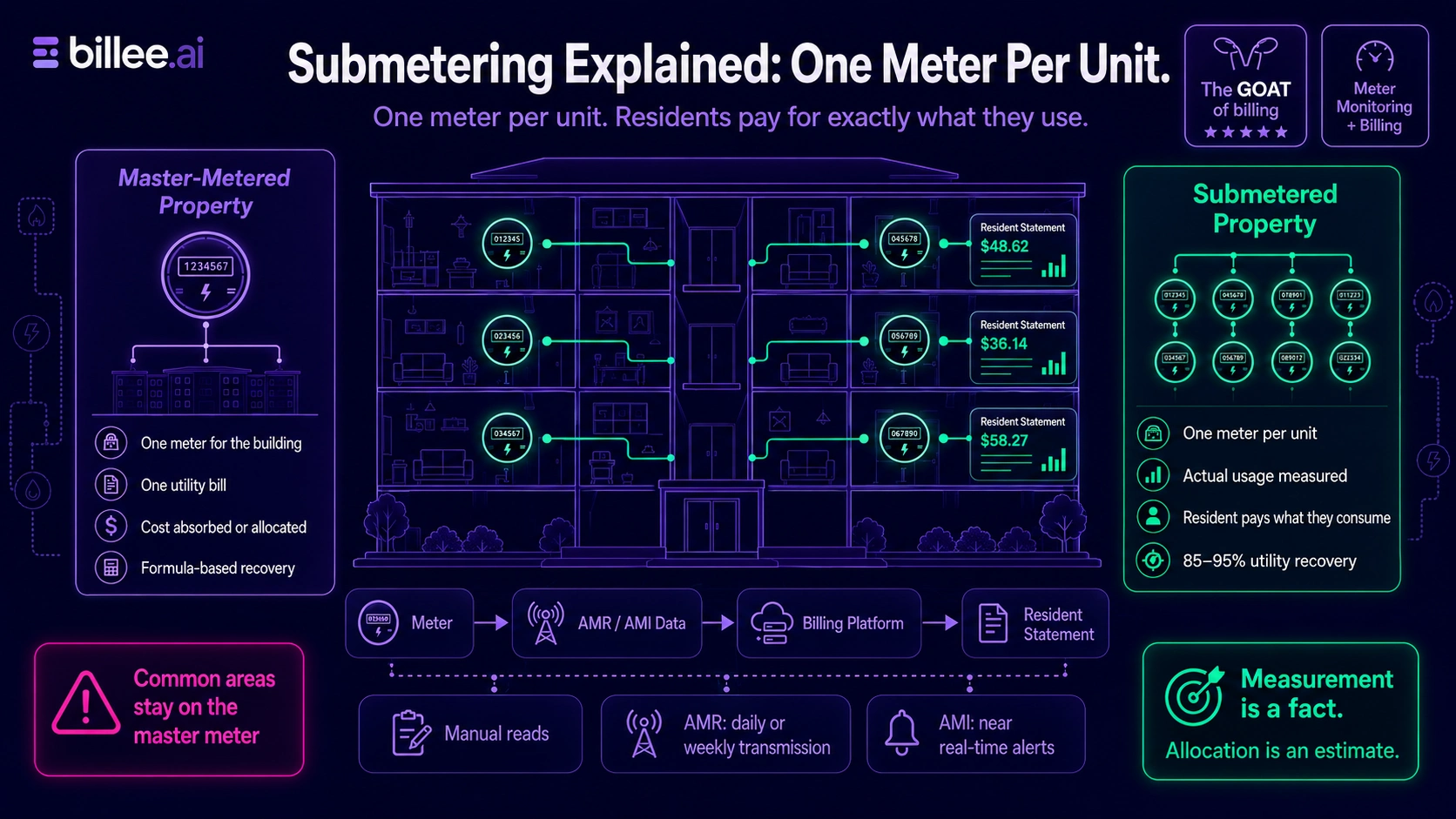
Submetering installs an individual utility meter at each unit and bills residents for exactly what they consume — water, electric, or gas. Properties using submetering recover an average of 85–95% of utility costs. That compares to 70–85% with RUBS and 0% when utilities are absorbed in rent. Billee manages submetering billing and meter monitoring as part of its full-service utility management offering for multifamily portfolios.
Key takeaways: A submeter measures one unit's actual consumption — residents pay for what they use, not an allocated share. Submetering produces the highest utility cost recovery of any billing methodology: 85–95%, versus 70–85% for RUBS. A two-year EPA study documented a 15.3% reduction in water use in submetered properties — statistically significant, with no comparable reduction seen under RUBS. Water submeters cost $300–$1,500 per unit to install; most operators recover that within 8–14 months. Regulations vary by state — most cap submetered rates at the utility tariff rate and require lease disclosure.
The core difference: one meter per building versus one meter per unit
In a master-metered property, one meter at the building boundary measures everything the property consumes. The operator gets one utility bill and either absorbs that cost or allocates it across units through RUBS or a similar formula.
Submetering changes the measurement point. An individual meter sits inside or adjacent to each unit and records only that unit's consumption. That reading — not a formula — is what the resident is billed for.
The distinction matters: allocation is an estimate. Measurement is a fact. Residents respond differently to the two.
What gets submetered — and what stays on the master meter
Water is the most commonly submetered utility in multifamily. It is also the most disputed, because consumption varies significantly by household size, behavior, and fixture condition. Install cost ranges from $300 to $1,500 per unit, depending on building age, plumbing layout, and meter technology.
Electric submetering applies where residents do not have their own utility accounts with the local utility company. Install cost runs $250–$500 per unit.
Gas submetering is less common and technically more complex to retrofit in older buildings.
Common areas — hallways, laundry rooms, outdoor lighting, amenities — remain on the master meter regardless of billing methodology. The operator owns those utility costs.
How the data moves from the meter to the bill
Once installed, a submeter's consumption data travels to the billing platform through one of three read methods.
Manual reads: A staff member walks the property, records each meter reading, and enters the data into a billing system. This works for smaller properties but introduces human error and leaves a monthly window during which leaks go undetected.
AMR (Automated Meter Reading): Meters transmit wirelessly on a scheduled basis — typically daily or weekly. No manual walks required. Data lands in the billing platform automatically.
AMI (Advanced Metering Infrastructure): Meters transmit continuously in near real time. A consumption spike in unit 14B at 3 a.m. that looks like a running toilet triggers an alert before the next billing cycle — not after the bill arrives.
The practical difference between AMR and AMI is response time. AMR tells you what happened at month-end. AMI tells you what is happening now.
What submetering recovers — and why residents conserve more
Submetered properties recover an average of 85–95% of utility costs. RUBS typically produces 70–85%. Properties with utilities included in rent recover 0%.
The gap is both structural and behavioral. A two-year EPA study found that submetered multifamily properties reduced water consumption by 15.3%, or 21.8 gallons per unit per day. That reduction was statistically significant. Properties using RUBS showed no statistically significant water use reduction compared to utilities-in-rent buildings.
Residents reduce consumption when their bill reflects their individual behavior. RUBS gives them no price signal to respond to. Submetering does.
What installation costs and when you break even
Water submeter installation runs $300–$1,500 per unit. The variation reflects building age, existing plumbing configuration, and whether the building uses wireless or wired hardware.
Electric submeter installation costs $250–$500 per unit. These are the two utility types most commonly submetered in multifamily.
Most operators recover the installation cost within 8–14 months through increased utility cost recovery. Properties with high per-unit utility rates and larger unit counts pay back faster.
What state regulations require
Submetering is regulated by each state's Public Utility Commission, and the rules differ materially across markets.
Most states apply two baseline requirements. First, rate caps: the amount billed to a resident cannot exceed the rate the utility charges at the tariff level. Submetering is cost recovery, not a revenue source. Second, disclosure: the lease must state clearly that the unit is individually metered and that billing reflects only that unit's usage.
In Texas, PUC Rule §25.141 governs submetering requirements specifically, including disclosure language and operator obligations. In California, SB 7 mandates submetering for all new multifamily buildings applying for a water connection after January 1, 2018.
Non-compliant submetering creates regulatory exposure and can complicate refinancing and disposition. Check state PUC rules before installation.
When submetering fits — and when RUBS is the better call

Many operators use a hybrid approach: submeter water (the highest-dispute utility) and apply RUBS to electric or gas in buildings where full submetering is not feasible. That is a practical and common structure.
How Billee manages submetering for your portfolio
Billee handles submetering billing, meter monitoring, and exception response as part of its full-service utility management platform. When a consumption anomaly appears — a leak, a vacant unit drawing water, a usage spike outside normal range — Billee's account team acts on the alert. You get the outcome. You do not get a notification and a to-do item.
Billee's platform also integrates with Yardi, RealPage, and Entrata, so submetering data flows into your existing property management stack without a separate reporting process.
Billee manages submetering and RUBS billing for multifamily operators who want accurate utility cost recovery without operating the system themselves. See how it works for portfolios like yours.
Frequently asked questions
What is submetering in multifamily housing?
Submetering installs an individual utility meter at each unit to measure that unit's actual water, electric, or gas consumption. The resident is billed for what they use, rather than receiving an allocated share of the building's total utility bill.
How does submetering compare to RUBS?
Submetering bills residents for measured consumption. RUBS allocates utility costs across units using a formula based on square footage, occupancy, or both. Submetering produces higher recovery (85–95% versus 70–85% for RUBS) and reduces consumption measurably. RUBS requires no hardware but provides no individual price signal to residents.
Does submetering actually reduce utility consumption?
A two-year EPA study documented 15.3% water savings in submetered multifamily properties — statistically significant. Properties on RUBS showed no significant reduction versus utilities-in-rent buildings. Residents reduce consumption when their bill reflects their individual behavior.
What does it cost to submeter a multifamily property?
Water submeters cost $300–$1,500 per unit to install, depending on building age and technology. Electric submeters cost $250–$500 per unit. Most operators recover the installation cost within 8–14 months through increased utility cost recovery.
Is submetering legal in every state?
Submetering is legal in most states and governed by state Public Utility Commissions. Rules vary. Most states prohibit charging residents above the utility's tariff rate. California mandates submetering for all new multifamily construction since January 2018. Texas requires specific lease disclosures under PUC Rule §25.141. Verify your state's rules before installing.
What is the difference between AMR and AMI meters?
AMR (Automated Meter Reading) transmits meter data wirelessly on a set schedule — daily or weekly. AMI (Advanced Metering Infrastructure) transmits continuously and flags anomalies in near real time, such as a consumption spike that may indicate a leak or a vacant unit drawing water. AMI is the more capable system for operators who want proactive monitoring.
Does Billee handle submetering billing?
Billee manages submetering billing, meter monitoring, and anomaly response as part of its full-service utility management platform. When a usage exception appears, the Billee account team takes action rather than routing a notification back to the operator.
Sources
United States Environmental Protection Agency. “WaterSense: Learn About Submetering.” EPA WaterSense Program, accessed June 2026.
Texas Public Utility Commission. “Rule §25.141: Submetered and Allocated Utility Service.” Updated 2024.
California Legislative Information. “SB 7: Water — Multiunit Residential Real Property.” Enacted 2008.
National Multifamily Housing Council. “Quick Facts: Apartment Market.” NMHC Research & Insight, 2025.
U.S. Department of Energy, Office of Energy Efficiency & Renewable Energy. “Building Technologies Office.” 2025.
U.S. Environmental Protection Agency. “ENERGY STAR Multifamily New Construction.” Accessed June 2026.
National Apartment Association. “Utility Expense Management Resources.” 2025.
Insights and Industry Trends