
What Is Utility Vendor Management? A Complete Guide for Multifamily Operators
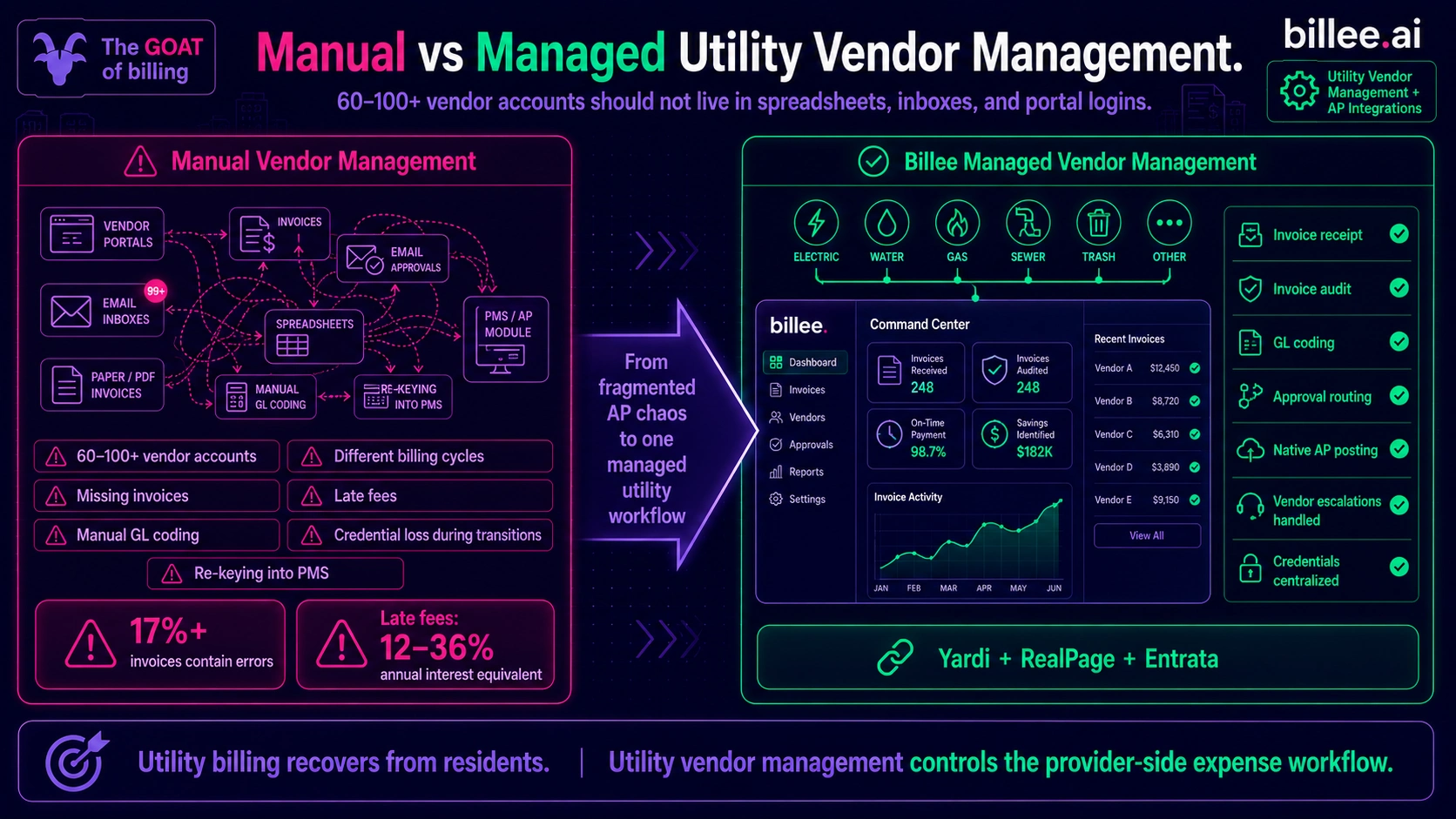
Utility vendor management is the function of overseeing utility service providers on behalf of a multifamily portfolio: receiving invoices, auditing them for errors, coding them to the correct GL, routing them for approval, and posting them to the property management system. Most multifamily portfolios manage 60–100+ utility vendor accounts across water, electric, gas, trash, telecom, and stormwater, each on a different billing cycle, each with its own portal and escalation path. Billee’s Utility Vendor Management + AP Integrations product takes this function off the property team entirely, integrating directly with Yardi, RealPage, and Entrata to handle every step from invoice receipt to ledger posting.
Key Takeaways
Utility vendor management and utility billing are distinct functions: vendor management handles the property-to-provider relationship; billing handles the property-to-resident relationship.
A 20-property portfolio can carry 60–100+ active utility vendor accounts, each with its own portal, billing cycle, and escalation contact.
At least 17% of utility invoices contain an error, according to ENGIE Impact, one of the nation’s largest utility billing auditors.
Most utility companies assess late fees equivalent to 12–36% annual interest, making missed payment deadlines one of the most expensive preventable costs in a multifamily portfolio.
The same utility vendor may require different GL codes per property, service type, and ownership structure, making manual GL coding structurally error-prone at scale.
Owner transitions are a utility vendor management flashpoint: account credentials held by departing staff routinely cause billing confusion and service interruptions in the 60–90 days after close.
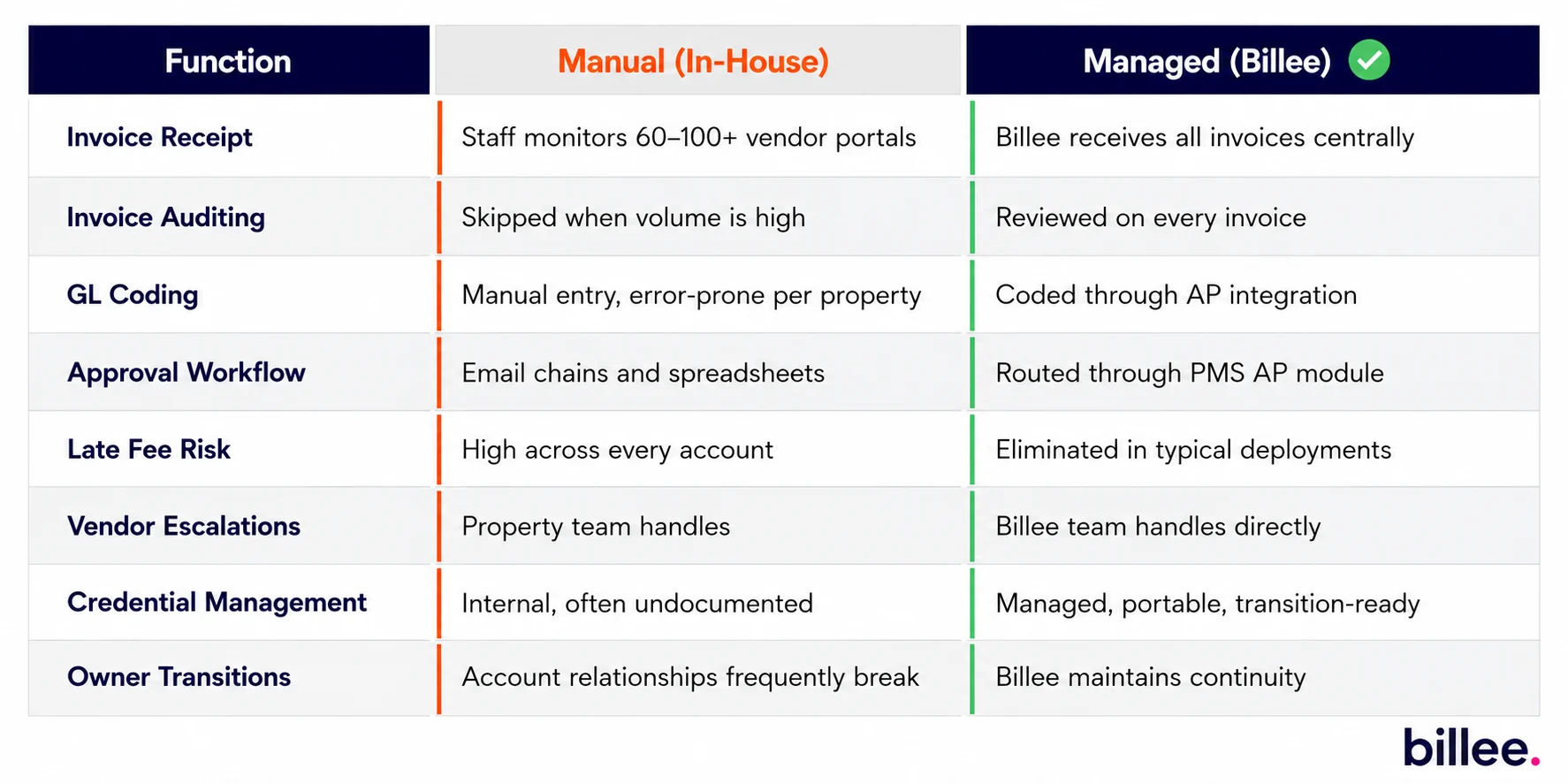
At a Glance: Manual vs. Managed Utility Vendor Management
The Five Functions of Utility Vendor Management
Utility vendor management is not one task. It is five distinct workflows that happen in sequence on every invoice, across every vendor, every billing cycle.
Invoice receipt. Someone has to collect invoices from all enrolled utility providers. In a manual operation, that means logging into vendor portals, tracking down missing invoices before deadlines pass, and centralizing what arrives in different formats from different billing systems.
Invoice auditing. According to ENGIE Impact, one of the nation’s largest utility billing auditors, at least 17% of utility invoices contain an error. Errors include incorrect amounts, misapplied rate structures, and usage spikes that may signal equipment malfunctions. An audit step catches these before payment. Skipping it means paying them.
GL coding. Each invoice must be coded to the correct general ledger account. As PredictAP notes in its analysis of invoice coding in commercial real estate, the same vendor may require different GL codes depending on the property, service type, ownership structure, or lease treatment. Manual GL coding introduces errors that distort property-level expense reporting for weeks.
Approval routing. Coded invoices must move through the accounts payable workflow before payment. In a manual operation, this means email chains, spreadsheet trackers, and approvals that stall when approvers are unavailable or inboxes are overloaded.
AP posting. Approved invoices must be posted to the property management system’s accounting ledger. Without a direct integration, this step requires manual data entry into Yardi, RealPage, or Entrata, a process that Planergy identifies as a leading source of errors and processing delays in vendor invoice management.
Each of the five functions is a distinct failure point. Most manual utility AP workflows have problems at multiple steps simultaneously.
How Many Utility Vendors Does a Multifamily Portfolio Actually Have?
The operational challenge of utility vendor management is volume, not complexity per vendor. Most multifamily portfolios are not managing one or two utility relationships. They are managing dozens.
A single property typically involves water (often municipal), electric (one or more regional providers), natural gas, trash collection, telecom and internet, stormwater, and irrigation. That is five to seven utility types per property, each with its own account number, portal login, billing cycle, and escalation contact.
A 20-property portfolio can carry 60–100+ active utility vendor accounts. A 50-property portfolio may carry 200 or more. Each account requires independent monitoring: due dates must be tracked, missing invoices must be chased, and an error on one account does not automatically flag errors on adjacent accounts.
The vendor count is the root cause of nearly every downstream problem in utility accounts payable: late fees, missed audits, GL coding errors, and credential loss during transitions.
Late Fees: The Preventable Expense That Compounds Across Every Property
Late fees on utility invoices are structurally likely in a manual AP operation. Most utility invoices carry short payment windows. Across 60–100+ accounts, some invoices will arrive late, some will not arrive at all, and some deadlines will be missed because no one is actively monitoring all of them simultaneously.
The cost compounds quickly. As Zego documents in its analysis of utility accounts payable mistakes, many utility companies assess late fees equivalent to 12%, 18%, 24%, or 36% annual interest rates. On a $5,000 invoice paid 30 days late under a 24% annual rate, the late fee is approximately $100. That is one invoice, one property, one month. Across a 20-property portfolio paying hundreds of invoices per month, these fees accumulate invisibly and consistently erode NOI.
According to Quadient’s research on AP automation, AP automation saves more than 70% of the time spent on accounts payable. That operational headroom is what eliminates late fees by eliminating the manual bottlenecks that cause them.
Late fees are not a discipline problem. They are a structural consequence of tracking too many vendor accounts manually with too few staff hours.
GL Coding Utility Invoices: Why the Same Vendor Gets Different Codes
GL coding is more complex in multifamily real estate than it appears. A water invoice at one property may code to a different GL account than an identical water invoice at another property in the same portfolio, depending on ownership structure, lease treatment, cost center configuration, or capital versus operating categorization.
PredictAP describes this directly: in commercial real estate, the coding decision for any given invoice requires understanding the property, the entity, the GL accounts, any allocation rules, and the approval process before a single character is entered. A coder working across dozens of properties under time pressure makes errors. Those errors are not random noise; they are systematic distortions in the expense profile of each affected property.
GL coding mistakes in utility invoices do not announce themselves. They sit in the ledger, quietly misrepresenting operating expenses until an audit, a lender’s due diligence review, or a year-end reconciliation surfaces them.
At refinancing or disposition, a clean, accurately coded AP trail is a material operational asset. Errors discovered during due diligence slow closings and, in some cases, affect valuations.
Owner Transitions: The 60-to-90-Day Utility Account Risk Window
Utility vendor management is tested most severely when a property changes ownership. The risk is specific and predictable: utility accounts carry over in the previous owner’s name, and the incoming team often cannot access them.
PropertyWorks, which specializes in license and utility transfers during acquisitions, describes the pattern directly: operations teams stretched thin by integration work get stuck on administrative tasks no one planned for. Utility account credentials live in a departing property manager’s inbox or in a shared spreadsheet the incoming team cannot locate. Invoices arrive at old addresses. Accounts go unpaid. Services are interrupted.
The National Apartment Association notes that resident billing complaints escalate precisely when properties are not actively monitoring billing accuracy, and vendor-side billing errors during transitions are a leading cause.
PropertyWorks’ guidance: start utility transfer planning before deal close, designate a single point of contact, and outsource to a team experienced in multi-unit handovers. Billee’s Utility Vendor Management product maintains vendor account continuity through ownership changes. Credentials are documented and portable, and do not depend on any individual staff member remaining with the outgoing organization.
The 60-to-90-day post-close window is the highest-risk period in utility vendor management. Most acquisition teams do not plan for it until it is already a problem.
Utility Vendor Management vs. Utility Billing: Two Different Functions
These two terms describe two distinct operational functions. Conflating them leaves gaps in both.
Utility billing is the property-to-resident function: allocating master-meter utility costs to individual residents using RUBS or submetering, then recovering those costs through monthly resident billing. The goal is cost recovery. The failure modes are under-recovery and resident billing disputes.
Utility vendor management is the property-to-provider function: receiving utility company invoices, auditing them for errors, coding them to GL, routing approvals, and posting to the PMS. The goal is accurate, timely payment. The failure modes are late fees, invoice errors, GL coding mistakes, and credential loss.
Both functions are necessary. They involve different workflows, different tools, and different operational failure points. A portfolio that handles billing recovery well but vendor management poorly is still absorbing preventable late fees and accumulating audit exposure on the expense side of the ledger every month.
What AP Integration with Yardi, RealPage, and Entrata Actually Means
“We integrate with your PMS” can mean very different things in practice, and the distinction is material.
A reporting integration means the vendor management service sends a file or report that someone on the property team enters into Yardi, RealPage, or Entrata manually. The data entry step is still there. It has been moved one step downstream, not eliminated.
A native AP integration means invoices flow directly into the PMS’s accounts payable module: GL-coded, routed for approval, and posted to the ledger without anyone re-keying data. The property team approves; they do not enter.
Manual AP entry is where GL coding errors originate, where approval bottlenecks develop, and where late fees accumulate when the entry queue backs up. A true AP integration eliminates all three failure points simultaneously.
Billee’s Utility Vendor Management + AP Integrations product connects natively to Yardi Voyager, Yardi Breeze, RealPage, and Entrata through their AP modules, not through file imports or reporting exports. Invoices are coded and approved within the Billee platform, then post directly to the ledger without manual re-entry.
How Billee Handles Utility Vendor Management
Billee takes over all five workflow functions on behalf of the property team.
Invoices from enrolled vendors flow into the Billee platform. The Billee team reviews each invoice for errors, assigns the correct GL code per property and ownership structure, routes the invoice through the AP approval workflow, and posts it to Yardi, RealPage, or Entrata through the native AP integration. Vendor escalations (disputed charges, service interruptions, meter accuracy issues) are handled by the Billee team directly. The property team is not in the escalation loop unless they choose to be.
Credential management is centralized and documented. When a property changes ownership, Billee maintains vendor account continuity. The incoming team does not spend the first 90 days rebuilding relationships or chasing logins that left with departing staff.
The customer portal at app.billee.ai provides two views: a Monthly Overview tab showing statements due in the current billing period, and a Vendor Breakdown tab showing every enrolled vendor and account in the portfolio. Both are accessible without logging into individual vendor portals.
Implementation takes 45 days. Vendor onboarding, PMS integration, and historical data migration are handled by the Billee team.
Billee handles utility vendor management end-to-end: invoice receipt through ledger posting, for multifamily portfolios managing 20 vendors or 200. See how it works for your portfolio.
Sources
Zego, “The Top 3 Utility Accounts Payable Mistakes Multifamily Companies Make,” 2025. (Cites ENGIE Impact audit finding: at least 17% of utility invoices contain an error; documents late fee rates of 12–36% annual interest equivalent.)
PredictAP, “What Is Invoice Coding Automation in Real Estate?,” accessed June 2026.
Quadient, “Accounts Payable Automation by the Numbers: 10 Statistics to Know,” September 2024.
PropertyWorks, “Who’s Handling License and Utility Transfers After an Acquisition?,” accessed June 2026.
National Apartment Association, “You Received a Resident Billing Complaint. Now What?,” accessed June 2026.
Planergy, “Vendor Invoice Management: What Is It and Best Practices,” accessed June 2026.
Insights and Industry Trends