

Multifamily Energy Management Best Practices 2026
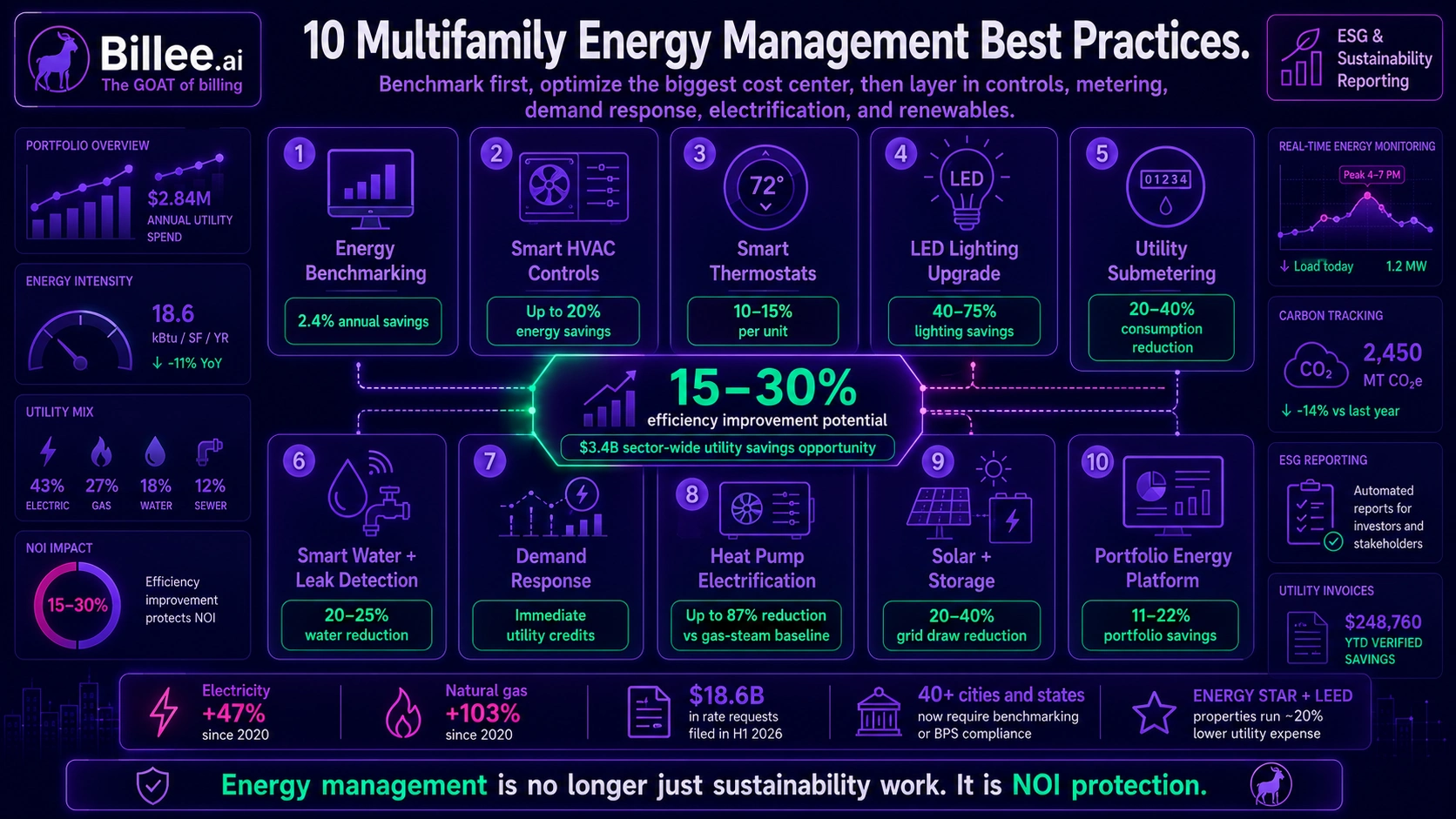
A strategic approach to energy management can improve the efficiency of U.S. multifamily properties by 15 to 30% and save $3.4 billion in utility costs, according to ACEEE and ENERGY STAR. With electricity up 47% since 2020, natural gas up 103%, and U.S. utilities filing a record $18.6 billion in rate increase requests in the first half of 2026 alone, the gap between proactive and reactive operators is now measured in hundreds of thousands of dollars per year. The best practices below are organized in execution order — benchmark first, optimize the biggest cost center (HVAC), then layer in controls, submetering, demand response, electrification, and renewables. Each step builds a more defensible, lower-cost, higher-NOI asset.
Key Takeaways
- A strategic approach to energy management can improve multifamily efficiency by 15 to 30% and save an estimated $3.4 billion in annual utility costs across the sector. (ACEEE via ENERGY STAR)
- HVAC and heating account for roughly 70% of total site energy in large multifamily buildings — making it the single highest-leverage upgrade category. (Urban Green Council)
- Smart HVAC energy management reduces HVAC runtime by 45% on average, delivering up to 20% in energy savings with a typical payback of 12 to 18 months. (Verdant/Copeland, 2026)
- LED lighting upgrades cut common area energy consumption by 40 to 75%, with payback typically in 1 to 3 years. (AEI Consultants; Mantis Innovation)
- Utility submetering consistently produces 20 to 40% reductions in resident utility consumption — a behavioral change that requires no capital improvement. (Utility Management and Conservation Association)
- As of 2026, more than 40 cities and states have adopted energy benchmarking ordinances, building performance standards, or both — with real financial penalties now being assessed. (Facilities Dive)
- ENERGY STAR and LEED certified multifamily properties operate with utility expenses approximately 20% lower than comparable non-certified buildings. (ENERGY STAR)
Multifamily Energy Management Best Practices: Savings and Payback at a Glance
| Best Practice | Energy / Cost Reduction | Typical Payback | Primary Source |
|---|---|---|---|
| Energy benchmarking | 2.4% per year average savings on buildings that act on data | Immediate (no capital required) | OECD; ENERGY STAR |
| Smart HVAC controls | Up to 20% energy savings; 45% runtime reduction | 12–18 months | Verdant/Copeland |
| Smart thermostats (occupancy-based) | 10–15% per unit | 12–24 months | Verdant/Copeland |
| LED lighting upgrade | 40–75% common area lighting energy | 1–3 years | AEI Consultants; Mantis Innovation |
| Utility submetering | 20–40% consumption reduction | 1.8–3 years | UMCA; NAA/NMHC |
| Smart water / leak detection | 20–25% water reduction | 2–4 years | Roomsys; industry benchmarks |
| Demand response enrollment | Utility credits or cash offsets against bills | Immediate | Verdant/Copeland; utility programs |
| Air source heat pumps | Up to 87% vs. gas-steam baseline (NYCHA pilot) | 3–7 years | Advanced Energy United |
| On-site solar + storage | 20–40% grid draw reduction | 7–12 years | RMI; Building Decarbonization Coalition |
| Portfolio energy management platform | 11–22% portfolio-wide savings | 2–3 years | OECD Energy Efficiency 2021; DOE Better Buildings |
Sources: Verdant/Copeland; ENERGY STAR; OECD; AEI Consultants; UMCA; Advanced Energy United; RMI; DOE Better Buildings Initiative
Why Energy Management Is a Financial Priority in 2026
Multifamily buildings account for an estimated 23% of U.S. residential energy consumption, making them a primary target for both efficiency upgrades and regulatory mandates. Energy costs are the third-largest operating expense in multifamily, behind debt service and payroll — and unlike those two, energy costs have been rising sharply. Electricity increased approximately 47% between 2020 and 2025. Natural gas increased 103%. Water and sewer increased 59%. U.S. utilities filed a record $18.6 billion in electric and gas rate increase requests during the first half of 2026 alone.
For operators absorbing those increases without a corresponding energy management strategy, the math deteriorates with every billing cycle. ENERGY STAR estimates that a strategic approach to energy management can improve the efficiency of U.S. multifamily properties by 15 to 30% and save $3.4 billion sector-wide in utility costs. Properties certified under ENERGY STAR or LEED typically run utility expenses approximately 20% lower than non-certified buildings of comparable size and age. The gap between managed and unmanaged portfolios is widening every year rates rise.
Multifamily Energy Management Best Practices
1. Audit First: Establish an Energy Baseline Through Benchmarking
Benchmarking is the prerequisite for every other practice on this list. You cannot prioritize upgrades, measure the impact of changes, or comply with building performance standards without a documented energy baseline. ENERGY STAR's Portfolio Manager is the standard benchmarking tool and the platform required for most regulatory filings — used by hundreds of thousands of commercial and multifamily buildings to track energy and water performance over time.
Multifamily properties with 20 or more units are eligible for a 1 to 100 ENERGY STAR score, a comparative rating that measures a building's energy performance against similar properties nationwide. The challenge specific to multifamily is whole-building data collection: residents who pay their own utility bills directly to the utility complicate data assembly. ENERGY STAR's interactive utility data access map shows which utilities provide aggregated data for multi-tenant buildings — dozens now do. For properties where aggregated data isn't available, benchmarking common areas provides a starting point and still generates actionable insights for in-building comparison and tracking over time.
Buildings that benchmark and act on the data save an average of 2.4% per year in energy costs, according to OECD analysis. That rate compounds. A 300-unit property absorbing $390,000 annually in utility costs saves roughly $9,400 per year in year one and more in every subsequent year as rates continue to rise. The benchmark also generates the data required for LEED and ENERGY STAR certification, investor ESG disclosures, and local benchmarking ordinance filings — making it a multi-purpose infrastructure investment, not a one-time reporting exercise.
2. Optimize HVAC — Your Largest Energy Spend
HVAC and heating account for roughly 70% of total site energy consumption in large multifamily buildings, per Urban Green Council's analysis of NYC building energy data. That makes HVAC the highest-leverage upgrade category in any energy management program. Every dollar invested in HVAC optimization generates proportionally more savings than the same dollar invested in any other building system.
Modern HVAC optimization goes well beyond scheduled temperature setbacks. Occupancy-based automation adjusts heating and cooling in real time based on whether units and common areas are actually occupied — cutting runtime during the hours when spaces are empty rather than assuming occupancy from a schedule. Smart HVAC energy management systems reduce HVAC runtime by 45% on average, delivering up to 20% in energy savings across a property, per Verdant/Copeland's 2026 benchmarking of deployed systems. Typical payback runs 12 to 18 months. Utility rebates in many markets cover a significant portion of upfront costs, with some programs covering up to 100% of the hardware investment.
For retrofit properties, targeted controls upgrades often avoid the need for full equipment replacement. Variable-speed drives on HVAC motors, occupancy-sensing controls on unit-level equipment, and building management system integrations that centralize portfolio-level monitoring all deliver measurable runtime reductions without replacing functional mechanical equipment. When replacement is necessary, heat pump technology delivers significantly better efficiency than the systems being replaced — covered below in the electrification section.
3. Deploy Smart Thermostats and Occupancy Controls in Units and Common Areas
Smart thermostat deployment is distinct from HVAC system upgrades — it addresses the control layer rather than the mechanical layer, and in many properties it is the faster and cheaper path to HVAC savings. The important distinction for multifamily is that consumer-grade smart thermostats (Nest, Ecobee, and similar residential products) are not designed for centralized multifamily HVAC systems. A property manager who installs residential thermostats across 200 units has 200 separate control systems to monitor, not one. Commercial-grade smart thermostats built for multifamily allow portfolio-level control, remote adjustment, and occupancy automation from a single dashboard.
The occupancy detection capability is what drives the savings. Dual-sensing systems that detect both motion and body heat identify occupancy accurately through the night and during extended absences, eliminating the gap between what a schedule assumes and what is actually happening in the unit. Common areas benefit from the same logic: corridors, fitness rooms, lobby spaces, and laundry facilities all represent heating and cooling expense in hours when no one is using them. Aligning climate control with actual occupancy — not assumed occupancy — cuts waste systematically across every space in the building.
Resident reception matters too. 77% of renters would pay $30 more per month for units featuring smart technology, per NMHC and Kingsley Associates research. A smart thermostat that saves residents money on their own utility bills while improving comfort is a retention asset, not just an energy tool.
4. Upgrade to LED Lighting and Smart Lighting Controls
LED lighting upgrades in common areas cut energy consumption by 40 to 75%, with payback typically arriving in 1 to 3 years. The economics are straightforward: LEDs draw less power, last significantly longer than fluorescent or incandescent alternatives, and generate less heat — which reduces the cooling load on HVAC systems in summer months. In a building where HVAC already accounts for 70% of site energy, any reduction in heat generation from other building systems has a multiplier effect.
Smart lighting controls extend the savings beyond the LED hardware itself. Occupancy sensors in corridors, stairwells, parking structures, laundry rooms, and amenity spaces ensure that lights are only on when spaces are occupied. Time-of-day scheduling in common areas aligns lighting levels with actual usage patterns. Dimming controls in outdoor and amenity spaces reduce consumption during low-traffic hours without eliminating the security and comfort function of the lighting.
Portfolio LED retrofit programs work best when standardized. The DOE Better Buildings Initiative documents a case study of National Church Residences establishing eligibility criteria and equipment specifications for a portfolio-wide LED retrofit — the standardization reduced per-property overhead and enabled bulk purchasing discounts that improved the ROI of the program as a whole. For operators managing multiple properties, a portfolio approach to LED upgrades generates more value than property-by-property decisions.
5. Submeter Utilities to Drive Conservation and Cost Recovery Simultaneously
Submetering serves two distinct financial functions that compound each other. The first is cost recovery: when residents receive a bill based on their actual measured consumption, the portion of the master meter bill that is recovered from residents increases from 0% (flat rate or in-rent) to 70 to 95% depending on the utility type and methodology. The second is conservation: when residents can see their consumption reflected in a bill, they use less. The Utility Management and Conservation Association documents a 20 to 40% reduction in consumption as a consistent outcome of submetering programs.
These two effects are additive. A property that installs water submeters recovers a larger share of a smaller master meter bill. The conservation effect reduces the base cost, and the recovery effect captures a higher percentage of that reduced base. A 300-unit example modeled by the UMCA produces a 1.8-year payback and $546,000 in 10-year net benefit when recovery and conservation are both counted.
Gas submetering regulatory standardization is accelerating in 2026. Think Utility Services' analysis notes that gas submetering laws are anticipated to become more consistent across states, and that this regulatory evolution is expected to accelerate adoption in both new construction and retrofitted communities. NYSERDA operates a dedicated submetering program for New York multifamily buildings, providing technical assistance and financing for qualifying properties. The data generated by submetering infrastructure also feeds directly into leak detection, anomaly alerting, ENERGY STAR benchmarking, and capital planning — making it a data infrastructure investment as much as an energy one.
6. Implement Smart Water Management and Leak Detection
Water and sewer costs increased approximately 59% between 2020 and 2025, making water the most sustained cost increase in the multifamily utility basket. The combination of aging infrastructure replacement requirements, federal PFAS treatment compliance costs, and drought-related rate adjustments in Western markets means the pressure is structural and ongoing. For master-metered properties absorbing water costs with no recovery mechanism, each rate increase flows directly into operating expense.
Smart water metering and leak detection address this from two directions. On the monitoring side, continuous usage tracking flags anomalies — a running toilet, a failing irrigation valve, a pipe failure — within hours rather than weeks, enabling repair before costs accumulate. Properties implementing advanced metering and leak detection systems report 20 to 25% reductions in water usage, per 2025 market research from Roomsys, driven by a combination of behavioral conservation and early leak intervention. The payback period on smart water meter installations averages 2 to 4 years across the multifamily sector.
Integration is the emerging best practice. Modern leak detection systems connect with smart thermostats and building energy platforms to create a unified building health dashboard — a single view of energy and water consumption, meter status, and anomaly alerts across the portfolio. Operators who manage water and energy monitoring through a unified platform catch issues faster, reduce maintenance workload, and generate cleaner data for ESG reporting and benchmarking compliance.
7. Enroll in Demand Response Programs
Demand response programs allow multifamily operators to earn credits or direct cash incentives by voluntarily reducing energy consumption during periods of peak grid demand. The programs are offered through utilities directly or through independent third-party administrators, and operate on an opt-in basis. When a peak demand event is forecast, the program notifies enrolled properties. Unless the operator opts out of that specific event, enrolled HVAC systems, water heaters, and other flexible loads automatically adjust to draw less power from the grid. The operator receives compensation — applied against their energy bill or paid directly — for the load reduction they contribute.
The financial logic is compelling. Demand response revenue reduces the net cost of energy without any change to the property's infrastructure. When combined with smart HVAC controls that already reduce runtime, demand response layers additional value on top of existing investments. Properties with on-site solar can also participate in demand response during generation events, contributing grid services in both directions. Utility rebate programs in many markets include demand response enrollment as an eligibility criterion for hardware incentives, creating a direct financial link between the two programs.
8. Electrify Heating and Hot Water with Heat Pumps
Air source heat pumps (ASHPs) transfer heat from outside air into the building rather than generating heat by burning fuel — a process that delivers 2 to 3 units of heat energy for every 1 unit of electrical energy consumed, compared to roughly 0.8 to 0.95 for gas combustion. For properties on gas heating, the switch to heat pumps represents the single largest available reduction in both energy cost and carbon emissions per unit.
The performance data in multifamily is strong. A 2023 pilot by the New York City Housing Authority testing cold-climate window ASHPs at scale found that units achieved an 87% energy reduction compared to the gas-steam baseline they replaced. Window ASHPs are particularly valuable in multifamily because they cost less than variable refrigerant flow or mini-split systems, and can be resident-owned — resolving the split-incentive problem in which operators pay for upgrades while residents benefit from lower bills.
The financial case improved sharply in 2026. ENERGY STAR's Revision 05 for Multifamily New Construction, effective January 1, 2026, sets a 15% savings target over ASHRAE 90.1-2016 for newly permitted buildings. Federal credits, state incentives, and utility rebates combining in 2026 create what Facilities Dive describes as "the fastest and most certain ROI on smart HVAC upgrades in a decade." Heat pump water heaters, running 2 to 3 times more efficiently than electric resistance alternatives, offer a lower-cost entry point for operators not yet ready for a full heating system transition.
9. Add Renewable Energy and On-Site Storage
On-site solar reduces grid dependency from the supply side, while demand response and smart controls reduce it from the demand side. The two strategies are complementary: a property that generates solar electricity during peak afternoon hours and simultaneously reduces HVAC load through demand response is reducing its grid draw on both dimensions simultaneously. Battery storage extends the value of solar generation into evening hours and provides backup capacity during grid interruptions.
RMI's analysis of residential electrification with flexible technology finds that properties pairing solar, heat pumps, smart thermostats, and storage can shift load to off-peak hours and inject energy back onto the grid in response to grid needs — generating revenue from multiple programs simultaneously. The Building Decarbonization Coalition's Q1 2026 momentum report identifies electrification plus storage as the preferred path for Class A multifamily properties pursuing both cost reduction and decarbonization goals.
Community solar programs offer an accessible path for properties where rooftop installation isn't feasible — either due to structural constraints, shading, or lease and ownership arrangements. Operators subscribe to a share of an off-site solar project and receive a credit against their utility bill for their proportional share of generation. The subscription model requires no capital investment and typically delivers immediate bill savings, making it the lowest-barrier renewable energy option available to multifamily operators.
10. Adopt a Portfolio-Level Energy Management Platform
All nine practices above generate data. The value of that data depends entirely on whether it is aggregated, analyzed, and acted on. A comprehensive energy management platform — covering real-time monitoring, analytics, controls integration, and reporting — delivers median energy savings of 11 to 22% in buildings, per OECD analysis of deployed systems. That savings range reflects not just the hardware upgrades themselves but the operational discipline that comes from having visibility across a portfolio in a single system.
What platforms make possible that individual upgrades alone do not: portfolio-level benchmarking that identifies which properties are underperforming relative to peers; usage spike alerts that catch HVAC malfunctions, meter failures, and leaks before they show up in a monthly invoice; rate schedule analysis that identifies properties on outdated tariff classifications; and compliance documentation that satisfies ENERGY STAR, LEED, and benchmarking ordinance requirements as a byproduct of standard operations. Operators who manage by monthly invoice review are always reacting. Operators managing through a real-time platform are always a step ahead.
The Compliance Landscape in 2026
Energy management is no longer only a financial decision — it is increasingly a compliance requirement. As of 2026, more than 40 cities and states have adopted energy benchmarking ordinances, building performance standards (BPS), or both, with enforcement shifting from voluntary best practices to enforceable mandates with real financial penalties.
New York City's Local Law 97 set the most consequential compliance benchmark in the sector. LL97 establishes carbon emissions limits for buildings over 25,000 square feet. Multifamily buildings classified as R-2 occupancy must limit emissions to 6.75 kgCO2e per square foot through 2029. The penalty for exceeding the cap is $268 per metric ton of CO2-equivalent above the limit — assessed annually, not as a one-time fine. Compliance reports covering 2025 emissions were due May 1, 2026, with a 60-day grace period to June 30. The NYC Department of Buildings began issuing Notices of Violation and assessing fines after that date. Approximately 57% of covered multifamily buildings are projected to exceed the stricter 2030 to 2034 emissions limits when they take effect, suggesting that compliance pressure will intensify significantly over the next four years.
New Jersey expanded mandatory benchmarking requirements for commercial and multifamily buildings in 2026. Property owners must report prior-year energy usage to the New Jersey Board of Public Utilities by July 1 annually. Beyond these high-profile mandates, Colorado, Washington, Virginia, Maryland, and Connecticut have all enacted utility billing disclosure requirements affecting how residents are informed about charges — requirements that intersect directly with billing methodology audits and lease addenda updates. Operators who have implemented best practices 1 through 10 above are generating the compliance documentation these ordinances require as a byproduct of their standard operations.
How Energy Management and Utility Billing Work Together
Energy management best practices reduce the amount of energy a property consumes and the cost of the energy it does consume. Utility billing determines how much of that cost is recovered from residents rather than absorbed by the operator. The two disciplines are the same financial problem viewed from different angles — and in 2026, operators who treat them separately are leaving significant NOI on the table.
Submetering, which appears in best practice 5 above, illustrates the connection most clearly. A submetering installation is simultaneously an energy management tool (it produces consumption data and drives conservation behavior) and a billing infrastructure (it determines how accurately resident charges reflect actual usage). The conservation savings reduce the master meter bill. The billing accuracy increases the percentage of that bill recovered from residents. Neither benefit is fully captured without the other.
Billee's full-service utility management platform handles the billing side of this equation end-to-end: automated billing and recovery across the portfolio, vacant cost recovery that recaptures expenses from residents who haven't transferred utilities into their name, invoice auditing that catches provider billing errors before they clear, and real-time meter monitoring that flags consumption anomalies the moment they appear. Billee's ESG & Sustainability Reporting product aggregates consumption data across the portfolio and produces reports formatted for ENERGY STAR Portfolio Manager, GRESB, and investor-required frameworks — turning the data generated by best practices 1 through 10 into defensible compliance documentation without adding reporting burden to the operations team.
For operators who have invested in the energy management stack and want to ensure that investment is fully captured in NOI, a billing methodology audit is the bridge between what a property consumes and what it recovers. Implementation goes live in 45 days. Talk to the team.
Frequently Asked Questions
What is multifamily energy management?
Multifamily energy management is the systematic practice of monitoring, controlling, and optimizing energy and water consumption across multifamily properties to reduce operating costs, improve NOI, and meet sustainability and compliance requirements. It includes benchmarking, HVAC optimization, smart controls, submetering, demand response, electrification, and renewable energy adoption — as well as the data infrastructure that connects these practices across a portfolio.
What percentage of multifamily energy costs come from HVAC?
HVAC and heating account for roughly 70% of total site energy consumption in large multifamily buildings, per Urban Green Council's analysis of NYC building energy data. This makes HVAC optimization the single highest-leverage investment in any multifamily energy management program.
How much can smart HVAC controls save a multifamily property?
Smart HVAC energy management systems reduce HVAC runtime by 45% on average, delivering up to 20% in total energy savings across a property, per Verdant/Copeland's benchmarking of deployed systems. Payback typically runs 12 to 18 months. Utility rebates in many markets can offset a significant portion of the upfront cost.
What is the ROI on LED lighting upgrades for multifamily buildings?
LED lighting upgrades in common areas reduce energy consumption by 40 to 75%, with payback typically arriving in 1 to 3 years. LEDs also reduce the building's cooling load because they generate significantly less heat than fluorescent or incandescent alternatives — providing a secondary energy savings effect on HVAC costs.
What cities and states require energy benchmarking for multifamily buildings in 2026?
More than 40 cities and states have adopted energy benchmarking ordinances, building performance standards, or both as of 2026. Notable requirements include New York City (annual benchmarking for buildings over 25,000 square feet, Local Law 97 carbon caps), New Jersey (mandatory benchmarking, 2025 data due to the BPU by July 1, 2026), and California, Colorado, Washington, and Illinois, which have enacted varying building performance and disclosure requirements.
What are the NYC Local Law 97 penalties for multifamily buildings?
The penalty is $268 per metric ton of CO2-equivalent above a building's annual emissions cap, assessed every year the building exceeds its limit. For multifamily R-2 buildings, the current cap is 6.75 kgCO2e per square foot through 2029, decreasing to 4.07 kgCO2e in 2030. Late filers face up to $0.50 per square foot per month in additional penalties.
What is demand response and how can multifamily operators benefit from it?
Demand response is a utility or third-party program that pays enrolled buildings to reduce energy consumption during periods of peak grid demand. When a peak event is forecast, the program notifies enrolled properties and their building systems automatically reduce load unless the operator opts out. Operators receive credits or direct payments for their contribution. The programs require no capital investment beyond the smart controls infrastructure that enables automated load adjustment.
How does submetering support energy management goals?
Submetering serves two compounding functions: cost recovery and conservation. When residents are billed for measured usage, the percentage of the master meter bill recovered from residents increases from 0% (flat rate or in-rent) to 70 to 95% depending on utility type and methodology. Simultaneously, residents who can see their consumption reflected in a bill use 20 to 40% less — reducing the master meter bill itself. A 300-unit property modeled by the Utility Management and Conservation Association shows a 1.8-year payback and $546,000 in 10-year net benefit when recovery and conservation are both counted.
Billee's full-service utility management platform handles billing execution, vacant cost recovery, meter monitoring, and ESG reporting across multifamily portfolios — with implementation in 45 days. Talk to the team.
Sources
1. ENERGY STAR, "Multifamily Housing: Good Energy Management Is Good Business," U.S. Environmental Protection Agency, accessed 2026.
2. Urban Green Council, "Energy End Uses in Large NYC Buildings," accessed 2026.
3. Verdant (Copeland), "Multifamily Energy Management Systems: A 2026 Guide to Eco-Friendly Living," May 13, 2026.
4. Verdant (Copeland), "10 Energy Efficiency Trends for Multifamily Buildings in 2026," December 5, 2025; updated February 28, 2026.
5. OECD, "Energy Efficiency 2021," December 2021.
6. U.S. Department of Energy Better Buildings Initiative, "Multifamily Sector Overview," accessed 2026.
7. AEI Consultants, "Energy Efficient Buildings," accessed 2026.
8. Mantis Innovation, "Beyond the Retrofit: Maximizing the Long-Term Value of Your LED Investment," accessed 2026.
9. Utility Management and Conservation Association, "Submetering," accessed 2026.
10. Think Utility Services, "The Future of Gas Submetering in 2026," accessed 2026.
11. NYSERDA, "Submetering for Multifamily Buildings," accessed 2026.
12. Roomsys, "2025 Smart Water Metering Market Trends and Insights for Residential Property Managers," 2025.
13. Advanced Energy United, "How States Turned to Advanced Energy to Heat Homes in 2025," January 2026.
14. RMI, "Reforming Energy Efficiency Programs to Increase Heat Pump Adoption," accessed 2026.
15. Facilities Dive, "The 2026 Map of Building Performance Standards Across the US," accessed 2026.
16. Envigilance, "LL97 Multifamily 2026 Guide: Avoid $268/Ton in 5 Steps," accessed 2026.
17. TTI Environmental, "Plan Ahead: 2026 NJ Energy Benchmarking for Commercial and Multifamily Buildings," accessed 2026.
18. Building Decarbonization Coalition, "Momentum Q1 2026," April 2026.
19. ENERGY STAR, "Highlights from Revision 05 of the Multifamily New Construction Program," January 2026.
Insights and Industry Trends


Explore more insights