

Top Multifamily Utility Management Mistakes to Avoid
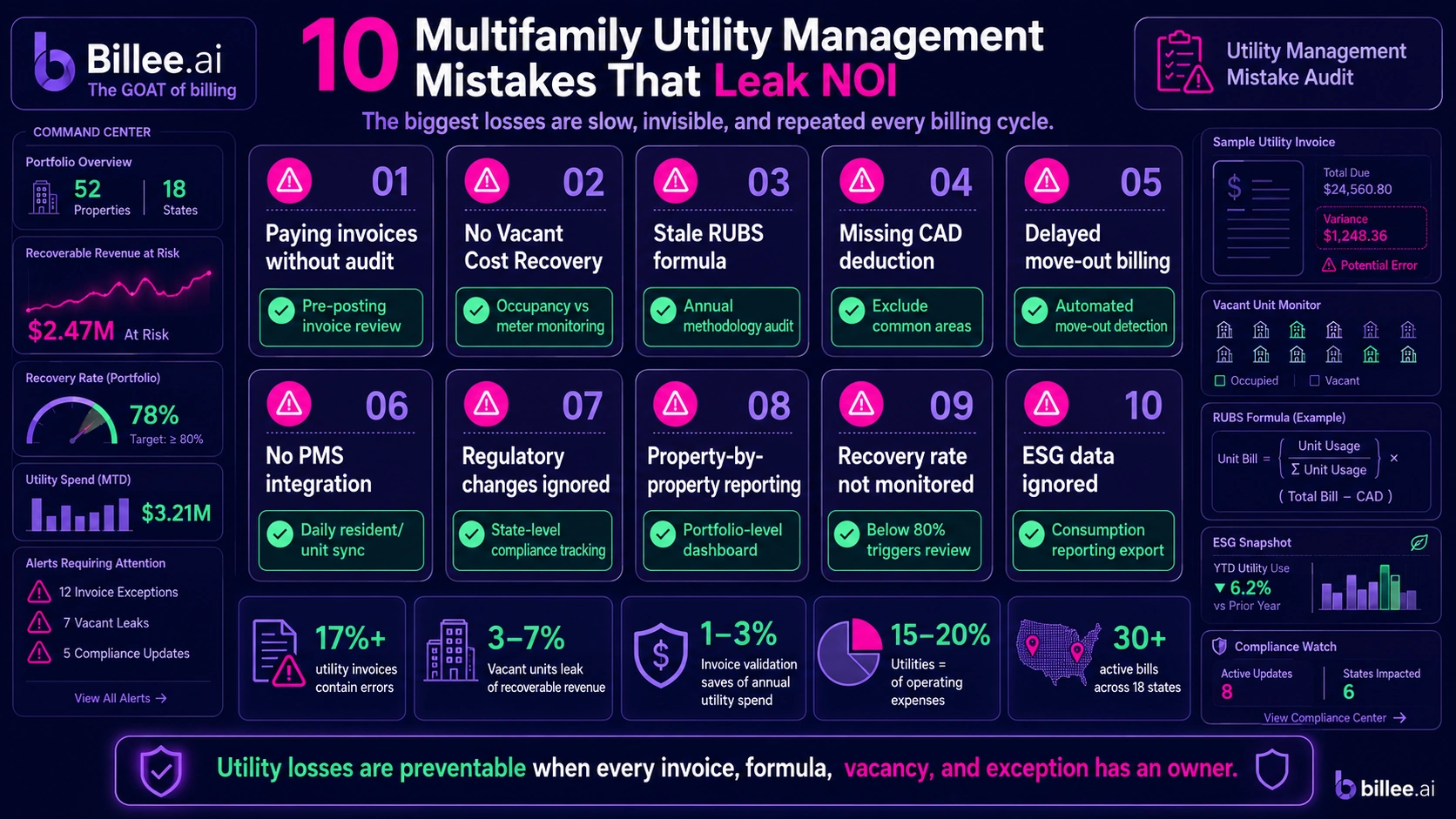
The most costly multifamily utility management mistakes are not dramatic failures. They are slow, invisible leaks: invoices paid with errors that compound for months, vacant units drawing utilities no one catches, RUBS formulas that drifted out of date years ago, and move-out bills issued too late to collect. Utilities account for 15 to 20 percent of multifamily operating expenses, one of the few cost categories that has not moderated in 2025 and 2026. The mistakes below determine how much of that expense gets recovered, and how much gets absorbed.
Key Takeaways
- At least 17% of utility invoices contain a billing error, per ENGIE Impact. At 200 invoices per month across a portfolio, that is 34 incorrect invoices entering the AP workflow every cycle.
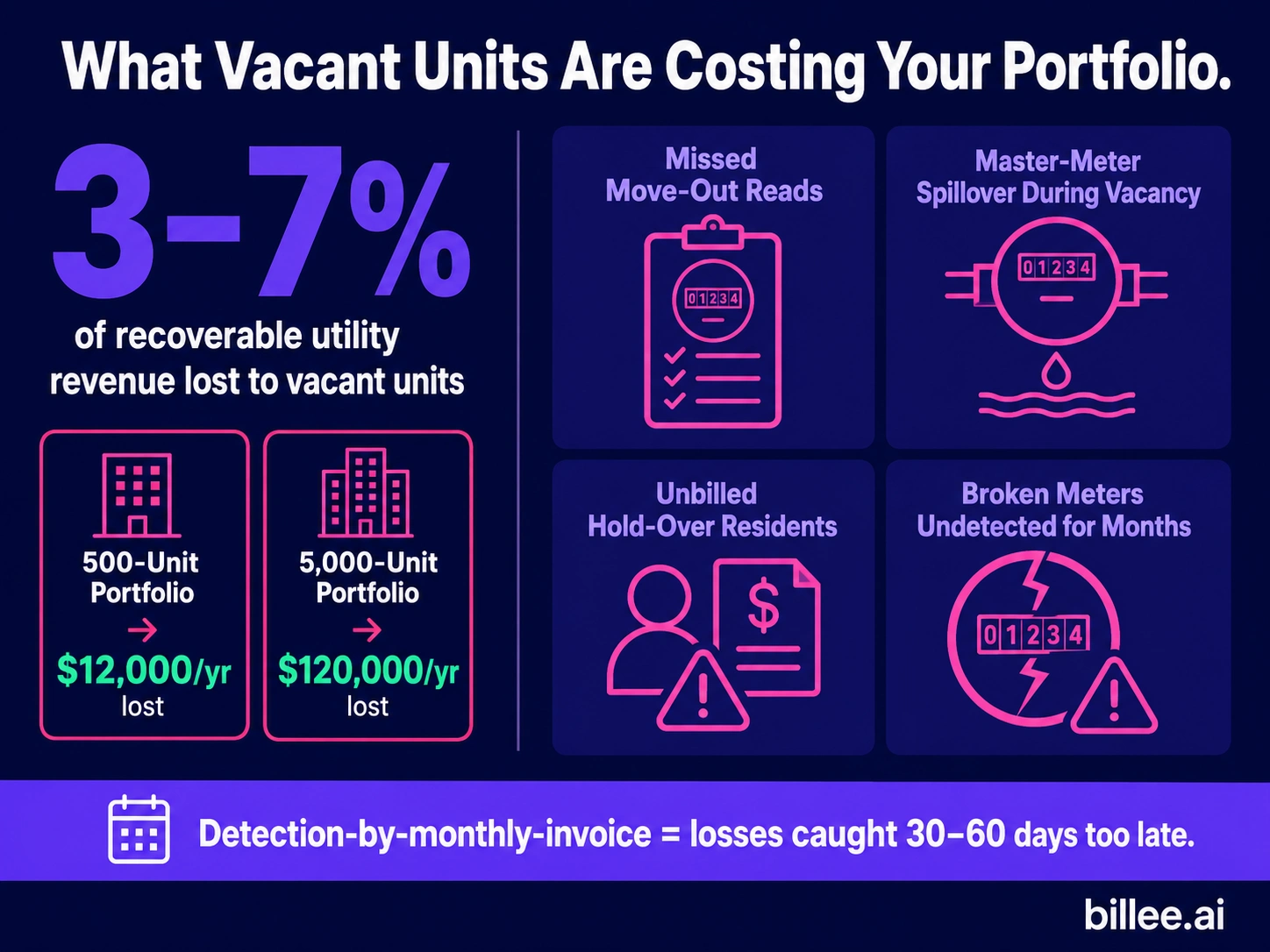
- Vacant units drain 3 to 7 percent of recoverable utility revenue from a typical multifamily portfolio, per industry estimates. Most operators take nearly a month to discover a utility transfer violation.
- RUBS formulas that are never audited drift. Stale occupancy data, unconfigured common area deductions, and wrong unit attributes quietly suppress recovery rates below the 80 percent floor that should trigger a methodology review.
- More than 30 active or recently enacted bills across 18 states are targeting utility billing in 2026. Operators not tracking regulatory changes face lease compliance exposure on every renewal cycle.
- Operators who validate invoices before paying them save 1 to 3 percent on annual utility spend. On a $500,000 utility budget, that is $5,000 to $15,000 that never should have been paid.
- Utilities and payroll are the two operating expense categories that have not moderated in 2025, per RealPage analytics. Every dollar of unrecovered utility cost compounds directly against NOI.
- Portfolio-level visibility into utility spend, not property-by-property reports, is what allows operators to catch outliers before they become losses and produce the audit trail lenders require at refinancing.
The 10 Mistakes at a Glance
| Mistake | Type | Financial Impact | How Hard to Detect |
|---|---|---|---|
| Paying invoices without an audit step | AP / vendor | 1–3% of annual utility spend | High — rate errors look plausible |
| No Vacant Cost Recovery program | Operations | 3–7% of recoverable revenue | High — takes ~30 days to surface |
| Stale RUBS allocation formula | Billing | Suppressed recovery rate | Medium — no alarm fires |
| Missing common area deduction | Billing / compliance | Overbilling + regulatory exposure | Low — easy to check; rarely audited |
| Delayed move-out billing | Collections | Unrecoverable balances | Medium |
| No PMS integration | Data / ops | Systematic errors every cycle | Low — appears functional until audited |
| Regulatory non-compliance | Legal | Fines, lease disputes | Medium — laws changed; old leases remain |
| Property-by-property reporting | Reporting | Slow outlier detection | High — no portfolio signal |
| Paying utility late fees | AP | Preventable per-invoice cost | Low — visible; rarely prioritized |
| Ignoring utility data for ESG | Reporting / capital | Missed refinancing value | Medium — invisible until a capital event |
Mistake 1: Paying Utility Invoices Without an Audit Step
At least 17% of utility invoices contain an error, according to ENGIE Impact, one of the nation's largest utility billing auditors. At 200 invoices per month across a portfolio, that is 34 incorrect invoices entering the AP workflow every billing cycle.
The errors are not all obvious. Rate structure mismatches apply the wrong tariff and recur silently for months. Service period errors look proportionally correct on the invoice. The amount is just for 45 days instead of 30. Usage spikes may be a vendor meter-read mistake or an active leak that nobody flagged. Each of these passes a visual review without triggering concern.
Paying first and auditing later generates a correction chain: vendor credit request, revised invoice, correcting AP entry. That correction workflow costs more staff time than a pre-payment audit would have. Operators who validate invoices before paying save 1 to 3 percent on annual utility spend, per analysis of multifamily AP workflows.
The fix: A pre-posting audit step that checks every invoice against the applicable rate schedule, billing period, and prior-period usage before it routes for approval. Anomalies get flagged for investigation. The operator approves only invoices that have passed the check.
Billee's Utility Vendor Management product audits every enrolled utility invoice before routing for approval. The Billee team contacts the vendor directly on any discrepancy. The property team does not see an invoice for approval until it has passed the audit step.
Mistake 2: Running No Vacant Cost Recovery Program
Vacant units draw utilities. Between one resident leaving and the next transferring service into their name, utility accounts often remain in the property's name. If no one is watching occupancy data against meter activity, that consumption accumulates on the master meter bill every cycle.
Industry estimates put vacant-unit utility leakage at 3 to 7 percent of recoverable revenue for a typical multifamily portfolio. Most operators take nearly a month to discover a utility transfer violation, by which point the loss is already compounded across multiple billing cycles.
A dashboard that surfaces vacant-unit exceptions is necessary but not sufficient. The exception has to be acted on: a bill generated, a credit requested, or a correction posted. Platforms that route exceptions to a queue without a person responsible for closing them produce reports, not recoveries.
The fix: Continuous occupancy-versus-meter monitoring with a defined workflow for each exception. Every flagged unit needs a resolution, not just a flag. Billee's Vacant Cost Recovery product routes every exception to the account team, who takes the action, not just surfaces the alert.
Mistake 3: Letting the RUBS Formula Go Stale
A RUBS formula configured at acquisition may use occupancy data from the original lease-up, unit square footage that was never verified against the as-built, or bedroom counts that predate a recent renovation. Over time, the allocation model becomes mathematically precise and economically wrong.
Units that should carry a larger share of the bill do not. Units that changed type or size after a renovation are still billed at their original attributes. The formula produces bills every month and nobody checks whether those bills reflect the property as it exists today.
The signal that something is wrong is the effective recovery rate. Billee's portfolio benchmark is 80 to 95 percent effective recovery across the customer base. Anything below 80 percent is a trigger for a methodology review, per Billee's standard. Most operators running a set-and-forget RUBS program do not track this number at all.
The fix: Annual methodology audit. Verify unit attributes against the current PMS data. Confirm that the allocation factors, whether square footage, occupancy count, or a hybrid, still reflect the actual property. Document the methodology so it can be produced on demand at refinancing.
Mistake 4: Skipping the Common Area Deduction
Hallways, lobbies, pools, fitness centers, leasing offices, and elevator equipment all consume utilities. Residents should not pay for that consumption. The common area deduction, the portion of the master meter bill excluded from resident allocation, is how that separation is made.
Industry practice is to deduct 10 to 25 percent of the master meter bill before running RUBS. Many operators running RUBS have never configured this deduction at all, which means they are allocating 100 percent of the master meter bill to residents, including the portion that covers common areas.
In Colorado, failing to exclude common area costs from resident RUBS allocations is a statutory violation under HB 26-1013, signed by Governor Polis on March 26, 2026. It is not a best-practice recommendation. It is a legal requirement. Other states with active billing legislation are moving toward similar requirements.
The fix: Calculate actual common area consumption by commodity. Subtract it from the master meter total before any allocation runs. Document the deduction methodology in the lease addendum so it can be disclosed to residents and produced during an audit.
Mistake 5: Issuing Final Move-Out Bills Too Late to Collect
Move-out billing has a built-in timing problem. The utility invoice for the final occupancy period may not arrive until weeks after the resident has returned their keys. If the final bill is generated after the resident has left the building, the operator loses the leverage of the security deposit and the active lease relationship.
Tracking down a former resident for a small utility balance almost never produces a payment. The cost of collection efforts on small outstanding amounts frequently exceeds the balance itself. The recoverable window for final utility charges is narrow: it closes at move-out.
The root cause is usually a manual process. Someone has to notice the move-out event, generate a final meter read, wait for the vendor invoice, prorate the charges, and issue the bill. Each handoff is a delay that may extend past the point where collection is practical.
The fix: Automated move-out detection tied to PMS lease-status changes. Pre-bill generation using consumption estimates where final invoices are not yet received. Final bill generated and sent before or at the time of move-out, with the balance settled against the deposit wherever state law permits.
Mistake 6: Running Utility Billing Without PMS Integration
Manual exports from the property management system, spreadsheet-based allocation, and manual charge postback introduce lag and error at every step. Vacant units get billed when they should not. Occupied units inherit timing distortions from prior residents. Unit attributes that do not match the PMS create allocation errors that carry forward through every billing cycle until someone catches them in a reconciliation.
The deeper problem is that manual utility billing feels functional until it is audited. The errors are invisible in individual bills and only appear when a lender or buyer's due diligence team asks for methodology documentation and discovers the process has no audit trail.
Charges posted to the wrong AR codes, because someone keyed them manually, produce GL distortions that persist until a correcting entry is made. At portfolio scale, these errors compound across properties and create reporting noise that makes it harder to manage the portfolio on the numbers.
The fix: Native PMS integration with daily resident and unit sync, automated move-in and move-out detection, and charge postback to resident ledgers without manual re-entry. Billee integrates natively with Yardi Voyager (version 7S and higher), Yardi Breeze, RealPage, and Entrata, with daily sync and automated AR code postback configured during the 45-day implementation.
Mistake 7: Not Tracking the Regulatory Landscape
More than 30 active or recently enacted bills across 18 states are targeting utility billing in 2026, according to Vitality's 2026 Utility Billing Compliance Guide. The changes are not incremental. Several are structural.
Connecticut bans RUBS for residential multifamily entirely, leaving direct billing or utility absorption as the only legal options. Colorado's HB 26-1013 codified four statutory conditions for compliant RUBS billing, and operators adding service fees on top of actual utility allocations are in violation. California's Civil Code governs submetering disclosure requirements. Many states now require specific lease language describing the allocation methodology, which means leases renewed without updated addenda are non-compliant even when the billing calculation itself is correct.
Most operators are compliant under the law as it existed at acquisition. The law changed. Old leases are still in use. That gap between what the current statute requires and what the existing lease addendum says creates enforcement exposure on every renewal.
The fix: Annual compliance review against current state PUC rules. Lease addendum updates treated as a systematic portfolio-wide process, not a property-by-property fix as renewals happen. Methodology documentation that is audit-ready on demand. Billee's Regulatory and Compliance product provides billing methodology audits against state PUC rules and access to legal support for remediation.
Mistake 8: Reporting Property by Property Instead of Portfolio-Wide
Most operators receive utility data from multiple vendors, in multiple formats, at the property level. A portfolio-level view of utility spend has to be reconstructed manually from disconnected reports, often a month or more behind the actual billing period.
Without a portfolio-level view, outliers go undetected for extended periods. A property paying the wrong rate structure for six months. A vendor that duplicated a billing period. A property with a water leak driving consumption 40 percent above the portfolio median. None of these surface in property-level reports until they are large enough to be noticed by the property team.
The capital markets problem is equally serious. At refinancing or disposition, lenders and buyers ask for utility expense history, methodology documentation, and recovery rate trajectory. Operators running property-by-property reporting cannot produce a consolidated view on short notice. That gap slows closings and, in some cases, affects valuations.
The fix: Portfolio-level utility dashboards that consolidate spend, recovery rate, and exception activity across all properties. What a CFO needs from utility reporting is not property summaries; it is a portfolio view with variance against budget, trend by utility type, and a clean audit trail. The data to build that view already exists in most portfolios. The question is whether it is being centralized.
Mistake 9: Not Monitoring the Recovery Rate
Utility billing is often treated as a background function: configure it once, run it every month, move on. The result is that the recovery rate, the percentage of actual utility cost recovered from residents versus absorbed by the operator, is never tracked as an operational KPI.
The number is calculable: total utility charges billed to residents divided by total utility cost billed to the property. Billee's portfolio benchmark places a healthy recovery rate at 80 to 95 percent. Below 80 percent is a trigger for a methodology audit, per Billee's standard. Most operators running a set-and-forget program have no idea where they sit relative to that range.
The compounding problem is that utilities are one of the few operating expense categories that have not moderated. Per RealPage analytics, utilities and payroll are the two categories that continued rising through 2025 while most other expense lines softened. An unmonitored recovery rate means unmonitored NOI exposure in an environment where utility costs only move in one direction.
The fix: Track effective recovery rate as a KPI, at the property level and across the portfolio. Review it quarterly. Run a billing methodology audit when the rate drops below 80 percent. Understand the benchmark your program should be hitting before the next asset review or refinancing conversation. See what 80 to 95 percent effective recovery actually means in practice for how to calculate it for your portfolio.
Mistake 10: Leaving Utility Data Out of ESG and Refinancing Reporting
Utility consumption data is already collected as a byproduct of billing. For most multifamily operators, it is the richest sustainability data set they hold. Yet most treat ESG reporting as a separate quarterly exercise that requires reassembling data that already exists, in formats that were not designed for reporting, from vendors who do not coordinate with each other.
The result is ESG claims that are difficult to document, ENERGY STAR benchmarks that are never filed because the consumption data is not in the right format, and GRESB questionnaires answered with estimates rather than actuals. Institutional lenders and buyers in 2026 increasingly ask for sustainability documentation. Properties that can produce defensible utility consumption data and ENERGY STAR scores are easier to underwrite.
The missed opportunity is that the data work is already done. If utility billing is managed centrally, ESG reporting becomes a formatted export from the billing system, not a reconstruction project. Operators who have not connected their utility management to their sustainability reporting are doing the same data work twice and producing a weaker output both times.
The fix: Treat ESG reporting as a byproduct of utility management, not a parallel function. Connect consumption data to ENERGY STAR Portfolio Manager. Build the reporting cadence into the billing workflow. Billee's ESG and Sustainability Reporting product produces reports formatted for GRESB and investor questionnaires directly from the utility data Billee already manages.
Frequently Asked Questions
What is the most expensive multifamily utility management mistake?
Skipping a Vacant Cost Recovery program is typically the single most expensive mistake in dollar terms. Vacant units drain 3 to 7 percent of recoverable utility revenue per portfolio, and most operators take nearly a month to discover each violation. At scale, that gap compounds across hundreds of units and multiple billing cycles before anyone catches it.
How do I know if my RUBS formula is out of date?
Check three things: whether your unit attributes in the billing system match the current PMS data, whether you have a common area deduction configured and documented, and what your effective recovery rate is. A recovery rate below 80 percent is a strong signal that the formula has drifted. Billee's portfolio benchmark is 80 to 95 percent for a well-configured RUBS program.
What recovery rate should a multifamily RUBS program produce?
Billee's customer dashboard benchmark is 80 to 95 percent effective recovery for RUBS billing. Submetering typically produces higher recovery rates, 85 to 95 percent, because it bills residents for actual unit-level consumption rather than an allocated share. Any program producing below 80 percent warrants a methodology audit before the next billing cycle.
How do I catch utility invoice errors before they post to the ledger?
A pre-posting audit checks each invoice against the applicable rate schedule, billing period, and prior-period usage before the invoice is routed for approval. Rate errors, period errors, and usage anomalies are flagged for investigation. The correction happens before payment, not after, which eliminates the vendor credit and correcting AP entry workflow that follows every error caught post-posting.
What utility billing changes do multifamily operators need to know about in 2026?
More than 30 active or recently enacted bills across 18 states are targeting utility billing in 2026. Colorado's HB 26-1013 codified four conditions for compliant RUBS billing, effective March 26, 2026. Connecticut bans RUBS for residential multifamily entirely. Multiple states now require specific allocation methodology disclosure in the lease, meaning leases renewed without updated addenda are non-compliant even when the billing calculation is correct.
How does utility management affect NOI in multifamily?
Utilities account for 15 to 20 percent of total multifamily operating expenses, per industry benchmarks. Recovery rate directly determines what portion of that expense is passed through to residents versus absorbed by the operator. A 10-percentage-point improvement in recovery rate on a $500,000 annual utility budget is $50,000 in additional NOI, without raising rent. Because utilities and payroll are the two operating expense categories that continued rising through 2025, unmanaged utility recovery compounds against NOI faster than most other expense lines.
What should a billing methodology audit cover?
A billing methodology audit should verify that unit attributes in the billing system match current PMS data, that a common area deduction is configured and documented, that the allocation formula still reflects the actual property composition, that lease addenda include the required disclosure language under current state law, and that the effective recovery rate is within the expected benchmark range. Billee conducts a billing methodology audit as part of every standard implementation and makes audit documentation available for refinancing and disposition due diligence.
When should a multifamily operator switch from RUBS to submetering?
Submetering makes sense when the property is new construction (where meter installation is cheaper at the design phase), when the state regulatory environment is moving toward submetering requirements, or when RUBS recovery rates have been optimized and the operator wants to capture the additional 10 to 15 percentage points that submetering typically produces. For an existing property already running well-configured RUBS above 80 percent recovery, the capital cost of submetering retrofits needs to be weighed against the incremental recovery lift and conservation benefits.
Billee manages utility billing, Vacant Cost Recovery, invoice auditing, and vendor management for multifamily operators who want the recovery without staffing the exception workflow themselves. Implementation goes live in 45 days. Talk to the team.
Sources
1. ENGIE Impact, via Zego, "The Top 3 Utility Accounts Payable Mistakes Multifamily Companies Make," 2025.
2. Simple Sub Water, "RUBS vs. Submetering: Financial Impact on NOI, Costs and Tenant Satisfaction," accessed 2026.
3. Vitality, "The Regulatory Shift: The 2026 Utility Billing Compliance Guide," 2026.
4. Colorado General Assembly, "HB 26-1013 Ratio Utility Billing Systems," signed March 26, 2026.
5. CRE Daily, "Operating Expenses Drop in Multifamily But Remain Elevated," 2025.
6. MRI Software, "5 Multifamily Utility Cost Recovery Strategies," accessed 2026.
7. Anchor Utility, "2026 Utility Management Trends in Multifamily," 2026.
8. Synergy Utility Billing, "5 Utility Billing Mistakes That Are Hurting Your Cost Recovery," accessed 2026.
Insights and Industry Trends


Explore more insights