
RUBS Billing for Multifamily: What Operators Need to Know
RUBS (Ratio Utility Billing System) is a formula-based method for allocating master-metered utility costs to multifamily residents based on factors like square footage, occupancy, or unit count. Properly run, RUBS recovers 70 to 85 percent of recoverable utility costs without installing meters.
This guide covers how it works, where it fits, what it costs in NOI relative to submetering, and what every operator needs to watch for in 2026.
Key takeaways
RUBS allocates utility costs to residents using a formula rather than measuring individual usage with meters. The formula typically combines square footage and occupancy to distribute the master-metered bill across units.
Typical RUBS recovery rates run 70 to 85 percent; submetering achieves 85 to 95 percent per industry analysis. The recovery gap is real, and it shows up in NOI.
RUBS is the right choice for portfolios where submetering is not economically viable. It is the wrong choice in states where the methodology is restricted (Connecticut prohibits it for residential multifamily) or where behavior change matters more than recovery rate.
State rules vary dramatically. Texas is the most permissive; California is tightly regulated; Connecticut prohibits RUBS for residential multifamily; Colorado's HB1090 added new disclosure requirements in 2026. A summary of state RUBS rules is essential for any multi-state operator.
The difference between a defensible RUBS program and one that erodes NOI comes down to documented methodology, kept-current formulas, and explicit lease disclosure. Programs without all three are exposed to both recovery loss and compliance risk.
What RUBS billing is
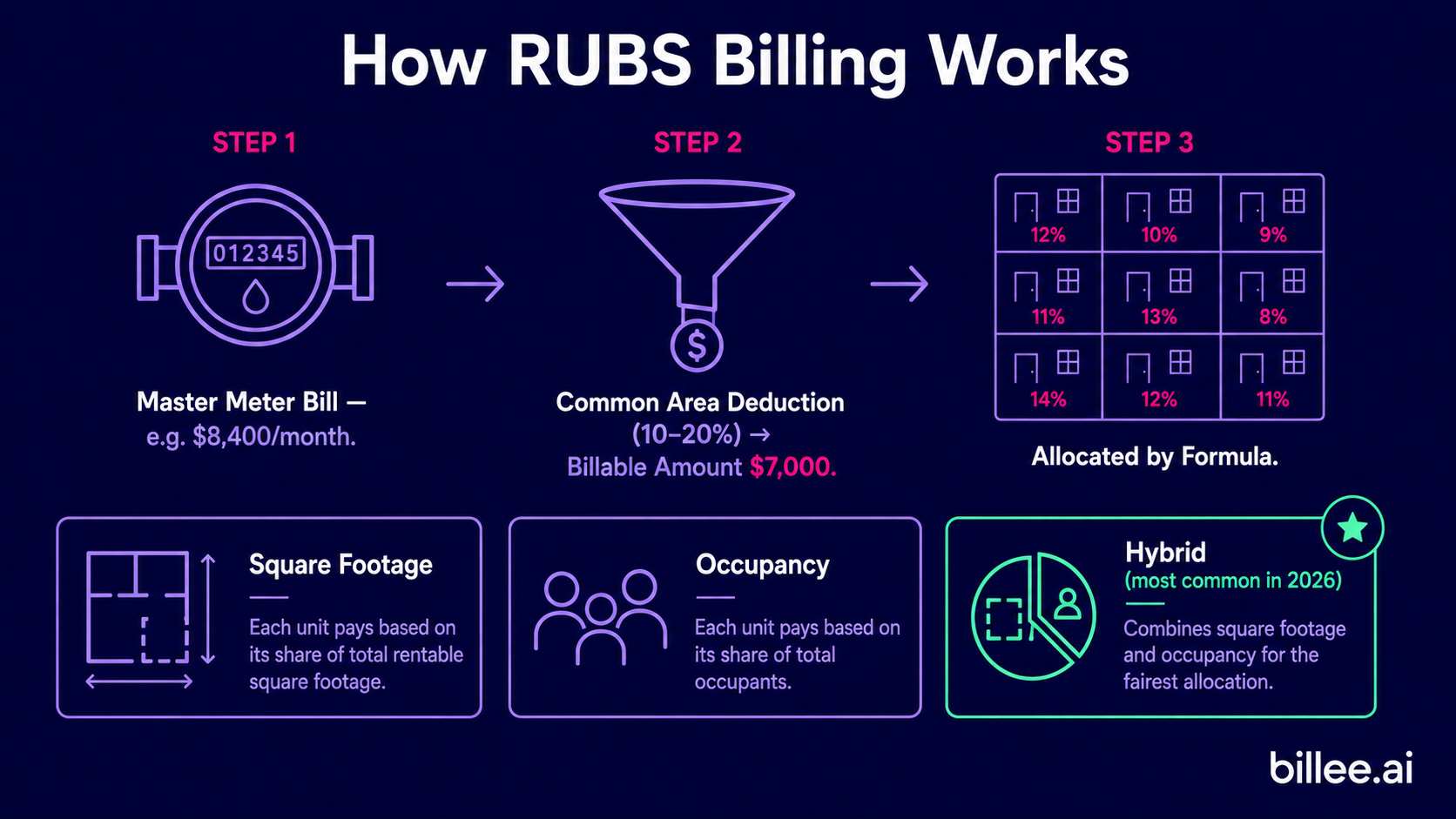
RUBS allocates the master meter bill to individual residents using a defined formula. There is no measurement of each unit's actual consumption. The system uses an agreed-upon proxy (most commonly a combination of square footage and occupancy) to distribute costs.
A typical RUBS calculation looks like this. The property's master meter bill arrives, say $8,400 for water in a 100-unit property for the month. A Common Area Deduction ("CAD") reduces the billable amount to account for non-resident consumption (leasing office, landscape irrigation, pool, common-area restrooms). The CAD is typically 10 to 20 percent, depending on the property. The remaining $7,000 is allocated to units based on the chosen formula. A unit that represents 1.2 percent of the total weighted allocation pays $84 that month.
The methodology matters more than most operators realize. A stale formula that has not been updated for unit-mix changes is the single most common cause of below-benchmark RUBS recovery. A missing or under-set CAD deduction is the second.
How RUBS allocation works in practice
The four allocation methods used in multifamily RUBS programs in 2026:
Square footage allocation. Each unit's share equals its square footage divided by total billable square footage. Simple to administer, but ignores occupancy differences.
Occupancy allocation. Each unit's share is based on the number of occupants. More aligned with actual usage for water especially, but harder to keep current.
Hybrid (square footage plus occupancy). The most common modern approach. Weights both factors to reflect the reality that a 600 sqft studio with two occupants drives more water usage than a 1,200 sqft one-bedroom with one occupant.
Per-unit equal allocation. Every unit pays the same share. Rare in modern multifamily; still appears in some smaller portfolios.
The choice of methodology affects recovery rate, resident satisfaction, and regulatory exposure. The hybrid approach is the industry default in 2026 because it produces the most defensible alignment between resident impact and cost share.
RUBS versus submetering: how to choose
The single most asked question about RUBS is when it makes sense versus installing submeters.
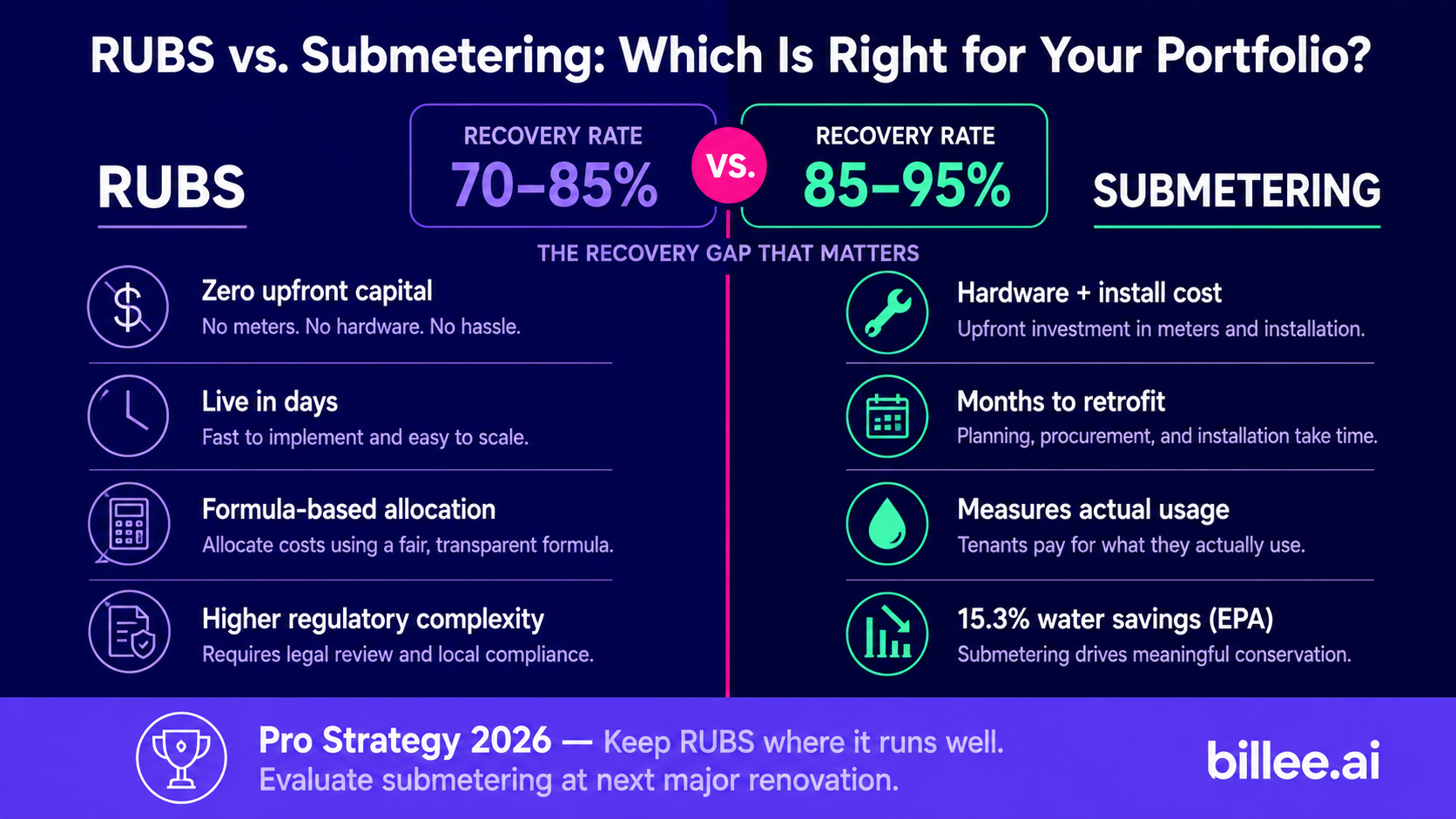
FactorRUBSSubmeteringTypical recovery rate70 to 85 percent85 to 95 percentBehavior change effectMinimalSignificant (15.3 percent water savings in a two-year EPA study)Upfront capitalNoneHardware plus installation cost per unitImplementation timelineDays to weeksMonths (especially retrofits)Regulatory complexityHigher; varies by stateLower; physical measurement is the gold standardBest fitExisting buildings where submeter retrofit is not economical; portfolios under PUC frameworks that permit RUBSNew construction; portfolios where behavior change and resident-fairness matter; states with strict allocation rules
The honest answer: submetering is the technically purer recovery method, and it produces measurable consumption reductions (the EPA study documented 15.3 percent water savings, roughly 21.8 gallons per unit per day). RUBS produces no comparable behavior change because residents see a bill but have no individual feedback loop on their own usage.
But submetering requires hardware, installation, and ongoing maintenance. For an existing 200-unit property without submeters in place, the retrofit cost often makes the RUBS-versus-submetering math tilt back toward RUBS, at least until the next major capital cycle. The 2026 "Pro Strategy" most operators have settled on: keep RUBS where it is running well, evaluate submetering at the next major renovation, and consider hybrid implementations where submeters cover water (the highest-impact utility) and RUBS handles the rest.
What RUBS actually recovers for NOI
The recovery rate is the headline number, but it understates the NOI impact. Across a 500-unit portfolio with $40 per unit per month in utility costs and a 75 percent RUBS recovery rate, the recovered revenue is roughly $180,000 annually. The gap to the achievable benchmark is another $36,000 in lost NOI. Across 5,000 units, the same gap represents $360,000 per year.
For institutional owners, the dollars compound during refinancing and disposition. A documented RUBS methodology with consistent recovery is a refinancing accelerant. A recovery rate that drifted because the CAD deduction has not been reviewed in three years is a due-diligence problem.
The state-by-state regulatory landscape
State Public Utility Commissions (PUCs) and state statutes govern how RUBS can be implemented. The 2026 baseline rules every operator should know:
Texas: most permissive. Texas PUC Chapter 24 is the most prescriptive RUBS framework in the country, and also the most operator-friendly. RUBS is used in nearly every 100+ unit apartment property in Texas. Disclosure, methodology, and dispute resolution rules are clearly defined.
California: tightly regulated. California Civil Code §1954.201–204 governs submetering and allocation. RUBS is permitted, but it is treated as part of rent for rent-control purposes. Operators in rent-controlled jurisdictions need to coordinate RUBS implementation with rent-setting decisions, and some municipalities (notably Mountain View) have ruled RUBS inconsistent with local rent control.
Connecticut: prohibited. RUBS is not legal for residential multifamily properties in Connecticut. Submetering is the only compliant allocation method.
Colorado: new in 2026. Colorado's HB1090 added explicit disclosure and methodology documentation requirements. Operators with Colorado portfolios should re-confirm their RUBS implementations meet the new standard.
Florida, Illinois, others. Each has its own framework. The common thread: transparent line-item charges on the resident bill, documented methodology, and explicit utility-billing language in the lease are the minimum standards across all states with active rules.
The compliance baseline is straightforward in 2026: clear line-item charges on every resident bill, documented allocation methodology, and explicit lease disclosure. Programs without all three are exposed.
Common RUBS mistakes operators make
The four mistakes that quietly erode RUBS recovery and create compliance exposure:
1. Stale formulas. RUBS allocations should be reviewed annually. Unit-mix changes (new ADA conversions, unit combinations, common-area expansions) shift the math, and a formula that was right two years ago can be materially off today.
2. Missing or under-set CAD deductions. Common Area Deductions need to reflect actual non-resident usage. An aggressive deduction is a compliance risk; an absent one is a recovery loss. The right answer is documented and revisited.
3. Inconsistent lease language across the portfolio. Multifamily operators frequently use multiple lease templates across acquisitions or property classes. RUBS disclosure language that is strong in one template and weak in another creates uneven legal exposure.
4. No audit trail. When a resident challenges a RUBS charge, or when a buyer's due-diligence team asks for methodology documentation during a sale, the absence of a clean audit trail is what turns a small issue into a real one.
How to evaluate a RUBS billing partner
For operators choosing to run RUBS with a third-party billing provider, the criteria worth grading hard:
Documented methodology that survives audit. Every calculation should be reproducible. If the provider cannot explain how a specific resident charge was derived, the methodology is a liability.
State expertise where you operate. A provider strong in Texas might be weak on California's rent-control intersection with RUBS. Confirm coverage of every state in the portfolio.
Annual methodology review. Allocation formulas should be on a documented annual review cadence, not "reviewed when something breaks."
Recovery rate transparency. A real provider will tell you the portfolio's effective recovery rate, the gap to benchmark, and what is driving any drift.
A defensible CAD deduction process. How is the deduction set, how often is it reviewed, and on what basis.
Integration with the PMS. Yardi Voyager, RealPage, Entrata: the billing provider should sync with the PMS for occupancy data and post charges back without manual work.
An audit trail ready for refinancing. Documentation should be export-ready for disposition due diligence.
How Billee handles RUBS
Billee operates RUBS billing as part of the Billing & Recovery Engine. The platform handles allocation, charge posting, and resident billing, while a named dedicated account team manages methodology reviews, CAD deduction calibration, vendor exceptions, and the audit trail.
The portfolio benchmark Billee tracks on the customer dashboard is 80 to 95 percent effective recovery (per Billee's standard portfolio benchmark). Anything below 80 percent triggers a review for stale formulas, CAD drift, or other recoverable gaps. Implementations typically go live in 45 days (per Billee's standard implementation timeline), including PMS integration with Yardi Voyager, Yardi Breeze, RealPage, or Entrata.
For operators currently running RUBS in-house or with a legacy provider, the first step is a billing methodology audit. This is the same audit Billee performs as part of every new customer onboarding, and it surfaces exactly where the current program is leaving money on the table.
Billee handles RUBS billing for multifamily operators who want accurate allocation, current methodology, and a clean audit trail without operating the system themselves. Talk to the team.
Sources
1. Simple Sub Water, "RUBS vs. Submetering: Financial Impact on NOI, Costs and Tenant Satisfaction," accessed 2026.
2. Dune Labs, "Things You Need to Know About RUBS Regulations Across States," November 7, 2022.
3. Public Utility Commission of Texas, "Texas PUC (Chapter 24, Substantive Rules Applicable to Water and Sewer Service Providers)," accessed 2026.
4. BFPM Inc., "How to Calculate Ratio Utility Billing System (RUBS)," accessed 2026.
5. California Legislative Information, "California Civil Code §1954.201–204," accessed 2026.
6. Bornstein Law, "California Ratio Utility Billing Systems," accessed 2026.
Insights and Industry Trends