

AMI vs AMR Meters: Which Is Right for Multifamily Properties
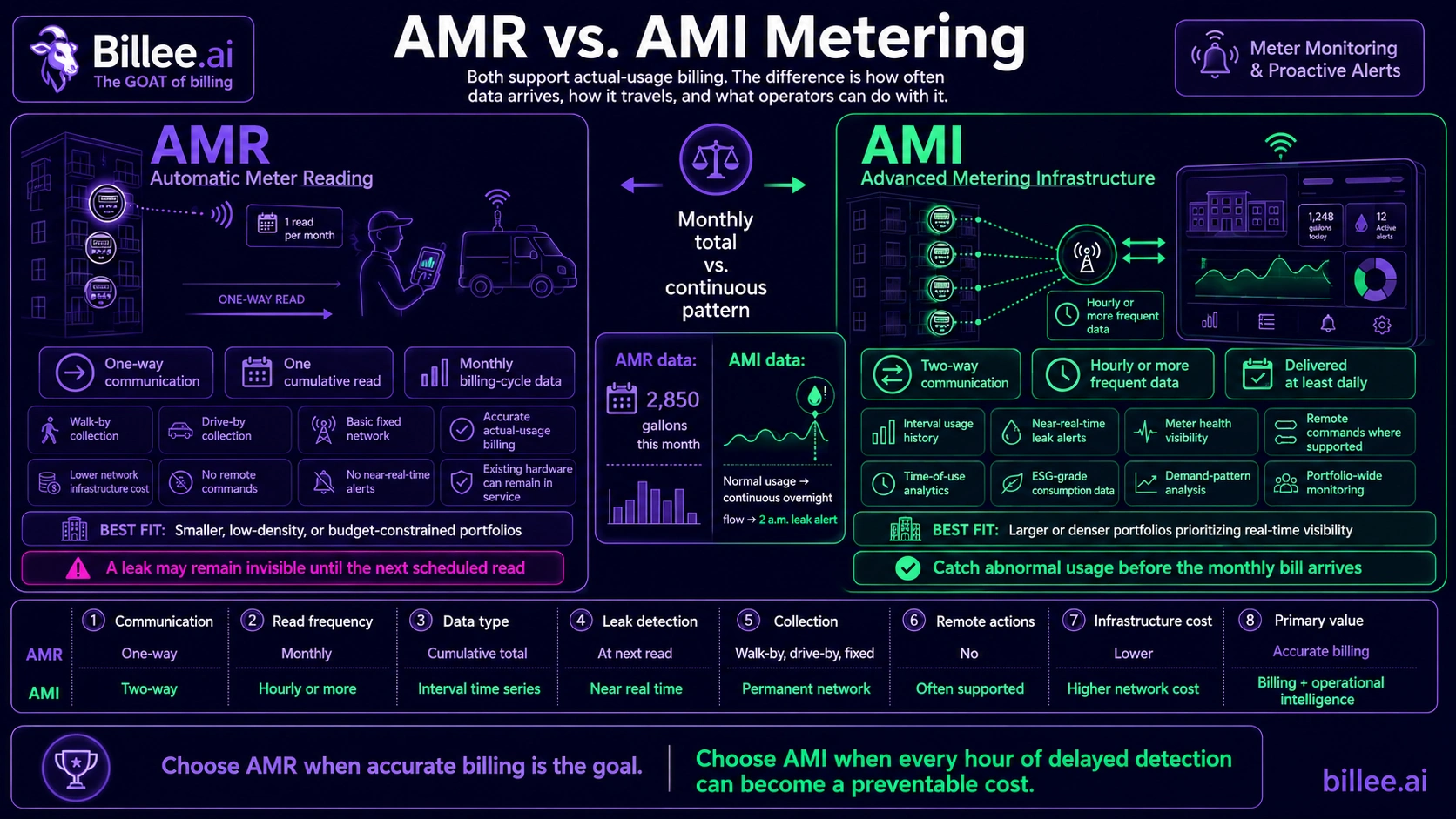
AMR (Automatic Meter Reading) sends one cumulative usage total per billing cycle over a one-way connection, while AMI (Advanced Metering Infrastructure) sends interval usage data, hourly or more often, over a two-way connection reaching both the utility and the property at least once a day. AMR fits smaller or budget-constrained portfolios needing accurate actual-usage billing without added infrastructure. AMI earns its premium when leak detection, real-time alerts, or ESG-grade data matter: only AMI can catch a running toilet at 2 a.m. before it becomes a four-figure water bill. Billee works across both AMR and AMI portfolios, watching meter activity and supporting the hardware behind either technology.
Key takeaways
- AMR is one-way and delivers one cumulative read per billing cycle. AMI is two-way and sends interval data, hourly or more often, to both the utility and the customer at least once a day, per the U.S. Energy Information Administration.
- Meter hardware cost has largely converged between the two. The real cost gap sits in network and software infrastructure, not the meter, per BMAG Meter and Bynry.
- Only AMI catches a leak in near-real time. AMR cannot surface an anomaly until the next scheduled read, which may be a month away, per Synergy Utility Billing and the EPA's facility-manager guide.
- Submetering, AMR or AMI, cuts water consumption by roughly 15% versus unmetered or RUBS-billed units, per EPA WaterSense's technical reference materials.
- National electric AMI penetration reached 76.8% by December 2023, up from 4.7% in 2007, per the Federal Energy Regulatory Commission. No public NMHC or NAA figure isolates AMI adoption within multifamily submetering specifically, a gap worth stating plainly instead of filling with an invented number.
- No state reviewed, including Texas, California, New York, Georgia, Washington, Maryland, and Indiana, mandates AMI by name. State rules set accuracy, testing, and disclosure standards either technology can meet.
What's the difference between AMR and AMI meters?
AMR stands for Automatic Meter Reading, and it only moves data one way. Badger Meter describes it as a transmitter on the meter register that sends a single cumulative number to a handheld reader on a walk-by route, a vehicle-mounted receiver on a drive-by route, or a basic one-way fixed network that skips the truck roll but still cannot push data on demand.
AMI stands for Advanced Metering Infrastructure, and it moves data both ways. The U.S. Energy Information Administration defines an AMI meter as one that measures and records usage at a minimum of hourly intervals and delivers that data to both the utility and the customer at least once a day. A cumulative read tells you a total. Interval data tells you a pattern, and that distinction drives almost every decision later in this article.
Both technologies operate inside a submetering program, where individual meters measure actual unit-level consumption instead of allocating one master bill by formula. Choosing between AMR and AMI is a question of how that data reaches you, not whether submetering makes sense.
How do AMI and AMR actually transmit data?
AMR relies on someone, or something, physically getting close to the meter. Envocore lists three collection methods: a walk-by with a handheld receiver, a drive-by with a vehicle-mounted receiver, or a one-way fixed network using radio frequency, power-line communication, or telephony that reports without a truck roll.
AMI relies on a permanent data network instead. Red Clay outlines four common methods:
- RF mesh: each meter relays data node-to-node, and the network heals itself if one node drops.
- Cellular: fast to deploy, but tied to a carrier's lifecycle.
- Point-to-multipoint or fixed wireless: needs less infrastructure, but has no redundancy if the base station fails.
- Power line carrier: reuses existing electric wiring, but is not well suited to near-real-time data.
American Water describes its AMI network plainly: small radio devices on each meter transmit hourly, encrypted data to receivers mounted on water tanks or utility poles. A radio on the meter and a receiver on a pole replace AMR's once-a-month total with an hourly data point.
AMI vs. AMR at a glance
AMR and AMI diverge across eight practical dimensions worth a capital-planning conversation. The table below lines them up.
| Dimension | AMR | AMI |
|---|---|---|
| Communication | One-way | Two-way |
| Read frequency | Monthly, tied to the billing cycle | Hourly or more frequent |
| Data type | Single cumulative total | Interval / time-series data |
| Leak or anomaly detection | No, visible only at the next scheduled read | Yes, near-real-time alerts |
| Collection method | Walk-by, drive-by, or basic one-way fixed network | Fixed network: RF mesh, cellular, point-to-multipoint, or power line carrier |
| Remote commands (e.g., disconnect) | No | Often yes |
| Upfront infrastructure cost | Lower (minimal or no network buildout) | Higher (towers, base stations, repeaters, head-end software) |
| Best fit | Small, budget-constrained, or low-density portfolios | Larger or denser portfolios prioritizing leak detection and granular data |
Comparison compiled from Badger Meter, the EIA, BMAG Meter, Envocore, and the EPA's AMI facility-manager guide, cited in full in the Sources section below.
What does each option cost for a multifamily portfolio?
Meter hardware costs have largely converged between AMR and AMI. BMAG Meter and Bynry agree: single meter terminal costs are comparable between the two systems, and the real expense difference sits in the network and software layer, not the meter.
Water submetering retrofits typically run $300 to $1,500 per unit, while electric retrofits run $250 to $500 per unit, per Synergy Utility Billing. Gas submetering costs are not itemized per unit, but Synergy's gas submetering guide puts the typical recovery gain at $60 to $180 per unit per year after leaving RUBS or absorbed costs. Across utility types, general submetering runs $200 to over $1,000 per unit, compared with $0 to $500 per property for RUBS software alone, per the National Center for Housing Management.
Payback on that investment consistently lands in 18 to 36 months across water, electric, and gas submetering. The reason shows up in submetering's return on investment: true submetering recovers 90 to 95% or more of billed usage, versus 70 to 85% for RUBS, per SimpleSUB Water.
No source in the available research isolates a clean, meter-only price difference between AMR and AMI hardware. Budget the technology choice at the network and software layer, not the meter, since that is where the real gap lives.
Does AMI actually catch leaks that AMR would miss?
Yes. The EPA's guide for facility managers documents real-world cases where AMI caught leaks that would have run for weeks under AMR:
- A Freeman Toyota dealership cut water usage by 50% after AMI flagged a leak.
- WorldMark by Wyndham saved more than 5 million gallons between 2015 and 2018, over a 40% reduction, once AMI alerts caught issues early.
- Albuquerque Public Schools used AMI to drop a continuous-flow leak from 300 gallons an hour to under 25 gallons an hour.
The stakes of a missed leak are not abstract. SimpleSUB Water estimates an undetected running toilet can cost $1,500 to $2,000 a year, a 1/8-inch pipe leak can waste up to 250 gallons a day, and a dripping faucet wastes more than 3,000 gallons a year. AMR cannot see any of that until the next scheduled read, sometimes a month later. AMI sees it within the hour and can alert the property before the bill does.
Are there regulations that require one technology over the other?
No state reviewed for this article requires AMI by name. Texas PUC Chapter 24, section 24.287 sets AWWA and ASME accuracy, calibration, testing, and recordkeeping requirements without naming a metering technology, and both AMR and AMI can meet them.
California takes a similar approach, with one wrinkle. SB 7, effective January 1, 2018, requires new multifamily construction to bill on actual measured consumption, which both AMR and AMI satisfy as true submetering rather than RUBS allocation. California Civil Code section 1954.204 separately gives landlords a 21-day window to repair a leak after a resident reports it, a duty AMI's real-time alerting makes easier to hit than a monthly AMR read.
Other states layer on their own rules, none naming a technology. Tehama Wireless tracks several:
- Georgia has required submetering in new multifamily construction since 2012.
- New York City requires ANSI C12.20-standard meters under Local Law 88 and Local Law 132.
- North Carolina leaves oversight to its state utilities commission.
- Washington mandates hot water submetering statewide, and Seattle adds its own threshold.
- Maryland requires housing authority approval before a property can submeter.
- Indiana follows state utility commission accuracy guidelines.
State rules set the bar on accuracy, certification, and disclosure, and leave the technology to the property.
How is adoption trending?
Electric AMI adoption crossed three-quarters of the country's meters by the end of 2023. National penetration reached 76.8% by December 2023, up from 4.7% in 2007, covering 128.4 million of the country's 167.2 million meters, per the Federal Energy Regulatory Commission. Residential AMI penetration sits at 77.3% by that same count.
Water AMI is growing even faster on a percentage basis, even though it started from a smaller base. The global water AMI market is projected to grow from $1.6 billion in 2024 to $22.3 billion by 2034, a compound annual growth rate near 30%, according to GM Insights.
None of that data is multifamily-specific. No NMHC or NAA figure isolates AMI-versus-AMR adoption within multifamily submetering, and this article will not manufacture one to fill that gap. The national trend line signals where metering technology is headed, not a multifamily benchmark to measure a portfolio against.
Which one is right for your portfolio?
Choose AMR when the portfolio is small, budget-constrained, or low-density enough that a network buildout does not pencil out. AMR also fits when the goal is accurate actual-usage billing rather than leak detection, existing hardware is not near end-of-life, and no state rule pushes toward real-time capability.
Choose AMI when leak detection and real-time alerting are an operational priority, not a nice-to-have. AMI also makes sense for portfolios large or dense enough to amortize network infrastructure, where ESG or NOI reporting needs granular, auditable data, or where first-generation AMR transmitters are already due for replacement, making the upgrade incremental rather than a sunk-cost loss.
The right answer also depends on the utility type. Water has the most mature AMI ecosystem and the clearest leak-detection return on investment. Electric AMI value leans toward time-of-use and demand analytics more than leak detection, and gas remains less AMI-penetrated in multifamily today.
Billee fits into this decision regardless of which technology a portfolio runs. Billee's Meter Monitoring and Proactive Alerts capability works with AMR infrastructure across major hardware vendors, so portfolios get visibility into meter health without ripping out working equipment. Billee's Hardware & Maintenance Support handles procurement, installation, and lifecycle management for whichever path a property chooses, AMR today or an AMI upgrade down the road.
FAQ
What is the difference between AMR and AMI water meters?
AMR meters transmit a single usage total once per billing cycle over a one-way connection. AMI meters transmit interval usage data, hourly or more often, over a two-way connection that also reaches the property in near-real time.
Can AMR meters detect leaks?
AMR meters cannot detect leaks between scheduled reads. A leak that starts the day after a monthly AMR read will not surface until the next read, sometimes weeks later.
Is AMI more expensive than AMR?
Meter hardware costs have largely converged between AMR and AMI. The real cost difference sits in network and software infrastructure, which is why dense portfolios tend to see a faster payback on AMI than spread-out, low-density ones.
Do I need AMI to comply with California's or Texas's submetering laws?
No. Neither Texas PUC Chapter 24 nor California's submetering statutes mandate AMI specifically. Both set accuracy, certification, and disclosure standards that AMR-based submetering can also meet.
Can I upgrade from AMR to AMI later without replacing everything?
Many portfolios treat an AMR-to-AMI upgrade as a phased replacement tied to normal hardware end-of-life rather than a full rip-and-replace. Meters get swapped as they age out or fail, so the network and software layer typically absorb most of the upgrade cost, not the meters themselves.
Which is better for electric submetering versus water submetering?
Water submetering has the most mature AMI ecosystem and the clearest documented leak-detection savings. Electric AMI delivers more value through time-of-use and demand analytics than through leak detection.
Does Billee install AMI or AMR meters?
Billee's Hardware & Maintenance Support handles procurement, installation coordination, and lifecycle management for metering infrastructure, whichever technology a portfolio runs. Billee's Meter Monitoring and Proactive Alerts capability works with AMR infrastructure across major hardware vendors, giving portfolios visibility into meter health either way.
How long does a submetering installation take in an occupied property?
Occupied-property retrofits generally take longer than new-construction installs because each unit needs a scheduled resident access window instead of installation during rough-in before move-in. Timelines vary by portfolio size, unit access, and whether the rollout is phased or all at once, so treat any fixed number you see elsewhere as a rough guide, not a guarantee.
Whichever technology a portfolio runs today, meter data only pays off if someone acts on it. Billee's team monitors meter activity across AMR and AMI infrastructure alike and manages the hardware lifecycle behind it, from installation through replacement. See how it works for portfolios like yours.
Sources
- U.S. Energy Information Administration, "How many smart meters are installed in the United States, and who has them?," updated October 20, 2023.
- BMAG Meter, "AMR vs AMI Water Meters: How To Choose?," November 8, 2025.
- Bynry, "AMR to AMI Upgrade: Implementation Guide for Utilities," May 2026.
- Synergy Utility Billing, "How to Choose a Water Submeter System for Multifamily," May 2026.
- United States Environmental Protection Agency, "Improving Water Management Using Advanced Metering Infrastructure: A Guide for Facility Managers," September 2022.
- United States Environmental Protection Agency, "WaterSense Technical Reference Manual, Metering Tech Sheet," July 2023.
- Federal Energy Regulatory Commission, "2025 Annual Assessment of Demand Response and Advanced Metering," December 2025.
- Badger Meter, "AMR vs. AMI: What's the Difference?," May 2022.
- Envocore, "AMR vs. AMI and When to Utilize Each," April 2024, updated December 2024.
- Red Clay, "Smart Meter: AMI Communication Methods," November 2017.
- American Water, "Advanced Metering Infrastructure (AMI) FAQ," accessed 2026.
- Synergy Utility Billing, "When Electric Submeter Systems Make Sense for Multifamily," May 2026.
- Synergy Utility Billing, "Gas Submeter Guide: Recover Multifamily Utility Costs," May 2026.
- National Center for Housing Management, "RUBS: Ratio Utility Billing System Explained for 2026," July 2026.
- SimpleSUB Water, "RUBS vs. Submetering: Financial Impact on NOI, Costs and Tenant Satisfaction," accessed 2026.
- Texas Public Utility Commission, "Chapter 24, §24.287: Submeters or Point-of-Use Submeters and Plumbing Fixtures," accessed 2026.
- National Apartment Association, "New Calif. SB 7 Law – And the Benefits of Submetering in Any State," accessed 2026.
- FindLaw, "California Civil Code Section 1954.204," accessed 2026.
- Tehama Wireless, "State Submetering Regulations: What You Need to Know," March 2025.
- GM Insights, "AMI Water Meter Market Statistics, 2025–2034 Report," November 2024.
Insights and Industry Trends


Explore more insights