

Utility Management Compliance for Multifamily Properties: The Complete 2026 Guide
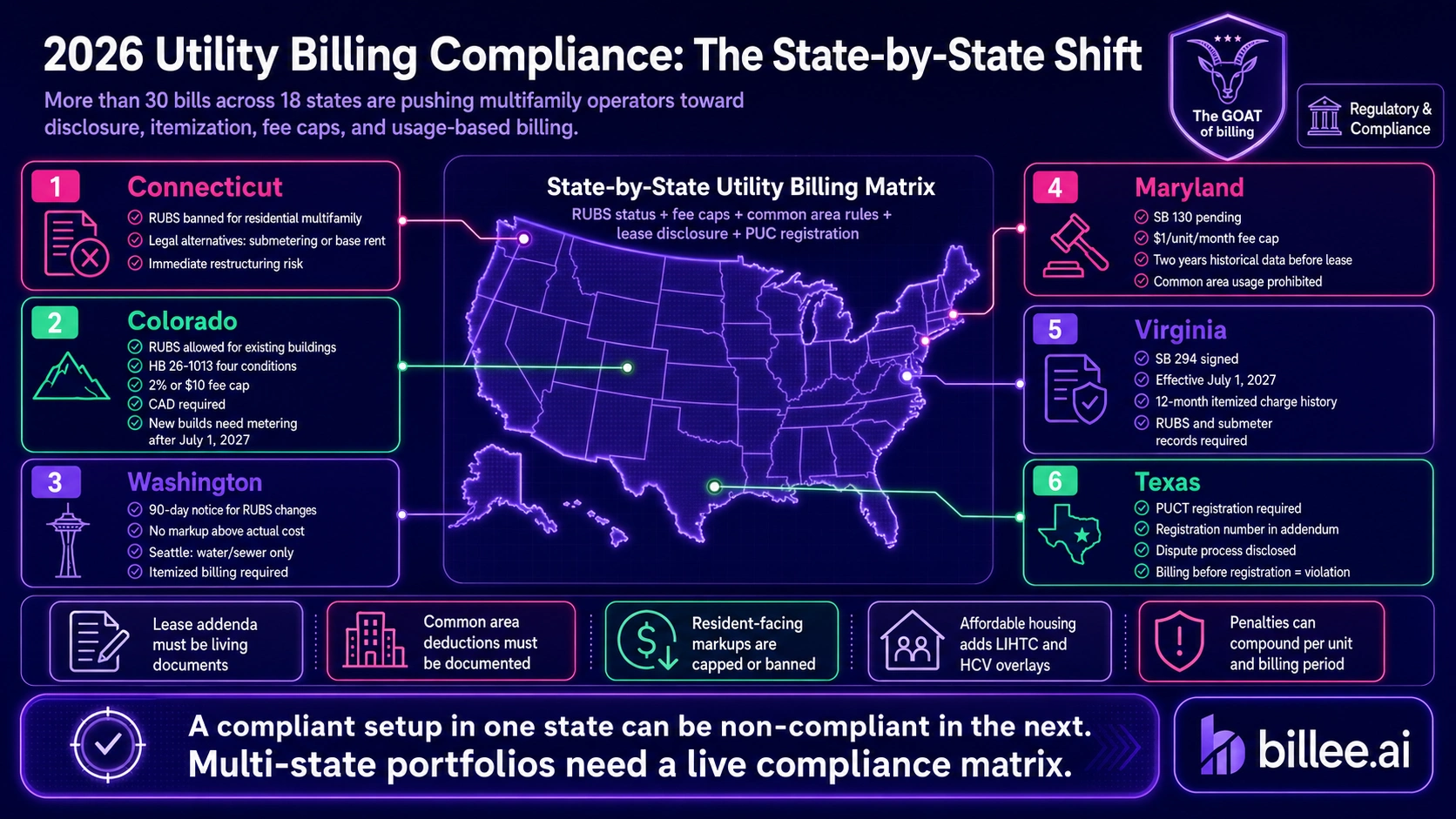
Over 30 active or recently enacted bills across 18 states are targeting utility billing in 2026. Multifamily utility compliance now requires operators to disclose allocation methodology before lease signing, cap or eliminate administrative markups, exclude common area costs from resident allocations, and update lease addenda every time a state law changes. Four states have binding requirements on the books already: Colorado, Connecticut, North Dakota, and Washington. The rest are moving fast. Operators who treat compliance as a one-time setup are issuing non-compliant bills on every renewal cycle.
Key Takeaways
- Connecticut bans RUBS for residential multifamily by court ruling. Legal alternatives are PURA-approved submetering or utility costs built into base rent as a fixed, predictable charge.
- Colorado now operates under two overlapping laws: HB 26-1013, which codified four RUBS conditions on March 26, 2026, and HB 25-1090, which capped administrative fees at 2% or $10 per month effective January 1, 2026.
- Maryland SB 130, pending as of mid-2026, would cap submetering administrative fees at $1 per unit per month and require two years of historical utility cost data before lease signing.
- Virginia SB 294, signed April 13, 2026 and effective July 1, 2027, requires that all nonpayment termination notices include a full itemized 12-month charge history, including RUBS and submeter debits.
- Washington's Third Party Utility Billing Act requires 90 days advance written notice before any RUBS program begins or changes on a month-to-month tenancy.
- LIHTC operators must review utility allowances at least annually under Treasury Regulation 1.42-10(b). An out-of-date allowance is a compliance event on the LIHTC file.
- Washington state's attorney general can pursue civil penalties of up to $7,500 per utility billing violation. In multiple other states, one month's rent plus attorney's fees is the standard statutory damage structure.
State Compliance Snapshot
| State | RUBS Status | Markup / Fee Cap | Common Area Exclusion | Key Authority |
|---|---|---|---|---|
| Colorado | Allowed (existing buildings only) | 2% or $10/month | Statutory requirement | HB 26-1013; HB 25-1090 |
| Connecticut | Banned (residential) | N/A | N/A | CT Supreme Court ruling |
| Washington | Allowed with 90-day notice | No markup above actual cost | Required (Seattle ordinance) | Third Party Utility Billing Act |
| Maryland | Allowed; SB 130 pending | $1/unit/month (SB 130 pending) | Required (SB 130 pending) | SB 130 |
| Virginia | Allowed | Not specified | Disclosure required | SB 294 (eff. July 2027) |
| California | Allowed | No markup above actual cost | Disclosure required | Civil Code; SB 681 |
| Arizona | Allowed (regulated) | Regulated by PUC | Regulated by PUC | ARS 33-1314.01 |
| Minnesota | Allowed | Markup prohibited | Disclosure required | State statute |
| Texas | Allowed (PUCT registration required) | No markup above provider bill | Disclosure required | PUCT rules |
| New York City | Allowed; S363A active statewide | Under review | Under review | Local Law 88 (submetering) |
| Seattle (city) | Allowed (water/sewer only; electricity excluded) | No markup above actual cost | Required | Seattle Third Party Billing Ordinance |
The Federal Baseline
What the Federal Framework Does and Does Not Cover
There is no single federal statute governing RUBS or private-market submetering for multifamily housing. Federal law sets minimum floors through two frameworks: HUD rules for federally assisted housing, and the Fair Housing Act's non-discrimination requirements. Everything above that floor is governed by state and local law.
For market-rate properties, state PUC rules, state landlord-tenant statutes, and city ordinances are the operative compliance layer. A billing practice that is permissible under federal law may be illegal in the state where the property sits. Multi-state operators cannot apply a single compliance standard across an entire portfolio.
Fair Housing Act — Consistent Application Across Units
The Fair Housing Act prohibits discrimination on the basis of race, color, religion, sex, handicap, familial status, and national origin. Utility billing methodology intersects with FHA requirements when allocation factors are applied inconsistently across units. Applying different RUBS factors to otherwise comparable units creates disparate treatment exposure, independent of whether the underlying formula is legally compliant in the applicable state.
The allocation method must be applied uniformly to all similarly situated units. Documentation confirming that the same formula applies identically across all units is a basic audit-readiness requirement.
HUD Disparate Impact Changes in 2026
On January 14, 2026, HUD issued a proposed rule that would eliminate federal regulations governing disparate impact liability under the Fair Housing Act, following a presidential executive order. Per the Federal Register notice, this rollback does not eliminate utility billing discrimination exposure for operators in all states.
California, New York, Washington, and Illinois maintain independent state-level fair housing agencies with authority to apply disparate impact analysis independently of federal enforcement. Multi-state operators cannot treat the federal proposed rule as a blanket reduction in exposure across their portfolio.
Why State and Local Law Is the Primary Compliance Layer
State PUC rules govern how utility costs may be billed and disclosed. State landlord-tenant statutes govern what must appear in a lease or addendum. City ordinances, such as Seattle's Third Party Billing Ordinance, can impose requirements stricter than state law. All three may apply simultaneously to a single property.
Operators managing across multiple states face a patchwork of requirements that cannot be standardized into a single lease addendum or billing program. A program compliant in Texas is non-compliant in Connecticut. A fee structure that meets Colorado's cap exceeds Minnesota's prohibition on markups entirely.
RUBS — Where It's Legal, Where It's Banned, and What Conditions Apply
Connecticut — Complete Ban by Court Ruling
The Connecticut Supreme Court ruled RUBS illegal for residential multiunit properties in Northland Investment Corporation v. Public Utilities Regulatory Authority. The ruling found that allocating utility costs through a ratio formula provides residents with an unpredictable payment obligation, which Connecticut law does not permit. Per Pullman and Comley's analysis, no legislative action is required to change this: the court ruling is binding.
Legal alternatives in Connecticut are PURA-approved submetering, or utility costs built directly into base rent as a fixed, predictable charge. Operators who acquired Connecticut properties with a RUBS program in place are in violation and should restructure before the next renewal cycle.
Colorado — Four Statutory Conditions Under HB 26-1013
Colorado HB 26-1013, signed by Governor Polis on March 26, 2026, codified four statutory conditions for compliant RUBS billing. Aggregate tenant charges cannot exceed the utility provider's actual bill. No markups are permitted. Common area costs must be excluded from resident allocations. The allocation method must be disclosed in the lease or addendum. Per Holland and Knight's review of the law, existing multifamily properties may continue using RUBS under these conditions.
New multifamily construction permitted after July 1, 2027, must be built with individual metered utility systems. RUBS will not be a legally available option for new Colorado builds after that date. Billee's Colorado RUBS compliance guide details what each condition requires operationally for existing properties.
Colorado — Junk Fee Prohibition and Markup Cap Under HB 25-1090
Colorado HB 25-1090, effective January 1, 2026, targets drip pricing across all residential rental transactions. Administrative fees on utility pass-throughs are capped at 2% of the bill or $10 per month, whichever is lower. Any mandatory charge, including utility-related administrative fees, must be included in the advertised total monthly price as a single clear figure. Per Otten Johnson's analysis, the Colorado Attorney General clarified that existing master-metered properties apportioning utility charges fairly and transparently are not penalized by the upfront pricing provision, but the fee cap applies regardless of when the program was configured.
Operators advertising a base rent and disclosing utility charges separately at lease signing violate HB 25-1090's upfront pricing requirement. This applies to online listing platforms as well as direct leasing conversations.
Washington State — Legal With 90-Day Notice and No-Markup Rule
Washington's Third Party Utility Billing Act governs RUBS programs at properties with three or more units. Adoption of RUBS requires advance written notice as part of a new or renewed rental agreement. Month-to-month residents are entitled to 90 days advance written notice before a RUBS program begins or changes. The allocation formula, including how common area utilities are handled, must be disclosed in full in the rental agreement.
Washington's no-markup rule applies statewide, not only within Seattle. The Seattle Third Party Billing Ordinance adds requirements for itemized billing and a defined dispute resolution process for properties within city limits. Seattle also prohibits RUBS for electricity entirely, permitting it only for water and sewer.
Seattle — Active Ban Campaign, Still Legal for Water and Sewer
As of July 2026, RUBS remains legal in Seattle for water and sewer. The Seattle Renters' Commission formally urged City Hall to ban ratio billing for all utility types. The mayor's office launched a renter survey in 2026 to inform policy, but no legislation has been introduced as of this writing.
Operators with Seattle multifamily exposure should treat this as a medium-term regulatory risk. The campaign is organized and documented, with city officials actively engaged. Properties relying on water and sewer RUBS in Seattle should have contingency plans in place before any legislation is introduced.
Arizona, Texas, and Minnesota — State-Specific Requirements
Arizona regulates ratio billing under ARS 33-1314.01, which sets specific disclosure conditions, billing statement format requirements, and a defined dispute resolution process. Compliance requires following PUC billing standards, not simply disclosing the formula.
Texas requires owners who bill residents for allocated utility service to register with the Public Utility Commission of Texas (PUCT) before billing begins. The lease or addendum must include the PUCT registration number, the billing methodology, and the dispute process. Failure to register is a standalone violation, independent of whether the billing calculation is accurate. Minnesota prohibits administrative markups on utility costs by statute. Operators in Minnesota may pass through actual utility cost to residents. No administrative fee above actual utility cost is permitted, regardless of how the charge is structured.
Other Active Legislation in 2026
Virginia SB 294, signed April 13, 2026 and effective July 1, 2027, does not restrict RUBS itself but requires that nonpayment termination notices include a full itemized statement of all charges and payments from the prior 12 months, including RUBS and submeter debits and credits. Maryland SB 130, pending as of mid-2026, would extend submetering fee caps and historical data disclosure requirements statewide. New York S363A is active in the state legislature. California SB 681 extends submetering disclosure requirements.
Entrata's 2026 legislative roundup tracks the full scope of active utility billing legislation by state and is a useful ongoing reference for operators managing multi-state portfolios.
Submetering Compliance Requirements by State
California — Pre-Lease Disclosure and Civil Code Requirements
California requires landlords who plan to charge residents separately for water service to provide written pre-lease disclosure in at least 10-point type before executing a rental agreement. This applies both to landlords required by state law to install water submeters and to those who submeter voluntarily. Civil Code requirements govern post-move-in billing transparency: residents have the right to request billing method documentation, supporting calculation information, and meter certification details, and landlords must produce this on request.
California SB 681, active in 2026, extends submetering disclosure requirements further. Operators running California submetering programs should treat current Civil Code requirements as a floor, not a ceiling, for what documentation must be maintained.
Maryland — SB 130 and the Fee Cap Framework
Maryland SB 130, pending as of mid-2026, would create the first statewide regulatory framework for water submetering in multifamily housing. Administrative fees would be capped at $1 per unit per month. Billing residents for common area usage or owner-caused leaks would be prohibited. Landlords would be required to provide prospective residents with two years of historical utility cost data before lease signing.
Maryland operators evaluating or already running submetering programs should structure them under SB 130 assumptions now. Waiting until the bill passes before updating contracts, lease addenda, and fee structures creates a compressed compliance timeline with no operational benefit from the delay.
New York City — Local Law 88 and Monthly Energy Statements
New York City's Local Law 88 requires covered multifamily buildings above the applicable square footage threshold to install electrical submeters for covered tenant spaces. Monthly energy-use statements must be provided to residents in covered spaces. LL88 compliance is part of the broader Local Law 97 building energy performance framework, and properties that are not LL88-compliant face compounded exposure under Local Law 97 as energy grades are calculated using data that assumes submeter compliance.
Washington State — Third Party Billing Act Applies to Submetered Properties
Washington's Third Party Utility Billing Act governs submetered properties on the same disclosure and no-markup terms as RUBS programs. All billing methodology must be disclosed in writing. No charge above actual property utility cost is permitted for any utility type. The Seattle Third Party Billing Ordinance adds itemized billing requirements and a formal dispute process for Seattle properties specifically.
Meter Certification and Accuracy Requirements
Most states that permit submetering require meters to be certified by the relevant weights-and-measures authority and retested at defined intervals. California requires landlords to provide meter certification information to residents on request. An uncertified meter, or a meter past its certification interval, creates billing accuracy and compliance exposure simultaneously: the accuracy of the charge is in question and the legal authority to issue it is impaired.
Operators running submetering programs should maintain a meter certification schedule alongside their compliance matrix. Certification lapses discovered during a lease dispute or PUC audit compound the cost of the underlying issue significantly.
Lease Disclosure and Addendum Requirements
Why the Lease Addendum Is the Primary Compliance Document
Most state utility billing laws operate through the lease. They require that billing methodology be disclosed in the rental agreement or an addendum. A compliant billing formula paired with a non-compliant or missing addendum is still a violation. The addendum is not a supporting document: it is the compliance document.
Operators who configure their billing program correctly but do not update the corresponding lease addendum to reflect current state law are issuing non-compliant documents on every renewal. The compliance risk lives in the file the resident signs, not only in the billing system that generates the charge.
What Every Compliant Utility Addendum Must Contain
At minimum, a compliant utility addendum must identify the allocation method and the specific factors used — whether square footage, occupancy count, bedroom count, or a hybrid formula. It must state whether common area costs are excluded and describe how that exclusion is calculated. Any administrative fee must be stated as both a dollar amount and a percentage. The addendum must identify the utility types covered, the resident's right to dispute a charge, and the dispute resolution process.
In Texas, the PUCT registration number must appear in the document. In Colorado, the Attorney General recommends including a sample calculation so residents can verify their charge against the stated formula. These are minimum standards: specific states may require additional disclosures under their applicable PUC rules.
Colorado, Virginia, and Texas — State-Specific Addendum Requirements
Colorado HB 26-1013 requires that the allocation method be disclosed clearly and conspicuously in the rental agreement or addendum. Leases executed, amended, or renewed after January 1, 2026, must comply. An addendum that predates HB 26-1013 and has not been updated is non-compliant on renewal, regardless of when it was originally drafted.
Virginia SB 294, effective July 1, 2027, requires that nonpayment termination notices include a full itemized statement of all charges from the prior 12 months, including RUBS and submeter debits. The billing records to support that notice must be maintained starting now: the documentation obligation begins before the notice requirement is effective. Texas requires the PUCT registration number, billing methodology, and dispute resolution procedure in the lease or addendum. A lapsed registration makes billing issued after the lapse date retroactively non-compliant for the entire lapse period.
The Renewal Trap — When Compliant Addenda Go Stale
A lease addendum compliant at acquisition may be non-compliant today. State laws changed in Colorado, Virginia, Maryland, and Washington in the 12 months before July 2026 alone. An operator with a 500-unit portfolio at 40% annual turnover is renewing approximately 200 leases per year. Each renewal under a stale addendum is a separate compliance event.
Lease addenda must be treated as living compliance documents requiring annual legal review, not as one-time setup documents. The review should be completed before the renewal cycle begins — not initiated after a resident complaint is filed or a PUC inquiry is received.
Service Fee and Markup Caps
States That Prohibit Markups Entirely
Minnesota, Washington state, and California prohibit charges above actual utility cost. Operators in these states may not recover billing administration costs through a resident-facing surcharge on utility bills. The full cost of billing program administration is an operating expense absorbed by the property, not passed through to residents in any form.
States With Defined Dollar or Percentage Caps
Colorado HB 25-1090 caps administrative fees at 2% of the bill or $10 per month, whichever is lower. Maryland's pending SB 130 would cap submetering administrative fees at $1 per unit per month. These caps apply to the resident-facing charge. They do not govern the contract between the operator and a third-party billing vendor, which is a separate operating cost.
How Third-Party Billing Contracts Interact With Fee Caps
The fee an operator pays to a billing vendor is a property operating expense. The compliance issue arises when any portion of that fee appears in the resident-facing bill as a separate line item. Where state law caps or prohibits resident-facing markups, the operator absorbs the billing vendor cost: the resident is charged only actual utility cost plus any permissible administrative cap.
Operators evaluating billing vendor contracts should identify whether the service fee is structured to be resident-facing or operator-absorbed. A contract that passes the vendor's management fee through to residents as a utility bill line item is non-compliant in Washington, Minnesota, California, Colorado above the cap, and Maryland above SB 130's cap.
Advertising and Upfront Pricing Under Colorado HB 25-1090
Colorado requires all mandatory charges, including utility-related administrative fees, to be included in the advertised total monthly price. The law targets drip pricing: the practice of advertising a low base rent and disclosing mandatory fees late in the leasing process. All mandatory charges must appear as a single clear total price, displayed more prominently than any other pricing information.
Per Simple Sub Water's HB 25-1090 analysis, the Colorado AG confirmed that existing master-metered properties apportioning utility charges fairly and transparently are not penalized by the upfront pricing provision for the allocation itself. But the administrative fee cap applies regardless of how the program was configured before January 1, 2026.
The Common Area Deduction
What Qualifies as Common Area Consumption
Hallways, lobbies, stairwells, elevators, fitness centers, pool equipment, leasing office lighting and HVAC, exterior lighting, and parking lot lighting all consume utilities that residents cannot control or reduce. These must be separated from the residential allocation before any RUBS calculation runs. Not every property has the same common area footprint, and the deduction should reflect the actual property's configuration, not a standardized estimate applied across a portfolio.
How to Calculate and Document the Deduction
The most defensible approach is dedicated submeters on common area electrical panels and water feeds, which produce actual consumption data by billing period. Where submetering is not installed, an estimate based on common area square footage as a percentage of total building square footage is the accepted proxy. Industry practice deducts 10 to 25 percent of the master meter bill before running RUBS, depending on the property's common area footprint.
The percentage must be documented, applied consistently, and updated when a renovation changes the common area configuration. In a lease dispute or PUC audit, the operator must produce documentation showing how the deduction was determined and how it was applied in each billing period. A deduction applied without supporting documentation is treated as arbitrary in a regulatory proceeding.
Colorado's Statutory Requirement and Why Other States Are Following
Colorado HB 26-1013 makes common area exclusion a statutory condition of compliant RUBS billing. Operators who allocate 100 percent of the master meter bill without excluding common area consumption are in violation of the statute, regardless of how the formula is otherwise structured. The law codified a practice that responsible billing programs had already been applying.
Even in states where a common area deduction is not yet explicitly mandated, allocating common area consumption to residents creates overbilling. Overbilling is the basis for lease disputes, PUC and AG complaints, and, at portfolio scale, class action risk. In states where penalties are measured per unit or per billing period, each bill that includes undeducted common area costs is a separate event with its own liability exposure.
Affordable Housing Overlays — LIHTC and Section 8
LIHTC — The Annual Utility Allowance Review Requirement
LIHTC properties must comply with Treasury Regulation 1.42-10(b), which governs utility allowance determination. The applicable allowance depends on whether the building receives Rural Housing Service rental assistance, has HUD-reviewed rents, or falls into neither category. Per Novogradac's guidance, property owners must review utility allowances at least once annually and update them when utility costs change materially.
An out-of-date utility allowance affects gross rent calculations for LIHTC-restricted units and constitutes a compliance event on the LIHTC file. The allowance is not a set-and-forget configuration: it is a recurring compliance obligation that must be documented and produced during state agency file reviews.
HOTMA and Layered Property Implications
The Housing Opportunity Through Modernization Act is being implemented across HUD-assisted programs. For properties with layered financing — LIHTC plus a HUD assistance program — HOTMA-driven changes to income definitions, asset thresholds, and verification practices must be checked against LIHTC documentation and recertification requirements. The two frameworks do not always align.
Operators managing layered properties cannot assume HOTMA compliance at the HUD layer means compliance at the LIHTC layer. Each program layer has its own documentation, recertification, and record-retention requirements, and changes driven by one program must be reviewed for impact on the other before implementation.
Section 8 and Housing Choice Voucher — Utility Allowance Offset Rules
HCV-assisted units where the owner pays utilities must apply HUD-published utility allowances as an offset to the resident's total housing payment. Operators who bill HCV-assisted residents directly for utilities without adjusting the allowance calculation are in violation of the Housing Assistance Payment contract, independent of whether the billing methodology is otherwise compliant under state law.
Dual Compliance Exposure in Affordable Housing
Affordable housing operators face compliance exposure on two independent tracks. State utility billing law applies to the property and all its units. Federal program rules apply to assisted units specifically. A RUBS program compliant under Colorado HB 26-1013 may still create a LIHTC compliance event if it affects gross rent calculations for income-restricted units.
Affordable housing utility billing decisions require review under both the applicable state law and the specific federal program regulatory agreement before implementation. The two reviews are not substitutes for each other — they address different legal frameworks with different compliance consequences.
What Non-Compliance Actually Costs
Civil Penalties by State
Washington state's attorney general can pursue civil penalties of up to $7,500 per utility billing violation under the Third Party Utility Billing Act. Colorado violations of HB 25-1090 carry AG enforcement authority and civil penalty exposure. Multiple states set statutory damages at one month's rent plus attorney's fees per violation. Where violations are measured per unit or per billing period, a systematic billing error across a portfolio compounds into significant aggregate exposure rapidly.
Lease Dispute and Class Action Exposure
A non-compliant utility addendum — one that fails to disclose the allocation methodology, omits the common area deduction, or charges above a statutory cap — gives residents grounds to dispute every charge issued under it. Lease disputes that share a common legal basis can be consolidated. An operator running the same non-compliant addendum across a multi-property portfolio faces consolidated exposure across all units billed under that addendum, not just the properties where a complaint was filed.
Due Diligence and Disposition Risk
Buyers and lenders at refinancing or disposition review lease compliance as part of standard due diligence. Non-compliant utility addenda discovered during a transaction require remediation: updated addenda, potential resident notification, and in some cases refund reserves for billing periods under the non-compliant document. Deals have been delayed and valuations adjusted when utility billing non-compliance surfaces late in due diligence.
The documentation that prevents this — current addenda, methodology audits, PUC registration records — is the same documentation that should be maintained as standard operating procedure between transactions. Operators who build the compliance file continuously do not need to reconstruct it under transaction-timeline pressure.
Reputational and Political Exposure
The Seattle RUBS ban campaign demonstrates that utility billing has become a resident advocacy issue with media coverage and organized political momentum. Hundreds of residents formed a campaign, and the Seattle Renters' Commission formally urged City Hall to act. Operators identified in press coverage as the subject of billing complaints face property-level reputational costs that compound leasing friction and retention risk well beyond the direct legal exposure.
Building a Compliance-Ready Billing Operation
The Annual Compliance Review Cycle
Utility billing compliance is not a one-time configuration. It requires an annual review cycle covering: current state law in every operating state, lease addenda against current requirements, common area deduction documentation and accuracy, fee structures against current caps, and PUC registration currency where required. Laws changed in Colorado, Virginia, Maryland, and Washington in the 12 months before July 2026.
An annual review timed only to the calendar year will miss mid-year legislative changes. The review should be triggered both annually and whenever a new utility billing law is enacted in any operating state. Most of the significant 2026 laws were signed in the first half of the year.
Documentation That Must Be Audit-Ready
The minimum audit-ready documentation package per property includes the allocation methodology document, the common area deduction calculation and basis updated for current property configuration, current lease addendum text with an execution date confirming compliance with current law, PUC registration certificates where required, and utility allowance review records for LIHTC properties. If any of these cannot be produced within 48 hours, the documentation standard is not met.
Multi-State Portfolio — Building a Compliance Matrix
A single lease addendum cannot be compliant across all states. Multi-state operators need a compliance matrix that maps applicable law by state, RUBS permitted or banned, markup cap or prohibition, common area deduction requirement, PUC registration status, and next scheduled review date. The matrix must be updated when any operating state passes new legislation — not only at the next annual review cycle.
Muni-Link's state-by-state regulatory guide is a useful reference for maintaining initial state mapping. But the operator — or their billing partner — is responsible for monitoring legislative changes that update that baseline after publication.
How Billee Supports Compliance Management
Billee's Regulatory and Compliance product audits billing methodology against current state PUC rules and maintains methodology documentation available for lender and investor due diligence. The Billee account team tracks regulatory changes across operating states and flags when lease addenda require updates before the next renewal cycle. Billee's full-service model means compliance tracking is part of the billing engagement from day one, not a separate task that the operations team manages in parallel.
What to Do When Expanding Into a New State
Pre-Acquisition Compliance Checklist
Before acquiring or assuming management of a property in a new state, the compliance review must cover: whether RUBS or submetering is legally permitted; whether PUC registration is required and the lead time to obtain it; the lease addendum requirements for the applicable state; whether a common area deduction is mandated; all applicable service fee and markup caps; and whether the property carries LIHTC or HCV assistance requiring a federal program overlay review.
This checklist should be completed before underwriting, not at closing. Underwriting for a property in a state where RUBS is banned, or where the current program requires restructuring, must account for the change in utility cost recovery from day one of ownership. A program that cannot be run legally cannot be included in the NOI projection.
The 90-Day Notice Problem
Washington state requires 90 days advance written notice before a RUBS program begins or changes on a month-to-month tenancy. An operator who acquires a Washington property where the prior owner was not running RUBS cannot immediately begin billing under a new program. The notice clock starts at notice, not at closing. The first 90 days of ownership under a new RUBS program produces no recovery from month-to-month residents.
Acquisitions in states with similar notice requirements must build the notice period into underwriting assumptions. Utility cost recovery cannot be modeled as beginning at the closing date in a state where advance notice is required before a program can legally start.
PUC Registration Lead Times
Texas PUCT registration, and similar requirements in other states, must be in place before billing begins. Registration involves applications, approvals, and in some jurisdictions a public filing period. Operators who plan to begin RUBS or allocated billing at a newly acquired property must initiate the registration filing as part of the transition timeline, with enough lead time to receive approval before the first bill is issued.
Billing issued before a required registration is in place is non-compliant for the entire period between the first bill and the date the registration is received. That exposure accumulates at one violation per billing period per unit until registration is complete.
Frequently Asked Questions
Is RUBS legal in all 50 states?
No. Connecticut bans RUBS for residential multifamily by court ruling. The Connecticut Supreme Court found that ratio billing provides residents with an unpredictable payment obligation that Connecticut law does not permit. Legal alternatives in Connecticut are PURA-approved submetering or fixed utility costs built into base rent. Most other states permit RUBS with varying disclosure, fee cap, and methodology conditions — and those conditions are changing rapidly in 2026.
What is the common area deduction and which states require it?
The common area deduction removes the portion of the master meter bill attributable to shared building spaces, including hallways, lobbies, fitness centers, and pool equipment, before any resident allocation runs. Colorado HB 26-1013 makes it a statutory requirement. Industry practice is to deduct 10 to 25 percent of the master meter bill depending on the property's common area footprint. In states where it is not yet explicitly required, allocating common area consumption to residents creates overbilling and lease dispute exposure regardless.
What disclosures must appear in a utility billing lease addendum?
At minimum: the allocation method and specific factors used, whether and how common area costs are excluded, any administrative fee stated as a dollar amount and a percentage, the utility types covered, and the resident's right to dispute and the dispute resolution process. Colorado requires the disclosure to be clear and conspicuous. Texas requires the PUCT registration number. The required contents vary by state and must be reviewed against current law before each renewal cycle.
Can a landlord charge an administrative fee on top of utility costs?
It depends on the state. Colorado caps administrative fees at 2% of the bill or $10 per month. Maryland's pending SB 130 would cap submetering administrative fees at $1 per unit per month. Minnesota, Washington, and California prohibit administrative markups above actual utility cost entirely. Operators must apply the applicable state cap to the resident-facing charge. The fee paid to a billing vendor is a separate property operating expense and is not governed by these caps directly.
What are the utility billing compliance requirements for LIHTC properties?
LIHTC properties must comply with Treasury Regulation 1.42-10(b) for utility allowance determination. Allowances must be reviewed at least annually and updated when utility costs change materially. An out-of-date allowance is a compliance event on the LIHTC file. Properties with layered HUD assistance must also assess HOTMA implementation for each affected program layer independently, since HOTMA requirements do not always align with LIHTC documentation and recertification rules.
What penalties do operators face for utility billing violations?
Washington state's attorney general can pursue civil penalties of up to $7,500 per violation. Colorado violations of HB 25-1090 carry AG enforcement authority and civil penalties. Multiple states set statutory damages at one month's rent plus attorney's fees per violation. Where violations are measured per unit or per billing period, a systematic billing error across a multi-property portfolio compounds into significant aggregate exposure. Non-compliant addenda discovered during a disposition can delay closings and affect valuation.
Is RUBS legal in Seattle?
As of July 2026, RUBS is legal in Seattle for water and sewer but prohibited for electricity. The Seattle Renters' Commission formally recommended a ban on ratio billing for all utility types, and the mayor's office is conducting a renter survey to inform policy decisions. No legislation has been introduced yet. Operators with Seattle exposure should monitor this actively: the political momentum is organized and publicly documented.
How often should a multifamily operator review its utility billing compliance?
At minimum annually, but the annual review is not sufficient on its own. State laws changed in Colorado, Virginia, Maryland, and Washington in the 12 months before July 2026. Any time a new utility billing law is enacted in an operating state, the compliance matrix and affected lease addenda should be reviewed immediately. Treating compliance as a calendar-year event misses mid-year legislative changes — and most of the significant 2026 laws were signed in the first half of the year.
Billee's Regulatory and Compliance product audits billing methodology against current state PUC rules, maintains documentation for lender and investor due diligence, and flags when lease addenda require updates before the next renewal cycle. Implementation goes live in 45 days. Talk to the team.
Sources
1. Vitality, "The Regulatory Shift: The 2026 Utility Billing Compliance Guide," 2026.
2. Holland and Knight, "Existing Colorado Multifamily Housing Developments Can Continue Using RUBS Under New Law," April 2026.
3. Entrata, "2026 Legislative Roundup: New Fee, Utility Billing, and Tenant Protection Laws Property Managers Should Know," 2026.
4. Otten Johnson, "HB25-1090 and the Ratio Utility Billing System (RUBS)," 2026.
5. Pullman and Comley, "Connecticut Landlords Beware: RUBs Billing Is Illegal in Multiunit Properties," accessed 2026.
6. Synergy Utility Billing, "Washington Submetering Laws," accessed 2026.
7. DENT Instruments, "US Submetering Compliance Map for Tenant Billing," accessed 2026.
8. Novogradac, "Determining the Applicable Utility Allowances for LIHTC Properties," accessed 2026.
9. Colorado General Assembly, "HB 26-1013 Ratio Utility Billing Systems," signed March 26, 2026.
10. Anchor Utility, "Navigating Utility Billing Regulations: A Guide for Multifamily Operators," 2026.
11. Muni-Link, "A Guide to Changing Utility Billing Regulations by State," accessed 2026.
12. Simple Sub Water, "Colorado HB25-1090 Explained: Landlords' Guide to Upfront Pricing and Water Billing Rules," 2026.
13. Think Utility Services, "Mastering Utility Billing Compliance: A Guide for Multifamily Operators," accessed 2026.
14. Arizona State Legislature, "ARS 33-1314.01: Utility Charges; Submetering; Ratio Utility Billing; Allocation," accessed 2026.
15. Envigilance, "LL88 Multifamily: Essential Facility Guide 2026," 2026.
16. U.S. Department of Housing and Urban Development, "Housing Discrimination Under the Fair Housing Act," accessed 2026.
17. Federal Register, "HUD's Implementation of the Fair Housing Act's Disparate Impact Standard," January 14, 2026.
Insights and Industry Trends


Explore more insights