
Utility Billing Corrections in Acquisition Diligence: What to Adjust Before You Lock the Pro Forma
Seller trailing-12 utility income often needs adjusting before it goes into your pro forma. Credits, catch-up billings, vacant-unit cost and lease or state limits all move the number. Billee Technologies, Inc. runs utility billing for multifamily operators. This guide lists the corrections to test, how to size each one, and where lenders and local rules cap the result.
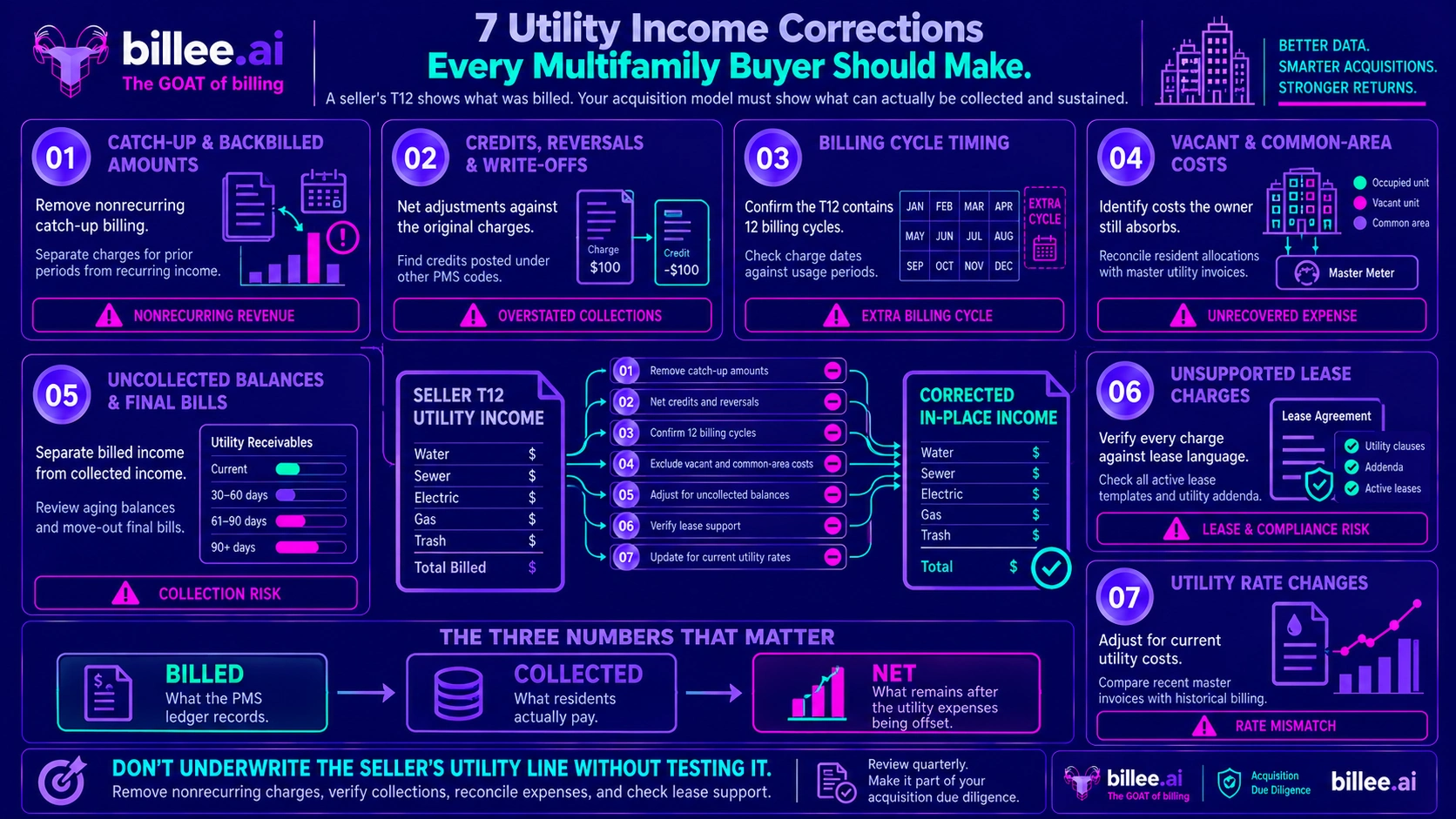
A seller's T12 shows what was billed. Your pro forma has to show what you can keep billing, collect and defend. Below are seven corrections to test, a bridge for the model and a check on what lenders will count. The dollar example is illustrative.
Key takeaways
- Test the utility line three ways: billed, collected, and net of the expense it offsets.
- Seven corrections do most of the work: catch-up billings, credits, cycle timing, vacant and common-area cost, uncollected balances, unsupported charges and rate changes.
- State and lease rules cap what you can recover. In Texas, water and sewer billing rules limit most undercharge adjustments to the previous six months.
- Fannie Mae's guide asks that other income exclude one-time extraordinary non-recurring items. A catch-up billing does not belong in the run rate.
- Keep post-close upside on its own line. Underwrite what the history supports.
The seven corrections at a glance
#CorrectionAsk the seller forUsual effect on in-place income1Catch-up or backbilled amountsLedger detail by charge date and billing periodDown2Credits, reversals and write-offsAdjustment-code detail from the PMSDown3Cycle timingCharge dates tied to usage monthsDown or up4Vacant and common-area costMaster invoices and the allocation methodExpense up, or recovery down5Uncollected balances and final billsAn aging report on utility chargesDown6Charges the lease does not supportEvery lease template and addendum in forceDown7Rate changes since the T1212 to 24 months of master invoicesExpense up, or income up if billable
The effects are directional, not forecasts. Your property may sit on the other side of any row.
Why the seller's utility line misleads
The utility line in a T12 is rarely one thing. Depending on how the PMS codes them, it can hold resident charges, move-out final bills, fees, catch-up billings and credits. Each can behave differently next year.
Three numbers matter. Billed is what the ledger shows. Collected is what came in. Net is what remains after the master invoices the line is meant to offset. A pro forma that carries only the first is carrying the most flattering one.
The diligence question is narrower than "what did the seller bill?" It is "what can a new owner bill next month, under these leases and this state's rules, and collect?" Everything below is a way to answer it.
Seven corrections to test in the T12
1. Catch-up or backbilled amounts
A one-time catch-up billing lifts the T12 and will not repeat. Ask for ledger detail by charge date and the billing period each charge covers. Anything that bills a prior period belongs outside the run rate. Fannie Mae's Multifamily Guide says the same in its own terms: other income must exclude one-time extraordinary non-recurring items.
2. Credits, reversals and write-offs
Credits can post to a different line from the charge they offset. If the seller books them under concessions or bad debt, the utility line looks cleaner than it is. Request adjustment-code detail from the PMS and net each credit back against the line it belongs to.
3. Cycle timing
A T12 can hold 11 or 13 billing cycles when a bill date moves or a cycle posts late. Count the cycles. Then tie each charge to its usage month and each month to a master invoice. A thirteenth cycle is a quiet way to overstate income.
4. Vacant units and common areas
Cost the owner absorbs never shows up in the reimbursement line. Check how much of the master invoices sits in vacant units and common areas, and whether the allocation method handles both. The expense line may already carry that cost, which is fine. The mistake is assuming the reimbursement line recovers it.
5. Uncollected balances and final bills
Billed is not collected. Ask for an aging report on utility charges and for the status of move-out final bills. Open balances on residents who have left rarely convert.
6. Charges the lease does not support
The addendum has to support both the method and every fee. Billee's audit methodology treats lease language gaps as a source of lost recovery. In a portfolio with several lease templates, read all of them. Billee's guide to RUBS lease addendum requirements lists what a compliant addendum includes.
7. Rate changes since the T12
Utility rates and master-invoice patterns move before billing catches up. Pull 12 to 24 months of master invoices and compare the trend with billed income. Rising expense against flat billing is either upside, if the leases let you pass it through, or a leak.
Documents to request
Billee's own audit asks for four document sets that cover the same billing period. They make a sound diligence request for any provider:
- Current provider reports. The billing methodology breakdown by commodity and the resident allocation charges report.
- Master invoices. Copies that match those reports. If you are unsure which apply, start with the most recent three months.
- Leases. Every lease and utility addendum version in force.
- The W-9 and legal entity name. They let you match master-invoice account names to the owner.
Add ledger detail by charge code, a utility aging report and the vendor contract. Billee's acquisition due diligence checklist covers the wider list.
Where law and lease cap the recovery
Corrections tell you what the seller overstated. Rules tell you what you can recover from here.
Texas lookback. For water and sewer billed under the Texas PUC's rules, 16 TAC §24.283(k), "Overbilling and underbilling," limits how far back an owner can reach. If a resident was undercharged for a reason other than a submeter error, the owner may adjust bills issued in the previous six months.
An undercharge of $25 or more calls for a deferred payment plan. Usage by a previous resident cannot be billed to the current one. A catch-up plan built on older months fails that test. Billee's Texas PUC Chapter 24 guide covers the rest of the rule.
Colorado conditions. Colorado's HB26-1013, approved March 26, 2026, allows ratio billing when four conditions hold:
- Total resident charges do not exceed the utility's charge for the premises.
- No markup, surcharge or administrative fee sits on top of actual charges, except as otherwise permitted by law.
- Common-area and shared-facility costs stay out of resident allocations.
- The method is disclosed clearly in the rental agreement or an addendum.
If a seller's income includes fees beyond actual cost, test them against those four. Billee's Colorado RUBS rules guide has the detail.
Everywhere else. Rules vary by state. Billee's state-by-state RUBS guide is a starting point, and counsel in the property's state decides.
Building the corrected pro forma
Put the corrections into one bridge, then separate what the history supports from what you plan to add. The table below is illustrative only: round numbers for a hypothetical 300-unit property, not Billee customer data.
StepIllustrative amountSeller T12 utility reimbursement line (13 billing cycles)$585,000Remove the thirteenth cycle–$45,000Remove a one-time catch-up billing–$18,000Net credits booked under other lines–$12,000Remove charges the leases do not support–$15,000Reserve for uncollected final bills–$10,000Add a rate increase already billable under the leases+$20,000Corrected in-place income$505,000
Run the expense side on its own: master invoices, plus the vacant-unit and common-area cost the owner carries. Then keep post-close changes, such as better vacant-unit recovery, on a separate line labeled upside.
Capitalized, the gap matters more than it looks. In this example the $80,000 gap, divided by whatever cap rate you use, is the value you would otherwise overpay.
What lenders will count
Fannie Mae. Section 203.01 of the Multifamily Guide lists reimbursements and utility among the items of other income. Other income must be stable, common in the market, free of one-time extraordinary non-recurring items and supported by prior years. The underwriter assesses each month within the prior full-year operating statement or, at a minimum, one covering the trailing six months (annualized). Income above the trailing three-month figure (annualized) counts only up to the highest single month in that window.
The practical point: a fee you fix at closing is real cash flow, but it may not be underwritten until it appears in the history. Billee's guide to audit ROI and valuation impact walks through the valuation math.
Freddie Mac. Section 60.17(e) of the Multifamily Guide governs appraisals. It lets the appraiser include income from sources other than residential units when at least three years of historical operations support it, it is common in the market and it is expected to continue. The sources it lists are commercial space, laundry, parking, cable television, vending and application fees.
Utility reimbursements are not named. Ask your lender and appraiser how they treat utility income before you build a valuation case on it.
How Billee Technologies handles it
Billee Technologies pairs a platform with a named, dedicated account team. Your people review and approve. Billee's team does the work.
Before close: a methodology review
Billee's audit reviews the four document sets above and produces a gap list. It covers methodology errors by commodity, allocation drift as unit mix changes, master-meter to unit-level reconciliation problems, legal-entity mismatches between invoices and ownership, and lease language that limits recovery.
Billee documents the audit for onboarding, recovery optimization and refinancing or disposition due diligence. If you are the buyer, ask whether Billee can run the review on a target property before close. Billee's guide to preparing a billing methodology audit explains what each document reveals.
After close: 45 days to live billing
Billee's standard implementation takes 45 days from kickoff to live billing. It covers PMS integration, vendor transition, historical data migration, a methodology audit of the formulas, submeter configuration and allocation logic, training for property and regional teams, and the first billing cycle. Your part is three tasks: approve resident communication templates, provide PMS access and historical data, and join one weekly check-in call. Billee's first-90-days guide lays out the calendar.
Buying several properties at once? Billee's guide to consolidating billing vendors after an acquisition covers sequencing.
Every month: errors caught before they post
Each month Billee assembles utility data, runs the allocation and produces a preliminary bill. Your billing administrator reviews per-resident detail next to Biller Highlights, the team's notes on exceptions, and can leave comments. Billee replies within 1–2 business days. After you approve, a biller locks the bill within 1–2 business days, charges post to the PMS resident ledger on the set date, and e-bills go to residents.
The review step is where a catch-up billing, an odd credit or a missing meter read shows up before a resident sees it. Billee's own guidance to customers: read Biller Highlights first, approve preliminary bills promptly, and generate final bills as soon as move-outs appear.
When something is wrong after it posts
Locked-bill revision requests and final-bill corrections run on the same 1–2 business-day standard. The portal keeps an activity log of every billing action by your team or Billee's, so a correction leaves a record.
Vacant-unit cost
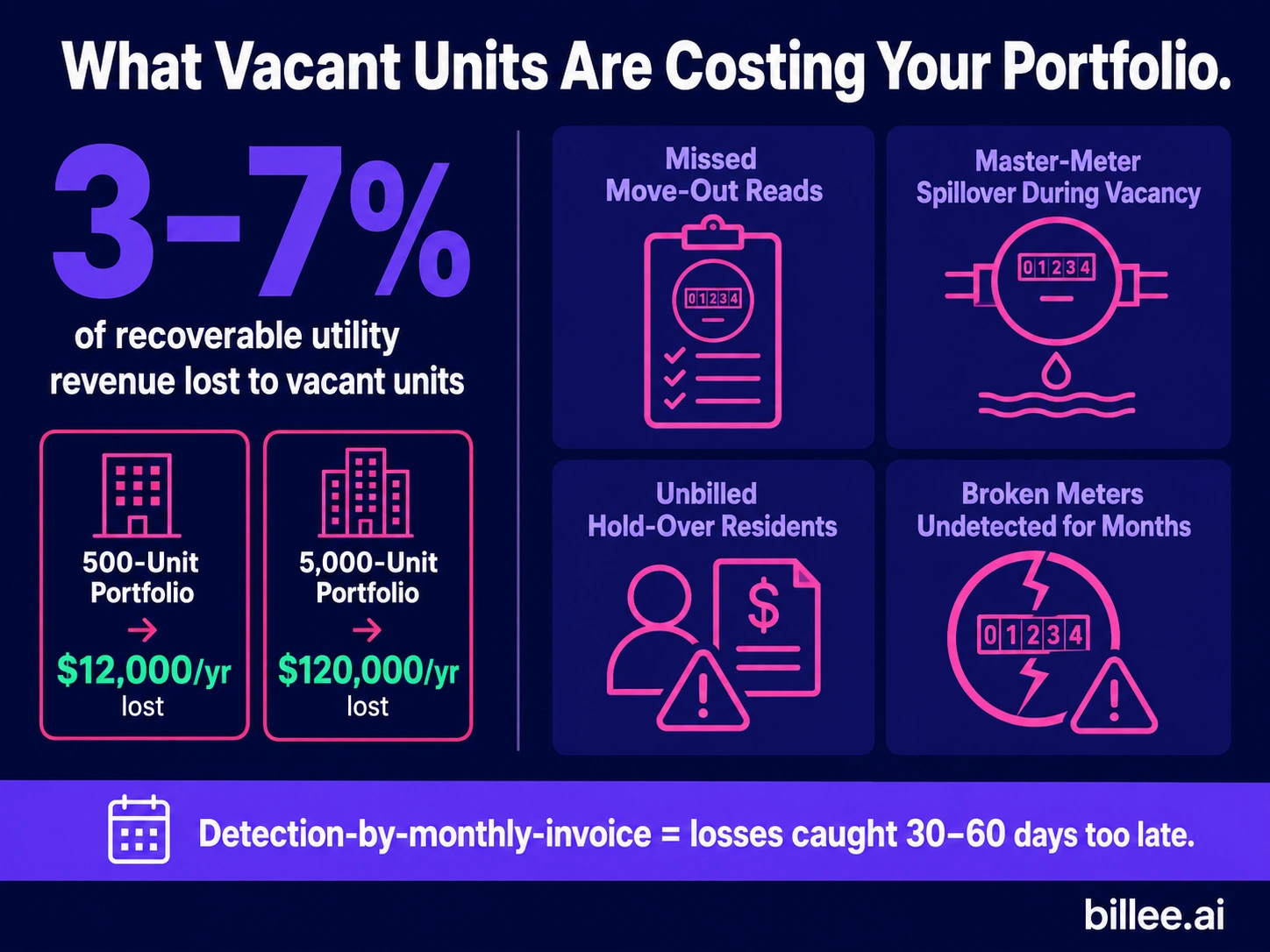
Billee's Vacant Cost Recovery watches meter activity against PMS occupancy data. When a unit marked vacant keeps drawing usage past a set threshold, the exception goes to a named team member who investigates and recovers the charge. Billee reports first measurable results within 30–45 days and full optimization in 90–120. In the model, treat this as post-close upside, not in-place income.
Billee also measures effective recovery against an 80–95% range and treats anything below 80% as a problem to investigate. The range is Billee's own framework, not an industry standard. Billee's guide to what 80–95% effective recovery means explains it, and the Vacant Cost Recovery page describes the service.
Compliance monitoring
Billee's Regulatory & Compliance service covers billing methodology audits, access to legal support and ongoing monitoring for rule changes. Access to legal support is not legal advice. Billee's guide to its regulatory and compliance support explains the scope.
What to ask Billee for in writing
- Whether a pre-close review is available for a target property.
- A dated plan for a multi-property acquisition, including how the properties are staged.
- Whether the 45 days ends at the first approved preliminary bill or when the first cycle locks and posts.
Who Billee is not for
- Portfolios under about 300 units, where Billee's full-service model is usually more than the job needs.
- Operators who want to run billing themselves with software alone. Billee's portal exists for review and approval, not self-service operation.
- Properties on a PMS Billee does not list. Billee lists Yardi, RealPage and Entrata, so confirm support first.
FAQ
Which utility documents should I request in acquisition diligence?
Ledger detail by charge code, master invoices, the billing methodology and allocation reports, every lease template and utility addendum, an aging report on utility charges and the vendor contract. Billee's audit uses four document sets that cover the same billing period.
Should I underwrite utility reimbursement income gross or net of the expense?
Show both. Underwrite the reimbursement line as corrected, then run the master-invoice expense on its own, including vacant-unit and common-area cost. The net is what a new owner keeps.
How do billing corrections show up in a T12?
Credits and reversals can post to a different line from the charge they offset, and catch-up billings sit in the month they posted. Request adjustment-code detail and charge dates to see both.
Will my lender count utility reimbursement income?
Fannie Mae's Guide lists utility among the items of other income and asks for history and exclusion of one-time items. Freddie Mac's appraisal rule requires three years of history for income from sources other than residential units and does not name utilities. Ask your lender and appraiser.
What if the lease does not support the seller's charges?
Treat the unsupported amount as at risk and remove it from the in-place number until the leases change. The rules on changing a billing method vary by state, so confirm with counsel.
How should I treat vacant-unit utility cost in the pro forma?
Keep it in the expense line as cost the owner carries. Show any recovery plan as separate post-close upside. Billee reports first measurable vacant-unit recovery within 30–45 days.
How soon can a new owner fix the billing after closing?
Billee's standard implementation takes 45 days from kickoff to live billing. Fixes that depend on lease changes can take longer, because lease terms and state notice rules set the timing.
Billee handles utility billing, vacant cost recovery and vendor management for multifamily operators who want a dedicated team behind the software. If an acquisition is on your calendar, talk to the team about your portfolio.
Sources
- Fannie Mae, "Multifamily Selling and Servicing Guide, Section 203.01: Underwritten Net Cash Flow," accessed October 2026.
- Texas Administrative Code, "Title 16, Part 2, Chapter 24, Subchapter I, Section 24.283: Billing (via Justia)," accessed October 2026.
- Colorado General Assembly, "House Bill 26-1013 (session law)," approved March 26, 2026.
- Freddie Mac, "Multifamily Seller/Servicer Guide, Chapter 60: Appraisals," accessed October 2026.
Insights and Industry Trends