

Texas PUC Chapter 24 Compliance Guide: Water Submetering and Allocation Rules for Multifamily Operators
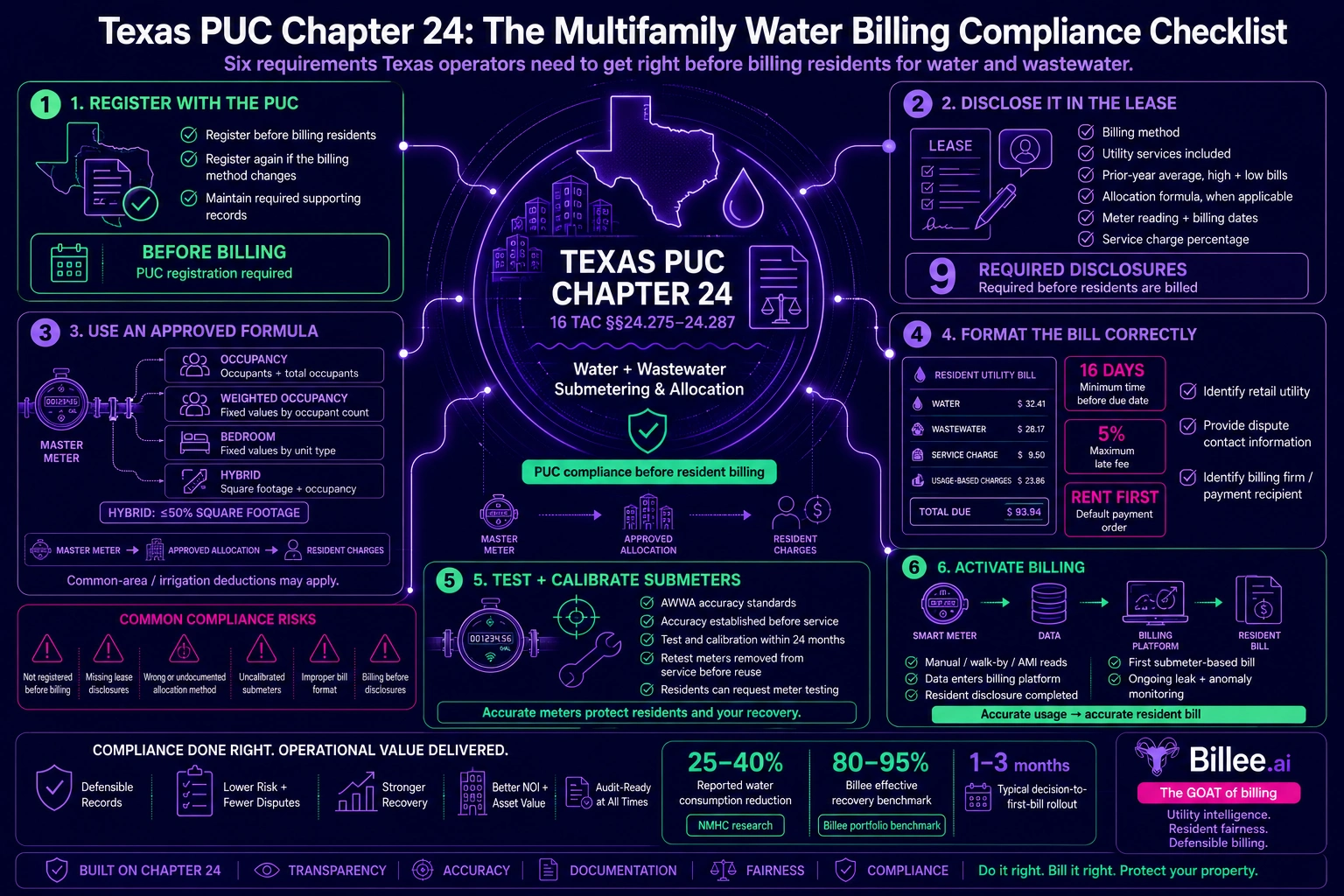
Texas PUC Chapter 24, Subchapter I, governs water and wastewater submetering and allocation billing for apartment houses, condominiums, and manufactured home communities in Texas. Owners must register with the Public Utility Commission of Texas before billing residents, disclose specific terms in the lease, use an approved allocation formula, and format bills to exact specifications. Submeters must meet defined accuracy standards, and the PUC has exclusive jurisdiction over billing disputes. Billee's Regulatory & Compliance service audits Texas portfolios against every requirement on this list.
Quick answer
Chapter 24 (16 TAC §§24.275 through 24.287) is the Public Utility Commission of Texas's rule for water and wastewater submetering and allocation. It is a different, more specific instrument than the broader Texas Utilities Code Chapter 291, which governs RUBS and submetered billing more generally. Chapter 24 applies to apartment houses with five or more units, condominiums, manufactured home communities, and multi-use facilities that bill residents for water and wastewater instead of folding it into rent.
Six things determine compliance: registering with the PUC before billing, disclosing the right terms in every lease, using one of the rule's approved allocation methods, formatting bills correctly, keeping submeters within accuracy standards, and knowing that the PUC, not a local court, has exclusive jurisdiction if a resident disputes a bill.
Key takeaways
- Chapter 24, Subchapter I (16 TAC §§24.275 to 24.287) is the Public Utility Commission of Texas's water and wastewater submetering and allocation rule, separate from the broader Texas Utilities Code Chapter 291.
- It applies to apartment houses with five or more interconnected units renting monthly or longer, plus condominiums, manufactured home communities, and multi-use facilities.
- Owners must register with the PUC before billing residents for submetered or allocated water and wastewater service, and again if the billing method changes.
- The service charge for submetered water and wastewater service is capped at 9% of the resident's charge, with exceptions for low-income housing tax credit and Section 8 units.
- Submeters must be calibrated to American Water Works Association accuracy standards and tested within a 24-month window.
- The PUC has exclusive jurisdiction over Chapter 24 violations, and residents can file a complaint directly with the commission.
Why this matters for multifamily operators
Chapter 24 applies to nearly every Texas apartment property that bills residents for water or wastewater outside of rent. That covers both submetering, where each unit has its own meter, and allocation, the RUBS-style method that divides a master water bill across units by formula.
Noncompliance is not a private matter between owner and resident. The PUC has exclusive jurisdiction over Chapter 24 violations, so an unresolved billing dispute can become a regulatory complaint rather than a lease-level disagreement. A pattern of noncompliance across a portfolio compounds that exposure at renewal, refinancing, or sale.
Chapter 24 is easy to conflate with Texas Utilities Code Chapter 291, the broader statute covering RUBS and submetered billing across utility types, already covered in Billee's guide to how RUBS rules vary by state. Chapter 291 sets the overall legal framework. Chapter 24 is the Public Utility Commission of Texas's detailed implementing rule specifically for water and wastewater, down to the exact allocation formulas and meter accuracy standards. A property can be squared away on Chapter 291's disclosure and fee-cap requirements and still be out of compliance with Chapter 24's registration, recordkeeping, or meter-testing specifics.
Who Chapter 24 applies to
Section 24.275 defines an "apartment house" as a property with five or more dwelling units connected by common walls, floors, or ceilings, occupied primarily on a nontransient basis, with rent charged at intervals of one month or longer. Properties with four or fewer interconnected units, single-family homes, and duplexes or triplexes fall outside the rule.
The same subchapter also covers condominiums, manufactured home communities, and multi-use facilities that bill for water and wastewater. It applies whether the property submeters each unit individually or allocates a master water bill by formula. Commercial-only properties are excluded.
What Chapter 24 requires, section by section
Subchapter I is organized into seven sections. The table below maps each to its core requirement. The sections that follow walk through the six that carry the most day-to-day compliance weight.
| Section | Covers | Core requirement |
|---|---|---|
| §24.275 | Definitions and applicability | Who the rule covers: apartment houses (5+ units), condos, manufactured home communities, multi-use facilities |
| §24.277 | Registration and records | Register with the PUC before billing; keep 10 categories of records; produce them in 3 to 30 days on request |
| §24.279 | Rental agreement | 9 required lease disclosures, including billing method, historical bills, and the allocation formula |
| §24.281 | Charges and calculations | 9% service charge cap on submetered water and wastewater; several approved allocation formulas; common area deductions |
| §24.283 | Billing | Required line items, 16-day minimum due date, rent-before-utilities payment order, 5% late fee cap |
| §24.285 | Complaint jurisdiction | PUC has exclusive jurisdiction; residents can file a complaint and appear remotely for a hearing |
| §24.287 | Submeter standards | AWWA and ASME accuracy standards; 24-month test and calibration window |
Register with the PUC before you bill (§24.277)
An owner who intends to bill residents for submetered or allocated water and wastewater service must register with the Public Utility Commission of Texas first. The same requirement applies if an owner later changes billing methods.
Ten categories of records back up that registration: current copies of the applicable Water Code and PUC rules, the retail utility's rate structure, water conservation information for residents, retail utility bills, the allocation formula and its inputs, submeter readings and test results, and monthly billing and revenue totals. Records must cover the current year and the previous calendar year, except submeter test results, which stay on file until the meter is retired.
Production timelines depend on where records live: 3 days if kept at an on-site manager's office, 15 days if not routinely on-site, and 30 days if the property has no on-site manager.
Get the lease disclosures right (§24.279)
Nine specific disclosures must appear in the rental agreement before a resident can be billed for submetered or allocated service. The lease must state the billing method, which utility services are included, that billing disputes run between the resident and the owner, and the average monthly bill for all units in the prior calendar year plus the highest and lowest months. For allocated billing, it must also describe the formula in plain language.
The lease must cover meter reading and billing dates, how long the owner has to repair a leak in the unit or in unsubmetered common areas, the resident's right to request bill verification, and the applicable service charge percentage.
Choose an approved allocation formula (§24.281)
Owners who allocate rather than submeter must use one of the rule's defined formulas. The options most relevant to standard apartment properties: occupancy ratio, where each unit's occupants are divided by the property's total occupants, a weighted occupancy formula with fixed values per occupant count, a bedroom-based formula that assigns fixed values by unit type, and a hybrid formula that blends square footage and occupancy, capped at 50% square footage.
Manufactured home communities can allocate by rental space area, condominiums can use contract-based methods, and any property can bill by submetered hot or cold water usage instead of a formula. Owners with unmetered irrigation must deduct at least 25% of the master meter bill for common area use before allocating the remainder. Properties with metered irrigation plus other common areas, or no irrigation at all, deduct at least 5%.
The service charge for submetered water and wastewater service is capped at 9% of the resident's charge. Residents in low-income housing tax credit units or receiving Section 8 assistance are exempt from that cap.
Format the bill correctly (§24.283)
Every bill must separately itemize the amount due for water, the amount due for wastewater, any base or customer service charge, and usage-based charges where applicable. The bill must also identify the retail utility, list dispute contact information, and name the billing firm and payment recipient.
Billing frequency follows the retail utility's own cycle, generally monthly. The due date cannot fall less than 16 days after the bill is mailed or hand-delivered, and it rolls to the next business day if it lands on a weekend or federal holiday. Payment applies to rent before utilities unless a third-party billing company collects on the owner's behalf or the resident designates otherwise. A one-time late fee, capped at 5%, is allowed only if the lease specifies the exact percentage.
Meet the meter accuracy standard (§24.287)
Submeters must be calibrated as close to zero error as possible, within American Water Works Association accuracy standards. Point-of-use submeters follow American Society of Mechanical Engineers standards instead. No submeter can go into service until its accuracy is established, and any submeter pulled from service must be retested before it goes back in.
Submeters need testing and calibration within a 24-month window. Residents can request a test. If the owner cannot show a test from within the prior 24 months, the owner tests the meter and, per the recordkeeping rule above, keeps the results on file until the meter is retired. Billee's guide to water submetering, step by step covers the installation and commissioning side of meeting this standard in the first place.
Know where complaints go (§24.285)
The Public Utility Commission of Texas has exclusive jurisdiction over Chapter 24 violations. Residents can file a complaint against an apartment house owner, condominium manager, manufactured home community owner, or multi-use facility owner directly with the commission, and both sides can appear remotely for a hearing.
Common mistakes
- Bundling the utility charge into the rent line instead of itemizing water, wastewater, and service charges separately, which violates §24.283's format requirement.
- Missing the 24-month submeter test window, especially on properties that inherited hardware from a prior owner or management company.
- Using an allocation formula that is not one of the rule's approved methods, or applying the wrong one to the wrong property type.
- Skipping the common area or irrigation deduction before allocating the master meter bill to residents.
- Applying resident payments to utilities before rent, which reverses §24.283's default order without a lease provision or third-party billing arrangement to justify it.
- Leaving required disclosures out of the lease addendum, particularly the prior year's average, high, and low bills, which owners frequently omit.
When to handle this in-house vs. bring in a partner
A single Texas property with a stable resident base and a disciplined property manager can often stay compliant with a checklist: confirm registration, keep the lease addendum current, verify the allocation formula matches what is disclosed, and calendar submeter testing every 24 months.
The burden compounds for multi-property or multi-state portfolios. Texas-specific requirements do not transfer to a national template, submeter testing records need tracking property by property, and a formula change at one property has to flow through the lease, the billing system, and the recordkeeping at the same time. Billee's complete guide to utility management compliance covers what that burden looks like across a full multi-state portfolio, not just Texas.
How Billee can help
Billee's Regulatory & Compliance service audits billing methodology against state PUC rules, including Chapter 24's registration, formula, and disclosure requirements, and documents the audit trail for lender and investor due diligence. The audit checks the same things a PUC complaint would: is the property registered, does the lease disclose what §24.279 requires, does the allocation formula match what residents were told, and are submeter test records current.
Billee's account team also coordinates with the meters themselves. Keeping submeters within the accuracy window Chapter 24 requires is a hardware and maintenance problem as much as a paperwork one, and Billee treats them as the same project instead of two separate workstreams.
FAQ
What is Texas PUC Chapter 24?
Texas PUC Chapter 24, Subchapter I, is the Public Utility Commission of Texas's rule governing water and wastewater submetering and allocation billing for apartment houses, condominiums, and manufactured home communities. It covers registration, lease disclosures, allocation formulas, billing format, and meter accuracy standards.
Is Chapter 24 the same thing as Texas Utilities Code Chapter 291?
Chapter 24 and Chapter 291 are different, related instruments. Chapter 291 is the broader statute covering RUBS and submetered billing generally, while Chapter 24 is the Public Utility Commission of Texas's detailed administrative rule specifically for water and wastewater.
Does Chapter 24 apply to submetering, allocation, or both?
Chapter 24 applies to both submetering, where each unit has its own meter, and allocation, the RUBS-style method that divides a master water bill by formula. The rule's registration, disclosure, and billing requirements apply either way.
Do I need to register with the Texas PUC before billing residents for water?
Registration with the Public Utility Commission of Texas is required before an owner bills residents for submetered or allocated water and wastewater service, and again if the owner later changes billing methods. Billee's Regulatory & Compliance audit checks registration status as part of a full Chapter 24 review.
What allocation formulas does Chapter 24 allow?
Standard apartment properties can allocate by occupancy ratio, a weighted occupancy formula, a bedroom-based formula, or a hybrid formula capped at 50% square footage. Manufactured home communities, condominiums, and submetered properties have additional formula options specific to those property types.
Is there a cap on the service fee I can charge?
The service charge for submetered water and wastewater service is capped at 9% of the resident's charge, with an exception for residents in low-income housing tax credit units or receiving Section 8 assistance.
How often do water submeters need to be tested in Texas?
Water submeters need testing and calibration within a 24-month window under §24.287. Residents can request a test at any time, and if the owner cannot produce a test from the prior 24 months, the owner retests the meter.
What happens if a resident disputes their water bill?
The Public Utility Commission of Texas has exclusive jurisdiction over Chapter 24 disputes. Residents can file a complaint directly with the commission, and both sides can appear remotely for a hearing.
Related reading
- PUC Disclosure Requirements for Multifamily Utility Billing: how billing statement disclosure rules compare across other regulated states.
- How RUBS Allocates Utility Costs in Multifamily Properties: the general math behind allocation formulas, beyond Chapter 24's specific methods.
- How to Prepare a Billing Methodology Audit: what a formal audit checks and how to get ready for one.
Billee's Regulatory & Compliance service audits Texas portfolios against Chapter 24's registration, formula, and disclosure requirements, and documents the trail for refinancing and disposition. Talk to the team.
Sources
- Public Utility Commission of Texas, "16 TAC §24.275: General Rules and Definitions," accessed August 2026.
- Public Utility Commission of Texas, "16 TAC §24.277: Owner Registration and Records," accessed August 2026.
- Public Utility Commission of Texas, "16 TAC §24.281: Charges and Calculations," accessed August 2026.
- Public Utility Commission of Texas, "16 TAC §24.283: Billing," accessed August 2026.
- Public Utility Commission of Texas, "16 TAC §24.287: Submeters or Point-of-Use Submeters and Plumbing Fixtures," accessed August 2026.
Insights and Industry Trends


Explore more insights