

From Audit Finding to Appraisal Line: How Utility Billing Recoveries Actually Move NOI and Valuation
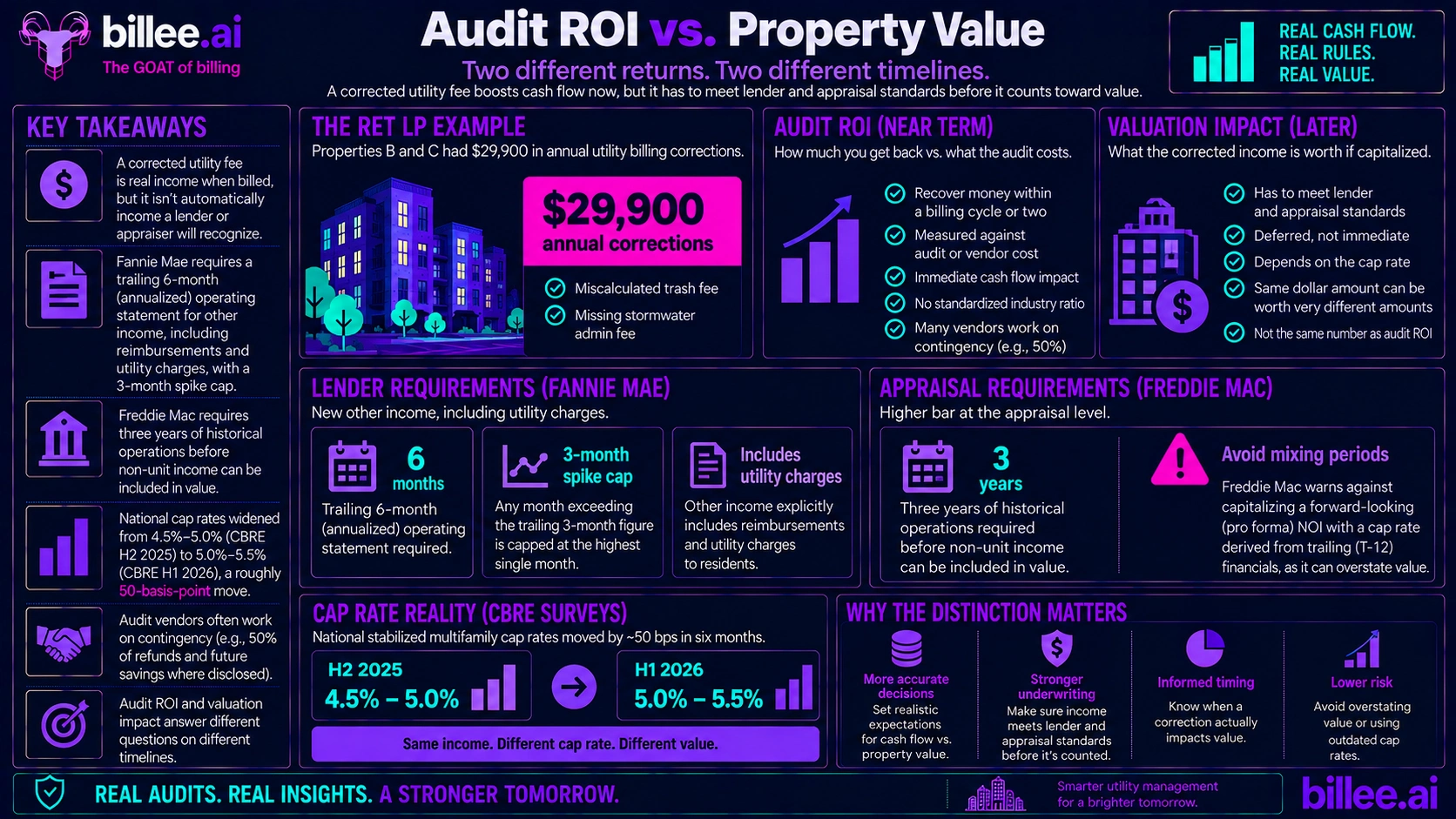
Properties B and C in the RET LP audit had a combined $29,900 in annual utility billing corrections, a miscalculated trash fee, a missing stormwater admin fee, fixed after Billee's property-by-property review. The easy version of what that's worth divides $29,900 by a cap rate and calls it added value. The real version is slower than that. A corrected fee that appears on next month's rent roll isn't yet income a lender will underwrite or an appraiser will capitalize. Fannie Mae's own guide requires new other income, reimbursements and utility charges included by name, to clear a trailing-income test before it counts toward Net Cash Flow. Freddie Mac's appraisal guide sets an even higher bar for the same category of income at the appraisal level. And the cap rate itself isn't fixed either: it moved by roughly 50 basis points nationally between two consecutive CBRE surveys in the past year. Audit ROI and valuation impact are related, but they are not the same number, and treating them as interchangeable is where the naive version of this math breaks down.
Quick answer
A utility billing correction has two separate returns. Audit ROI is the immediate one: money recovered against what the audit or the vendor relationship cost, measurable within a billing cycle or two. Valuation impact is the deferred one: what that corrected income is worth if capitalized into the property's value, and it doesn't kick in the moment the fee is fixed. Fannie Mae requires other income, including reimbursements and utility charges, to be supported by a trailing 6-month (annualized) operating statement before it counts toward underwritten Net Cash Flow, with any month exceeding the trailing 3-month figure capped at that window's highest single month. Freddie Mac's appraisal guide sets a three-year historical-operations bar for the same category of income. Until a correction clears whichever standard applies, it's real cash flow but not yet bankable NOI, and even once it clears, the cap rate used to capitalize it should reflect where rates actually are, not a round number assumed for convenience.
Key takeaways
- A newly corrected utility fee or allocation error is real income the moment it's billed, but it isn't automatically income a lender or appraiser will recognize in a valuation.
- Fannie Mae's Multifamily Selling and Servicing Guide requires other income, explicitly including reimbursements and utility charges to residents, to be supported by a trailing 6-month annualized operating statement, with a 3-month spike cap.
- Freddie Mac's Multifamily Guide sets a stricter bar at the appraisal level: three years of historical operations before non-unit income can be included in gross income used to value the property.
- Freddie Mac's own appraiser guidance warns against capitalizing a forward-looking (pro forma) NOI with a cap rate derived from trailing (T-12) financials, calling the result a potential overvaluation.
- National stabilized multifamily cap rates widened from a 4.5%-5.0% range in CBRE's H2 2025 survey to 5.0%-5.5% in its H1 2026 survey, a roughly 50-basis-point move in about six months.
- The same dollar amount of corrected income is worth a meaningfully different amount depending on which cap rate in that range gets applied, and on which Texas metro the property sits in.
- Utility bill audit vendors commonly work on contingency, and where the fee is disclosed, it runs high: Pacific Utility Audit states its fee at 50% of refunds and future savings identified.
- There's no single codified industry-wide "audit ROI" ratio for utility billing audits specifically; vendor case studies and adjacent industries (accounts-payable recovery audits) use different, not directly comparable, benchmarks.
- Audit ROI and valuation impact answer different questions on different timelines, and a portfolio decision that conflates them risks overstating what a correction is worth in the near term.
Why this matters
The shorthand used illustratively elsewhere in this series, take an annual correction, divide by an assumed cap rate, call the result added value, is useful for showing that fee corrections aren't trivial. It's a worse guide for an actual transaction. Two things it skips matter a great deal once real money and a real closing date are involved: whether the income has cleared the underwriting or appraisal standard that determines if it counts at all, and whether the cap rate applied to it reflects the range the market is actually trading at, rather than a flat number assumed for simplicity.
Both of those skipped steps are governed by published rules, not judgment calls. Fannie Mae and Freddie Mac each set out, in their own multifamily guides, exactly how new or corrected other income gets treated before it's recognized. And cap rates are surveyed and published twice a year by CBRE and others, which means there's no excuse for using a stale or invented number when a specific, current range is available. This piece works through both.
The seasoning problem: why "recovered" income isn't automatically "underwritten" income
Fannie Mae's trailing-income rule
Fannie Mae's Multifamily Selling and Servicing Guide governs how Delegated Underwriting and Servicing (DUS) lenders calculate Underwritten Net Cash Flow, the number that drives loan sizing. Its rule for other income is specific: other income must be stable, common in the market, exclude one-time extraordinary items, and be supported by prior years. The guide requires assessing "the individual month's other income within the prior full-year operating statement or, at a minimum, an operating statement covering at least the trailing 6 months (annualized)." Where there are fluctuations, other income can exceed the trailing 3-month annualized figure only up to the highest single month used in that 3-month calculation, not simply the new, higher run rate.
The guide's list of what counts as other income under this rule names reimbursements and utility charges to residents specifically, alongside application fees, late fees, pet fees, and storage income. A freshly corrected stormwater admin fee or a fixed allocation error falls squarely into this category. In practice, that means a lender working from Fannie Mae's guide can't annualize month one of a correction and call it done. They need at least six trailing months on the books, annualized, and even then a spike above the trailing 3-month figure gets capped at that window's highest month rather than credited in full.
Freddie Mac's three-year bar at the appraisal level
Freddie Mac's Multifamily Seller/Servicer Guide sets a different, and considerably longer, standard, though at a different point in the process. Chapter 60 covers appraiser and appraisal requirements, and Section 60.17(e), addressing income, states that an appraiser "may include income from sources other than residential units when calculating total gross income if such income is supported by at least three years' historical operations, is common in the market and is expected to continue in the future." The section's examples, commercial space, laundry, parking, cable, vending, application fees, sit in the same "other income" category that utility reimbursement income belongs to by definition.
Three years is a materially higher bar than Fannie Mae's six trailing months, and it applies at the appraisal step rather than at loan-level underwriting. A separate piece of Freddie Mac's own guidance reinforces the same caution from a different angle: its appraisal materials distinguish "stabilized operations" from "stabilized occupancy," warning explicitly that defaulting to an assumed stabilized occupancy number isn't the same as demonstrating stabilized income, of which a newly corrected fee is one component.
Why the two GSEs land in such different places
The gap isn't a contradiction; it reflects two different questions being asked at two different points in a deal. Loan-level underwriting asks whether cash flow is dependable enough to size debt against, which is a shorter, more operationally focused question, hence Fannie Mae's trailing-6-month standard. Appraisal asks what the asset itself is worth to a hypothetical buyer, a more conservative question by design, hence Freddie Mac's three-year bar for non-unit income specifically. An operator running corrections across a portfolio should expect a fixed fee to become loan-eligible income well before it becomes appraisal-eligible income, and should plan financing and disposition timelines accordingly rather than assuming one clears both standards at once.
The cap-rate mismatch: why forward-looking corrections need forward-looking rates
Freddie Mac's own warning against T-12-derived cap rates on pro forma NOI
Even once income clears whichever seasoning standard applies, the rate used to capitalize it matters as much as the income figure itself. Freddie Mac's own appraiser training material addresses this directly: "Applying a capitalization rate developed with T-12 NOI (or any backward-looking NOI estimate) to the appraiser's proforma NOI will yield a potentially aggressive result and a potential overvaluation of the subject property." The same guidance ties this back to the Appraisal Institute's own text, The Appraisal of Real Estate, on matching how comparable-sale NOI and subject NOI are calculated before applying a rate derived from one to the other.
What this looks like on an actual corrected line item
Applied to a fee correction, the warning is concrete: a cap rate pulled from a market's trailing 12-month sales data, before the correction existed, isn't the right rate to apply to a pro forma NOI that already assumes the correction is fully realized and stable. Doing so compounds two optimistic assumptions, that the income is fully seasoned and that the market hasn't moved, into a single number that overstates value on both counts. The more defensible approach treats the corrected income and the cap rate as two separate variables to get right, not one shortcut.
What a realistic cap rate actually does to a correction, in 2026
National multifamily cap rates, H2 2025 to H1 2026
CBRE's twice-yearly U.S. Cap Rate Survey is the standard industry reference, drawing on thousands of cap rate estimates across more than 50 markets. Its H2 2025 edition, published in February 2026, put national stabilized multifamily cap rates at 4.5%-5.0%, with multifamily ranked the top sector for expected returns over the coming decade. Its H1 2026 edition, published in August 2026, the most current available, shows that range widening to 5.0%-5.5%, a roughly 50-basis-point move in about six months. Infill multifamily carried the most bearish outlook of any subtype in that survey.
Texas metro detail
Texas metros vary meaningfully within the national range. CBRE's H2 2025 survey put Class A infill stabilized cap rates at 4.25%-4.75% in both Austin and Dallas, 4.75%-5.25% in Houston, and 4.75%-5.25% in San Antonio, with suburban product generally running 25-50 basis points higher than the infill figures. A portfolio spanning Houston and DFW, the geography this series has covered throughout, sits across a real spread even within Texas, before national movement is factored in.
Sensitivity table: the same correction, a real range of outcomes
Applying Properties B and C's combined $29,900 in corrected annual income across a realistic 2026 range, rather than a single assumed rate, shows how much the answer moves:
| Cap rate | Implied added value |
|---|---|
| 4.25% (Austin/Dallas Class A, H2 2025) | ~$703,500 |
| 4.75% (Houston/San Antonio Class A, H2 2025) | ~$629,500 |
| 5.00% (national low end, H1 2026) | ~$598,000 |
| 5.25% | ~$569,500 |
| 5.50% (national high end, H1 2026) | ~$543,600 |
The spread between the low and high end of this range, roughly $160,000 on a $29,900 correction, is larger than most operators would guess from a single flat-rate assumption, and it's before accounting for whether the income has cleared a seasoning standard at all.
The other half of the equation: what does the audit itself cost, and what does it return?
Contingency-fee models in the utility-audit industry
Separately from valuation impact, there's a more immediate question: what does finding and fixing these corrections actually cost, and how quickly does that cost pay back? Third-party utility bill audit firms commonly price on contingency rather than a flat fee, and where a specific number is disclosed, it tends to be high. Pacific Utility Audit states its model plainly: the firm receives 50% of any refunds or credit adjustments, and 50% of any actual monthly savings identified for a future period. That's a real, named figure from a firm that does this work, not an estimate.
A real vendor case study, worked out
Util Auditors publishes a results page with a worked example that lands in the same range: a gross refund of $85,577.39 against an audit fee of $42,788.69, a net refund of $42,788.70, close to a 50/50 split of the gross recovery. The same case projected $100,483.80 in future savings over 60 months ($1,674.73 a month), for a stated total net benefit of $143,272.50 across five years. It's one documented example, not a guarantee, but it shows the contingency math in practice rather than in the abstract.
Why there's no single "audit ROI" industry standard
No authoritative body, the Appraisal Institute, the National Apartment Association, or a comparable organization, publishes a standardized "audit ROI" ratio specifically for utility billing audits. What exists instead is a set of vendor-specific figures that aren't directly comparable to each other. UtiliSave, a separate utility audit firm, frames its value proposition as a straight multiplier through capitalization rather than a cost ratio: "every dollar we recover drops straight to NOI, and at a 5% cap rate becomes $20 of asset value." In the accounts-payable recovery audit industry, a related but distinct field, PRGX cites an average 10x return for clients on a stated 10-40% contingency range, and apexanalytix describes ROI "often exceeding 300 percent" on fees in the 20-30% range. None of these figures are utility-audit-specific, and none constitute an industry standard; they're useful only as labeled, separate data points, not as a single number to benchmark against.
Putting the two together: audit ROI is immediate, valuation impact is deferred and conditional
The two halves of this article answer different questions on different clocks. Audit ROI measures what a correction returns against what it cost to find and fix, and that math resolves quickly, often within the first billing cycles after implementation. Valuation impact measures what the corrected income is worth if capitalized into the asset's value, and that math doesn't resolve until the income has cleared whichever seasoning standard a lender or appraiser applies, and only at whatever cap rate the market is trading at when it's measured, not the rate assumed when the correction was made.
Treating these as one number, take the correction, apply a fee ratio, then also divide by a cap rate and add it to the same total, double-counts a benefit that actually arrives in two separate places at two separate times. The accurate framing keeps them apart: audit ROI is a near-term cash-flow story, valuation impact is a longer-term, conditional one that depends on facts (seasoning, cap rate) an operator doesn't fully control.
What this means operationally for a portfolio
Before a sale or refinance
Check how long a given correction has been running against whichever standard the lender or appraiser involved actually uses, Fannie Mae's trailing 6 months for loan sizing, Freddie Mac's three years for appraisal-level non-unit income, and don't assume a correction made shortly before a transaction will be fully recognized in either process.
At acquisition due diligence
A seller's pro forma NOI that includes recent utility billing corrections deserves the same scrutiny an operator would apply to any other other-income line: how long has it actually been collected, and does it clear the standard the buyer's own lender will apply, not just the standard the seller used to build the pitch.
In the annual audit cycle
Track not just whether a correction is in place, but how long it's been in place, since that clock is what eventually converts a cash-flow improvement into a valuation improvement. This is a natural extension of the audit cadence Billee recommends elsewhere in this series.
Common mistakes
- Assuming a correction is bankable NOI the moment it's billed. Fannie Mae requires at least a trailing 6-month annualized track record for other income including utility charges; Freddie Mac's appraisal standard requires three years for the same category.
- Applying a T-12-derived cap rate to a pro forma NOI that already assumes the correction is fully realized. Freddie Mac's own guidance flags this specific mismatch as a path to overvaluation.
- Using a flat, assumed cap rate instead of the current published range. National stabilized multifamily cap rates moved roughly 50 basis points between two consecutive CBRE surveys within the past year; a stale assumption misstates the answer in either direction.
- Treating audit ROI and valuation impact as the same figure. They resolve on different timelines and depend on different facts; adding them together overstates the near-term benefit.
- Comparing a utility-audit vendor's advertised ROI to a different industry's benchmark. Accounts-payable recovery-audit figures (PRGX, apexanalytix) describe a different, adjacent industry, not utility billing specifically.
- Not checking how long a seller's pro forma corrections have actually been running during acquisition due diligence. A recently implemented fix on a seller's pro forma may not clear the buyer's own lender's trailing-income standard.
What getting this right is worth
Properties B and C's $29,900 in combined corrected annual income is worth somewhere between roughly $543,600 and $703,500 in added asset value depending on where in the current cap-rate range it's capitalized, a real spread, and that's before accounting for whether the correction has cleared a trailing-income standard at all. Scaled to the full $220,500 Billee recovered across the five audited properties in the RET LP portfolio, the same cap-rate range implies added value anywhere from roughly $4.0 million to $5.2 million, a wide enough spread that which end of it applies is not a rounding error. Getting the sequencing right, know what's recovered now, know when it clears the relevant standard, know what rate actually applies when it's measured, is what turns a fee correction into a number a lender or appraiser will actually recognize, rather than one that only works in a pitch deck.
How Billee can help
Billee's Regulatory & Compliance service runs the audit discipline that produced the corrections behind Properties B and C, as an ongoing part of managing a portfolio rather than a one-time contingency engagement. That distinction matters for the seasoning question this piece covers: a correction implemented and tracked consistently, month over month, builds the trailing operating history a lender or appraiser will actually credit, rather than a spike that shows up once and needs to be explained.
FAQ
Does a corrected utility fee count as income the moment it's billed?
It's real cash flow the moment it's billed, but it isn't automatically income a lender or appraiser will recognize. Fannie Mae requires a trailing 6-month annualized operating statement to support other income including utility charges; Freddie Mac's appraisal standard requires three years of historical operations for the same category.
How long does a utility billing correction need to run before a lender will count it?
Under Fannie Mae's Multifamily Selling and Servicing Guide, at least the trailing 6 months (annualized), with any month exceeding the trailing 3-month figure capped at that window's highest single month.
How long does it need to run before an appraiser will count it?
Freddie Mac's Multifamily Guide sets a three-year historical-operations bar for non-unit income, including utility reimbursement income, at the appraisal level, a considerably longer standard than the loan-underwriting one.
Why shouldn't I just apply today's cap rate to a correction I just made?
Because the income itself likely hasn't cleared the seasoning standard that would make it recognized NOI yet, and Freddie Mac's own guidance separately warns against applying a cap rate derived from trailing (T-12) data to a forward-looking pro forma NOI, since doing both can compound into an overvaluation.
What's a realistic multifamily cap rate in Texas right now?
CBRE's most recent surveys put Class A infill stabilized cap rates at roughly 4.25%-4.75% in Austin and Dallas and 4.75%-5.25% in Houston and San Antonio, within a national stabilized range that widened to 5.0%-5.5% in CBRE's H1 2026 survey.
What does a typical utility bill audit cost?
Third-party audit vendors commonly price on contingency. Where a specific figure is disclosed, it runs high: Pacific Utility Audit states 50% of refunds and identified future savings. There's no single industry-standard percentage, and figures vary by vendor.
Is there an industry-standard "audit ROI" for utility billing audits?
No. No authoritative body publishes a standardized ratio for utility-audit ROI specifically. Vendor case studies and adjacent industries like accounts-payable recovery audits use different figures that aren't directly comparable to each other.
Should I count audit ROI and valuation impact as the same benefit?
No. Audit ROI is a near-term cash-flow return that resolves quickly. Valuation impact is a longer-term, conditional return that depends on the income clearing a seasoning standard and on the cap rate applied when it's eventually measured. Adding them together double-counts the benefit.
How does this affect due diligence when buying a property with recent utility billing corrections on the pro forma?
Check how long the seller's corrections have actually been running against the standard the buyer's own lender applies, not just the standard the seller used to build the pitch, since a recently implemented fix may not clear a trailing-income requirement yet.
Related reading
- RET LP Portfolio Case Study: the audit behind Properties B and C, and the $220,500 recovered across five Texas properties.
- How Often Should You Actually Audit Your Utility Billing?: the cadence that builds the trailing operating history this piece depends on.
- What a Legacy Utility Cap Is Actually Costing You: another look at what an uncorrected fee costs over time, before the correction and seasoning clock even start.
- The Utility Billing Fees That Don't Show Up in the Per-Unit Rate: the vendor-economics side of what audit and recovery arrangements actually cost.
If a pending sale or refinance depends on utility billing corrections that haven't been checked against actual seasoning and cap-rate standards, that's worth confirming before it's underwritten by someone else. Talk to the team.
Sources
- Fannie Mae, "Multifamily Selling and Servicing Guide, Part II, Chapter 2: Valuation and Income," effective September 28, 2026.
- Freddie Mac, "Multifamily Seller/Servicer Guide, Chapter 60: Appraiser and Appraisal Requirements," Guide Bulletin Update, August 25, 2026.
- Freddie Mac, "Value of Non-Stabilized Multifamily Properties," appraisal guidance.
- Freddie Mac, "Appraisal Forum Presentation," Multifamily appraiser guidance.
- CBRE, "U.S. Cap Rate Survey H2 2025," published February 10, 2026.
- CBRE, "U.S. Cap Rate Survey H1 2026," published August 2026.
- Pacific Utility Audit, "What Is a Utility Auditor?"
- Util Auditors, "Results"
- UtiliSave, "The Value of an Audit"
- PRGX, "AP Recovery Audit Services Guide"
Insights and Industry Trends



Explore more insights