

Colorado RUBS Rules 2026: What Multifamily Operators Need to Know
Last updated: July 2026
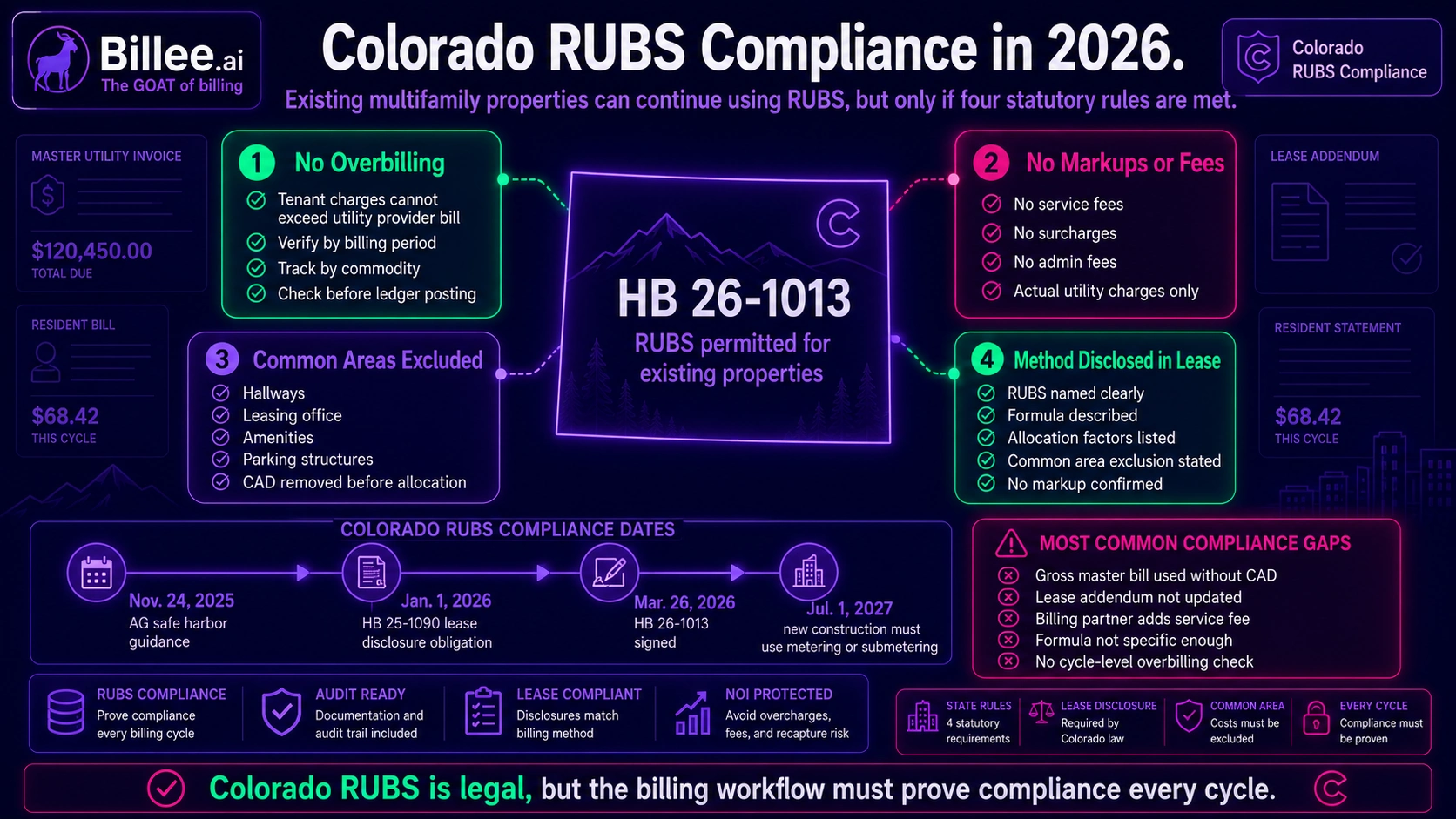
RUBS is legal in Colorado in 2026. HB 26-1013, signed by Governor Polis on March 26, 2026, formally confirmed that ratio utility billing systems are permitted for existing multifamily properties. Four conditions govern compliance: no overbilling, no markups, common area costs excluded from tenant allocations, and the allocation method disclosed in the lease. Properties with building permits filed on or after July 1, 2027 must use direct metering or submetering instead of RUBS.
Key points at a glance:
- RUBS is legal for existing Colorado multifamily properties under four statutory conditions
- Any lease entered, amended, or renewed on or after January 1, 2026 must include updated RUBS disclosure language
- Common area utility costs cannot be included in any tenant RUBS allocation
- No markups, surcharges, or administrative fees can be added on top of actual utility charges under RUBS
- New construction with permits filed on or after July 1, 2027 must use direct metering or submetering
| What changed | Key date | What operators must do |
|---|---|---|
| HB 25-1090 price transparency law takes effect | January 1, 2026 | Update all leases; applies to renewals and new leases signed after this date |
| Colorado AG enforcement guidance issued | November 24, 2025 | RUBS safe harbor outlined with four conditions; operators relied on this guidance until HB 26-1013 passed |
| HB 26-1013 codifies RUBS as legal | March 26, 2026 | Existing properties can continue using RUBS indefinitely, provided four statutory conditions are met |
| New construction RUBS prohibition | July 1, 2027 (permit filing date) | Projects with permits filed on or after this date must use direct metering or submetering |
What HB 25-1090 Changed for Colorado Utility Billing
HB 25-1090, Colorado's price transparency law, took effect on January 1, 2026. It prohibited landlords from charging tenants more than the actual amount billed by the utility provider for their unit. That language created an immediate compliance problem for RUBS billing: RUBS does not bill by individual unit. It allocates the master meter bill proportionally across all residents, which meant the charge any individual resident paid was not the amount billed by the utility for that unit.
The resulting legal uncertainty led to months of operator confusion and a wave of guidance requests to the Colorado Attorney General's office. Eliminating RUBS would have required every master-metered property in Colorado to install individual submeters at significant capital cost, on an accelerated timeline, with no transition period.
Beyond the RUBS question, HB 25-1090 imposes three requirements that all Colorado landlords must comply with regardless of billing methodology. All mandatory fees must be included in the advertised base rent as a total price display. Administrative fees on utility billing are capped at $10 per month or 2 percent of the bill, but not both. The law applies to any lease entered, amended, or renewed on or after January 1, 2026, and is not retroactive.
What the Colorado AG Said About RUBS (November 2025)
Before any clarifying legislation passed, the Colorado Department of Law issued a guidance memorandum on November 24, 2025. The memo stated that the Attorney General's office would not pursue enforcement actions against landlords using RUBS, provided four specific conditions were met. This AG safe harbor was the only legal footing Colorado operators had for RUBS from January through March 2026.
The four AG conditions were: aggregate tenant charges could not exceed the utility provider's total bill for the property; no markups or fees could be added above actual utility charges; common area costs had to be excluded from tenant allocations; and the allocation method had to be clearly disclosed in the lease. Those four conditions became the statutory framework that HB 26-1013 later codified into law.
Operators who updated their practices and lease language between January 1 and March 26, 2026 based on the AG guidance were already compliant with HB 26-1013 when it passed. Operators who did not take any action during that period are now behind on two fronts: the statutory requirements and the lease update obligation that applied from January 1.
What HB 26-1013 Actually Says (The Four Rules)
HB 26-1013 amends Colorado Revised Statutes Section 6-1-737 to make clear that the price transparency law does not prohibit RUBS. It passed the Colorado House 41-22, passed the Senate 23-12, and was signed by Governor Polis on March 26, 2026, taking effect immediately. The law establishes four statutory requirements that define compliant RUBS in Colorado.
Rule 1: Total tenant charges cannot exceed the utility provider's actual bill
The aggregate amount billed across all residents combined cannot exceed what the utility company charged the property for the same billing period. This is a hard ceiling, not a guideline. If the master meter bill for a given month totals $38,400 across water, electric, and gas, the total billed to all residents across those same utility types cannot exceed $38,400.
Operators running multiple commodity types need to track this per utility, not just in aggregate. A property that runs RUBS on water and electric separately must verify the no-overbilling rule holds for each commodity individually. The easiest way to confirm compliance is to run the math at billing cycle close before charges post to resident ledgers, which is part of how Billee's billing cycle prelim review works.
Rule 2: No markups, surcharges, or administrative fees
Landlords cannot add any charge on top of the actual utility amount. No service fee, no administrative fee, no processing surcharge. HB 25-1090 already capped administrative utility fees at $10 per month or 2 percent of the bill, but HB 26-1013 goes further for RUBS specifically: any fee above the actual utility charge is prohibited for properties using RUBS to allocate costs.
This rule has an immediate operational implication for operators whose billing platform or billing partner currently adds a per-unit service fee on top of the utility allocation. That arrangement is non-compliant under Colorado law. Operators in this situation need to audit their billing contracts now and either renegotiate fee structures or switch providers before their next lease renewal cycle.
Rule 3: Common area utility costs must be excluded from tenant allocations
Utility consumption in shared spaces cannot be allocated to residents. Hallways, lobbies, leasing offices, fitness centers, parking structures, elevator equipment, pool systems, and property management offices all fall under this exclusion. The common area deduction, known in the industry as a CAD, must be calculated and removed from the billing pool before any RUBS allocation runs against the remaining balance.
This is the most operationally common failure point in Colorado RUBS compliance. Many master-metered properties calculate RUBS against the gross master meter bill without subtracting common area consumption first. Under HB 26-1013, running RUBS on the gross bill without a CAD is a statutory violation, not just a methodology question. Operators who have never configured a common area deduction need to do so before their next billing cycle. For more on how CAD errors suppress recovery rates, see what 80-95% effective recovery actually means in practice.
Rule 4: The allocation method must be disclosed in the rental agreement
The specific RUBS formula must be written into the tenant's lease or a signed utility addendum. General language such as "utilities allocated proportionally" does not satisfy the disclosure requirement. The method needs to describe how costs are divided across units, what allocation factors are used (occupancy count, square footage, or a weighted combination), and how the common area deduction is calculated before the resident share is determined.
Any lease renewed or entered after January 1, 2026 that does not include this specific disclosure language is non-compliant, even if the billing calculation itself follows all other rules. The disclosure obligation predates HB 26-1013 by several months, which means operators who updated their billing methodology but did not update their lease language are still exposed. According to Holland & Hart's guidance on the law, adding a dedicated utility billing addendum that describes the RUBS methodology and includes sample calculations is the recommended approach for clear compliance.
What Needs to Change in Your Leases
Every Colorado lease entered, amended, or renewed on or after January 1, 2026 requires updated utility billing language. The following items must be addressed before the next renewal cycle.
- Name the methodology. The lease or addendum must identify RUBS by name as the billing methodology used for the property.
- Describe the formula. The allocation factors must be specified: occupancy-weighted, square footage-based, or a documented hybrid approach with the weighting explained.
- Confirm common area exclusion. The addendum should state that common area utility costs are excluded from the resident allocation pool before RUBS is applied.
- Confirm no markup. The addendum should confirm that residents are billed their proportionate share of actual utility charges only, with no service fees, markups, or surcharges added.
- Update advertising materials. HB 25-1090 requires that all mandatory and unavoidable costs be included in the advertised base rent, including utility estimates where applicable.
Operators managing large Colorado portfolios should treat the lease addendum update as a systematic process across all properties, not a property-by-property fix as leases come up for renewal. The obligation applied from January 1, 2026, so any lease renewed without updated language since that date is already retroactively non-compliant. For operators who have not yet started this process, a billing methodology audit is the fastest way to identify gaps across the portfolio before enforcement attention increases.
The July 1, 2027 Deadline for New Construction
HB 26-1013 includes a future-state provision that most operators focused on existing portfolios have not yet absorbed. Any residential property with a building permit filed on or after July 1, 2027 cannot use RUBS. Those properties must use direct metering by the utility provider or submetering. RUBS is not available as a billing option for new construction in Colorado after that permit date.
The practical implication for developers is that the decision point is the permit filing date, not the construction completion date or the lease-up date. A project that files permits in September 2027 must be designed for individual metering or submetering infrastructure, regardless of when residents move in. That infrastructure is substantially cheaper to integrate at the design phase than to retrofit after construction is complete.
For acquisition underwriting on new builds, the cost of submetering needs to be in the pro forma. Submetering typically recovers 85 to 95 percent of utility costs, compared to 70 to 85 percent for RUBS, so the NOI math at stabilization is actually stronger with submetering than with RUBS. The capital cost is real, but so is the recovery lift. Operators evaluating whether to pursue submetering on existing properties before they are required to can review the full RUBS vs. submetering comparison and when to make the switch.
The Three Operational Errors That Create Compliance Risk
The four statutory rules sound straightforward. In practice, most compliance failures trace back to three specific operational breakdowns.
Common area costs have not been carved out of the billing pool. This is the most widespread issue. Properties that have been running RUBS against the gross master meter bill for years, without a configured common area deduction, are overbilling residents and are now in violation of HB 26-1013. The fix requires calculating actual common area consumption by commodity, subtracting it from the master meter total before allocation, and documenting the deduction methodology so it can be disclosed in the lease addendum.
Lease addenda were not updated before January 1, 2026. The disclosure obligation under HB 25-1090 applied to leases renewed or entered from that date forward. Many operators who updated their billing calculations did not simultaneously update their lease language. A property running a fully compliant RUBS calculation with an outdated lease addendum that does not describe the allocation methodology is still technically non-compliant on the disclosure requirement.
The billing partner is adding service fees on top of the utility allocation. Legacy utility billing platforms and some managed service providers charge a per-unit monthly fee that is added to the resident's utility bill above the actual utility charge. Under HB 26-1013, this fee structure is prohibited for RUBS billing in Colorado. Operators need to review their current billing contracts and confirm whether their provider's fee appears on the resident-facing bill as a charge above the utility allocation. If it does, that arrangement must change before the next billing cycle.
How Billee Handles Colorado RUBS Compliance
Billee's standard 45-day implementation includes a billing methodology audit. It covers formula configuration, common area deduction calculation by property and by commodity, and a review of lease addendum language for utility billing disclosure. These are not Colorado-specific add-ons. They are part of every Billee onboarding.
For Colorado operators already running RUBS with another provider, Billee's audit process reviews current billing reports, master meter invoices, and existing lease agreements. It surfaces common area deduction gaps and lease disclosure deficiencies before they become enforcement issues. The audit references the specific report formats used by major billing platforms, so the gap analysis is based on the operator's actual data rather than a generic review.
Each monthly billing cycle includes a preliminary report that customers review before charges post to resident ledgers. The Billee team flags exceptions and items requiring attention through Biller Highlights in the prelim. Operators get a compliance review checkpoint built into the standard billing workflow, not treated as a separate exercise.
For operators with more complex compliance needs, multi-state portfolios, or properties preparing for refinancing, Billee's Regulatory & Compliance product provides billing methodology audits and access to legal support.
Ready to audit your Colorado RUBS setup against the new rules? Talk to the Billee team.
Frequently Asked Questions
Is RUBS legal in Colorado in 2026?
RUBS is legal in Colorado for existing multifamily properties as of 2026. HB 26-1013, signed March 26, 2026, formally confirms that ratio utility billing systems are permitted, provided operators meet four conditions: no overbilling, no markups, common area costs excluded, and allocation method disclosed in the lease.
What does HB 26-1013 require for RUBS compliance?
HB 26-1013 establishes four requirements. The total amount billed to all tenants cannot exceed the utility provider's actual bill for the property. No surcharges, markups, or administrative fees can be added on top of the actual utility charges. Common area utility costs must be excluded from the tenant allocation pool. The allocation method must be clearly described in the tenant's lease or addendum.
What did HB 25-1090 change about utility billing in Colorado?
HB 25-1090, effective January 1, 2026, prohibited charging tenants more than the actual utility charge for their unit and capped administrative utility fees at $10 per month or 2 percent of the bill. It also required all mandatory fees to be included in the advertised base rent. The law created ambiguity about RUBS legality that was later resolved by HB 26-1013.
What is the Colorado common area deduction requirement for RUBS?
Colorado law requires that utility costs for common areas and shared facilities be excluded from RUBS tenant allocations entirely. The common area deduction must be calculated and subtracted from the master meter bill before any allocation is run. Properties running RUBS against the gross master meter bill without a common area deduction are in violation of HB 26-1013.
Do I need to update my lease agreements for Colorado RUBS?
Any lease entered, amended, or renewed on or after January 1, 2026 must include RUBS disclosure language. The lease or addendum must name RUBS as the methodology, describe the specific allocation formula, confirm common area exclusion, and confirm no markup above actual utility charges. Leases renewed after January 1, 2026 without this language are non-compliant even if the billing calculation itself is correct.
When does the Colorado RUBS ban on new construction take effect?
The ban applies to residential properties with building permits filed on or after July 1, 2027. Those properties must use direct metering by the utility provider or submetering. The relevant date is the permit filing date, not the construction completion date or occupancy date.
Can Colorado landlords charge an administrative fee on top of RUBS?
No. HB 26-1013 prohibits adding any surcharge, markup, or administrative fee on top of actual utility charges for properties using RUBS. HB 25-1090 separately caps utility administrative fees at $10 per month or 2 percent of the bill, but that cap does not create a carve-out for RUBS; the prohibition under HB 26-1013 is more restrictive for RUBS billing specifically.
What happens if my RUBS billing does not comply with HB 26-1013?
Non-compliant RUBS billing in Colorado violates the Colorado Consumer Protection Act, which HB 25-1090 and HB 26-1013 amend. The Colorado Attorney General's office has enforcement authority under the Act. The most practical risk is lease dispute exposure during renewals or at move-out, particularly where overbilling above the utility provider's actual charge can be documented by a resident.
Sources
- Colorado General Assembly, "HB 26-1013 Ratio Utility Billing Systems," signed March 26, 2026. Official bill text, vote records, and session law.
- Holland & Hart LLP, "RUBS Relief: Residential Landlords Can Still Use RUBS Under New Colorado Law," December 5, 2025. Analysis of the AG guidance memo and compliance action items.
- Holland & Knight LLP, "Existing Colorado Multifamily Housing Developments Can Continue Using RUBS Under New Law," April 2026. Post-enactment analysis of HB 26-1013.
- Otten Johnson, "HB25-1090 and the Ratio Utility Billing System (RUBS)." Analysis of HB 25-1090's impact on RUBS prior to HB 26-1013.
- Apartment Association of Metro Denver, "Update on the Upcoming HB 1090 Compliance Law." Industry guidance on operator compliance steps.
- Colorado Division of Real Estate, "HB25-1090 Summary." Official state agency summary of HB 25-1090 requirements.
Insights and Industry Trends


Explore more insights