
Which States Require Submetering? New-Construction Mandates, Billing Rules and Where RUBS Still Works (2026)
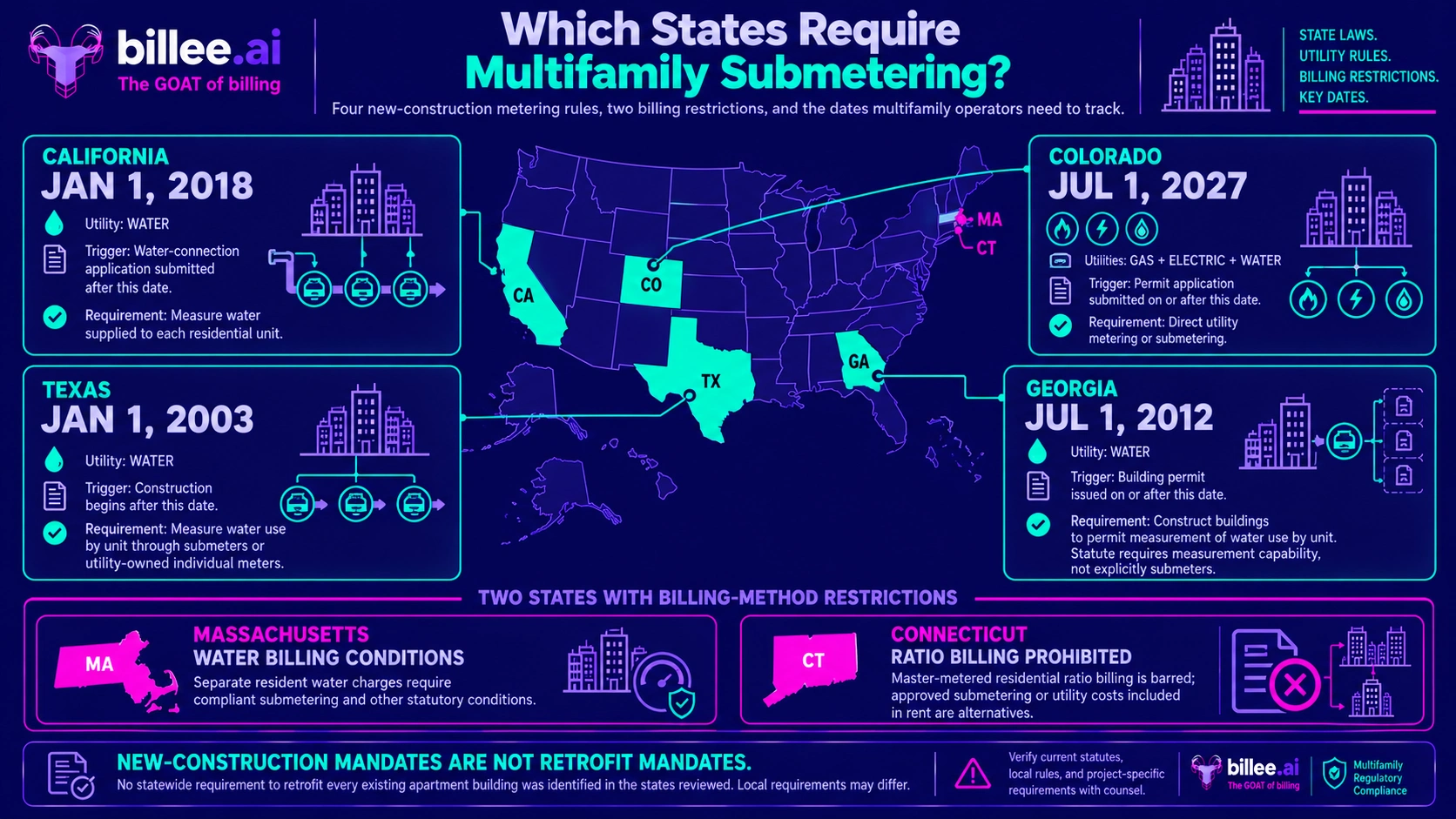
No state we checked requires submetering in every existing apartment building. The mandates target new construction: Texas (water, since 2003), California (water, since 2018), Georgia (water measurement, since 2012) and Colorado (gas, electric and water, from July 2027). Massachusetts and Connecticut tie billing to measurement. Billee Technologies, Inc. tracks these rules for multifamily operators.
Submetering mandates are a new-construction story. Existing buildings keep their billing options in the states below, but two states restrict the methods and one bans ratio billing outright. This guide covers the four mandates, the two billing-rule states, a trigger table for your pipeline and what to confirm with counsel.
Key takeaways
- Four states set metering rules for new construction: Texas, California, Georgia and Colorado. We found no state that requires existing buildings to retrofit meters.
- The triggers differ. Texas looks at when construction begins, California at the water-connection application, Georgia and Colorado at the permit. Track the state's trigger, not the opening date.
- Colorado reaches furthest: gas, electric and water, for residential premises with permits applied for on or after July 1, 2027.
- Georgia's statute requires new buildings to be constructed to permit measurement of water use by unit. It does not use the word submeter.
- Massachusetts and Connecticut do not mandate meters. Massachusetts conditions water charges on a compliant submeter, and Connecticut bars ratio billing.
- Some compliance maps list other states as mandates. We could not verify a mandate in New Jersey, Washington or Florida, and left them out.
The mandates at a glance
StateRule typeUtilityTriggerExisting buildingsTexasNew-construction meteringWaterConstruction begins after January 1, 2003; apartment houses (five or more units), manufactured home rental communities, multiple use facilities and condominiumsNot covered by the mandateCaliforniaNew-construction meteringWaterWater-connection application submitted after January 1, 2018; new multiunit residential and mixed-useNot covered by the mandateGeorgiaBuilt to permit measurementWaterNew multiunit residential buildings permitted on or after July 1, 2012Not covered by the mandateColoradoNew-construction meteringGas, electric, waterPermits applied for on or after July 1, 2027; residential premisesRatio billing may continue on four conditionsMassachusettsBilling conditionWaterCharging a resident for waterAppliesConnecticutRatio billing barredMaster-metered utility service2024 Supreme Court rulingApplies
Read the table as a starting point. Each row has fine print below, and counsel should confirm the current text.
Texas: water, construction begun after 2003
Texas Water Code Section 13.502(b) requires the owner of an apartment house, a manufactured home rental community or a multiple use facility, or the manager of a condominium, on which construction begins after January 1, 2003, to provide for measuring each unit's water use. The owner can do that with submeters it owns, or with individual meters owned by the retail public utility.
An apartment house is a property with five or more dwelling units, per the Texas PUC's copy of Subchapter M. Two provisions modify the rule. Subsection (c) covers government-assisted housing for low-income residents, where the owner installs a plumbing system compatible with submeters. And under subsection (d), on the owner's request the utility installs individual meters unless it finds installation infeasible, in which case the owner installs compatible plumbing.
One more rule travels with the mandate. Subsection (e) bars switching from submetered to allocated billing unless the PUC approves in writing after a showing of good cause and the owner meets the commission's rental agreement requirements. Billee's Texas PUC Chapter 24 guide covers billing, disclosure and registration.
California: water, connection applications after January 1, 2018
California's SB 7 (Chapter 623, Statutes of 2016, approved September 25, 2016) added Water Code Section 537.1. Under Section 537.1(a), a water purveyor must require a measurement of the water supplied to each residential dwelling unit as a condition of new service. It applies to newly constructed multiunit residential and mixed-use structures whose water-connection application is submitted after January 1, 2018.
Unless a local ordinance or regulation already requires individual metering, the owner installs and reads submeters, unless the purveyor agrees to install individual meters. Billing and disclosure rules for submetered water sit in Civil Code Sections 1954.201 through 1954.219. Billee's California submetering and RUBS guide walks through them.
Georgia: water, permitted on or after July 1, 2012
Georgia's rule is narrower than the label "mandate" suggests. Under O.C.G.A. Section 12-5-180.1(c), new multiunit residential buildings permitted on or after July 1, 2012 "shall be constructed in a manner which will permit the measurement" of water use by each unit. A public water system or the owner or operator can do the measuring.
The text we read does not use the word submeter. It requires buildings that can be measured by unit. We read the 2010 version of the code on Justia, so confirm the current wording before relying on it.
Colorado: gas, electric and water, from July 1, 2027
Colorado is the broadest of the four. HB26-1013, approved March 26, 2026, adds C.R.S. 6-1-737(4.5)(b). For residential premises with permits applied for on or after July 1, 2027, gas, electric and water service must be metered either directly by the utility provider or by a submeter.
The permit date controls, not the opening date. A permit application filed before July 1, 2027 falls outside the mandate as written, so confirm with counsel before you plan around it.
The same law governs existing premises. Ratio billing may continue when total resident charges stay within the utility's charge for the premises, no markup or fee sits on top of actual charges except as permitted by law, common-area costs stay out, and the method is disclosed clearly in the rental agreement or an addendum. Billee's Colorado RUBS rules guide has the detail.
Billing rules: Massachusetts and Connecticut
Two states do not mandate meters but still shape how you can bill.
Massachusetts. G.L. c.186, Section 22 sets the conditions for charging a resident for water. A licensed plumber installs the submeter, the unit has water-conservation devices, the landlord certifies compliance, the tenancy is new, and a written rental agreement covers the charge. Billee's Massachusetts submetering guide covers the electric side and the water details.
Connecticut. In 2024 the state Supreme Court held in Northland Investment Corp. v. PURA that ratio utility billing is prohibited in master-metered multiunit residential buildings. Two routes remain, per Pullman & Comley: build projected utility costs into rent, or submeter under a plan PURA approves. Billee's guide to where RUBS is banned or restricted shows how Connecticut compares.
What we did not find
We found no statewide rule that forces existing apartment buildings to add meters. A negative is hard to prove, so check local codes, your lender and your utility. Billee's state-by-state RUBS guide covers the billing rules that do apply to existing buildings.
Some compliance maps list New Jersey as a mandate. Coverage from 2011 describes a Board of Public Utilities approval that allows water submetering in newly constructed multifamily buildings, not one that requires it. We also could not verify a mandate in Washington or Florida.
What the triggers mean for your pipeline
SituationWhat to checkGround-up development in Texas, California, Georgia or ColoradoThe state's trigger date: construction start, water-connection application or permit. Design the metering before the trigger, not after.Colorado project near the July 1, 2027 dateWhether the permit application falls before or after the date, with counsel's view.Acquisition of a building built after a triggerWhether the meters exist and were installed as the statute requires. In Texas, whether billing is submetered or allocated, since switching back needs PUC approval.Existing building billed by ratioThe state's billing rules. No retrofit mandate found, but Massachusetts and Connecticut restrict ratio billing.Development with a lender or utility requirementAny metering requirement they set on top of the statute.
How Billee Technologies helps
Billee Technologies pairs a platform with a named, dedicated account team. Your people review and approve. Billee's team does the work.
Check the rule before the design is final
Billee's Regulatory & Compliance service covers billing methodology audits, access to legal support and ongoing monitoring for rule changes. Access to legal support is not legal advice. Billee's guide to its regulatory and compliance support explains the scope.
An audit reviews the allocation logic and lease language against the state's rules before the first bill goes out. Billee's 45-day standard implementation includes a methodology audit of the formulas, submeter configuration and allocation logic.
Put the meters in and keep them honest
Billee's Hardware & Maintenance Support covers ordering, installation coordination, calibration, repair dispatch and replacement of metering hardware. It works with major submeter vendors. Billee lists new-build operators standing up metering on a new property among the portfolios it serves. Billee's guide to a defensible meter program for new construction lays out the decisions before ground breaks.
Watch the meters once they are live
Billee's Meter Monitoring watches meter activity continuously. When a reading spikes, drops or flatlines, the platform raises an alert and the Billee team acts: dispatching a repair, contacting the resident, pulling the meter or escalating to the owner. Billee describes it as experts who take action, not just notify. Read more in Billee's guide to meter monitoring and proactive alerts.
Bill it either way
Billee's Billing & Recovery Engine allocates charges using RUBS, submetering or a hybrid, and works for both RUBS-billed and submetered portfolios. Each month Billee assembles utility data and produces a preliminary bill. Your billing administrator reviews it next to Biller Highlights, the team's notes on exceptions, and Billee replies to comments within 1–2 business days. After approval, charges post to the PMS resident ledger on the set date.
Billee measures effective recovery against an 80–95% range and treats anything below 80% as a problem to investigate. The range is Billee's own framework, not an industry standard.
What to ask Billee for in writing
- Which states' rules Billee's monitoring covers, and how often it updates its guidance.
- Which hardware vendors Billee works with, and who installs on a new build.
- Whether the 45-day standard implementation applies to a new build that has no billing history to migrate.
Who Billee is not for
- Portfolios under about 300 units, where Billee's full-service model is usually more than the job needs.
- Anyone looking for a legal opinion on whether a project triggers a mandate. Billee gives access to legal support, not legal advice, so involve counsel.
- Operators who want to run billing themselves with software alone. Billee's portal exists for review and approval, not self-service operation.
FAQ
Which states require submetering in new multifamily construction?
Four, in our review. Texas requires water measurement by unit where construction begins after January 1, 2003. California requires it where a water-connection application is submitted after January 1, 2018. Georgia requires buildings permitted on or after July 1, 2012 to be built to permit measurement. Colorado requires gas, electric and water metering where permits are applied for on or after July 1, 2027.
Does any state require submetering in existing buildings?
We found none. The mandates apply to new construction. Massachusetts and Connecticut still restrict the billing methods existing buildings can use.
Is submetering the same as direct metering under these laws?
No. Colorado accepts metering directly by the utility provider or by a submeter. Texas accepts owner-owned submeters or utility-owned individual meters. California makes the owner install submeters unless the water purveyor agrees to install individual meters.
Does Georgia require submeters?
The statute requires new multiunit residential buildings permitted on or after July 1, 2012 to be constructed to permit measurement of water use by each unit. The text we read does not use the word submeter. Confirm the current code with counsel.
Can existing Colorado properties keep using RUBS after July 2027?
The metering requirement applies to residential premises with permits applied for on or after July 1, 2027. Existing properties can continue ratio billing if they meet the four conditions in HB26-1013.
Can I switch from submetered to allocated billing in Texas?
Not freely. Section 13.502(e) bars the change unless the PUC approves it in writing after a showing of good cause and the owner meets the commission's rental agreement requirements.
How do I track trigger dates across a pipeline?
Log the trigger the state uses, not the opening date: construction start in Texas, water-connection application in California, and permit date in Georgia and Colorado.
Billee handles utility billing, vacant cost recovery and vendor management for multifamily operators who want a dedicated team behind the software. If a new build or an acquisition is on your calendar, talk to the team about your portfolio.
Sources
- State of Texas, "Texas Water Code, Section 13.502 (via Public.Law)," accessed October 2026.
- Public Utility Commission of Texas, "Texas Water Code, Chapter 13, Subchapter M (PDF)," accessed October 2026.
- California Legislature, "Senate Bill No. 7, Chapter 623, Statutes of 2016 (chaptered text)," approved September 25, 2016.
- State of Georgia, "O.C.G.A. Section 12-5-180.1 (2010 code, via Justia)," accessed October 2026.
- Colorado General Assembly, "House Bill 26-1013 (session law)," approved March 26, 2026.
- Massachusetts Legislature, "General Laws, Part II, Title I, Chapter 186, Section 22," accessed October 2026.
- Carmody Torrance Sandak & Hennessey LLP, "Connecticut Supreme Court Says No to Unpredictable Utility Cost-Sharing in Multiunit Residential Buildings," September 4, 2024.
- Pullman & Comley LLC, "Connecticut Landlords Beware: RUBs Billing is Illegal in Multiunit Properties," September 2, 2025.
- NJBIZ, "N.J. becomes the last state to OK sub-metering at apartment buildings," August 30, 2011.
Insights and Industry Trends