
Setting Up a Defensible Meter Program for New Construction and Renovation
New construction and major renovation are the cheapest moments an operator will ever have to get a meter program right. Every decision made before occupancy, meter ownership, technology, network design, commissioning, gets baked into the property for years. Retrofitting a mistake later costs far more than avoiding it at the design table, and this piece pulls together the calibration standards, testing cadence, cost math, staffing, and state law already covered in this series into one framework for building a program that holds up from day one.
Key Takeaways
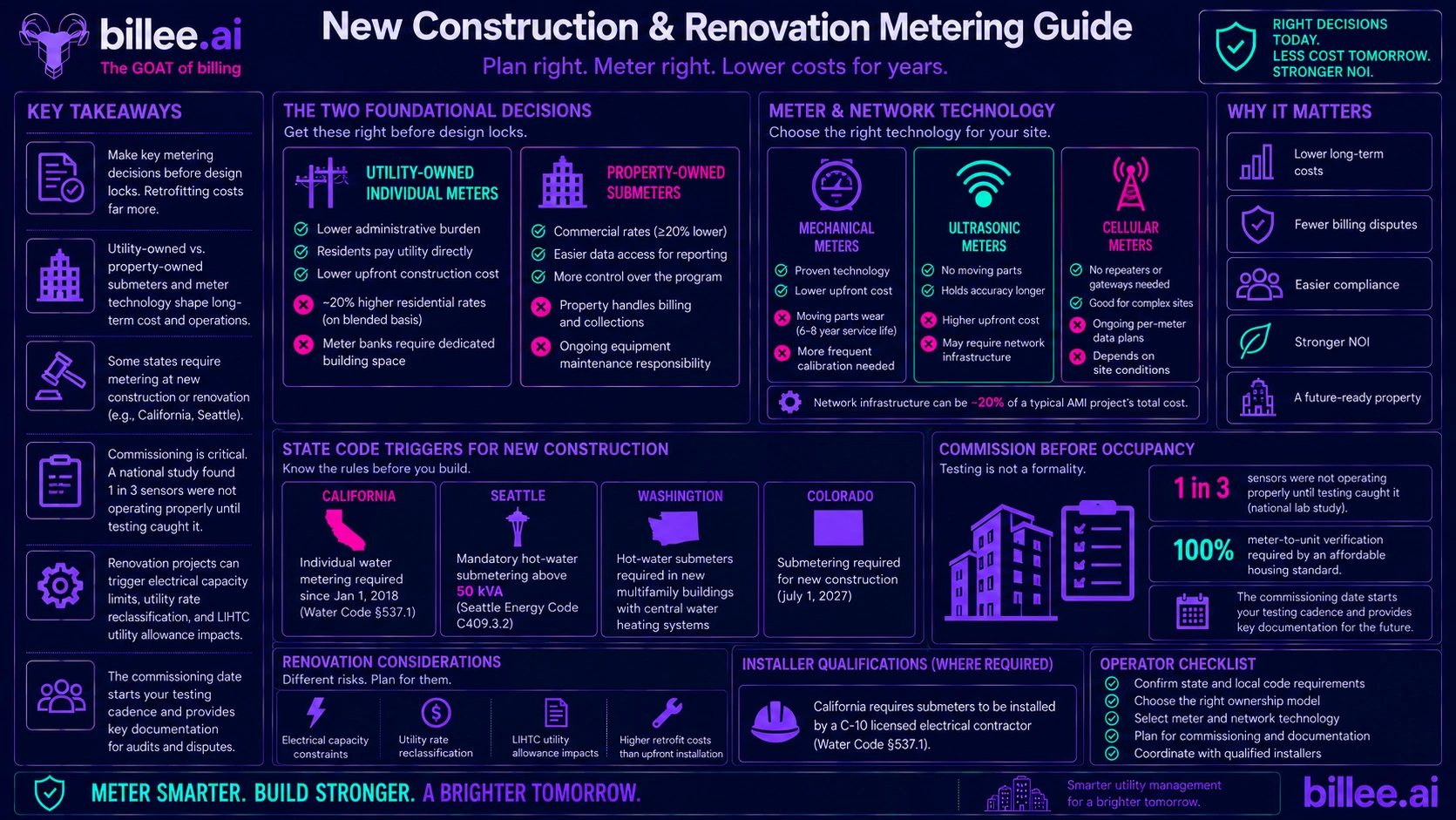
- The two foundational choices, utility-owned meters versus property-owned submeters, and which meter and network technology to use, should be made before design locks, not discovered during construction.
- Several states trigger metering requirements specifically at new construction or renovation: California has required individual water metering for new multiunit residential water connections since January 1, 2018, and Seattle's energy code triggers mandatory hot-water submetering above a 50 kVA electric-demand threshold.
- Commissioning before occupancy is not a formality. One national lab study found a third of sensors in commissioned buildings were not actually operating properly until testing caught it, and a real affordable-housing standard requires 100% verification that every meter is assigned to the correct unit before residents move in.
- Renovation and retrofit projects carry a different risk profile than new construction: electrical capacity constraints, utility rate reclassification, and utility allowance impacts for LIHTC properties can all be triggered by a metering change made without full coordination.
- The commissioning date matters beyond opening day. It is the clock that starts the testing cadence covered in Billee's guide on how often submeters should be calibrated, and the strongest documentation an operator will have if a dispute or acquisition review ever asks how the program started.
Decisions to Make Before Ground Breaks
Utility-owned meters or property-owned submeters
A Colorado Housing Finance Authority guide on multifamily electrification lays out this tradeoff clearly. Utility-owned individual meters mean lower administrative burden, since residents pay the utility directly and the property only handles common-area charges, along with lower upfront construction cost since the utility typically supplies the meters. The drawback is that residential rate structures typically run about 20% higher on a blended basis than commercial rates, and meter banks require dedicated building space. Master metering with property-owned submeters flips that trade: whole-building commercial rates reduce effective utility costs by at least 20%, and data access for reporting is simpler, but the property owner takes on billing, collection, and equipment maintenance responsibility.
Meter and network technology
Billee's guides on service-life planning and meter maintenance staffing cover the mechanical-versus-ultrasonic decision and the network layer that carries readings back to billing software. New construction adds one more real option: cellular-connected meters that skip repeater and gateway infrastructure entirely. A meter manufacturer's technical white paper puts network infrastructure at roughly 20% of a typical AMI project's total cost, driven largely by radio-frequency systems needing unobstructed line of sight that trees, other buildings, and common construction materials can block. Cellular connectivity trades that infrastructure cost for a different one, ongoing per-meter data plans, and the right choice depends on site conditions more than a universal rule.
Code triggers to check before design starts
A handful of jurisdictions attach metering requirements specifically to new construction or major system replacement, and missing one during design is far more expensive to fix than catching it early. California's Water Code Section 537.1 has required individual water metering, by individual meter or submeter, for newly constructed multiunit residential water connections since January 1, 2018, and the statute stays in force until the state's own Building Standards Code adopts an equivalent standard. Seattle's energy code, under Section C409.3.2, triggers mandatory hot-water submetering once a building's water heating system exceeds 50 kVA of combined electrical demand, a threshold that catches most mid-size and larger multifamily projects with central heat pump water heating. More broadly, Washington State requires hot-water submeters in new multifamily buildings with central water heating systems, and Billee's guide on state submetering rules covers Colorado's separate July 2027 new-construction metering mandate.
Installer qualifications where they exist
California's statute goes a step further than most states by specifying who can install the required submeters. Installation must be performed by either a licensed contractor employing journey-level workers from a state-approved apprenticeship program, or a service agency registered with the Department of Food and Agriculture, the same agency that runs the CTEP certification program covered in Billee's guide on state rules. A property that cannot produce installer credentials alongside its meter records has a documentation gap even if the meters themselves are accurate.
Design-Phase Coordination
Getting infrastructure into the drawings early
A real affordable-housing green-building standard reviewed for this article requires plumbing riser locations to be coordinated with structural design from the start, specifically to avoid the kind of costly conflicts that show up when metering is treated as an afterthought bolted onto a finished floor plan. The same logic applies to network infrastructure: repeater and gateway placement, or the absence of that need entirely under a cellular system, should be part of the electrical and low-voltage design package, not a punch-list item.
What a well-documented design submittal looks like
The same standard requires proposed pipe routing for each unit type, calculated hot-water pipe volume between the heat source and each fixture, and estimated hot-water delivery time, using the current edition of the Uniform Plumbing Code's peak water demand calculator rather than older rule-of-thumb methods. That level of documentation is a useful benchmark for what a defensible design submittal actually contains, well beyond a simple meter count on a spec sheet.
Commissioning Before Occupancy: The Defensibility Core
The 100%-testing standard
The clearest statement of what pre-occupancy commissioning should actually verify comes from the same affordable-housing standard: 100% testing that every meter is assigned to the correct dwelling unit, correctly identifies its utility type, and accurately reports consumption within the metering software platform, all before residents move in. That is a meaningfully higher bar than confirming meters are installed and physically functioning.
Why this step is not optional
General building commissioning practice backs this up. A national laboratory's guide to building commissioning found that in studied buildings, a third of sensors were not actually operating correctly until functional performance testing caught the problem. Commissioning in that context includes point-to-point checks confirming every sensor and measurement device reports what it is supposed to report, with issues logged and corrected before final sign-off rather than discovered later through resident complaints.
What the handoff package should contain
Borrowing directly from that general commissioning framework, a meter program's handoff documentation should include a systems manual with manufacturer records and verified as-built drawings, dated initial test results for every meter, an issues log showing what was caught and corrected before occupancy, and installer license or registration records where the jurisdiction requires them. This package is what turns a routine construction milestone into evidence that will hold up years later.
Renovation and Retrofit-Specific Considerations
Converting an existing master-metered building
The same ownership tradeoff from new construction applies during renovation, complicated by whatever infrastructure already exists. A conversion project needs its own infrastructure audit before hardware selection, evaluating whether the building's plumbing uses a point-of-entry configuration with one line per unit or a multi-point configuration with separate lines per fixture, since that determines what retrofit hardware will actually fit.
Electrical capacity limits in electrification-driven retrofits
The Colorado Housing Finance Authority guide flags a risk that is easy to miss during early planning: a building's total electrical service may have enough capacity for new equipment like heat pumps, while the distribution feeders or individual unit sub-panels do not. That gap can trigger unplanned code-compliance work and utility coordination delays discovered mid-project rather than during design.
The rate reclassification risk
Increased electrical demand from a retrofit can shift a property from flat residential utility rates to demand-based commercial tariffs, where peak kilowatt demand, not just total consumption, drives the monthly bill. This shift can materially increase costs even when annual energy use stays flat, and it is a consequence of the metering and service decision, not a separate issue to address afterward.
The LIHTC utility allowance wrinkle
For Housing Tax Credit properties, changing the metering approach during renovation can shift utility allowance value by 20% or more, according to the same electrification guide. That makes metering decisions on affordable properties a compliance question as much as an engineering one, and it needs coordinating with utility allowance policy rather than decided by the construction team in isolation.
Managing resident disruption
A municipal water utility's meter replacement process offers a useful model for what good resident communication looks like during a retrofit: advance written notice 15 to 60 days before the work, a brief service interruption measured in minutes rather than hours, flexibility to reschedule around a resident actively using water, and written confirmation left on-site after the work is done. A multifamily retrofit touching dozens or hundreds of units benefits from the same discipline, applied at scale.
What Makes a Meter Program Defensible
The commissioning date starts the clock
Billee's guide on testing cadence covers how often a meter should be retested after it enters service. That interval starts counting from the commissioning date, not from whenever someone eventually gets around to the first recalibration, which makes a dated, complete commissioning record the foundation the entire ongoing maintenance program is built on.
State-specific documentation belongs at commissioning, not later
Billee's guide on state rules showed that the compliance floor varies significantly by state, from California's certification and installer-qualification requirements down to states with only general disclosure rules. Building the right documentation habit at commissioning, regardless of what a specific state technically requires, is far easier than retrofitting compliance into a program that started without it.
A commissioning report is the strongest evidence available later
Billee's guide on the cost of uncalibrated meters covers what a billing dispute or an acquisition due-diligence review actually asks for. A dated, complete commissioning record answers those questions directly, while a property with no such record is left reconstructing history from memory and incomplete files.
New Construction vs. Renovation at a Glance
| Consideration | New Construction | Renovation and Retrofit |
|---|---|---|
| Primary decision point | Design phase, before drawings lock | Infrastructure audit, before hardware selection |
| Biggest risk | Missing a code trigger before permitting | Electrical capacity limits discovered mid-project |
| Documentation starting point | Commissioning report, dated at occupancy | Baseline consumption history, dated before conversion |
| Resident impact | None, no occupants yet | Requires active disruption management and notice |
| Utility allowance impact | Set once at initial lease-up | Can shift 20%+ if not coordinated with allowance policy |
Best Practices
Treat commissioning as a deliverable, not a milestone
A commissioning report that sits in a project closeout binder and is never referenced again has not actually protected the property. It needs to be the reference document the ongoing maintenance program is built from.
Check code triggers before finalizing meter count
California's water submetering requirement and Seattle's 50 kVA hot-water threshold are specific enough that a generic regional assumption can miss them. Confirming the applicable trigger for the actual jurisdiction, before the meter schedule is finalized, avoids a costly mid-construction change.
Coordinate metering decisions across disciplines
The utility allowance, electrical capacity, and rate-structure consequences covered in this article all point the same direction: a metering decision made by one discipline in isolation from finance, compliance, and electrical engineering is a decision made with incomplete information.
What to Look for in a Partner
- Experience navigating jurisdiction-specific new-construction and renovation metering triggers, not just general submetering installation
- A documented commissioning process that produces the kind of dated, complete record this article describes
- Coordination with utility allowance policy on affordable housing projects, not metering decisions made in isolation
- A clear resident communication plan for any retrofit project, modeled on advance notice and minimal disruption
How Billee Supports This
Billee's Regulatory & Compliance product is built to hold the commissioning and testing documentation this article describes, from the day a property comes online through every retest afterward. Billee's Meter Monitoring & Alerts picks up where commissioning leaves off, flagging drift and communication gaps across the life of the program rather than only at the moments someone remembers to check.
FAQ
When should a meter program be planned during a new construction project? Before design locks. Utility-owned versus property-owned metering, technology and network choice, and jurisdiction-specific code triggers all need answers before plumbing risers and electrical infrastructure are finalized in the drawings.
What does commissioning actually verify beyond installation? A real commissioning process confirms every meter is assigned to the correct unit, correctly identifies its utility type, and accurately reports consumption, verified through functional performance testing rather than assumed from installation alone.
Does California require water submeters in all new apartment construction? Yes, for water connection applications submitted on or after January 1, 2018, under Water Code Section 537.1, with specific installer qualification requirements attached to the statute.
What's the biggest risk in a renovation that adds or converts metering? Electrical capacity limits and utility rate reclassification are the two most commonly underestimated risks, since a retrofit can push a property from flat residential rates to demand-based commercial tariffs without that consequence being obvious during early planning.
How does a LIHTC property's utility allowance get affected by a metering change? A metering approach change during renovation can shift utility allowance value by 20% or more, which means the decision needs coordination with utility allowance policy rather than being made by the construction team alone.
Why does the commissioning date matter after occupancy? It sets the clock for the ongoing testing cadence covered in Billee's calibration guides, and it becomes the dated record an operator relies on if a billing dispute or acquisition review ever asks how the meter program started.
Getting a meter program right at construction or renovation is far cheaper than fixing it later. Talk to Billee about building the documentation trail from day one, not after the first dispute.
Sources
- Colorado Housing Finance Authority, "Utility Metering, Multifamily Affordable Housing Electrification Hub"
- FindLaw, "California Water Code Section 537.1"
- Seattle Department of Construction and Inspections, "Tip #424: Submetering Requirements"
- Housing Consortium, "EBP Guidelines for Domestic Water Heating and Distribution"
- Pacific Northwest National Laboratory, "A Guide to Building Commissioning"
- Metron, "Reaching the Final Five Percent"
- Portland Water Bureau, "Water Meter Replacements"
- K2D Consulting Engineers, "Submetering Integration Framework for Multi-Family Properties"
Insights and Industry Trends