
Massachusetts Submetering Rules 2026: What Multifamily Operators Need to Know
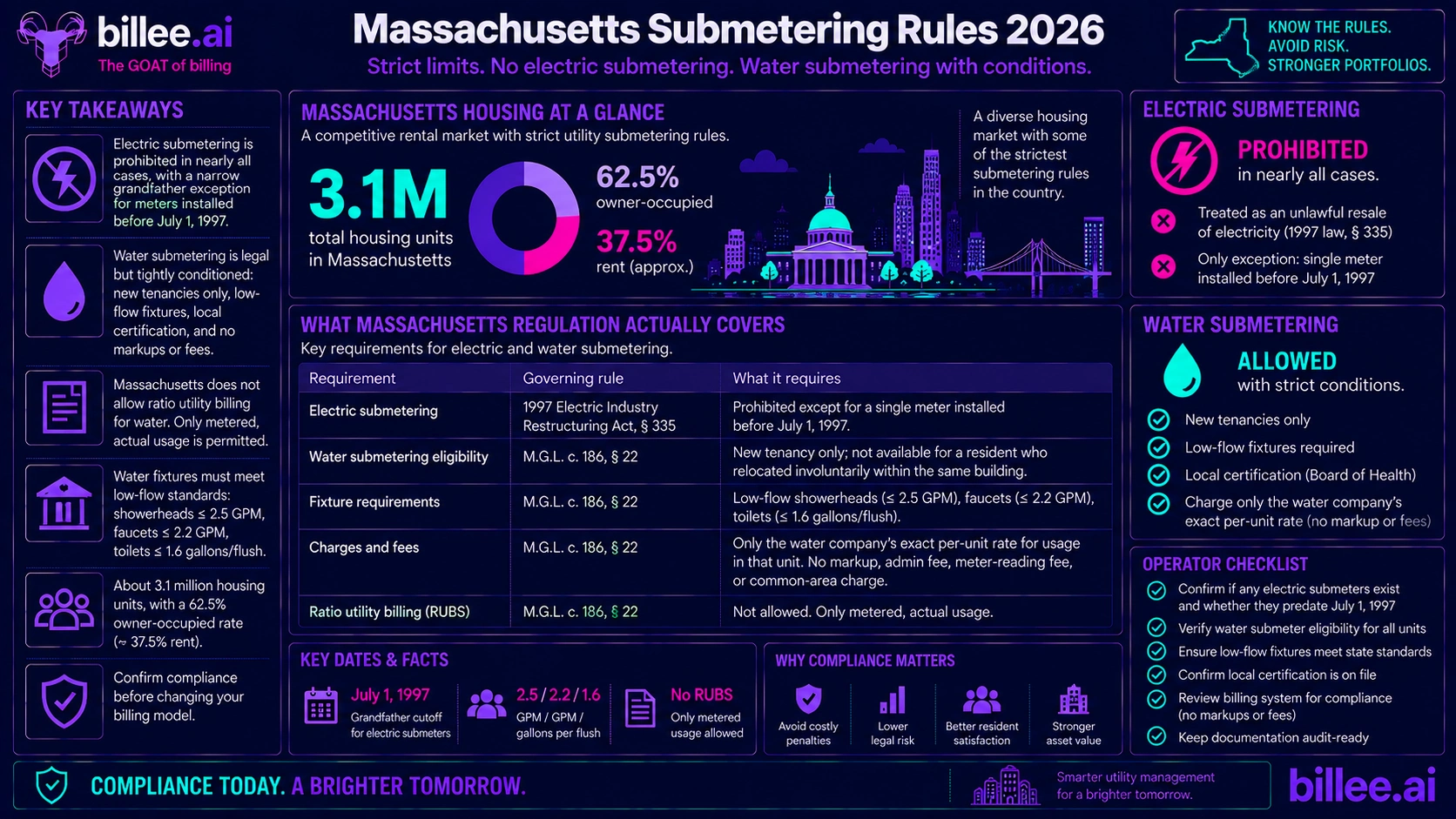
Massachusetts is the most restrictive state in Billee's state-guide series so far. Electric submetering is effectively prohibited outright, treated as an illegal resale of electricity under a 1997 restructuring law, with only a narrow grandfather exception for meters installed before July 1, 1997. Water submetering is allowed, but only for new tenancies, only with low-flow fixtures already installed, only after a landlord certifies compliance to local authorities, and only at the water company's exact per-unit rate with no markup or fees permitted. There is no ratio utility billing option for water under state law; the statute requires actual submetered usage. Billee's Regulatory & Compliance service confirms which path, if any, is legally available before a Massachusetts property changes its billing model.
Quick answer
Massachusetts prohibits electric submetering in nearly all cases. Under Section 335 of Chapter 164 of the Acts of 1997, submetering electricity to residents counts as an illegal resale of power, and the only exception is a building with a single meter installed before July 1, 1997. Water submetering is legal but tightly conditioned under Massachusetts General Laws Chapter 186, Section 22: the tenancy must be new (not an involuntary transfer within the same building), the unit must already have low-flow showerheads, faucets, and toilets, the landlord must certify compliance to the local Board of Health or Inspectional Services Department, and the resident can be billed only the water company's exact per-unit rate for water used exclusively in that unit, with no markup, service charge, or common-area cost included. Massachusetts law does not authorize a ratio utility billing formula for water; only metered actual usage qualifies.
Two things determine what's legally possible: whether the utility is electric, which is essentially off the table, or water, which is available only if every condition in the statute is met before the first submetered bill goes out.
Key takeaways
- Massachusetts prohibits electric submetering as an unlawful resale of electricity, with a narrow exception for buildings that installed a single meter before July 1, 1997, under Section 335 of the 1997 Electric Industry Restructuring Act.
- Water submetering is legal only under Massachusetts General Laws Chapter 186, Section 22, and only for a new tenancy, not a resident relocated involuntarily within the same building.
- Low-flow fixtures are mandatory before water submetering is allowed: showerheads at 2.5 gallons per minute or less, faucets at 2.2 gallons per minute or less, and toilets at 1.6 gallons per flush or less.
- Water charges are capped at the water company's exact per-unit rate for usage in that unit alone. No markup, administrative fee, meter-reading fee, or common-area charge is permitted.
- Massachusetts law does not recognize ratio utility billing for water. Only metered, submetered actual usage supports charging a resident.
- Massachusetts has roughly 3.1 million housing units, with a 62.5% owner-occupied rate, meaning about 37.5% of households rent.
Why this matters for multifamily operators
Massachusetts is the state in this series where the honest answer to "can I bill residents for utilities the way I do elsewhere" is often no. Billee's guide to where RUBS is banned or restricted by state tracks states that go beyond disclosure rules into outright prohibition, and Massachusetts belongs on that list for electric service specifically. An operator who submeters electricity in a Massachusetts acquisition without confirming a pre-1997 grandfathered meter is billing residents for something the state treats as an illegal resale.
Water is more workable, but every condition in the statute has to be true at once, not just mostly true. A unit with older fixtures, a resident who moved from another unit in the same building rather than starting a genuinely new tenancy, or a landlord who never filed the required certification with the local Board of Health all fail the statute regardless of how the lease is written.
What Massachusetts regulation actually covers
| Requirement | Governing rule | What it requires |
|---|---|---|
| Electric submetering | 1997 Electric Industry Restructuring Act, § 335 | Prohibited except for a single meter installed before July 1, 1997 |
| Water submetering eligibility | M.G.L. c. 186, § 22 | New tenancy only; not available for a resident who relocated involuntarily within the same building |
| Fixture requirements | M.G.L. c. 186, § 22 | Low-flow showerheads (≤2.5 GPM), faucets (≤2.2 GPM), toilets (≤1.6 gallons/flush) |
| Certification | M.G.L. c. 186, § 22 | Landlord certifies compliance to the local Board of Health or Inspectional Services Department, under penalty of perjury |
| Billing cap | M.G.L. c. 186, § 22 | Exact water company per-unit rate for in-unit usage only; no markup, fee, or common-area charge |
| Submeter access | State Sanitary Code, 105 CMR 410.130 | Residents must have access to submeters affecting their unit |
Electric submetering is effectively prohibited
Under Section 335 of Chapter 164 of the Acts of 1997, submetering electricity to residents is treated as an unlawful resale of power. The only exception is a building where a single meter was installed before July 1, 1997, and an owner relying on that exception needs documentation, since electric companies can confirm installation dates. The State Sanitary Code, 105 CMR 410.00, reinforces this by requiring owners to pay for electricity unless residents have separate, utility-installed meters under a written rental agreement, not landlord-installed submeters. The legal path to recovering electric costs in Massachusetts is including them in rent, not billing residents based on measured consumption.
Water submetering is legal, but only under strict conditions
Massachusetts General Laws Chapter 186, Section 22 permits water submetering only for a tenancy that is genuinely new: the previous resident left voluntarily or was lawfully evicted, and the new resident did not relocate involuntarily from another unit in the same building. Before billing can start, the unit needs low-flow showerheads rated at 2.5 gallons per minute or less, faucets at 2.2 gallons per minute or less, and toilets at 1.6 gallons per flush or less. The landlord must certify compliance with every requirement to the local Board of Health or Inspectional Services Department, under penalty of perjury, and the rental agreement must disclose the billing arrangement clearly and conspicuously in plain language. Billee's guide to RUBS vs. submetering covers the broader tradeoffs between the two models; in Massachusetts, submetering is effectively the only water billing option the law recognizes.
What the water law does not permit
The statute caps water charges at the water company's exact per-unit rate multiplied by units delivered exclusively to that dwelling unit. No establishment fee, meter-reading fee, billing fee, or submetering fee is allowed on top of that, and no charge for common-area water usage can be passed to residents. Massachusetts law does not authorize a ratio utility billing formula for water: allocation by square footage, occupancy, or any other formula does not satisfy the statute, which requires actual submetered usage. Bills must show the submeter reading, consumption, per-unit charge, total due, and payment date, with a 15-day due date for monthly bills or 30 days for longer billing intervals.
Shutoff and maintenance protections tied to submeter billing
A resident can request submeter accuracy testing at any time; if the meter is defective, the landlord pays for the test and must rebate any overcharge. Landlords must credit residents for water lost to leaks once repaired and keep the water system in good working order. Critically, a landlord cannot shut off water service over an unpaid submeter charge, a narrower and separate protection from the general utility shutoff rules that apply elsewhere. Under 105 CMR 410.130, residents must also have access to any submeter that affects their unit.
Common mistakes
- Submetering electric service in a Massachusetts acquisition without confirming, and documenting, that a single meter was installed before July 1, 1997.
- Treating a resident's move from one unit to another within the same building as a "new tenancy" that qualifies for water submetering, when the statute excludes involuntary within-building relocations.
- Starting water submetering before low-flow fixtures are installed and verified, rather than treating the fixture retrofit as a prerequisite.
- Adding a service charge, meter-reading fee, or administrative fee to a submetered water bill, when the statute caps charges at the water company's exact rate.
- Assuming a ratio utility billing formula satisfies Massachusetts water billing law, when only actual submetered usage qualifies.
- Shutting off water service over an unpaid submeter charge, which the statute prohibits regardless of how far behind the account is.
When to handle this in-house vs. bring in a partner
A single Massachusetts property that already qualifies for water submetering, with fixtures verified and certification filed, can often manage day-to-day billing with a disciplined property manager tracking the per-unit rate cap and bill-format requirements.
Confirming eligibility in the first place is the harder problem, especially across a portfolio with mixed acquisition histories. Determining whether a building's electric meters predate July 1, 1997, whether a given water tenancy actually qualifies as new under the statute, and whether fixtures and certification are documented takes research most property managers aren't set up to do property by property. Billee's complete guide to utility management compliance covers what that burden looks like across a full portfolio, not just Massachusetts.
How Billee can help
Billee's Regulatory & Compliance service confirms, property by property, whether electric submetering is legally available under the 1997 grandfather exception and whether a water tenancy meets every condition in Chapter 186, Section 22 before billing starts. The audit checks the specific things a Board of Health complaint or a resident dispute would test: is the certification filed, do the fixtures meet the flow-rate standard, and does the billed rate match the water company's per-unit charge exactly.
Billee's account team also flags Massachusetts properties where neither path is legally available, so an operator isn't left assuming a billing model works until a resident or a municipal inspector says otherwise. Billee's compliance review is often the fastest way to get a straight answer on a Massachusetts property.
FAQ
Can I submeter electricity to residents in Massachusetts?
Almost never. Electric submetering is treated as an illegal resale of power under the 1997 Electric Industry Restructuring Act, except for a building with a single meter installed before July 1, 1997.
Is water submetering legal in Massachusetts?
Yes, but only under Massachusetts General Laws Chapter 186, Section 22, which requires a new tenancy, low-flow fixtures, landlord certification to local authorities, and billing at the water company's exact per-unit rate with no markup.
Does Massachusetts allow RUBS for water billing?
No. The statute requires actual submetered usage. A ratio utility billing formula based on square footage, occupancy, or another allocation method does not satisfy Massachusetts law.
Can I charge a service fee on top of the submetered water rate?
No. Massachusetts law caps water charges at the water company's exact per-unit rate for usage in that unit. No establishment fee, meter-reading fee, billing fee, or submetering fee is allowed.
What counts as a "new tenancy" for water submetering eligibility?
A tenancy where the prior resident left voluntarily or was lawfully evicted. A resident who relocated involuntarily from another unit in the same building does not create a qualifying new tenancy.
Can a landlord shut off water for an unpaid submeter charge?
No. Massachusetts law specifically prohibits shutting off water service over an unpaid submeter charge, separate from general utility shutoff protections.
What happens if a resident disputes a submeter reading?
The resident can request accuracy testing at any time. If the meter is defective, the landlord pays for the test and must rebate any overcharge to the resident.
How does Billee handle Massachusetts properties?
Billee's Regulatory & Compliance service confirms property by property whether electric submetering is available under the 1997 grandfather exception and whether a given water tenancy meets every condition in Chapter 186, Section 22, before any billing change goes live.
Related reading
- Illinois RUBS Rules: What Multifamily Operators Need to Know: a state that regulates billing through landlord-tenant law rather than prohibiting a utility type outright.
- New York Submetering Rules: What Multifamily Operators Need to Know: a state that permits electric submetering through an agency approval process Massachusetts doesn't offer.
- Washington RUBS Rules: What Multifamily Operators Need to Know: a state debating new restrictions rather than one with a long-standing prohibition already in place.
Billee's Regulatory & Compliance service confirms which utility billing paths are legally available for a Massachusetts property before any billing change goes live. Talk to the team.
Sources
- Commonwealth of Massachusetts, "Massachusetts law about submetering water for tenants," accessed September 2026.
- Commonwealth of Massachusetts, "Electric submetering overview," accessed September 2026.
- Massachusetts Legislature, "Massachusetts General Laws Chapter 186, Section 22," accessed September 2026.
- Cornell Law School Legal Information Institute, "940 CMR 38.00, Unfair and Deceptive Fees," accessed September 2026.
- U.S. Census Bureau, "QuickFacts: Massachusetts," accessed September 2026.
Insights and Industry Trends