

California Submetering and RUBS Law Explained
California does not have one law governing submetering and RUBS billing. It has four separate legal threads, each covering a different utility type or billing scenario: water submetering disclosure, a narrow shared-meter rule, a rate-parity rule for master-metered gas and electric, and RUBS allocation, which operates under general contract law unless local rent control overrides it. Billee tracks all four when configuring a California property's billing setup. The most common point of confusion, Assembly Bill 1248, proposed new state-level RUBS restrictions but died in committee in February 2026 and was never enacted.
Quick answer
Water submetering in new multifamily construction is governed by Civil Code Sections 1954.201 through 1954.204, enacted through Senate Bill 7. Master-metered gas and electric service falls under Public Utilities Code Section 739.5, enforced by the California Public Utilities Commission (CPUC). A narrower rule, Civil Code Section 1940.9, applies only when a resident's own meter also covers an area outside their unit.
RUBS allocation itself has no dedicated state disclosure statute. It runs on the lease and general contract law at the state level, though some cities layer their own rent-control restrictions on top, as Mountain View has done.
Key takeaways
- California regulates water submetering, master-metered gas and electric, and a narrow shared-meter scenario through three separate legal sources, not one unified law.
- Water submetering disclosure under Civil Code Section 1954.204 applies only to multifamily buildings constructed after January 1, 2018. It is not retroactive to older buildings.
- Civil Code Section 1940.9 is sometimes described as a general RUBS disclosure requirement. It is not: it applies specifically when a resident's own gas or electric meter also serves an area outside that resident's unit.
- The CPUC's rate-parity rule under Public Utilities Code Section 739.5 means a master-metered resident's per-unit gas or electric rate can never exceed what the utility would charge for direct service.
- Assembly Bill 1248 would have added new state-level RUBS restrictions but died on inactive file on February 2, 2026. It is not California law.
- Local rent control can restrict RUBS even where state law does not. Mountain View's rent stabilization ordinance has prohibited RUBS for new tenancies since March 1, 2024.
Why this matters for multifamily operators
California operators field the "is RUBS even legal here" question more often than operators in almost any other state, largely because of headline confusion around bills that never passed. The accurate picture is both more specific and more permissive than the rumor mill suggests.
Billee configures California properties against all four legal threads at enrollment: confirming whether water is submetered or allocated, whether gas or electric is master-metered, whether a local rent-control ordinance applies, and updating the configuration when any of those change.
The four things California regulation actually covers
| Legal source | What it covers | Applies to |
|---|---|---|
| Civil Code §1954.201–204 (enacted by SB 7) | Water submetering: pre-lease disclosure, permitted charges, leak repair, dispute resolution | Water only, new construction after January 1, 2018 |
| Civil Code §1940.9 | Disclosure when a resident's own meter also serves an area outside their unit | Gas and electric, any rental, any construction date |
| Public Utilities Code §739.5, CPUC-enforced | Rate parity and itemized billing for master-metered service | Gas and electric master-metered properties |
| No dedicated state statute | RUBS allocation formula and disclosure | Governed by lease and contract law, subject to local rent-control overlays |
Water submetering: Civil Code Sections 1954.201 through 1954.204
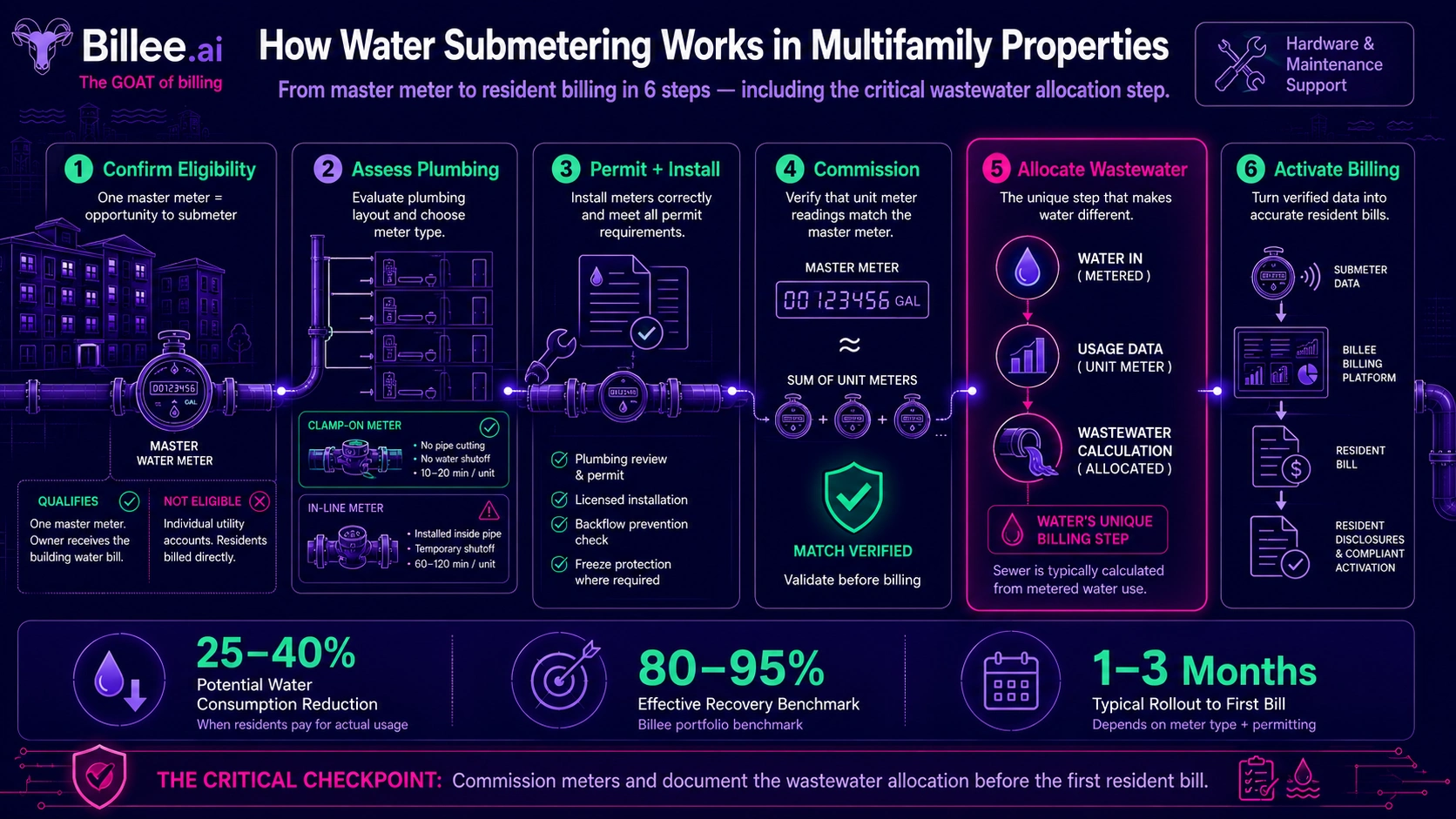
California's water submetering chapter states its own purpose plainly: to encourage conservation and to make submetering practices "just and reasonable" with safeguards for both residents and owners. Section 1954.202 defines a submeter as a device measuring the water consumption of an individual rental unit, and in the same chapter, separately defines RUBS as cost allocation based on square footage, occupancy, or similar physical factors. Defining both terms in one chapter does not mean both get the same treatment: the substantive requirements that follow apply to submeters specifically, not to RUBS.
Section 1954.203 sets the technical bar: a submeter must be inspected and tested under the Business and Professions Code, must measure only the water supplied exclusively to that unit, must be readable by the resident without the landlord entering the unit (submeters installed before January 1, 2018 are exempt from that access rule), and must be recalibrated on a regular schedule.
Section 1954.204 sets the disclosure bar: before the lease is signed, the owner must disclose in writing that water will be billed separately, provide estimated monthly bills based on comparable usage, list contact information for billing questions and leak reports, and disclose the resident's right to request submeter testing through the county sealer. Owners have 21 days to investigate and repair a reported leak before billing adjustments apply. Billee's own water submetering process guide covers the operational side of getting a submeter installed and commissioned.
The shared-meter disclosure rule: Civil Code Section 1940.9
Section 1940.9 covers a specific, narrower situation than submetering or RUBS: a resident's own individual gas or electric meter also measures usage for an area outside that resident's unit, a shared hallway light on a resident's circuit, for example. When that happens, the owner must disclose the condition and either execute a written agreement on who pays for the outside-the-unit portion, become the customer of record themselves, or install separate metering for the shared area.
Section 1940.9 does not require disclosure of a RUBS allocation formula. A resident whose owner fails to comply can sue to force the owner to become the customer of record, or to recover payments made for the outside-the-unit service retroactive to when disclosure should have occurred.
Master-metered gas and electric: the CPUC's rate-parity rule
Public Utilities Code Section 739.5 sets the rule for properties where gas or electric service runs through a single master meter billed to the owner, then allocated to residents. The core requirement is rate parity: a resident's per-unit rate can never exceed what the utility would have charged for direct service to that unit.
The statute also requires itemized billing that mirrors the format of the utility's own bill, public posting or on-request access to the current rate schedule, and proportional pass-through of any rebate the master-meter customer receives. Maintenance of the submeter system beyond the master meter is the owner's responsibility, not the utility's.
RUBS generally: contract law, plus local rent control where it applies
No dedicated California statute imposes disclosure or formula requirements on RUBS allocation the way Texas Chapter 24 or Chapter 291 does. RUBS terms live in the lease and are governed by general contract law at the state level. Billee's broader state-by-state RUBS guide covers how that compares to states with dedicated RUBS statutes.
Local rent control can override that default. Mountain View's Community Stabilization and Fair Rent Act has prohibited RUBS for new tenancies since March 1, 2024, treating utilities as part of stabilized rent. Existing RUBS arrangements must go through a One-Time Utility Adjustment Petition to fold utility costs into fixed rent. Operators with properties in rent-controlled California jurisdictions should confirm whether a similar local restriction applies before assuming state law is the only rule in play.
How the four threads apply to one property
Most California properties only trigger one or two of these threads at a time, not all four. A property built in 2021 with individual water submeters and a single master electric meter is a common combination: the water side follows Sections 1954.201 through 1954.204 in full, the electric side follows the CPUC's rate-parity rule under Section 739.5, and Section 1940.9 only comes into play if one resident's electric meter happens to also cover a shared area.
A property built in 1995 with no water submeters and a flat per-square-foot utility charge on the lease is a different combination entirely: no submetering disclosure applies because there's no submeter, no CPUC rate-parity rule applies because there's no master-metered gas or electric being allocated, and the RUBS charge itself runs on the lease terms unless the property sits in a rent-controlled city. Confirming which combination applies to a given property, before assuming the disclosure or rate rules from one thread apply to another, is the first step of any California billing setup.
Assembly Bill 1248: what it would have done, and why it isn't law
Assembly Bill 1248 would have restricted RUBS to water and sewer charges only, prohibiting most other RUBS arrangements statewide, and added new fee-disclosure and payment-application requirements for California rentals. The bill died on inactive file on February 2, 2026 and was never enacted.
Assembly Bill 1248 is not California law. No equivalent state-level restriction on RUBS currently exists. An operator who has heard that California banned RUBS is hearing an inaccurate version of a bill that stalled before passage, not a description of current law.
The bill's sponsor and the California Apartment Association reportedly continued discussions after it stalled, so a narrower version could resurface in a future session. That's a reason to watch the legislative calendar, not a reason to treat the original bill as if it already passed.
Common mistakes
- Treating Civil Code Section 1940.9 as a general RUBS disclosure requirement. It applies only to the narrower shared-meter scenario, not to formula-based allocation across many units.
- Assuming the water submetering disclosure rules under Section 1954.204 apply to buildings built before January 1, 2018. They apply to new construction only, and older buildings are not required to retrofit into compliance.
- Assuming Assembly Bill 1248 is in effect and configuring billing around a restriction on RUBS that does not currently exist in California law.
- Missing the CPUC's rate-parity requirement on master-metered gas or electric, which caps the per-unit rate at what the utility would charge directly and requires itemized billing that mirrors the utility's own format.
- Not checking whether a local rent-control ordinance, like Mountain View's, restricts RUBS even where state law does not. State-level permissiveness does not override a stricter local rule.
- Treating California's rules as one unified framework instead of four separate ones tied to different utilities and scenarios, which leads to applying the wrong disclosure language to the wrong situation.
When to handle this in-house vs. bring in a partner
A single California property outside a rent-controlled jurisdiction is manageable in-house with a clear checklist: confirm whether water is submetered or allocated, whether gas or electric is master-metered, and whether Section 1940.9's shared-meter scenario applies anywhere on the property.
A portfolio spanning multiple California jurisdictions is where the overlay complexity compounds. Some cities restrict RUBS through rent control and some do not, and that local layer changes the billing configuration independent of anything at the state level.
How Billee can help
Billee's regulatory and compliance support includes a billing methodology audit that checks which of California's four legal threads actually applies to a given property before billing configuration goes live, not after a dispute surfaces. That means confirming submetering status, master-meter status, local rent-control exposure, and current disclosure language against what the property is actually doing.
Billee also monitors state and local regulatory activity on an ongoing basis and updates a property's configuration when a rule changes, rather than leaving that check to the next audit cycle.
FAQ
Is RUBS legal in California? RUBS is legal in California. It operates under the lease and general contract law at the state level, with no dedicated state RUBS disclosure statute, though some cities restrict it through local rent control.
What is Assembly Bill 1248, and is it currently law? Assembly Bill 1248 was a 2025 to 2026 session bill that would have restricted RUBS to water and sewer charges only. It died on inactive file on February 2, 2026, and is not California law.
Does California require water submeters in all apartment buildings? California requires water submeters only in multifamily buildings constructed after January 1, 2018, under Senate Bill 7. Existing buildings built before that date are not required to retrofit submeters.
What does Civil Code Section 1940.9 actually require? Civil Code Section 1940.9 requires disclosure and a written payment agreement when a resident's own gas or electric meter also serves an area outside that resident's unit. It does not govern RUBS allocation formulas.
Can a landlord charge more per unit than the utility charges for master-metered gas or electric? Public Utilities Code Section 739.5 requires rate parity: a resident's per-unit rate for master-metered gas or electric can never exceed what the utility would charge for direct service.
Can a city restrict RUBS even if state law allows it? Local rent-control ordinances can restrict or prohibit RUBS beyond what state law requires. Mountain View has prohibited RUBS for new tenancies since March 1, 2024 under its rent stabilization ordinance.
Does Billee handle California-specific utility billing compliance? Billee configures California properties against all four applicable legal threads (water submetering, the shared-meter rule, CPUC rate parity, and local rent-control overlays) and updates that configuration as rules change.
Related reading
For billing statement disclosure requirements across states, see PUC Disclosure Requirements for Multifamily Utility Billing. For how RUBS and submetering compare directly, see RUBS vs. Submetering. For the difference between master-metered and submetered properties generally, see Master-Metered vs. Submetered Multifamily.
Billee configures California billing against the state's actual legal requirements, not headline rumors about bills that never passed. Talk to the team about your portfolio.
Sources
- FindLaw, "California Civil Code Section 1954.202."
- FindLaw, "California Civil Code Section 1954.203."
- FindLaw, "California Civil Code Section 1954.204."
- FindLaw, "California Civil Code Section 1940.9."
- FindLaw, "California Public Utilities Code Section 739.5."
- CalMatters Digital Democracy, "SB 7: Housing: water meters: multiunit structures," 2015-2016 session.
- LegiScan, "California AB1248, 2025-2026 Regular Session."
- City of Mountain View, "Utilities Charges and RUBS, Community Stabilization and Fair Rent Act."
Insights and Industry Trends


Explore more insights