
Where Is RUBS Banned or Restricted? A 2026 State-by-State Reference
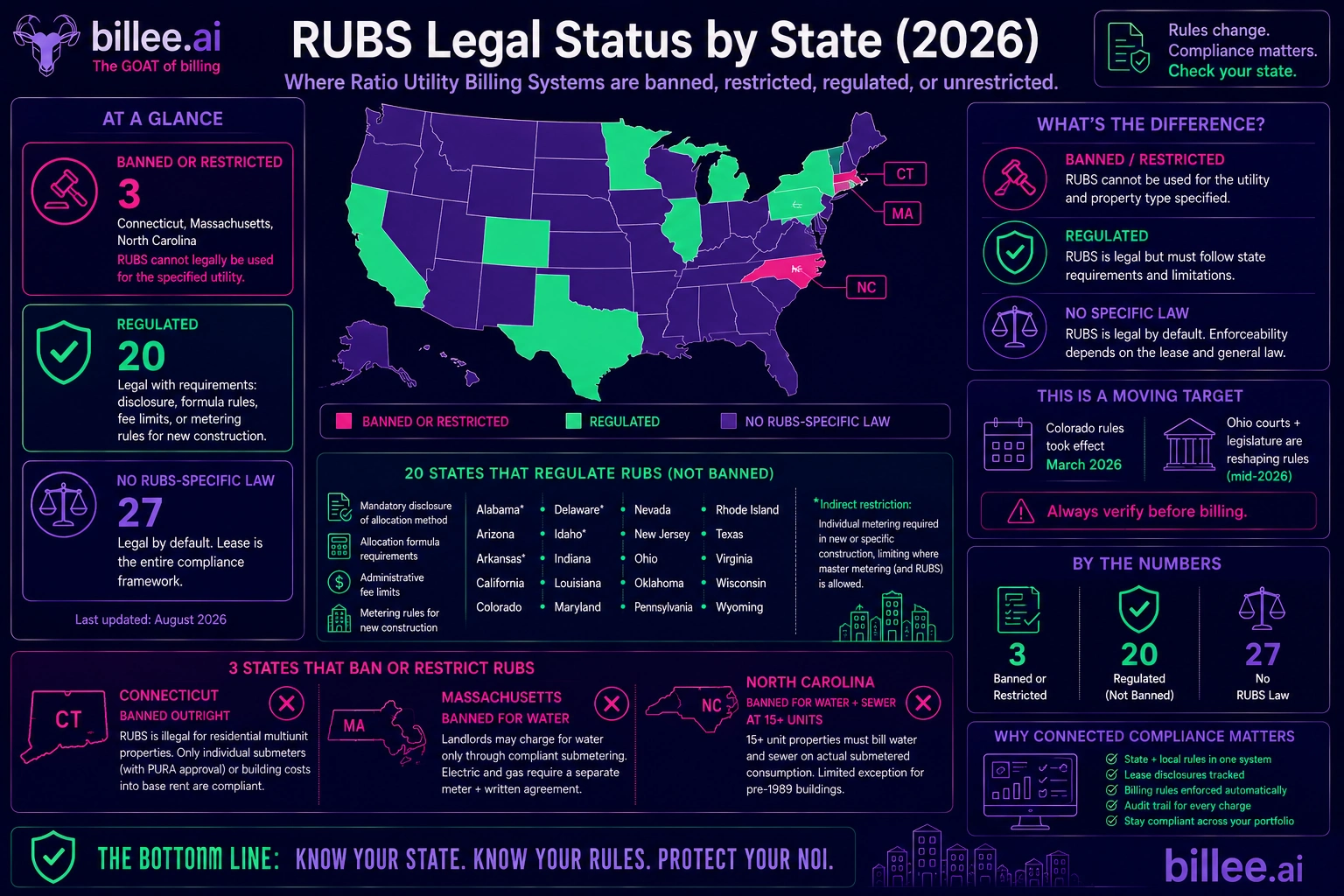
Ratio Utility Billing System (RUBS) is banned outright in only one state, Connecticut, where the state Supreme Court ruled the practice illegal for residential multiunit properties in 2024. Two more states restrict it sharply enough to rule out a standard RUBS program: Massachusetts bans formula billing for water specifically, and North Carolina bans it for water and sewer at properties with 15 or more units. Twenty additional states regulate RUBS directly, through disclosure rules, allocation-formula requirements, administrative fee limits, or restrictions on where master metering itself is allowed. The remaining 27 states have no RUBS-specific statute at all, which means enforceability depends entirely on the lease. Billee's full state-by-state compliance guide covers what each of these rules requires in practice; this reference is the fast lookup for where RUBS is banned, restricted, or regulated.
Last updated: August 2026
Key Takeaways
- Connecticut is the only state where RUBS is illegal outright, following a 2024 state Supreme Court ruling that formula-based billing violates the state's individual-metering requirement.
- Massachusetts and North Carolina restrict RUBS for specific utilities rather than banning it across the board: Massachusetts for water, North Carolina for water and sewer at properties with 15 or more units.
- Twenty states regulate RUBS directly, ranging from detailed frameworks like Texas, Colorado, Virginia, and Arizona to narrower disclosure-only rules like Nevada and Wisconsin.
- Four of those twenty states, Alabama, Arkansas, Delaware, and Idaho, restrict RUBS indirectly by requiring individual metering in new or specific construction, which narrows where RUBS-eligible master metering is legal.
- Twenty-seven states have no RUBS-specific law. RUBS is legal there by default, but the lease addendum is the entire compliance framework.
- This is a moving target: Colorado's rules took effect in March 2026, and Ohio's courts and legislature are actively reshaping submetering regulation as of mid-2026.
At a Glance: RUBS Legal Status by Category
StatusStatesWhat It MeansBanned or restricted3 — Connecticut, Massachusetts, North CarolinaRUBS cannot legally be used for the utility and property type specified, ranging from an outright ban to a narrower water/sewer restriction.Regulated20 — including Texas, Colorado, Arizona, Virginia, Indiana, Maryland, CaliforniaRUBS is legal but governed by a specific law: mandatory disclosure, allocation-formula rules, administrative fee limits, or a metering requirement for new construction.No RUBS-specific law27 — including Florida, Ohio, Pennsylvania, TennesseeNo dedicated statute exists. RUBS is legal by default; enforceability depends entirely on the lease and general landlord-tenant or consumer-protection law.
The 3 States That Ban or Restrict RUBS
Only one state makes ratio utility billing illegal outright. Two more restrict it sharply enough that a standard national RUBS program will not be compliant for at least one utility type. These are the three states where switching to individual submetering, or building utility costs into base rent, is not optional.
Connecticut: Banned Outright
Connecticut is the one state where RUBS is flatly illegal for residential multiunit properties. In Northland Investment Corporation v. Public Utilities Regulatory Authority, 349 Conn. 35 (2024), the state Supreme Court held that allocating utility costs by formula violates Connecticut General Statutes Section 16-262e(c), which requires landlords to bear utility costs unless a unit is individually metered. Two compliant paths remain: building anticipated utility costs into a fixed base rent, or installing individual submeters with PURA approval. (Pullman & Comley)
Massachusetts: Banned for Water
Massachusetts law states that a landlord may charge a tenant for water usage "only" through compliant submetering equipment, which forecloses ratio or formula billing for water specifically. The statute is less explicit for electric and gas, where a landlord who wants to bill a tenant separately still needs a separate meter and a written agreement. (Massachusetts General Laws Chapter 186, Section 22)
North Carolina: Banned for Water and Sewer at Larger Properties
North Carolina bars ratio billing for water and sewer at properties with 15 or more units: those buildings must bill on actual submetered consumption, with only a narrow exception for buildings that predate 1989 and have Commission-approved allocation already in place. Smaller properties and other utility types fall outside this specific rule. (North Carolina Utilities Commission, Rules R18-1–R18-8)
20 States That Regulate RUBS Without Banning It
These states allow RUBS but attach real requirements to it: written disclosure of the allocation method, specific formula rules, administrative fee limits, or, in four cases, a restriction on where master metering itself is legal, which indirectly limits where RUBS can be used at all. A national lease addendum that ignores these requirements is a compliance gap, not a formality.
- Alabama. Alabama Power's PSC-approved Special Electric Rules bar master metering in multi-unit residential buildings built after January 1, 1981, with exceptions for buildings lacking individually-controlled HVAC, student housing, and senior housing. RUBS remains usable in qualifying older or exempt buildings. (Alabama Public Service Commission)
- Arizona. Arizona law explicitly names and regulates "ratio utility billing": the lease must disclose the utility services billed separately and the administrative fee, that fee is limited to the landlord's actual administrative costs, and tenants get a two-step dispute process: written objection to the landlord, then a civil complaint in justice court if unresolved. (Arizona Revised Statutes §33-1314.01 (Justia))
- Arkansas. Arkansas PSC General Service Rules bar gas and electric utilities from installing master meters or combined billing in newly constructed residential complexes of two stories or fewer and in mobile home parks, restricting where RUBS-eligible master metering can be used. (Arkansas Public Service Commission, Rule 5.20)
- California. Civil Code §1940.9 requires landlords to disclose a shared or master gas/electric meter condition and reach a written agreement with the tenant before or at the start of tenancy. Public Utilities Code §739.5 requires master-meter customers who submeter gas or electric to bill tenants no more than the utility itself would charge. (California Civil Code §1940.9 (FindLaw))
- Colorado. HB 26-1013, signed March 26, 2026, requires aggregate resident charges to match the utility provider's actual bill with no markup, excludes common-area costs from the resident allocation, and requires lease disclosure. New construction permitted after July 1, 2027 must submeter instead. (Colorado General Assembly)
- Delaware. Delaware Code Title 25 §5312 bars a landlord from separately charging a tenant for a utility unless it is separately metered, at a charge capped at the provider's actual cost, for metering systems installed after July 17, 1996. Pre-1996 systems are exempted. (Delaware Code, Title 25 §5312)
- Georgia. Georgia law lets owners of qualifying multi-unit buildings use an "economic allocation methodology" to bill tenants for water and wastewater, mandatory for buildings permitted after July 1, 2012, with lease disclosure required and charges capped at actual cost plus a reasonable fee. It's limited to water and wastewater; electric and gas allocation fall to general consumer-protection law. (Georgia Code §12-5-180.1 (Justia))
- Idaho. Idaho PUC rules require individual electric metering in most multi-occupant residential buildings built or converted after July 1, 1980 with individually-controlled heating or cooling, and cap the rate charged to submetered mobile-home-park tenants at the utility's residential rate. (Idaho Public Utilities Commission, IDAPA 31.26.01)
- Illinois. The Tenant Utility Payment Disclosure Act requires a landlord who bills tenants a proportionate share of a master-metered bill to disclose the allocation formula in writing, make underlying utility bills available on request, and ensures total tenant collections cannot exceed the actual utility bill. (Illinois Compiled Statutes, 765 ILCS 740)
- Indiana. Indiana law explicitly names Ratio Utility Billing System (RUBS) as a lawful sub-billing method and regulates it: mandatory disclosures, a $4 administrative-fee cap, a ban on late fees, minimum payment windows, and a right to file complaints with the Indiana Utility Regulatory Commission. (Indiana Utility Regulatory Commission)
- Maryland. Maryland law explicitly defines and regulates the Ratio Utility Billing System, requiring landlords to give prospective tenants detailed written disclosures before charging RUBS, with the RUBS lease clause unenforceable if disclosures aren't provided. (Maryland Real Property Article §8-212.4)
- Minnesota. Minnesota bans ratio (formula) billing of electricity entirely: landlords must individually meter, submeter, or fold electric costs into rent. The state does explicitly permit and tightly regulate ratio billing for natural gas (mandatory square-footage formula) and water/sewer (mandatory occupancy formula), with fee caps, effective for leases from January 1, 2025. (Minnesota Statutes §504B.216)
- Nevada. NRS 118A.200 requires a single rent disclosure figure that includes mandatory fees, and permits a separate monthly utility fee only with specific disclosure: an asterisked note when the utility can't contract directly with the tenant, or disclosure that a unit is on a master-metered water system before charging for it. (Nevada Revised Statutes §118A.200 (Nevada Legislature, official))
- New Mexico. The Uniform Owner-Resident Relations Act entitles residents to copies of bills and the calculations used to apportion submetered utility costs on request, bars allocating a vacant unit's share to occupied units, and caps the information-request fee at $5. (NMSA 1978 §47-8-20(F))
- Oregon. Oregon law requires written disclosure when a utility charge benefits the landlord or other tenants, disclosure of the allocation method when one bill covers multiple tenants, billing within 30 days of the provider's invoice, and remedies up to twice actual damages or one month's rent for violations. (Oregon Revised Statutes 90.315)
- Texas. Texas Utilities Code Chapter 184 ("Electric and Water Metering") governs allocation billing in apartments and mobile home parks: it requires the rental agreement to disclose the allocation computation method in writing, and it caps the charge at no more than the per-unit rate the utility charges the property owner, with no markup allowed. (Texas Utilities Code, Chapter 184 (Justia, mirroring official code))
- Utah. Utah Code explicitly bars municipalities from regulating submetering, ratio utility billing, or other utility cost allocation methods, protecting an owner's right to contract with tenants over utility payment. This is a preemption provision shielding RUBS from local restriction, not a consumer-disclosure rule. (Utah Code §10-8-85.5)
- Virginia. Virginia law explicitly defines and regulates ratio utility billing systems: the method must be stated in the lease, allocation must use square footage, occupancy, bedrooms, or another agreed method, billing periods must match the utility's, and late fees are capped at $5. (Code of Virginia §55.1-1212)
- West Virginia. West Virginia law states that if the rental agreement provides for it, a landlord may use submetering equipment, energy allocation equipment, or a ratio utility billing system: a brief statutory authorization naming RUBS and conditioning its use on lease disclosure, without formula or fee-cap detail. (West Virginia Code §37-6A-1)
- Wisconsin. A Department of Agriculture, Trade and Consumer Protection rule requires landlords to disclose before signing a lease whether utilities are included in rent and, when units aren't separately metered, to disclose the basis on which utility charges will be allocated among units. (Wis. Admin. Code § ATCP 134.04)
27 States With No RUBS-Specific Law
The majority of states have never enacted a RUBS-specific statute, administrative rule, or public utility commission requirement. That does not mean no risk. It means the lease addendum is the entire compliance framework, backstopped by general landlord-tenant and consumer-protection law rather than a dedicated RUBS rule.
Alaska, Florida, Hawaii, Iowa, Kentucky, Louisiana, Maine, Michigan, Mississippi, Missouri, Montana, Nebraska, New Hampshire, New York, North Dakota, Oklahoma, Pennsylvania, Rhode Island, South Carolina, South Dakota, Tennessee, Vermont, Washington, and Wyoming all fall into this category.
Ohio is the one to watch closely. No statute governs RUBS allocation itself, but an April 2026 state Supreme Court ruling held that submetering companies are regulated public utilities, and the legislature passed submetering rules (HB 173) that the governor vetoed in June 2026, with a competing bill still pending. None of this reaches RUBS/ratio-allocation billing directly yet, but the state's submetering landscape is unsettled enough to monitor. (Office of the Ohio Consumers' Counsel)
Kansas has a real submetering statute, K.S.A. 58-25,127, requiring pass-through billing at actual cost with no markup, but it governs true submetering, not formula-based RUBS allocation, which remains unaddressed by state law. (Kansas Office of the Revisor of Statutes)
New Jersey has no statewide RUBS statute, but Jersey City, a municipality rather than the state, has passed local ordinances requiring RUBS disclosure and transparency. Operators with New Jersey properties should check municipal rules, not just state law. (New Jersey Department of Community Affairs)
How Billee Fits In
Billee's Regulatory & Compliance product tracks which category a property falls into, banned, regulated, or unaddressed, and configures the RUBS allocation formula, disclosure language, and administrative fee structure to match. That configuration happens at enrollment, and Billee monitors state-level activity so a portfolio's compliance baseline doesn't go stale when a state like Colorado or Ohio changes its rules mid-year.
For operators with properties in Connecticut, Massachusetts, or North Carolina specifically, Billee's team helps plan the transition to a compliant alternative, fixed-rent inclusion or individual submetering, rather than leaving that decision to a property-level scramble. Talk to the team about your specific states.
FAQ
Which states have banned RUBS?
Connecticut bans ratio utility billing outright for residential multiunit properties. Massachusetts bans it specifically for water billing, and North Carolina bans it for water and sewer at properties with 15 or more units. No other state has an outright ban as of mid-2026.
Is RUBS restricted for new construction in any state?
Yes. Alabama, Arkansas, Delaware, and Idaho don't ban RUBS directly, but they require individual electric or water metering in new or specific construction types, which removes the master metering that RUBS depends on for buildings built after each state's cutoff date.
Does Minnesota allow ratio billing for electricity?
No. Minnesota bans formula-based ratio billing of electricity entirely, requiring individual metering, submetering, or inclusion in rent instead. The state does permit and separately regulate ratio billing for natural gas and water, each with its own mandatory formula.
Will more states ban RUBS?
It's a live possibility in several states. Washington considered a statewide ban in 2019 that didn't pass, though Seattle has continued pushing local restrictions. Ohio's courts and legislature are actively reshaping submetering regulation as of 2026, and Colorado only enacted its current rules in March 2026 after years with no statute at all. Operators with multi-state portfolios should treat this list as current, not permanent.
What should I do if my state bans RUBS?
Two paths are typically compliant: build anticipated utility costs into a fixed base rent, or install individual submeters where the state's utility commission allows it. Both require updating the lease and, in most cases, utility commission or vendor coordination; this isn't a same-day fix.
Is RUBS banned nationwide?
No. There's no federal ban on ratio utility billing. Legality and regulation are set state by state, which is exactly why a single national lease addendum creates risk: what's compliant in Texas or Florida may be illegal in Connecticut and heavily restricted in Massachusetts or North Carolina.
Sources
1. Pullman & Comley, "Connecticut Landlords Beware: RUB Billing Is Illegal in Multiunit Properties," accessed August 2026.
2. Massachusetts General Court, "General Laws Chapter 186, Section 22," accessed August 2026.
3. North Carolina Utilities Commission, "Rules R18-1 through R18-8," accessed August 2026.
4. Alabama Public Service Commission, "Special Electric Rules, Rule E-2," accessed August 2026.
5. Arizona Legislature, "Arizona Revised Statutes Section 33-1314.01," accessed August 2026.
6. Arkansas Public Service Commission, "General Service Rules, Rule 5.20," accessed August 2026.
7. California Legislative Information, "Civil Code Section 1940.9," accessed August 2026.
8. Colorado General Assembly, "HB 26-1013," accessed August 2026.
9. Delaware General Assembly, "Delaware Code, Title 25, Section 5312," accessed August 2026.
10. Georgia General Assembly, "Georgia Code Section 12-5-180.1," accessed August 2026.
11. Idaho Public Utilities Commission, "IDAPA 31.26.01, Master Metering Rules for Electric Utilities," accessed August 2026.
12. Illinois General Assembly, "765 ILCS 740, Tenant Utility Payment Disclosure Act," accessed August 2026.
13. Indiana Utility Regulatory Commission, "Sub-billing (Landlords)," accessed August 2026.
14. Maryland General Assembly, "Real Property Article Section 8-212.4," accessed August 2026.
15. Minnesota Office of the Revisor of Statutes, "Minnesota Statutes Section 504B.216," accessed August 2026.
16. Nevada Legislature, "Nevada Revised Statutes Section 118A.200," accessed August 2026.
17. New Mexico Legislature, "Uniform Owner-Resident Relations Act, Section 47-8-20(F)," accessed August 2026.
18. Oregon State Legislature, "Oregon Revised Statutes 90.315," accessed August 2026.
19. Texas Legislature, "Utilities Code, Chapter 184: Electric and Water Metering," accessed August 2026.
20. Utah State Legislature, "Utah Code Section 10-8-85.5," accessed August 2026.
21. Virginia Legislative Information System, "Code of Virginia Section 55.1-1212," accessed August 2026.
22. West Virginia Legislature, "West Virginia Code Section 37-6A-1," accessed August 2026.
23. Wisconsin Department of Agriculture, Trade and Consumer Protection, "Wisconsin Administrative Code ATCP 134.04," accessed August 2026.
24. Office of the Ohio Consumers' Counsel, "Utility Service for Tenants: Submetering," accessed August 2026.
25. Kansas Office of the Revisor of Statutes, "K.S.A. 58-25,127," accessed August 2026.
26. New Jersey Department of Community Affairs, "Landlord-Tenant Information: Utilities," accessed August 2026.
Insights and Industry Trends