
What Is Meter Monitoring & Proactive Alerts?
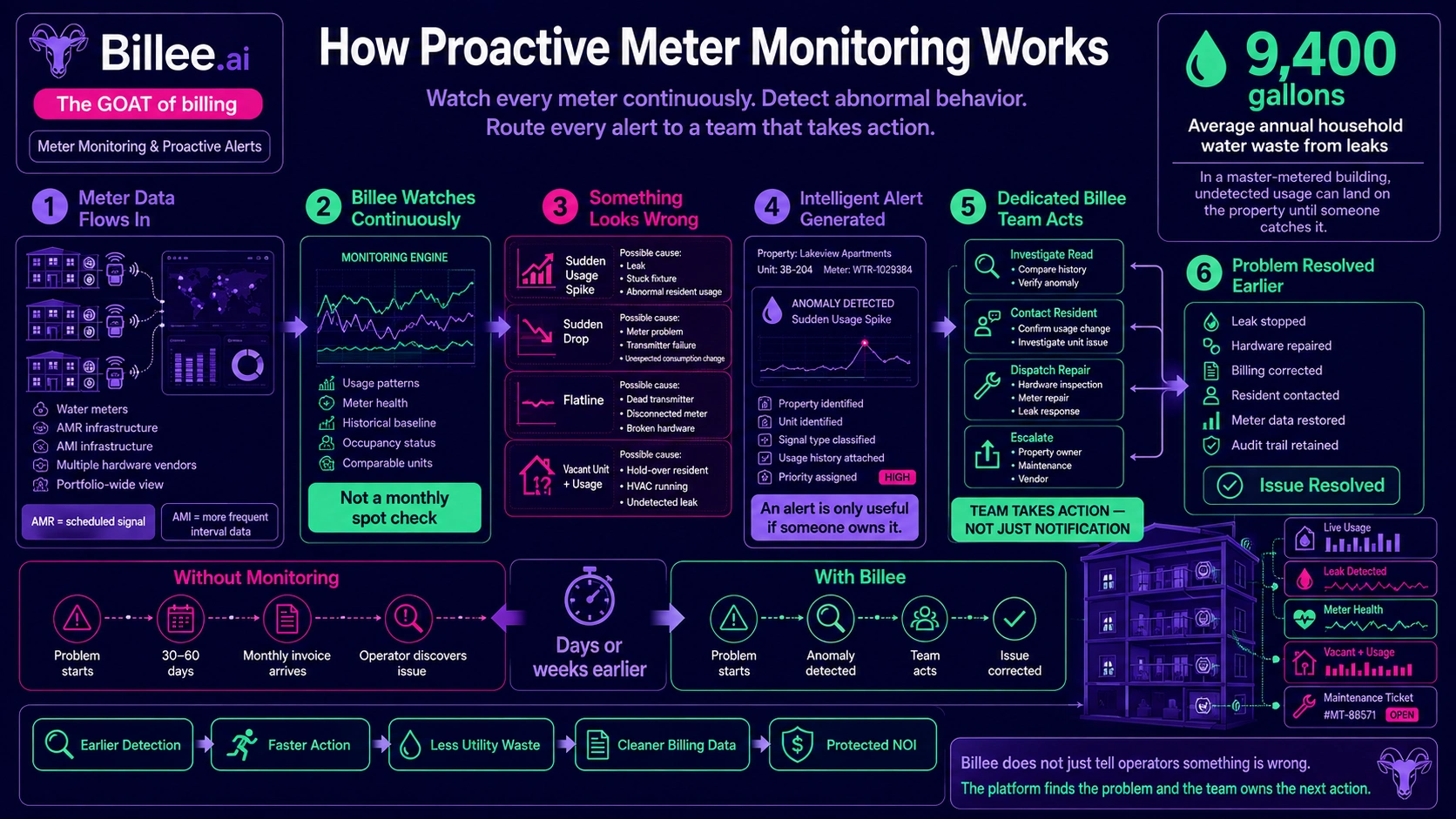
Meter monitoring and proactive alerts is Billee's real-time monitoring service for the metering infrastructure across a multifamily portfolio. Billee watches meter activity continuously, and when a reading looks wrong, a usage spike, a sudden drop, or a flatline that signals broken hardware, the platform generates an intelligent alert and routes it to the Billee account team. The team investigates and acts: dispatching a repair, contacting the resident, or escalating to the owner. The result is catching a problem days or weeks before the next monthly invoice would have surfaced it.
Key takeaways
- Billee monitors meter activity continuously across a portfolio and generates an alert on a usage spike, an unexpected drop, or a flatline that signals broken hardware.
- Every alert routes to Billee's dedicated account team, not just a dashboard, and the team investigates, dispatches repairs, or escalates as needed.
- The average family wastes 9,400 gallons of water a year to undetected household leaks, per the EPA's WaterSense program. In a master-metered building, that cost lands on the property until someone catches it.
- Meter monitoring works with AMR infrastructure across major hardware vendors, and AMI properties generate even more frequent data for it to work with.
- Meter monitoring and Vacant Cost Recovery run on the same continuous-monitoring logic and work together as Billee's proactive recovery approach.
- Meter monitoring is one of Billee's seven products and can be purchased on its own or as part of the full platform.
The problem meter monitoring solves
Meter monitoring is one piece of the broader multifamily utility management function, and it exists because meters fail quietly. A leak runs for weeks before a resident notices a change in water pressure. A transmitter dies and the meter stops reporting, but nothing about the property looks different from the curb. By the time a monthly invoice reveals the problem, the cost has already been absorbed.
Leaks that run for weeks before anyone notices
Water leaks are the most expensive version of this problem. The average family wastes 180 gallons a week, or 9,400 gallons a year, to undetected household leaks, according to the U.S. Environmental Protection Agency's WaterSense program. A single running toilet can generate that kind of waste with nothing looking wrong from inside the apartment, and in a master-metered building, that usage lands on the property's bill, not a resident's statement. Multiply one undetected leak across a portfolio and the unrecovered cost adds up fast.
Broken meters and flatlined data
A meter that stops transmitting does not announce itself. The reading flatlines or stops arriving altogether, and unless something is watching for that specific pattern, a dead meter can go unnoticed for months while billing and recovery for that unit run on stale or estimated data.
Vacant units with nobody watching the meter
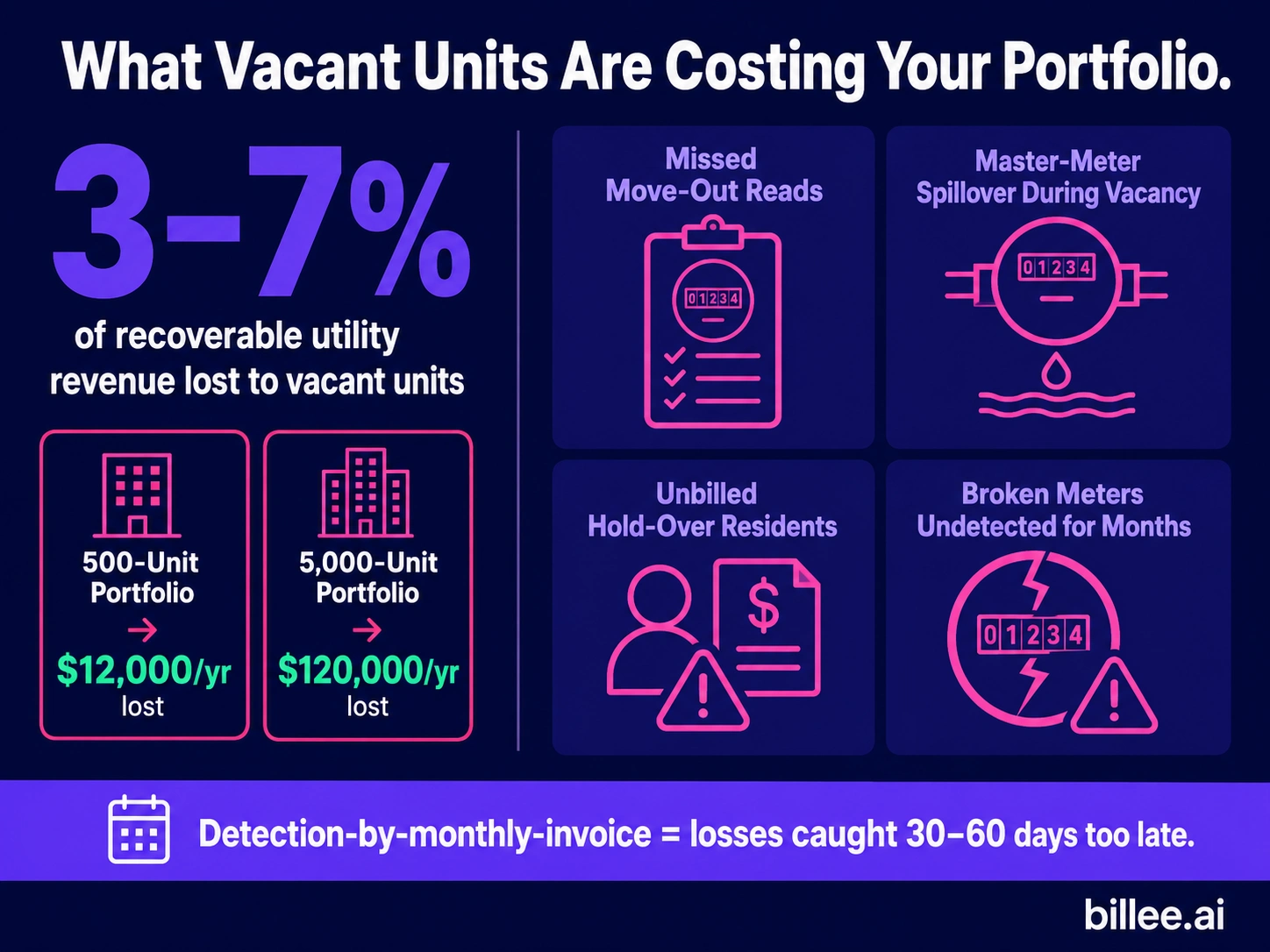
Vacant units create a version of the same blind spot. HVAC left running for freeze protection, a hold-over resident, or a leak in an empty apartment can all run up real utility cost while no one is physically checking that unit. Billee treats this as a related but distinct problem, covered in full below.
The detection gap: what "waiting for the invoice" actually costs
Most operators find out about a meter problem when the monthly invoice arrives, typically 30 to 60 days after the cost was incurred. By then, the recovery window is mostly closed: a hold-over resident has moved on, and a leak has already run its course. Meter monitoring exists to close that gap by watching meter activity as it happens, instead of waiting for an invoice to reveal a problem after the fact.
How meter monitoring and proactive alerts work
Billee's meter monitoring service combines continuous technical monitoring with a team that takes action on what it finds. Billee watches meter activity across a portfolio in real time, and a named account team acts on every alert the platform generates, rather than leaving the alert to sit in a dashboard.
Continuous monitoring across the portfolio
Billee monitors meter activity continuously across every property in a portfolio, not on a monthly or per-property spot-check basis. The platform pulls data from AMR (automated meter reading) infrastructure across major hardware vendors into one unified view, so an operator with properties on different meter brands still gets a single portfolio-level picture of meter health.
What triggers an alert
Three patterns generate an alert: a sudden usage spike, a sudden drop, or a flatline that signals broken or disconnected hardware. Each pattern points to a different kind of problem, and the Billee team investigates accordingly.
From alert to action
An alert nobody acts on is just a notification. Billee's meter monitoring is built around a different model: experts who take action, not just notify. When the platform flags an issue, the Billee team investigates and takes the next step itself, whether that means dispatching a technician for a hardware repair, contacting the resident directly, pulling the meter for inspection, or escalating to the property owner.
Alert response and the account team model
Every meter alert routes to Billee's dedicated account team, the same named team that handles billing exceptions and vendor management for the portfolio, not a generic support queue. That continuity, one named point of contact instead of a rotating queue, is what turns a monitoring alert into a resolved issue instead of an open ticket.
| Signal | What it usually means | What the Billee team does |
|---|---|---|
| Sudden usage spike | A leak, a stuck fixture, or a genuine change in resident usage | Investigates the read and follows up with the resident if needed |
| Sudden drop or flatline | A dead transmitter or a disconnected meter | Dispatches for hardware inspection and repair |
| Usage on a vacant-flagged unit | A hold-over resident, HVAC left running, or an undetected leak | Routes to the account team to investigate and correct billing |
| Consistently high baseline vs. comparable units | An inefficient fixture or an equipment issue | Flags the unit for resident communication or a maintenance follow-up |
What's included in Billee's meter monitoring service
- Real-time monitoring of meter activity across every property in the portfolio
- Intelligent alerts that surface a spike, a drop, or a flatline before the next scheduled read or invoice
- A team that takes action on every alert: investigating, dispatching repairs, contacting residents, or escalating to the owner
- Reduced liability exposure, because broken meters and active leaks get addressed quickly instead of sitting unresolved for a billing cycle or more
Outcomes you can expect
Meter monitoring pays off in two concrete ways, on top of the liability reduction already covered above.
Faster detection and reduced bill shock
Per Billee's own operational data, meter monitoring typically catches a problem days or weeks earlier than the next scheduled invoice would reveal it. Catching a leak like the one described above in its first week instead of its sixth means the master-meter bill reflects a repaired problem, not two months of running water.
Cleaner data for ESG and recovery reporting
Consumption data is only as reliable as the meters generating it. A portfolio with actively monitored, well-maintained meters produces cleaner consumption data, which flows directly into ESG and CFO-level reporting without needing correction after the fact.
How meter monitoring pairs with Vacant Cost Recovery
Meter monitoring and Vacant Cost Recovery run on the same underlying logic: watch continuously, flag anything unusual, and route it to a person who acts. Meter monitoring asks whether any meter's activity pattern looks wrong; Vacant Cost Recovery asks specifically whether a unit flagged as vacant is showing usage it should not have. Together, they cover both sides of the same NOI-protection problem, and Billee treats them as one proactive recovery story rather than two separate tools bolted together.
How meter monitoring works with hardware and maintenance support
Monitoring finds the problem, but someone still has to fix the physical hardware behind it: a dead transmitter, a miscalibrated meter, or a unit that needs a new meter installed. Billee's Hardware & Maintenance Support covers that side, handling procurement, installation coordination, calibration, and repair dispatch so the meters generating the data stay accurate.
How it integrates with Yardi, RealPage, and Entrata
Meter monitoring sits on top of a portfolio's metering hardware rather than inside a specific property management system, so it works the same way regardless of which PMS an operator runs. Billee's broader platform includes a native Yardi Voyager integration along with RealPage and Entrata connections, and meter monitoring benefits from that same connected view without a separate setup process.
Who this is for
Meter monitoring is a strong fit for:
- Portfolios with submetering infrastructure already installed
- Operators in high-leak-risk geographies, including older water infrastructure and freeze-prone climates
- Asset managers who need defensible meter health data ahead of a refinancing or disposition, the kind of documentation covered in Preparing Utility Cost Data for Refinancing or Disposition
Meter monitoring vs. meter reading: what's actually different
A meter read is a snapshot: a number captured at one point in time, whether by a manual read, an AMR drive-by, or an AMI network ping, that becomes the basis for the next bill. Meter monitoring is different. It watches the pattern of readings over time and flags the moment something looks wrong, instead of waiting for the next scheduled read to reveal it days or weeks later.
The distinction matters most with hardware. Properties with AMI meters generate interval data multiple times a day, giving monitoring more frequent signal than AMR properties, which report on whatever cadence the AMR system uses. Either way, monitoring depends on having submetering infrastructure in place already; a RUBS-billed property without unit-level meters has nothing for it to watch.
FAQ
What is meter monitoring in multifamily utility billing?
Meter monitoring is Billee's real-time monitoring service for a portfolio's metering infrastructure, generating an alert when a reading shows a usage spike, an unexpected drop, or a flatline that signals broken hardware.
How does Billee know when a meter is broken?
A broken or disconnected meter typically stops reporting or reports a flat, unchanging value. Billee's monitoring flags that flatline as an alert and routes it to the account team for a hardware inspection.
Does meter monitoring work with AMR meters, or only AMI?
Billee's meter monitoring works with AMR (automated meter reading) infrastructure across major hardware vendors, and AMI properties get even more frequent signal for it to work with.
How is meter monitoring different from Vacant Cost Recovery?
Meter monitoring watches every meter in a portfolio for unusual activity. Vacant Cost Recovery specifically checks whether a unit flagged as vacant is showing usage it should not have. The two run on the same continuous-monitoring logic and work together.
Does meter monitoring help with ESG reporting?
Yes. Actively monitored, quickly repaired meters produce more reliable consumption data, and that data is what feeds ESG and sustainability reporting.
Can I get meter monitoring on its own, or only as part of the full platform?
Meter monitoring is one of Billee's seven products and can be purchased on its own or as part of Billee's integrated platform.
What kind of portfolio benefits most from meter monitoring?
Portfolios with existing submetering infrastructure see the most direct benefit, especially in high-leak-risk geographies like older buildings or freeze-prone climates. Asset managers preparing for a refinancing or sale also rely on it for defensible meter health data.
Billee watches meter activity across a portfolio and puts a real team behind every alert, not just a dashboard. Talk to the team about your properties.
Sources
- United States Environmental Protection Agency, WaterSense Program, "Statistics and Facts," accessed 2026.
Insights and Industry Trends