
Virginia RUBS and Submetering Rules 2026: Lease Disclosure, Fee Limits and What Changes July 1, 2027
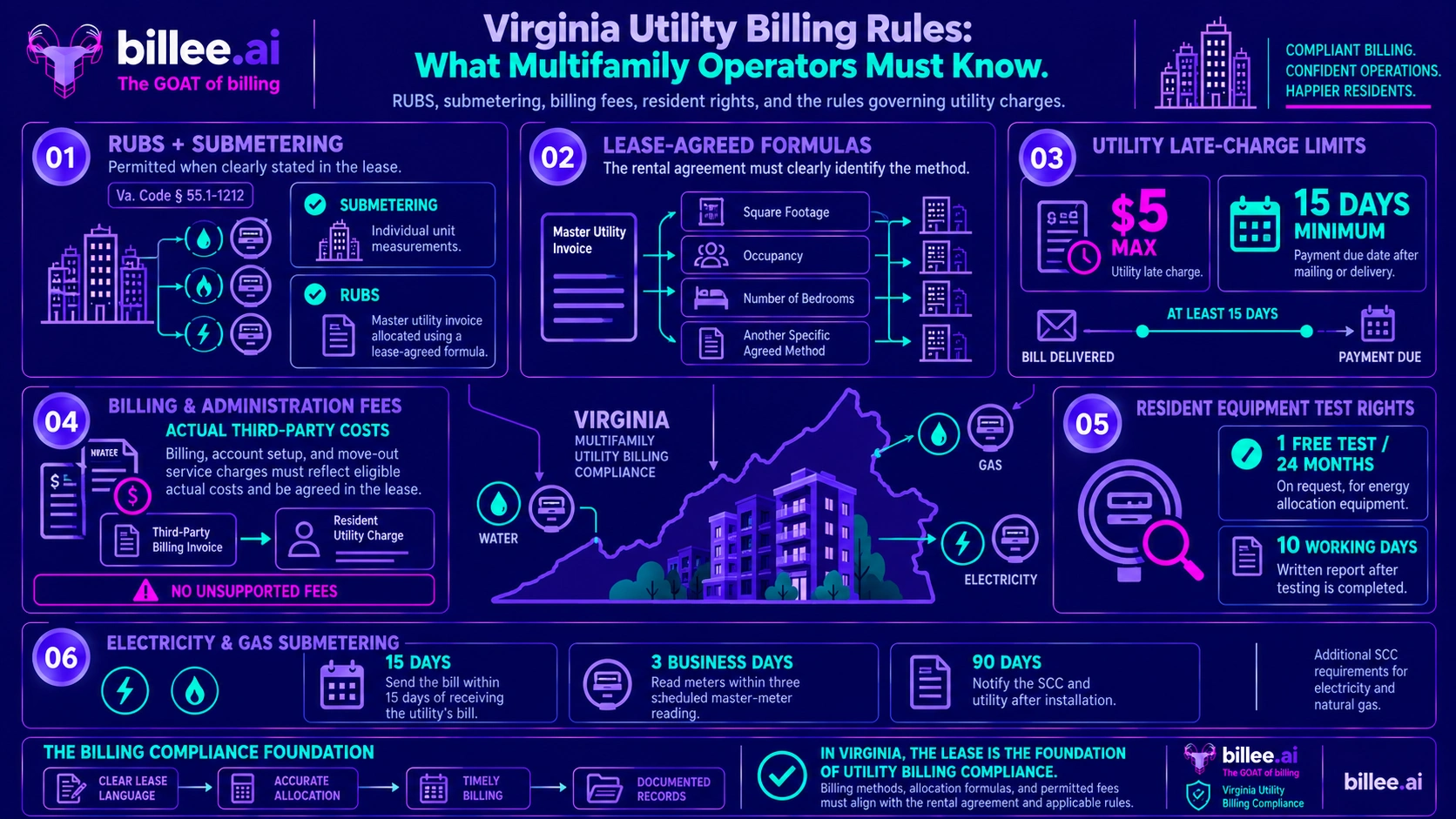
Virginia allows submetering and ratio utility billing only when the lease clearly says so, under Va. Code § 55.1-1212. Late charges are capped at $5, and bills follow the utility's billing period unless the lease says otherwise. Laws taking effect July 1, 2027 add billing-fee payment histories to required records and itemized charges to nonpayment notices. Billee Technologies, Inc. helps operators review compliance.
Virginia keeps its core utility billing rules in one statute, with State Corporation Commission (SCC) rules layered on for electricity and natural gas. The state's legislative site shows two versions of the statute: the current text, effective until July 1, 2027, and an amended text that takes effect that day. This guide covers both, the limits that apply today and a checklist for getting ready.
Key takeaways
- The statute allows submetering equipment and a ratio utility billing system (RUBS) if the lease or rental agreement clearly states them.
- Allocation can use square footage, occupancy, number of bedrooms or another specific method agreed in the lease.
- A late charge may be up to $5, and the payment due date must be at least 15 days after the bill is mailed or delivered.
- Billing fees are allowed as additional service charges that cover the actual costs of administrative expenses and billing charged by a third-party provider, if the lease agrees to them.
- Residents can request a free test of energy allocation equipment once in a 24-month period and get a written report within 10 working days.
- From July 1, 2027, the copying-charge sentence leaves the records subsection, and records must include how billing fees are calculated and a history of billing fee payments.
- Bill summaries say that from the same date a nonpayment notice must carry a written statement of charges and payments, including utility debits and credits.
Virginia utility billing at a glance
TopicNow (through June 30, 2027)From July 1, 2027Lease statementSystems allowed if clearly stated in the rental agreement or leaseSameAllocation methodSquare footage, occupancy, bedrooms or another method agreed in the leaseSameBilling periodSame period as the utility unless the lease expressly provides otherwiseSameLate chargeUp to $5; due date not less than 15 days after mailing or delivery of the bill; treated as rentSameBilling feesAdditional service charges for actual third-party administrative and billing costs, if agreed in the leaseSame textEquipment testFree on request, once per 24 months per resident; written report within 10 working daysSameRecordsResident may inspect and copy records; owner may charge a reasonable copying costCopying-charge sentence removed; records include a description of how billing fees are calculated and a history of billing fee paymentsNonpayment noticeExisting notice rules applyPer bill summaries: written statement of charges and payments, including utility debits and credits
What § 55.1-1212 allows today
The current text of Va. Code § 55.1-1212 defines a ratio utility billing system as a program that uses "a mathematical formula for allocating" the water, sewer, electric, oil or natural gas bills the owner receives from a third-party provider among the residents of a building. It permits formulas based on square footage, occupancy, number of bedrooms or some other specific method agreed in the lease.
The lease controls. Energy submetering equipment, energy allocation equipment, water and sewer submetering equipment and a ratio utility billing system may be used if clearly stated in the rental agreement or lease. Billee's guide to RUBS lease addendum requirements covers what to put in the addendum.
Billing follows the utility. The owner must bill for electricity, oil, natural gas, or water and sewer for the same billing period as the utility serving the building, unless the lease expressly provides otherwise.
The late charge is capped. An owner may require a late charge of up to $5 if the resident fails to pay when due. The statute says the due date "shall not be less than 15 days following the date of mailing or delivery" of the bill. In ratio billing, the late charge is treated as rent.
Billing fees must track real costs. An owner may collect "additional service charges, including monthly billing fees, account set-up fees, or account move-out fees." The charges cover the actual costs of administrative expenses and billing charged to the owner by a third-party provider, and the lease must agree to them. Billee's guide to hidden utility billing vendor fees explains how fees like these draw scrutiny.
Utilities can also be included in rent. The statute recognizes that approach too.
Energy versus water and sewer
The statute covers both, but the State Corporation Commission's standards reach only energy. Equipment for energy submetering and energy allocation must meet SCC requirements under § 56-245.3. Sections 56-245.2 and 56-245.3 speak of electricity and natural gas, and we did not find water or sewer mentioned in them. Section 56-245.3 also addresses the rates an owner may charge for energy, so read it alongside § 55.1-1212 before setting billing fees.
The SCC's electricity and natural gas rules add operating requirements. Under 20VAC5-305-20:
- The owner is responsible for providing, installing, sealing (if necessary) and maintaining the equipment.
- The owner must notify the SCC and the utility in writing within 90 days after installation is complete.
- The lease must clearly state that the unit uses the equipment, that bills rest on its readings and that disputes over the bill amount or the equipment's accuracy are between the resident and the owner.
Under 20VAC5-305-90, bills follow the utility's billing period and go out "no later than 15 days after receipt of the utility's bill." Meters are read within three business days of the scheduled reading of the utility's master meter.
Estimates are allowed only when the equipment has been tampered with, is out of order or cannot be accessed, and must be marked as estimates. Underbilled residents can pay in installments for not more than 10 months. Each bill must state that it does not come from the utility.
Resident rights
Testing. On a resident's request, the owner must test the energy allocation equipment without charge. The free test is limited to once in a 24-month period for the same resident, and a written report of the results is due within 10 working days after the test is complete.
Records. Under the current text, residents may inspect and copy billing records during reasonable business hours, and the owner may charge a reasonable fee that reflects the actual cost of copying. That charge goes away on July 1, 2027 (see below).
Private claims. SCC enforcement does not end a resident's or owner's private right of action for breach of the lease terms the statute requires. The statute also places these systems outside the jurisdiction of the Department of Agriculture and Consumer Services. Billee's guide to handling resident utility bill disputes covers the practical side, and its guide to utility billing transparency covers resident rights more broadly.
Local government fees
Section 55.1-1212 also lets an owner pass through local government fees by formula. The covered fees are stormwater, recycling, trash collection, elevator testing, fire or life safety testing and residential rental inspection programs. Instead of raising rent, the owner may allocate the fees by a mathematical formula if the lease clearly says so.
Administrative charges are limited to the actual costs of administering the program. For buildings under the Virginia Residential Landlord and Tenant Act, the fees and the administrative expenses are treated as rent. Billee's guide to stormwater, trash and admin fees covers how operators handle these charges.
What changes July 1, 2027
Two identical bills, HB 1361 and SB 294, were signed April 13, 2026 as Chapters 783 and 784 of the 2026 Acts, with an effective date of July 1, 2027. The amended text of § 55.1-1212 on the state's site carries both chapter numbers in its history. We could not read the chaptered bill text, so the nonpayment-notice details below come from bill summaries and a law-firm alert.
Records. The sentence allowing a reasonable copying charge is gone from the amended text. Records must include "a description of how monthly energy and utility billing fees are calculated" and "a history of billing fee payments for each tenant" over the tenancy or the past 12 months, whichever is shorter.
Nonpayment notices. Summaries of SB 294 and HB 1361 say a termination notice for nonpayment is ineffective unless it includes a written statement of the resident's charges and payments for the tenancy or the past 12 months, whichever is shorter. The statement covers late fees, attorney fees, costs, other contracted charges, and energy and utility debits and credits. Gentry Locke describes the same change as utility billing information on nonpayment notices where submetering or allocation systems are used.
Court filings. The summaries also say a landlord may not file an unlawful detainer over an alleged lease violation until a proper termination notice has been given.
Portable solar. A separate section, § 55.1-1212.1, takes effect January 1, 2027. A resident in a unit under a ratio utility billing system may not use or install a small portable solar generation device without the landlord's express written approval.
Aggregator pages disagree on the records-request fee, so confirm the chaptered text with counsel before you change any process.
How to get ready
- Read the lease. Confirm it names the system, the allocation method, the billing fee and the late charge, and that the late charge stays at $5 or less. Billee's guide to preparing a billing methodology audit lists what reviewers ask for.
- Check bill timing. Compare your cycle with the utility's billing period and, for electric and gas submetering, the 15-day bill deadline.
- Test your fee wording. Make sure each billing fee reflects actual third-party administrative and billing costs and is in the lease.
- Build the record trail. By July 1, 2027, be able to produce a description of how billing fees are calculated and a payment history per resident, plus 12-month statements of charges and payments for nonpayment notices.
- Log equipment work. Keep installation dates, the 90-day SCC notice, test requests and written reports in one place.
- Ask counsel about the 2027 text. Billee's state-by-state RUBS guide shows how Virginia compares with other states.
How Billee Technologies helps
Billee Technologies pairs a platform with a named, dedicated account team. Your people review and approve. Billee's team does the work. For a state with a lease-first statute and a records change coming, that means a checked method, tested meters and a billing record you can hand over.
Check the lease and the method
Billee's Regulatory & Compliance service covers billing methodology audits, access to legal support and ongoing monitoring for rule changes. Access to legal support is not legal advice. Billee's guide to its regulatory and compliance support explains the scope.
A Billee audit reviews four required document categories: the current billing provider's reports, master meter invoices, lease agreements, and the property's W-9 and legal entity name. It surfaces lease language gaps that limit recoverable amounts, along with methodology gaps, allocation drift and reconciliation problems. In Virginia, where the lease is the source of the right to bill, the lease gaps matter most. Billee's 45-day standard implementation includes a methodology audit of the formulas, submeter configuration and allocation logic.
Keep the meters honest
Billee's Hardware & Maintenance Support covers ordering, installation coordination, calibration, repair dispatch and replacement of metering hardware. When a resident asks for a test of the equipment, calibration records are the starting point. Billee's guide to submeter calibration frequency explains how often to check.
Catch a meter problem before it becomes an estimate
Virginia's SCC rules allow estimated bills only when equipment has been tampered with, is out of order or cannot be accessed. Billee's Meter Monitoring watches meter activity continuously and raises an alert when a reading spikes, drops or flatlines. The Billee team then acts: dispatching a repair, contacting the resident or escalating to the owner. Monitoring works on portfolios that already have submetering infrastructure. Read more in Billee's guide to meter monitoring and proactive alerts.
Bill it and keep the record
Billee's Billing & Recovery Engine allocates charges using RUBS, submetering or a hybrid. Each month Billee assembles utility data and produces a preliminary bill. Your billing administrator reviews it in the Billee portal next to Biller Highlights, the team's notes on exceptions, and can download a Detail Resident Report or an Itemized Report from the Monthly Billing Cycle page. Billee replies to comments within 1–2 business days.
After approval, charges post to the PMS resident ledger on the set date. The portal's activity log records every billing action, who performed it and when, and residents can retrieve past bills through a secure link in their e-bill emails. Those records point the right way for Virginia's 2027 changes. Whether they match the statute's exact format is a question for Billee in writing.
What to ask Billee for in writing
- Whether Billee configures Virginia's rules per property, including the $5 late-charge ceiling, the billing period and the lease-stated allocation method.
- Which fees, if any, appear on a Virginia resident's bill, and how Billee documents that they track actual third-party costs.
- How Billee's monthly cycle maps to the 15-day bill deadline in 20VAC5-305-90 for electric and gas submetered properties.
- Whether Billee's reports can produce a billing-fee payment history and a 12-month statement of charges and payments for a resident, and in what format.
- Whether Billee handles equipment test requests, written reports and the 90-day SCC notice, or leaves them to the owner.
Who Billee is not for
- Portfolios under about 300 units, where Billee's full-service model is usually more than the job needs.
- Anyone looking for a legal opinion on how Virginia's statute applies to a lease. Billee gives access to legal support, not legal advice, so involve counsel.
- Operators who want to run billing themselves with software alone. Billee's portal exists for review and approval, not self-service operation.
FAQ
Does Virginia require the lease to mention RUBS or submetering?
Yes. Va. Code § 55.1-1212 allows submetering equipment and a ratio utility billing system if clearly stated in the rental agreement or lease. For electricity and natural gas, the SCC's rules add that the lease must state the equipment is used and that bills rest on its readings.
Is RUBS legal in Virginia?
Yes, under the conditions in § 55.1-1212. The lease must state the system, and allocation must use square footage, occupancy, number of bedrooms or another specific method agreed in the lease.
Can an owner charge a billing fee in Virginia?
Yes, as an additional service charge if the lease agrees to it. The charge covers the actual costs of administrative expenses and billing charged to the owner by a third-party provider.
What is the late-fee cap on a Virginia utility bill?
A late charge may be up to $5. The payment due date must be at least 15 days after the bill is mailed or delivered, and the late charge is treated as rent.
Can a resident ask for a meter test in Virginia?
Yes, for energy allocation equipment. The owner must test it without charge on request, no more than once in a 24-month period for the same resident, and send a written report within 10 working days after the test.
What billing records must Virginia owners keep?
Residents may inspect and copy billing records during reasonable business hours. From July 1, 2027, those records must include a description of how billing fees are calculated and a history of billing fee payments for each resident over the tenancy or the past 12 months, whichever is shorter.
What changes for utility billing on July 1, 2027?
The copying-charge sentence leaves § 55.1-1212, and the records requirements expand. Bill summaries also say nonpayment notices must carry a written statement of charges and payments, including utility debits and credits. Confirm the chaptered text with counsel.
Can residents install portable solar devices in a RUBS unit?
Not without approval. Under § 55.1-1212.1, effective January 1, 2027, a resident in a unit under a ratio utility billing system may not use or install a small portable solar generation device without the landlord's express written approval.
Billee handles utility billing, vacant cost recovery and vendor management for multifamily operators who want a dedicated team behind the software. If you operate in Virginia, talk to the team about your portfolio.
Sources
- Virginia Legislative Information System, "Code of Virginia § 55.1-1212," accessed October 2026.
- Virginia Legislative Information System, "Code of Virginia, Title 56, Chapter 10, Article 2.1 (Sections 56-245.2 and 56-245.3)," accessed October 2026.
- Virginia Administrative Code, "State Corporation Commission, 20VAC5-305-20 (electricity and natural gas submetering and energy allocation equipment)," accessed October 2026.
- Virginia Administrative Code, "State Corporation Commission, 20VAC5-305-90 (billing under the same rules)," accessed October 2026.
- Policy Risk, "Virginia SB 294 (2026)," accessed October 2026.
- Policy Risk, "Virginia HB 1361 (2026)," accessed October 2026.
- Gentry Locke, "Virginia's 2026 General Assembly Session Brings Significant Changes for Landlords and Manufactured Home Park Owners," accessed October 2026.
- Virginia Legislative Information System, "Code of Virginia § 55.1-1212.1," accessed October 2026.
Insights and Industry Trends