

How to Handle Resident Utility Bill Disputes in Multifamily
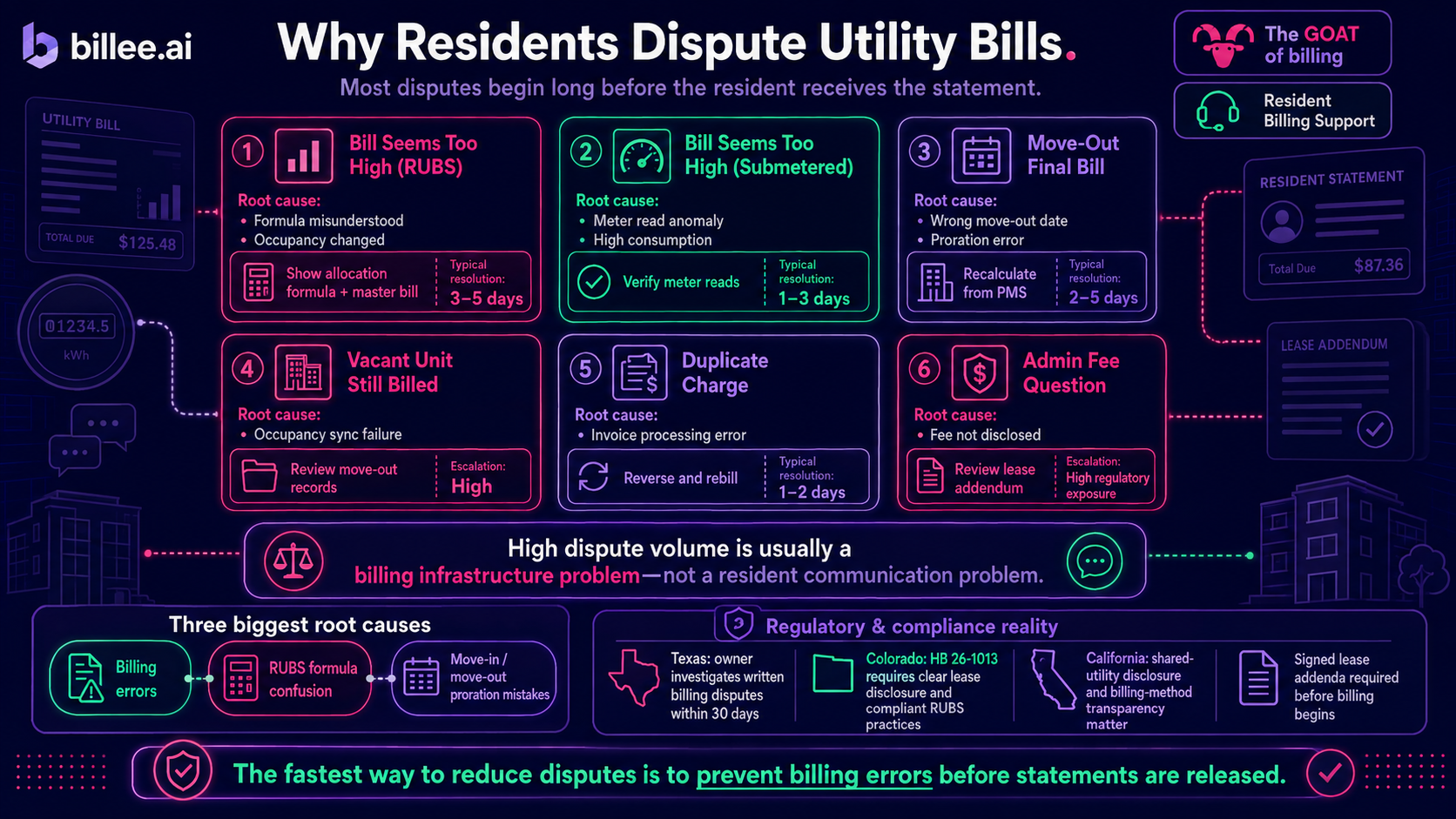
TL;DR: Most resident utility bill disputes in multifamily properties trace to three root causes: billing errors in invoice processing, allocation methodology the resident does not understand, and move-in or move-out proration mistakes. A documented dispute resolution process -- acknowledge within 24 hours, investigate within 30 days, resolve in writing -- prevents the majority from escalating. Submetered properties have a structural advantage: disputes can be resolved with documented meter reads. RUBS disputes require defending a formula, which is harder and increasingly subject to state regulatory scrutiny in 2026. High dispute volume at a property is a diagnostic signal: it means the billing infrastructure has a problem that transparency alone will not fix.
Key Takeaways
- Resident utility bill disputes most commonly originate from three causes: billing errors, RUBS methodology disputes, and move-out proration errors. Fixing the underlying infrastructure reduces dispute volume more than any communication strategy.
- Texas PUC Chapter 24 requires dispute investigations to be completed within 30 days. Texas residents also have the right to review the master bill and all submeter reads for the current month and the preceding 12 months.
- Colorado's HB26-1013 (signed March 26, 2026) confirms RUBS remains legal but adds four conditions: charges cannot exceed the utility provider's actual bill, no markups are permitted, common-area costs must be excluded, and the allocation method must be disclosed in the lease.
- California Assembly Bill 1248 (effective April 1, 2026) substantially restricts RUBS. Most RUBS arrangements are now prohibited in California, with narrow exceptions for water and sewer charges under specific conditions.
- Submetered billing generates an auditable consumption record -- opening and closing reads, read date, and consumption -- that resolves most disputes with documented evidence. RUBS disputes require defending a formula estimate, which is harder to resolve and more likely to escalate.
- High dispute volume is a lagging indicator of billing accuracy problems. Properties with well-configured billing platforms, clear resident statements, and accurate move-out prorations generate far fewer disputes than properties using manual processes.
At-a-Glance: Dispute Types and Resolution Paths
| Dispute Type | Root Cause | Resolution Tool | Time to Resolve | Escalation Risk |
|---|---|---|---|---|
| "My bill is too high" (RUBS) | Formula not explained; occupancy change | Provide formula breakdown + master bill | 3--5 days | Medium (if formula wrong) |
| "My bill is too high" (submetered) | Meter read error; high consumption | Pull meter reads; verify against prior cycle | 1--3 days | Low (data is auditable) |
| Move-out final bill dispute | Proration error; wrong move-out date | Verify PMS move-out date; recalculate | 2--5 days | Medium |
| Vacant unit billing after move-out | Resident billed after occupancy ended | Review PMS dates; issue credit if warranted | 1--3 days | High (legal risk) |
| Double charge / billing error | Invoice processing error | Reverse and reissue corrected bill | 1--2 days | Low if caught quickly |
| Administrative fee dispute | Fee not disclosed in lease | Review lease addendum; credit if undisclosed | 1--3 days | High (regulatory risk) |
Why Resident Utility Bill Disputes Happen
Disputes do not occur because residents are difficult. They occur because the resident received a charge they cannot verify or did not expect. That is a billing problem, not a communication problem -- and it starts well before the bill reaches the resident.
Billing Errors in Invoice Processing
The most common dispute trigger is a billing error: a charge that is simply wrong. The invoice from the utility provider was entered incorrectly. The billing period was applied to the wrong cycle. A unit that moved out last month is still being billed. The master bill total was transposed. None of these errors are intentional, but all of them produce a resident bill the resident cannot reconcile with their actual occupancy or usage.
Manual invoice processing is the primary source of billing errors. When utility invoices are entered by hand, transcription errors enter the system and propagate to every resident bill in that cycle. A single digit error in the master bill total distributes across all resident accounts proportionally -- every resident in the building receives a slightly wrong bill that cycle.
RUBS Methodology the Resident Does Not Understand
RUBS bills charge residents a formula-derived share of a master meter total. The resident's charge fluctuates cycle to cycle based on total property consumption, occupancy count, and any changes to the allocation base. A resident who moved in expecting a flat utility charge and received a RUBS bill 20% higher than the prior month has a legitimate question: why did my bill go up when I did not change my behavior?
The answer -- property-wide consumption increased, or the occupancy count changed, or the formula was reconfigured -- is factually accurate. But if the resident was not given a clear explanation of RUBS methodology at move-in, and if the bill statement does not show the formula and the master bill total, the resident has no way to verify the charge. That gap between charge and verifiability is where disputes begin.
Move-In and Move-Out Proration Errors
Final bills are the highest-risk billing moment in the resident lifecycle. The proration covers the period from the last full billing cycle through the resident's exact move-out date and must account for any deposits, credits, or prior unpaid balances. Errors in move-out date (pulled from a lease rather than the actual key return date), incorrect daily rate calculation, or failure to apply a deposit correctly produce a final bill the resident disputes.
Move-in proration errors are less common but create the same problem in reverse: a resident billed for a period before they occupied the unit has a valid dispute, and handling it poorly in the first weeks of a tenancy creates a poor impression of the property's billing operations.
The Legal Baseline -- What Your Bills Must Include
Required Disclosures on Every Statement
Regardless of whether a property uses RUBS or submetering, utility bills must meet minimum disclosure requirements. At minimum, every resident utility statement must show the billing period, the due date, the date charges become overdue, any applicable late fees, and the date those late fees may apply. The name, address, and contact information for the billing entity must also appear on every bill.
For submetered utilities specifically, the bill must include the present and last preceding submeter readings, the read date, and the amount of consumption for the period. A bill that shows only a dollar amount without the underlying meter data is not compliant with the disclosure requirements in most states that permit submetering.
For RUBS, the bill must show the allocation method and formula -- not just the total charge. Residents have the right to understand how their share of the master bill was calculated, and that calculation must appear on or with every statement.
Lease Addendum Requirements by Billing Method
The utility billing methodology must be disclosed in the lease or a lease addendum before the resident signs. The addendum should specify which utilities are billed back to residents, the billing method (RUBS or submetered) for each utility, the formula used for any RUBS allocation, any administrative or service fees charged for billing operations, and the dispute resolution process available to residents.
Undisclosed administrative fees are among the most legally exposed billing practices in multifamily. A property charging a $5 monthly billing service fee that is not clearly disclosed in the lease addendum faces a regulatory complaint risk that substantially exceeds the fee revenue. Several states explicitly cap or prohibit administrative fees; where they are permitted, disclosure in the lease is mandatory.
State-Specific Rules That Override General Practice
Utility billing regulations vary significantly by state, and 2026 brought notable changes in two large markets. Colorado's HB26-1013, signed March 26, 2026, confirms that RUBS is legal for existing multifamily properties but imposes four conditions: aggregate tenant charges cannot exceed the utility provider's actual bill, no markups are permitted, common-area costs must be excluded from the tenant allocation base, and the allocation method must be disclosed in the lease.
California Assembly Bill 1248, effective April 1, 2026, substantially restricts RUBS in California. Most RUBS arrangements are now prohibited, with narrow exceptions for water and sewer charges under specific conditions. California operators currently using RUBS for electric or gas should verify their compliance status with the new law.
Texas PUC Chapter 24 remains the most detailed state-specific framework for submetered and allocated utility billing. Chapter 24 requires that dispute investigations be completed within 30 days of the resident's notification. It also gives Texas residents the right to review the master bill and all submeter reads for the current month and the preceding 12 months -- a broad transparency right that operators must be prepared to honor.
The RUBS Dispute Vulnerability
RUBS disputes are structurally harder to defend than submetered disputes because the charge is a formula estimate, not a measured value. A resident who challenges a submetered charge can be shown documentary evidence: the opening read, the closing read, the date of each read, and the consumption calculation. That evidence resolves most disputes.
A resident who challenges a RUBS charge can be shown the formula -- but the formula is an estimate of their fair share, not a measurement of their actual usage. In jurisdictions where residents are aware of their rights, the argument that the formula is inherently arbitrary has traction. A resident who received a bill for 8% of the master meter total may reasonably ask why they are not allocated 6% or 10% -- and the answer ("because our formula uses square footage") is not as satisfying as a meter reading.
Building a Dispute Resolution Process That Scales
Step 1 -- Acknowledge and Log the Dispute Within 24 Hours
Every dispute should be acknowledged within 24 hours of receipt. The acknowledgment does not need to resolve the dispute -- it needs to confirm receipt, assign a case number or reference, and set an expectation for response timeline. Residents who escalate utility billing disputes to regulatory agencies or online reviews almost always cite lack of response as the triggering factor, not the original charge.
Logging every dispute in a centralized system is not optional for portfolios of meaningful scale. Without a log, dispute frequency is invisible, resolution time is untracked, and adjustment decisions are inconsistent. The log is also the evidence of your process if a dispute escalates to a regulatory inquiry.
Step 2 -- Investigate: Meter Reads, Formula, and Prior Bills
Investigation for submetered disputes starts with the meter reads: pull the opening and closing reads for the disputed period, verify the reads are consistent with the prior cycle, and check for any meter errors or anomalies. If the read is accurate, provide the documentation to the resident. If the read appears anomalous, escalate to a meter inspection.
Investigation for RUBS disputes starts with the formula configuration: verify the formula applied to this cycle matches the disclosed methodology, verify the master bill total was correct, verify the occupancy count used in the calculation was accurate for the billing period, and verify that common area costs were properly excluded from the allocation base. Formula errors -- especially occupancy count errors and common area deduction errors -- are the most common causes of RUBS over-billing.
Step 3 -- Approval Logic for Adjustments
Billing adjustments must have defined approval authority. A site manager should have authority to issue small credits (under a defined threshold) for clear errors without escalation. Regional managers and accounting should approve larger adjustments. All adjustments should be documented with the reason code and the approver.
Inconsistent adjustment decisions -- crediting one resident for a disputed charge while refusing the same credit to another resident with an identical dispute -- create legal exposure and resident relations problems. Documented approval logic ensures adjustments are consistent and defensible.
Step 4 -- Communicate the Resolution in Writing
All dispute resolutions should be communicated in writing, whether by email or written notice. The written resolution should state the dispute, summarize the investigation, identify whether a billing error was found, and specify any adjustment applied to the resident's account. If no error was found, the resolution should explain the evidence reviewed and the conclusion.
Written resolution documentation protects the property if the resident escalates to a regulatory agency. A property that can produce a written investigation summary and a documented resolution has a strong defense. A property that resolved the dispute verbally and kept no record has no defense.
Step 5 -- Track and Report Dispute Metrics
Dispute frequency by property is one of the most useful diagnostic metrics in utility billing operations. A property generating 15 resident disputes per billing cycle has a billing infrastructure problem. That problem may be an inaccurate RUBS formula, recurring meter read errors, move-out billing errors, or a billing statement that is confusing enough that residents routinely cannot reconcile their charges.
The metrics to track: total disputes per cycle, dispute rate as a percentage of total accounts billed, average resolution time, adjustment rate (percentage of disputes that result in an adjustment), and the distribution of dispute reasons. Patterns in dispute data identify the specific fix needed.
Submetering vs. RUBS -- How Billing Method Affects Dispute Outcomes
Submetered Data as Auditable Evidence
Submetered billing generates a consumption record for each billing period: opening read, closing read, read date, and calculated consumption. This record exists whether or not a dispute arises. When a resident disputes a submetered bill, the investigation starts with documented facts, not formula estimates.
Submetered records also support the right -- required under Texas PUC Chapter 24 and similar frameworks in other states -- for residents to inspect 12 months of meter read history. A property with clean submetered records can honor that right immediately. A property using RUBS has no equivalent data to produce.
Why RUBS Disputes Are Harder to Defend
RUBS disputes require the property to defend a methodology decision rather than a measurement. The resident is not questioning whether the meter read was accurate -- they are questioning whether the formula is fair. In states with RUBS restrictions (California, and increasingly others), this vulnerability is compounded by regulatory exposure if the methodology is even slightly out of compliance.
The practical implication: properties using RUBS should invest in exceptionally clear bill design that explains the formula in plain language, and should have their RUBS methodology reviewed against current state regulations before a dispute forces the issue.
Documentation That Protects You in Either Case
Regardless of billing method, three documents protect a property in any utility billing dispute: the signed lease addendum disclosing the billing methodology, the resident bill for the disputed period, and the investigation record documenting what was reviewed and what was found. With these three documents, virtually any legitimate dispute can be resolved. Without them, even accurate charges are difficult to defend.
Reducing Disputes at the Source
Transparent Bill Design -- What Residents Need to See
A utility bill that prevents disputes shows the resident four things: the total master bill for the property, the allocation method used to calculate the resident's share, the calculation itself (formula or meter reads), and the resulting dollar amount. A bill that shows only the final dollar amount is a dispute waiting to happen.
Clear bill design is not a design question -- it is a data availability question. Residents can only see what the billing platform puts on the statement. Properties whose billing platforms produce opaque statements that omit formula detail or master bill totals should treat that as a platform deficiency, not a communication challenge.
Resident Education at Move-In
The move-in orientation is the right time to explain utility billing methodology. Residents who understand at move-in that their water bill is RUBS-allocated and will fluctuate with property-wide consumption are less likely to dispute a higher-than-expected bill in month three. Residents who receive a RUBS bill in month three with no prior explanation have a legitimate grievance about transparency.
Move-in education should cover the utility billing method for each utility (RUBS or submetered), what the bill will look like, how to read the statement, what the billing cycle dates are, and how to contact the billing team with questions or disputes. This information should also be in the resident welcome packet and available on the resident portal.
Catching Errors Before Bills Go Out
The best dispute resolution strategy is catching billing errors before the bill reaches the resident. This requires a preliminary review step in the billing cycle -- comparing the sum of all resident bills to the master meter total, flagging any unit-level anomalies (a bill double the prior cycle, a unit with zero consumption), and reviewing move-out prorations before they are finalized.
Properties with a dedicated billing team that reviews each cycle before release catch the majority of errors at this stage. Properties where billing is run by on-site staff who also manage leasing, maintenance, and resident relations catch far fewer errors before release -- and handle far more disputes after.
How Billing Infrastructure Determines Dispute Volume (Billee)
What High Dispute Volume Signals About Your Billing Operations
High dispute volume is not a resident relations problem. It is a billing accuracy problem that manifests in resident relations. Properties generating more than 2--3% of billed accounts as disputes per cycle have a systemic billing issue: an error-prone process, an opaque statement format, a RUBS formula that is misconfigured, or move-out billing that consistently requires adjustment.
Treating high dispute volume with communication training rather than billing process improvement addresses the symptom rather than the cause. The right diagnostic question is: what percentage of disputes result in a billing adjustment? If that percentage is high, billing errors are real and frequent. If it is low but dispute volume is still high, the billing methodology or statement clarity needs improvement.
How Billee's Platform and Team Reduce Dispute Root Causes
Billee's Billing and Recovery Engine runs a preliminary billing report before every cycle closes, allowing both the Billee team and the property manager to review charges before they reach resident accounts. Anomalies -- a unit billed double the prior cycle, a move-out unit still carrying a balance, a master bill total inconsistent with the prior month -- are flagged for investigation before the billing cycle locks.
Billee maintains a dedicated resident support line (phone: (214) 983-8060; email: residentsupport@billee.ai) staffed 9 am -- 5 pm CST, Monday--Friday. When a resident contacts the property with a billing dispute, having a direct resident support contact at the billing provider substantially reduces the burden on on-site staff and ensures disputes are handled by team members with access to the full billing record.
Billee's service level agreement covers final bill issue review within 1--2 business days -- the billing window where move-out disputes are most time-sensitive and most likely to affect security deposit processing.
The Link Between Dispute Rate and Recovery Rate
High dispute volume and low recovery rate frequently appear together because they share the same root cause: billing errors and process gaps. A cycle where 10% of accounts contain errors will produce both a high dispute rate (residents catching the errors) and a reduced recovery rate (errors that were not caught reduce the billed total). Fixing the underlying billing process improves both metrics simultaneously.
If your property is generating high dispute volume or operating with a recovery rate below 80%, the billing infrastructure is the right place to start. The Billee team can audit your billing setup and identify the specific gaps -- across RUBS formula configuration, statement design, move-out process, and cycle review procedures.
Frequently Asked Questions
Can a resident refuse to pay a utility bill they dispute?
A resident who disputes a utility bill should not simply withhold payment without following the property's dispute resolution process. In most states, residents are expected to pay the undisputed portion of the bill while the dispute is under investigation. Withholding full payment can result in late fees and delinquency charges. Operators should not shut off utilities during a pending dispute investigation -- this creates significant legal exposure.
What must a multifamily utility bill include by law?
At minimum: billing period, due date, date charges become overdue, applicable late fees, and the name and contact information for the billing entity. Submetered bills must include opening and closing meter reads, read date, and consumption amount. RUBS bills must disclose the allocation formula and the master bill total. Requirements vary by state -- California, Texas, Colorado, and New York have specific utility billing disclosure rules that go beyond the federal minimum.
How long do I have to respond to a resident billing dispute?
Texas PUC Chapter 24 requires dispute investigations to be completed within 30 days. Other state frameworks set different timelines. As a practical matter, an acknowledgment within 24 hours and a resolution within 5--10 business days for standard disputes prevents escalation to regulatory agencies in virtually every jurisdiction.
Is RUBS billing legally challengeable by residents?
Yes, and the regulatory landscape is tightening. California Assembly Bill 1248 (effective April 1, 2026) prohibits most RUBS arrangements in California. Colorado's HB26-1013 (March 2026) permits RUBS but under four specific conditions. Texas and Florida have regulatory frameworks governing RUBS disclosure and methodology. A resident who believes their RUBS billing violates applicable state rules can file a complaint with the state PUC or attorney general's office.
What documentation do I need for a utility billing dispute?
Three documents cover virtually every scenario: the signed lease addendum disclosing the billing methodology, the utility bill for the disputed period, and a written investigation record documenting what was reviewed and what was found. For submetered disputes, add the meter read history for the disputed period and the preceding cycle.
What happens if I do not resolve a billing dispute?
Unresolved disputes escalate. Common escalation paths include complaints to the state Public Utility Commission, complaints to the attorney general's consumer protection office, negative reviews affecting leasing, and -- in cases involving regulatory violations -- formal investigations and potential fines. Most disputes that reach regulatory agencies could have been resolved with a prompt investigation and a written response.
Can I charge late fees on a disputed utility bill?
Practice varies by state. In most jurisdictions, it is inadvisable to charge late fees on a disputed amount while the investigation is pending -- this is viewed as coercive and can itself trigger a regulatory complaint. The standard approach is to hold late fee application for the disputed amount until the investigation is complete and the resolution is communicated in writing.
How do I reduce utility billing disputes at my property?
The most effective interventions are operational, not communicational: accurate RUBS formula configuration updated every time the unit mix or occupancy basis changes, clean move-out proration processes that pull the actual key-return date from the PMS, a preliminary billing review before each cycle closes, and resident statements that show the formula and master bill total in plain language. Properties that address these root causes see dispute volume fall significantly within two to three billing cycles.
Sources
- Anchorutility.com. "Navigating Utility Billing Regulations: A Guide for Multifamily Operators." Accessed July 2026. https://anchorutility.com/navigating-utility-billing-regulations/
- Anchorutility.com. "2026 Utility Management Trends in Multifamily." Accessed July 2026. https://anchorutility.com/2026-utility-management-trends-in-multifamily/
- Banyan Utility. "Navigating Utility Billing Regulations: A Guide for Multifamily Operators." Accessed July 2026. https://banyanutility.com/navigating-utility-billing-regulations/
- DocDraft. "How to Dispute a Bill in the United States." Accessed July 2026. https://www.docdraft.ai/legal-guides/disputing-a-bill
- Entrata. "2026 Legislative Roundup: New Fee, Utility Billing, and Tenant Protection Laws Property Managers Should Know." Accessed July 2026. https://www.entrata.com/blog/2026-legislative-roundup-new-fee-utility-billing-and-tenant-protection-laws-property-managers-should-know
- Holland & Knight. "Existing Colorado Multifamily Housing Developments Can Continue Using RUBS Under New Law." April 2026. https://www.hklaw.com/en/insights/publications/2026/04/existing-colorado-multifamily-housing-developments-can-continue
- MangoApps. "Utility Billing Dispute Resolution Form Template." Accessed July 2026. https://www.mangoapps.com/templates/forms/utility-billing-dispute-resolution-form-2
- MuniBilling. "Streamlining RUBS with Utility Bill Data Processing." Accessed July 2026. https://blog.munibilling.com/blog/streamlining-rubs-with-utility-bill-data-processing
- National Tenant Services Authority. "Utility Billing in Rental Housing: Tenant Rights and RUBS Explained." Accessed July 2026. https://nationaltenantservicesauthority.com/utility-billing-tenant-rights
- PestShare. "Guide to Fixing Multifamily Utility Billing Framework." Accessed July 2026. https://www.pestshare.com/multifamily-utility-billing/
- Texas PUC. "Chapter 24: Substantive Rules Applicable to Water and Sewer Service." Accessed July 2026. https://ftp.puc.texas.gov/public/puct-info/agency/rulesnlaws/subrules/water/subchi/24.283/24.283.pdf
- Texas PUC. "Tenant Guide to Allocated Service." Accessed July 2026. https://ftp.puc.texas.gov/public/puct-info/consumer/facts/factsheets/waterfacts/TenantGuideAllocatedService.pdf
- Think Utility Services. "Mastering Utility Billing Compliance: A Guide for Multifamily Operators." Accessed July 2026. https://thinkutilityservices.com/mastering-utility-billing-compliance-a-guide-for-multifamily-operators/
- UBWest. "Utility Billing Best Practices for New Property Managers." Accessed July 2026. https://www.ubwest.com/multifamily-utility-billing/utility-billing-best-practices-for-new-property-managers/
Insights and Industry Trends


Explore more insights