
How Often Should Submeters Be Calibrated? A Multifamily Operator's Guide
Knowing what calibration means and knowing how often to do it are two different problems. This guide assumes the first is settled and focuses on the second: how to set a testing interval for your own portfolio rather than guessing, or applying one fixed calendar to every meter regardless of type, age, or history.
Key Takeaways
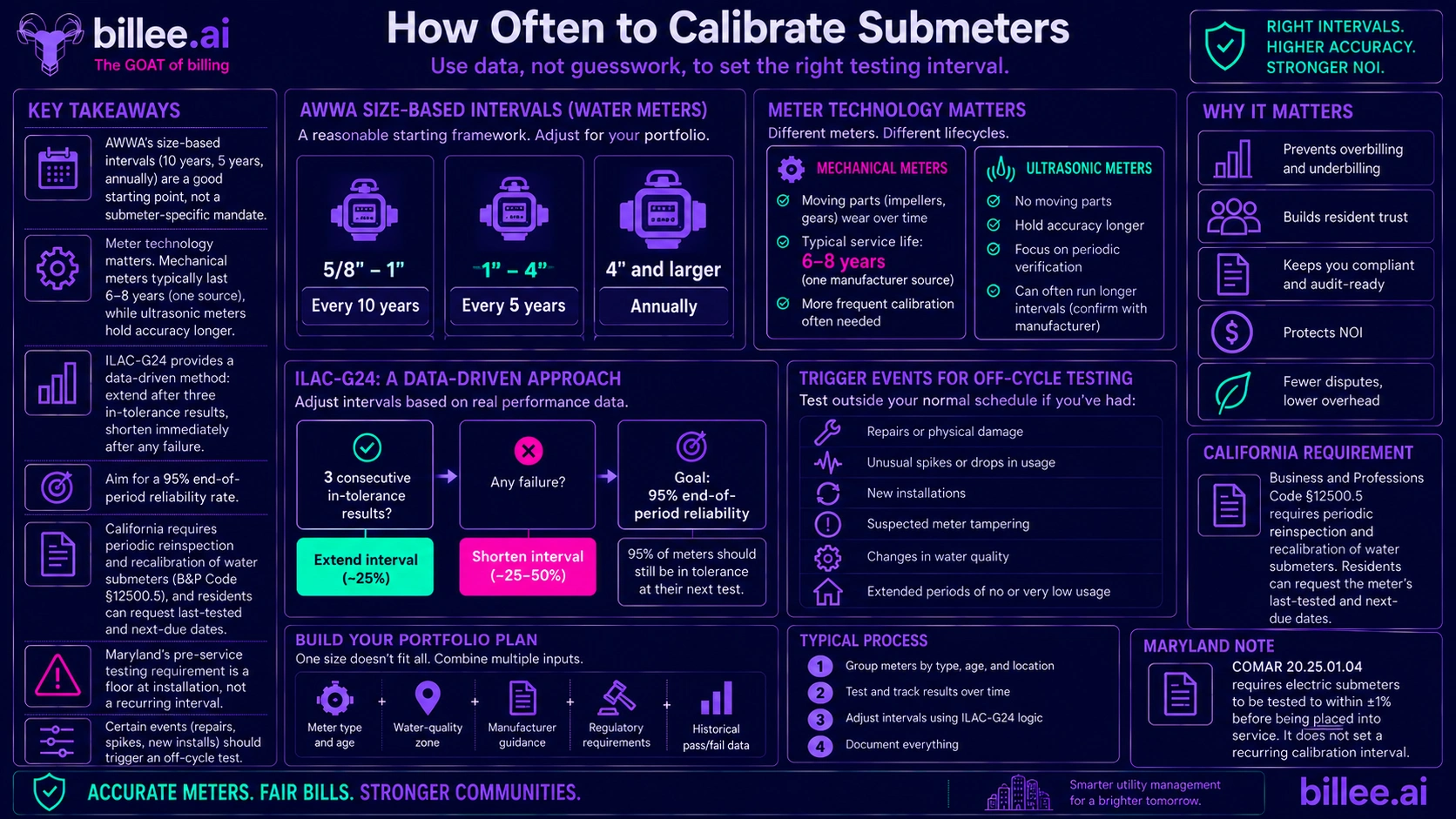
- AWWA's size-based intervals (every 10 years for 5/8-inch to 1-inch water meters, every 5 years for 1-inch to 4-inch meters, annually for 4 inches and larger) are a reasonable starting framework, not a submetering-specific mandate.
- Meter technology changes the right cadence. Mechanical meters wear as impellers and gears degrade, with a typical service life around 6 to 8 years per one manufacturer source, while ultrasonic and other no-moving-parts meters hold accuracy longer, shifting the question from when to recalibrate toward when to simply verify.
- A widely used methodology called ILAC-G24 offers a genuinely data-driven way to set an interval instead of guessing: extend the interval after three consecutive in-tolerance results, cut it immediately after any failure.
- The industry benchmark for judging whether an interval is set correctly is a 95% end-of-period reliability rate, meaning 95% of meters should still be in tolerance when they come up for their scheduled test.
- California requires periodic reinspection and recalibration of water submeters under Business and Professions Code Section 12500.5, including a resident right to request the meter's last-tested and next-due dates. That is a distinct requirement from the billing-methodology rules most often discussed for the state.
- Maryland's pre-service testing requirement, covered in this cluster's companion piece on what calibration means, is a floor at installation. It says nothing about how often a meter should be tested afterward.
- Several trigger events should force an off-cycle test regardless of where a meter sits in its normal schedule.
Why "How Often" Doesn't Have One Universal Answer
Start with AWWA's size-based framework, then adjust
AWWA recommends utility-owned water meters be tested every 10 years for 5/8-inch to 1-inch meters, every 5 years for 1-inch to 4-inch meters, and annually for meters 4 inches and larger. That framework, covered in more depth alongside the accuracy standards themselves in Billee's companion piece on submeter calibration, is a reasonable starting point even for submeters. It was written for utility mains meters, not apartment submeters specifically, which is exactly why it needs adjustment rather than blind application.
Meter technology changes the calculus
Mechanical water meters, the kind with impellers or gears that physically move with flow, wear down over time. One meter manufacturer puts typical mechanical meter service life at roughly 6 to 8 years before replacement becomes more sensible than continued recalibration, though that figure comes from a single manufacturer source rather than an independent standard and should be treated as directional. Ultrasonic meters work differently: they measure flow using sound waves rather than moving parts, so they have nothing mechanical to wear out. That does not mean ultrasonic meters never need attention, but it does mean the operative question shifts from "when will this wear out" to "when should we verify it's still reading correctly."
Three sources of a "recommended interval" rarely agree
A manufacturer's suggested calibration interval, a regulatory floor like Maryland's pre-service requirement, and an industry practitioner benchmark like the "test a third of your submeters annually" guidance are three different things that often do not point to the same number. None of them is wrong. They answer different questions: what the hardware can tolerate, what the law requires at minimum, and what a working program has found practical. Reconciling the three, not picking one, is the actual job.
A Data-Driven Way to Set Your Own Interval
The metrology field has a formal methodology for this problem called ILAC-G24, built around adjusting calibration intervals based on real performance data rather than a fixed calendar. Translated into multifamily terms, it works like this: group your meters by type, age, and water-quality zone rather than treating the whole portfolio as one population. Track whether each group's meters pass or fail their tests over several testing cycles.
If a group of meters comes back in tolerance three testing cycles in a row, extend that group's interval, typically by something like 25%. If any meter in a group fails, shorten the interval for that group immediately, often by 25 to 50%, rather than waiting for the next scheduled review. The target most calibration programs aim for is a 95% end-of-period reliability rate: 95% of meters in a group should still be within tolerance when they come up for their next scheduled test. A group falling below that threshold means the interval for that group is too long.
This matters more than it might sound like it does. A property with older mechanical meters in a hard-water zone and a property with newer ultrasonic meters in a low-mineral-content zone have no business being tested on the same calendar. Letting pass and fail data drive the interval, group by group, is what actually closes that gap instead of over-testing one population and under-testing the other.
State Rules Can Set a Ceiling Independent of Best Practice
Maryland's floor, briefly recapped
Maryland's COMAR 20.25.01.04 requires electric submeters to be tested and adjusted to within plus or minus 1% before being placed into service. That requirement is about the moment a meter enters service, not an ongoing testing cadence, which is why it sets a floor rather than answering the "how often" question this guide is built around.
California's periodic recalibration requirement
California takes a different approach for water submeters. State law requires submeters to be inspected, tested, and verified before installation, and then reinspected and recalibrated within time limits set by regulation. Residents have the right to request, in writing, the date a submeter was last tested and the date by which it must be tested again. This is a genuinely different kind of requirement than the billing-methodology and disclosure rules most commonly discussed for California's submetering law, and it means a California operator cannot simply adopt a generic AWWA-based interval without checking whether state law sets a shorter one.
This guide is not attempting a full state-by-state accounting of testing-frequency laws. Maryland and California are used here as two concrete, verified examples that state law can set an ongoing testing requirement independent of AWWA guidance or manufacturer recommendations, not as a complete list of which states do this.
Off-Cycle Testing Triggers
A calendar-based interval, however well set, is not the only thing that should trigger a test. Certain events should force an off-cycle test regardless of where a meter sits in its normal schedule: acquiring a property with unfamiliar or undocumented meter history, any renovation or plumbing and electrical work that touches the meter or its surrounding infrastructure, a consumption anomaly flagged by real-time monitoring software, a resident billing dispute that calls a specific meter's accuracy into question, and a mechanical meter approaching its expected service life even without any red flag having appeared yet.
Building a Cadence: Starting Points by Meter Type
| Meter Type / Technology | Stability Profile | Regulatory or Manufacturer Starting Point | When to Test Off-Cycle |
|---|---|---|---|
| Mechanical water (displacement, turbine, compound) | Wears with use; ~6-8 year typical service life per manufacturer guidance | AWWA size-based intervals (10/5/1 year) | Approaching expected service life; unexplained under-registration |
| Ultrasonic water | No moving parts; stable long-term accuracy | Manufacturer verification schedule rather than a wear-based interval | Consumption anomaly; post-installation verification |
| Electric | Subject to voltage loss, phasing errors, battery depletion | ANSI C12.20 classes; Maryland requires ±1% pre-service testing | Post-renovation electrical work; monitoring-flagged anomaly |
| Gas (diaphragm) | Less publicly documented drift profile | Manufacturer guidance is the primary reference point | Any suspected inaccuracy, given thinner standardization |
Best Practices for Building a Portfolio-Wide Calibration Calendar
Group meters by type, age, and risk, not as one population
A single fixed calendar applied across every meter type and vintage in a portfolio will over-test some meters and under-test others. Segmenting by technology, age, and water quality or usage intensity is what makes a testing budget actually efficient.
Let pass and fail data adjust the interval
The staircase approach described above is not a theoretical exercise. Applied consistently, it turns a calibration program from a fixed cost into something that gets more efficient over time as good-performing meter groups earn longer intervals and struggling groups get caught sooner.
Budget for replacement, not just recalibration
As a mechanical meter approaches its expected service life, the right decision is often replacement rather than another recalibration cycle. Building that transition into a capital plan, rather than reacting to a failed test, keeps the calendar from turning into a string of emergency repairs.
What to Look for in a Calibration Partner
- A documented, data-adjusted testing interval rather than a single fixed calendar applied to the whole portfolio
- The ability to segment a portfolio by meter type, age, and risk rather than treating every meter the same way
- Awareness of state-specific testing requirements beyond the most commonly cited ones, since a generic interval can fall short of what state law actually requires
- A defined process for off-cycle testing triggers, not just a scheduled one
How Billee Supports Calibration Scheduling
For the fundamentals of what calibration means and how accuracy standards differ by meter type, see Billee's companion piece, What Is Submeter Calibration and Why It Matters for Billing Accuracy. Billee's Meter Monitoring & Proactive Alerts is what catches the off-cycle triggers described above in real time, flagging a consumption anomaly before it becomes a resident-facing billing problem.
The actual scheduling and dispatch against a data-adjusted calendar runs through Billee's Hardware & Maintenance Services, which builds calibration cadence around meter type and portfolio-specific performance data rather than a single calendar applied everywhere.
FAQ
How often should water submeters be tested? AWWA recommends utility-owned meters be tested every 10 years for 5/8-inch to 1-inch meters, every 5 years for 1-inch to 4-inch meters, and annually for meters 4 inches and larger. Submeters should follow manufacturer guidance, adjusted using actual pass/fail performance data rather than applied as a fixed rule.
How often should electric submeters be tested? There is no single universal number. Maryland requires electric submeters to be tested to within plus or minus 1% before being placed into service, but that is a one-time pre-service requirement, not an ongoing cadence. Most programs set an ongoing interval based on manufacturer guidance and adjust it using real performance data.
Do ultrasonic meters need calibration as often as mechanical meters? Generally no. Ultrasonic meters have no moving parts to wear out, so they tend to hold their accuracy longer than mechanical meters, which degrade as impellers and gears wear. The right question for ultrasonic meters shifts from wear-based recalibration to periodic verification.
What is the ILAC-G24 staircase method, in plain terms? It is a way to adjust a calibration interval based on real results instead of guessing. If a meter or group of meters passes its test three times in a row, the interval gets extended. If any test fails, the interval gets shortened immediately.
Does California require periodic submeter recalibration? Yes. California requires water submeters to be periodically reinspected and recalibrated under state law, and residents have the right to request the dates a submeter was last tested and is next due. This is separate from the billing-methodology and disclosure rules most often discussed for California.
What events should trigger an off-cycle test? Acquiring a property with undocumented meter history, renovation work touching the meter, a monitoring-flagged consumption anomaly, a resident billing dispute, and a mechanical meter approaching its expected service life.
How long do mechanical water meters typically last before replacement? Roughly 6 to 8 years, according to one meter manufacturer's guidance, though this figure is not drawn from an independent industry standard and should be treated as directional rather than a hard rule.
Is a regulatory minimum the same thing as a safe testing interval? No. A regulatory requirement like Maryland's pre-service test or California's periodic recalibration sets a legal floor, not necessarily the optimal interval for a specific meter's actual performance. Data-driven adjustment on top of that floor is what closes the gap.
A calibration calendar built on real performance data catches drift earlier than a fixed schedule ever will. Talk to Billee about building a metering hardware and calibration program tailored to your portfolio's meter types and history.
Sources
- U.S. EPA, "WaterSense at Work, Section 2.1: Metering and Submetering"
- TechMaster, "How to Set Calibration Intervals: ILAC-G24 Methods That Survive Audits"
- BMAG Meter, "The Ultimate Guide to Ultrasonic Water Meters"
- California Apartment Association, "California Water Submeter Requirements for Multi-Family Properties"
- Utilivisor, "Why and How to Calibrate Your Electric Submeter"
- Cornell Law School, Legal Information Institute, "Md. Code Regs. 20.25.01.04: Electric Submetering"
Insights and Industry Trends