

The Utility Fee Most Multifamily Operators Forget to Charge
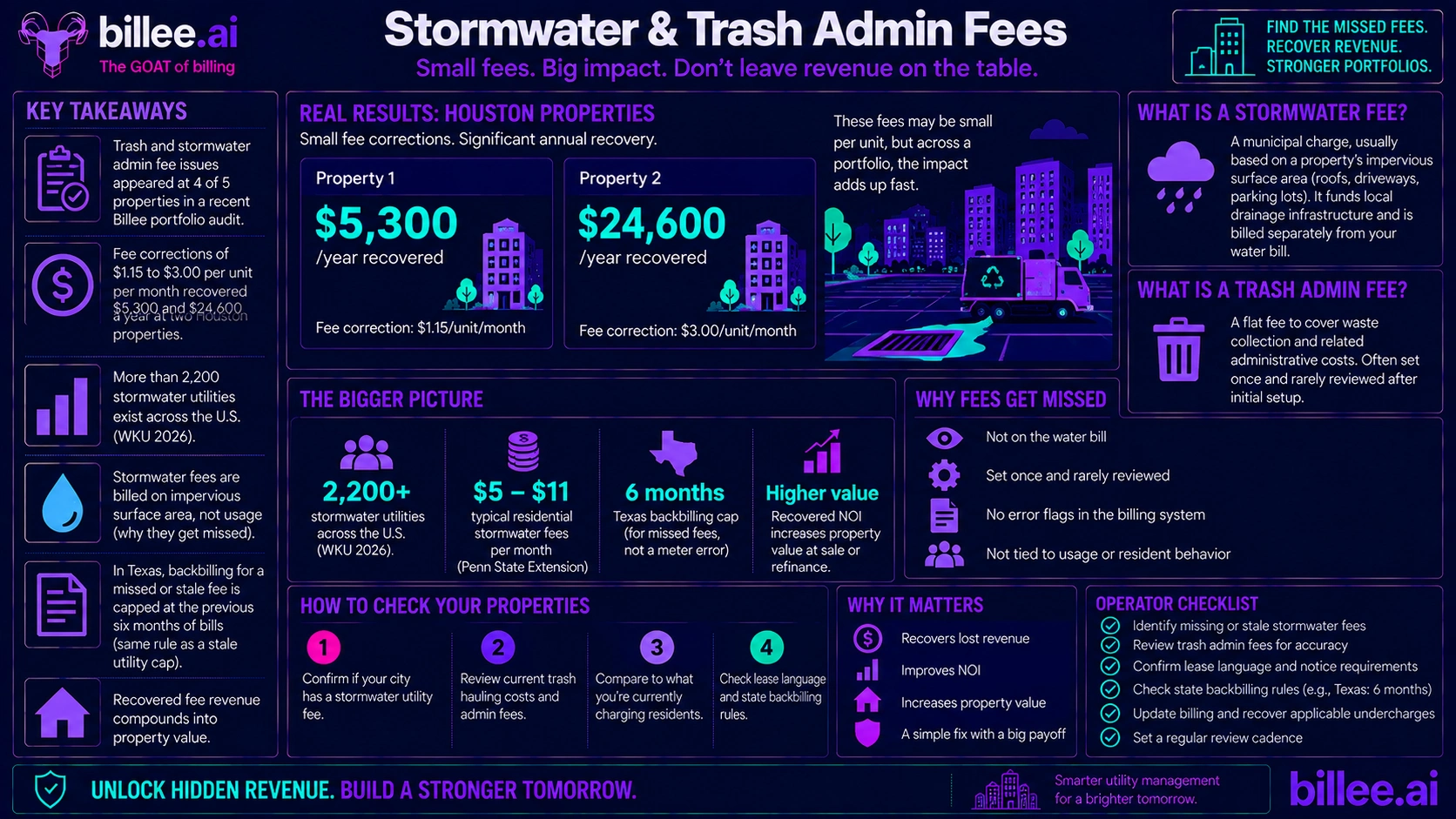
Stormwater and trash admin fees were the single most common issue in a recent Billee portfolio audit, showing up at four of five properties reviewed, more often than broken meters or a stale utility cap. At two Houston properties where fee corrections were the entire fix, no broken meters, no cap, correcting trash and stormwater admin fees as small as $1.15 to $3.00 per unit per month recovered $5,300 and $24,600 a year. These are not dramatic numbers property by property. Multiplied across a portfolio, they are the kind of gap that hides in plain sight for years.
Quick answer
A stormwater admin fee is a municipal charge, usually billed on a property's impervious surface area rather than water usage, that funds local drainage infrastructure. Because it is assessed separately from the water and sewer bill and does not move with metered consumption, it does not get caught by the same review that typically checks usage-based billing. A fee that was never added, or one added years ago and never revisited, quietly becomes lost recovery that nothing in a normal billing workflow flags on its own.
Key takeaways
- Trash and stormwater admin fee issues appeared at four of five properties in a recent Billee portfolio audit, more often than any other issue type.
- Fee corrections of $1.15 to $3.00 per unit per month recovered $5,300 and $24,600 a year at two Houston properties where fees were the only issue found.
- More than 2,200 stormwater utilities have been enacted across the United States, per the Western Kentucky University Stormwater Utility Survey 2026.
- Stormwater fees are billed on impervious surface area, not usage, which is exactly why they sit outside the normal water-bill review cycle.
- For comparison, residential stormwater fees commonly run $5 to $11 a month in markets that have been studied closely, per Penn State Extension, suggesting even corrected fees can still be conservative.
- In Texas, backbilling a resident for a missed or stale fee, which is not a meter error, is capped at the previous six months of bills, the same rule that limits recovery on a stale utility cap.
- Recovered fee revenue compounds into property value the same way any other corrected NOI does.
Why this matters for multifamily operators
A stormwater fee is not part of the water bill. It is a separate municipal charge, assessed on a property's impervious surface, roofs, driveways, parking lots, and it is typically invoiced to the property owner directly rather than flowing through the same channel as metered water and sewer usage. That distinction matters operationally: a team that carefully reviews metered utility bills for accuracy can still miss a stormwater fee entirely, because it was never part of that review in the first place.
Trash admin fees have a similar blind spot. They are often set once, at a flat dollar amount, and then left alone the same way a utility cap gets left alone, reviewed rarely if ever after the initial setup.
That is exactly the pattern a recent Billee audit of a 36-property, roughly 10,000-unit Texas portfolio found. Trash and stormwater fee issues turned up at four of the five properties audited in that pass, more properties than had broken meters. At two of those properties, correcting the fees was the entire fix required, and it still recovered five figures a year each.
What a stormwater fee actually is, and why it gets missed
Stormwater fees exist because developed land changes how rain moves. Roofs, driveways, and parking lots prevent water from soaking into the ground, creating runoff that a municipality has to manage through pipes, detention ponds, and street sweeping, infrastructure that costs money to maintain. Many municipalities fund that maintenance through a dedicated stormwater utility fee rather than folding it into the general water bill, a structure the Clean Water Act's MS4 permit program has pushed many cities toward over the past several decades.
More than 2,200 of these utilities now exist nationally, and the number has been rising for years. Because the fee is based on a property's impervious surface area rather than metered consumption, it does not appear on the same bill as water usage, is not triggered by any change in resident behavior, and does not move when usage does. A property team reviewing utility bills for unusual consumption patterns has no reason to notice a stormwater line item that was never added, or one that has not changed in years, because nothing about it looks like a billing error in the way a usage spike does.
Trash admin fees miss for a related but simpler reason: they are usually a flat number set once at lease-up or acquisition, with no mechanism that prompts anyone to check whether it still reflects the actual hauling cost.
How to tell if you're missing one
A few checks are worth running property by property:
- Confirm whether the municipality charges a stormwater utility fee at all, and if so, what the current rate is.
- Compare that current rate against what, if anything, is being billed to residents for it.
- Check whether the trash admin fee has changed since it was first set, and against what the hauler currently charges.
- Look for properties where one fee is billed correctly but a related fee, trash or stormwater, is entirely absent, a pattern that shows up often once one gap is found.
| Property (Houston, TX) | Issue found | Fee correction | Annual recovery |
|---|---|---|---|
| Example B | Incorrect trash fee, missing stormwater fee | Trash $2.95 to $3.00; added $1.15 stormwater | $5,300/year |
| Example C | Incorrect trash fee, missing stormwater fee | Trash $1.15 to $3.00; phased in $3.00 stormwater | $24,600/year |
How to calculate the portfolio-wide exposure
- Start with the per-unit monthly gap. Even $1 to $3 a month per unit is the right order of magnitude based on the case examples above.
- Multiply by the number of units at the property. A 300-unit property with a $2 monthly gap is already $7,200 a year on that one line item.
- Multiply again across every property in the portfolio with the same or a similar gap, since the case study above found the same pattern at four out of five properties checked, not just one.
- Compare the resulting number against the cost of running the audit. A gap this size, multiplied across a portfolio, tends to dwarf the cost of finding it.
How to add or correct a fee without breaching existing leases
Whether a new or corrected fee can be passed through to residents depends on what the existing lease already allows. The broader the operating-expense or utility pass-through language in the lease, the more likely a fee correction fits within it; a narrower lease may require the change to wait for renewal.
That is exactly the pattern in the case study above: at properties where a fee needed to be added rather than simply corrected, the new charge was phased in with lease renewals rather than applied mid-term. Reviewing the lease language first, rather than assuming a fee can be added immediately, avoids turning a legitimate correction into a resident dispute.
How much you can actually recover, and why timing matters
The annual figures above are the value of correcting the fee going forward, not necessarily the size of a one-time recovery for years the fee was missing. In Texas, backbilling a resident for a missed or stale fee, which is not a meter error, is capped at the previous six months of bills, the same rule that limits recovery on a stale utility cap. A trash or stormwater fee that has been missing for years is not going to yield years of backdated recovery. It yields, at most, a few months of catch-up plus the full corrected rate every year after that.
That corrected rate, recurring every year, is still the real prize. It is just a different number than the total years of history the fee was missing, and it is worth being precise about which one a portfolio is actually counting on.
What a corrected fee is worth beyond the monthly bill
Correcting a missing or stale fee raises NOI permanently, and NOI is the number buyers and lenders use to price the property. Applying a hypothetical 6% cap rate, a common reference point for stabilized multifamily assets, to the $24,600 recovered annually at the larger of the two fee-only examples above works out to roughly $410,000 in added property value. Cap rates vary by market and asset condition, so this is illustrative rather than a guaranteed appraisal outcome, but it shows why a fee this small is still worth finding: a corrected line item that looks minor on a monthly statement is worth a multiple of itself the moment the property is valued.
Common mistakes
- Reviewing usage-based utility bills without checking for stormwater fees separately. Because a stormwater fee does not move with metered consumption, a usage-focused billing review will not catch one that is missing or stale.
- Treating a corrected fee as fully retroactive. Backbilling limits mean the corrected go-forward rate, not a multi-year lump sum, is usually the realistic recovery.
- Assuming a fee that is billed correctly at one property is billed correctly everywhere. The case study above found the same fee gap at four different properties, not just one.
- Adding or raising a fee mid-lease without checking the lease's pass-through language first. A narrow operating-expense clause can turn a legitimate correction into a dispute if it is applied before renewal.
- Not tracking trash and stormwater fees as their own line items in the portfolio system. When they are lumped in with general utility charges, a missing one does not surface on its own.
- Assuming a small per-unit gap is not worth chasing. A $1 to $3 monthly gap multiplied across a few hundred units, and then across a portfolio, is exactly how a $5,300 or $24,600 annual recovery gets left on the table.
When to handle this in-house vs. bring in a partner
One property with one suspected fee gap is manageable in-house: confirm the municipality's current stormwater rate, check the trash hauler's current charge, compare both against what residents are actually billed, and correct at renewal if the lease requires it.
Checking every property in a portfolio for the same gap, and confirming which fee type is missing where, is the harder, ongoing problem. That is a systematic review across every property and every municipality's current rate, not a one-time check, since a fee correct today can still go stale again in a few years the same way a utility cap does.
How Billee can help
Billee's Regulatory & Compliance service audits trash and stormwater admin fees against current municipal rates and hauler contracts, property by property, and checks the backbilling rules that apply before promising a recovery number that is not actually collectible. It's how the $5,300 and $24,600 recoveries above surfaced, two fixes among $220,500 recovered across five properties in a single pass of a 36-property Texas portfolio.
Billee's account team then tracks each corrected fee on the portfolio dashboard, so a fee that is right today does not quietly go stale again the way the ones in this audit did.
FAQ
What is a stormwater admin fee?
A municipal charge, usually based on a property's impervious surface area rather than water usage, that funds local drainage infrastructure like pipes and detention ponds.
Why do stormwater fees get missed so often?
They are billed separately from the water and sewer bill and do not move with metered consumption, so a usage-focused billing review has no reason to catch one that is missing or stale.
How much revenue can a missing stormwater or trash fee cost a property?
It depends on the size of the gap and the property's unit count. In one audited case, correcting fees of $1.15 to $3.00 per unit per month recovered $5,300 and $24,600 a year at two properties.
Can I add a stormwater fee to an existing lease?
It depends on the lease's pass-through language. A broad operating-expense clause may already allow it; a narrower lease typically requires phasing the fee in at renewal.
Can I bill residents for the years a fee was missing?
Usually not in full. In Texas, for example, backbilling for this kind of undercharge is capped at the previous six months of bills, so the corrected go-forward rate is typically the realistic recovery.
Is a stormwater fee the same as a utility cap or RUBS charge?
No. A stormwater fee is a separate municipal charge tied to impervious surface area. A utility cap and RUBS are both ways of billing metered utility usage, which is a different category of charge entirely.
How common are stormwater utility fees?
More than 2,200 have been enacted across U.S. municipalities, and the total has been growing for years, per the Western Kentucky University Stormwater Utility Survey.
Does correcting a fee like this affect property value?
Yes. A corrected fee raises recurring NOI, and NOI drives the property's valuation at sale or refinance, the same relationship that applies to any other corrected billing line item.
How does Billee catch fee gaps like this?
Billee's Regulatory & Compliance service audits trash and stormwater admin fees against current municipal and hauler rates, property by property, the same process that surfaced the fee gaps in Billee's RET LP portfolio audit.
Related reading
- When a Legacy Utility Cap Is Quietly Costing Your Portfolio $100K a Year: another fee that goes stale the same way, from the same portfolio audit.
- The Real Return on Replacing a Broken Submeter: a companion piece on another silent billing gap.
- Top Multifamily Utility Management Mistakes: other recurring errors that quietly cost NOI.
- Catching Billing Errors Before They Post: how routine audits catch issues before they compound.
If trash or stormwater admin fees haven't been checked against current municipal rates in a while, it's worth finding out what's missing. Talk to the team.
Sources
- Warren Campbell, "Western Kentucky University Stormwater Utility Survey 2026," June 2026.
- Penn State Extension, "What is a Municipal Stormwater Fee?," accessed 2026.
- Public Utility Commission of Texas, "16 TAC §24.283, Billing (Water Utility Submetering and Allocation)," current rule.
Insights and Industry Trends


Explore more insights