

Utility Billing Transparency: Resident Rights and Operator Obligations
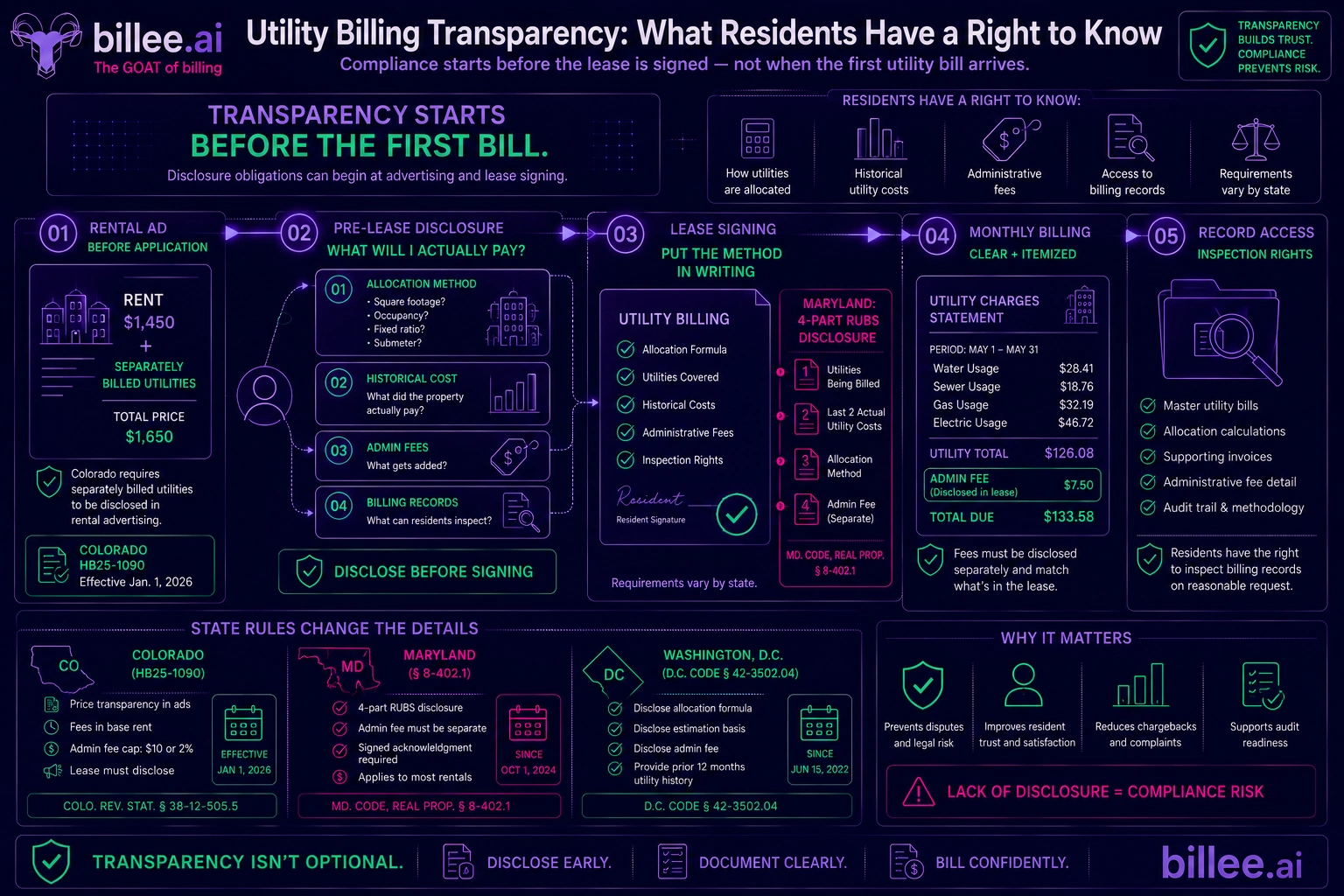
Multifamily residents increasingly have a legal right to see how their utility bill was calculated before they sign a lease, not just after the first invoice arrives. States including Colorado, Maryland, and DC now require operators to disclose the allocation method, share historical billing data, cap administrative fees, and let residents inspect billing records on request. Skipping these steps carries real risk: under Maryland law, a lease clause requiring payment of a ratio-utility-billing charge becomes unenforceable if the required disclosure was never given. Billee's Regulatory & Compliance support builds this disclosure trail into its standard billing methodology audit.
Key takeaways
- Transparency obligations increasingly start before the lease is signed, not at the first invoice. Colorado's HB25-1090 requires the utility allocation formula to be disclosed in the lease itself, effective January 1, 2026.
- Maryland residents have a standing right to inspect utility billing records on written request, not only during an active dispute.
- Non-disclosure can carry a direct financial consequence. Under Maryland's Real Property § 8-212.4, a lease provision requiring payment of ratio-utility-billing charges is unenforceable if the required disclosure was never given.
- Administrative fee caps are spreading. Colorado limits fees to $10 per month or 2% of the bill, not both; Maryland's new water submetering rules cap fees near $1 per unit per month.
- Billee's Regulatory & Compliance support builds this disclosure trail into the same lease and billing review the billing methodology audit already performs.
What "utility billing transparency" actually requires
Three distinct points where disclosure obligations attach
Utility billing transparency spans three separate legal moments: before the lease is signed, during the billing cycle, and at the point of a dispute or nonpayment notice. Each is governed differently, and confusing the three is the most common compliance gap operators run into.
The ongoing, statement-level rules, what must appear as a line item on the monthly bill, are covered in Billee's PUC Disclosure Requirements article. Fair Housing documentation obligations around utility charges are covered separately in Fair Housing and Utility Charge Documentation. The dispute-stage rules are covered in How to Handle Resident Utility Bill Disputes. This article covers a different point in the timeline: pre-lease and advertising disclosure, plus the standing, non-dispute-dependent right to inspect records.
Why the pre-lease layer catches operators off guard
Most compliance attention goes to the monthly statement, since that is where resident complaints originate. Pre-lease disclosure is newer and less operationally visible, which is exactly where 2026 legislative activity concentrated: Colorado's price-transparency law and Maryland's expanded disclosure statute both target what happens before a resident signs, not just what shows up on the bill afterward.
What residents have a right to ask for
Residents have a right to ask for the billing method, historical cost data, fee transparency, and standing access to billing records. The District of Columbia's Office of the Attorney General published one of the clearest single summaries of these rights in an April 27, 2026 consumer alert.
The billing method and allocation formula
Residents can ask exactly how their utility charge is calculated: by square footage, occupancy, a fixed ratio, or submeter reads. DC's Attorney General lists "the specific billing method that is used to calculate each utility" as a baseline disclosure. Colorado's HB25-1090 goes further, requiring landlords to disclose the allocation formula directly in the rental agreement, not in a separate document a resident might never see.
Historical usage and cost data
Under Maryland's Real Property § 8-212.4, a landlord using ratio utility billing must provide copies of its last two actual utility bills before a resident can be charged. DC's guidance adds that residents can request past building utility bills by type and the average monthly bill across all units from the previous year. Either way, a resident should be able to see what similar units have actually paid, not just take the operator's word for it.
Fee, markup, and administrative-charge transparency
Administrative fees on top of the actual utility cost are increasingly capped by statute rather than left to the lease. Colorado caps the fee at $10 per month or 2% of the utility bill, not both. Maryland's new water submetering rules cap the service charge at $1 per unit per month and prohibit billing residents for common-area costs, leaks, or maintenance. Both states share a simpler underlying principle: a resident cannot be charged more than what the utility itself charged the building.
The right to inspect billing records
Maryland law creates a standing right, not a dispute-dependent one. Real Property § 8-212.4 states that a landlord using ratio utility billing "shall, on written request by a tenant, allow a tenant to inspect records retained by the landlord that document a bill for utilities." A resident does not need to be mid-dispute to exercise this right. That standing quality is what separates this layer from the dispute-process rules covered in Billee's resident utility bill disputes guide, linked above.
What operators are obligated to provide, and when
Operators face a compliance timeline with four distinct checkpoints: advertising, lease signing, ongoing tenancy in direct-charge buildings, and submetered properties specifically.
At advertising, before an application is even submitted
Colorado's HB25-1090 requires every rental advertisement to display a single, clear "total price" more prominently than any other pricing information, and to disclose when utilities are billed separately from rent. An advertisement that shows only base rent, with utility costs disclosed for the first time at lease signing, does not meet Colorado's standard as of January 1, 2026.
At lease signing, the required disclosure package
Colorado requires the allocation formula in the lease itself. Maryland requires a specific four-part disclosure package before a resident can be charged under ratio utility billing: a statement identifying every utility being billed, copies of the landlord's last two bills for each, the allocation method, and the prior year's average monthly bills across the property. Maryland's statute also requires notice of the resident's inspection right and a citation to the statute itself.
For direct-charge buildings of six or more units
Maryland treats direct-charge buildings differently from ratio-billed ones. Under Real Property § 8-205.1, a landlord who bills residents directly for water, sewer, gas, or electric service must either provide a copy of the actual utility bill or give written notice, before the initial lease and each renewal, of the total utility costs billed to the landlord in the prior year, broken out by utility type. Operators sometimes assume Maryland's ratio-billing disclosure rule covers this case too, but § 8-205.1 is a separate statute with its own requirement.
For newly submetered properties
Maryland's water submetering law, cross-filed as Senate Bill 130 and House Bill 220, passed the 2026 session and adds a third layer for submetered water billing. It caps administrative charges at $1 per unit per month, bars billing residents for costs beyond the water provider's actual charges, and requires landlords to keep records of provider charges and revenue collected. It also requires giving residents historical cost data for comparable units before they sign. Legal-industry sources report an effective date of October 1, 2026, though operators should confirm the final date before updating lease paperwork.
What happens when operators skip these steps
The consequences are not uniform, but they are real. Maryland's is the sharpest: under § 8-212.4, a lease provision requiring payment of the ratio-utility-billing charge is unenforceable if the disclosure was never provided, leaving the operator with no contractual basis to collect it. Colorado's approach is more calibrated. Its Attorney General issued a November 24, 2025 memorandum creating a safe harbor for landlords who avoid overbilling, keep fees within the statutory limit, exclude common-area costs, and disclose clearly, and confirmed the office would not enforce the statute retroactively against leases signed before January 1, 2026.
Where these obligations vary most by state
Pre-lease disclosure requirements differ sharply by state, and several changed in 2026 alone.
| State | Pre-lease disclosure required | Fee cap | Standing record-inspection right | Governing law |
|---|---|---|---|---|
| Colorado | Yes, allocation formula in the lease and in ads | $10/month or 2% of bill, not both | Not specified in HB25-1090 | HB25-1090, effective Jan. 1, 2026 |
| Maryland (ratio billing) | Yes, four-part disclosure package | Must be disclosed; no flat statutory cap found for ratio billing generally | Yes, on written request | Real Property § 8-212.4 |
| Maryland (direct-charge, 6+ units) | Yes, bill copy or prior-year cost notice | Not specified | Not specified | Real Property § 8-205.1 |
| Maryland (submetered water) | Yes, historical comparable-unit costs | $1/unit/month | Record-maintenance requirement, not an explicit inspection right | SB 130 / HB 220, expected effective Oct. 1, 2026 |
| Washington, D.C. | Yes, per Attorney General guidance | Not specified in the alert | Yes, RUBS record inspection | Consumer Protection Procedures Act, per April 2026 OAG alert |
Many other states, including Texas and California, regulate what must appear on the monthly utility statement itself; see Billee's PUC Disclosure Requirements article, linked above, for that layer. A distinct, codified pre-lease disclosure requirement like Colorado's or Maryland's is a newer and less uniform standard. Operators expanding into a new state should confirm the current rule rather than assume it matches wherever they operate today.
How Billee fits in
Billee's Regulatory & Compliance support gives operators billing methodology audits and access to legal support, so they can meet state-specific disclosure rules with a documented trail instead of a scramble every time a new state law passes.
The lease's utility addendum and disclosure language are already part of what Billee's billing methodology audit reviews, alongside provider reports, master meter invoices, and the property's legal entity documentation. Building state-required disclosure language into that same review is a natural extension of an audit Billee already performs, not a new project for the operations team to own.
For multi-state operators, this matters most at the portfolio level. A disclosure package that satisfies Maryland's four-part requirement will not automatically satisfy Colorado's lease-embedded formula rule, or a future state's version of either. Billee's audit process is built to speak the language of each state's requirement rather than apply one template everywhere.
FAQ
What must a landlord disclose about utility billing before a resident signs a lease?
Requirements vary by state, but they commonly include the allocation method, the utility provider's actual charges, and any administrative fees. Colorado requires the allocation formula in the lease itself; Maryland requires a four-part written disclosure package before a resident can be charged under ratio utility billing.
Can residents request the actual utility bills used to calculate their charges?
In Maryland, yes. Real Property § 8-212.4 requires a landlord to provide copies of its last two utility bills as part of the required disclosure, and residents can separately request to inspect billing records in writing at any time.
What happens if an operator skips the required utility billing disclosure?
In Maryland, the lease provision requiring the resident to pay the ratio-utility-billing charge becomes unenforceable. Colorado relies more on administrative enforcement and safe-harbor guidance than on voiding lease terms outright.
Are there limits on administrative fees for utility billing?
Yes, in a growing number of states. Colorado caps the fee at $10 per month or 2% of the bill, not both. Maryland's new water submetering rules cap the fee near $1 per unit per month.
Is utility billing transparency the same as what must appear on my monthly statement?
No. Statement-content rules govern what must appear as a line item on each bill. Pre-lease transparency rules govern what a resident must be told before they ever sign.
Do these disclosure rules apply to both ratio utility billing and submetered properties?
The specific requirements differ by billing model. Maryland regulates ratio utility billing under § 8-212.4, direct-charge buildings under § 8-205.1, and submetered water billing under its 2026 submetering law separately, each with its own disclosure package.
How does Billee help operators meet these disclosure requirements?
Billee's Regulatory & Compliance support reviews lease and billing documentation against state-specific rules as part of its standard billing methodology audit, and gives operators access to legal support for interpreting requirements as they change.
Billee audits billing methodology against state disclosure rules and documents the trail operators need for refinancing, disposition, or a resident inquiry. Talk to the team.
Sources
- Holland & Knight, "Colorado AG Issues Guidance on New Price Transparency Law Affecting Colorado Residential Leases," December 2025.
- District of Columbia Office of the Attorney General, "Attorney General Schwalb Issues Alert to Help Tenants Understand How Utilities Are Billed & Make Sure They Are Not Overpaying," April 27, 2026.
- Maryland General Assembly, "Real Property § 8-212.4," accessed 2026.
- Maryland General Assembly, "Real Property § 8-205.1," accessed 2026.
- Maryland Department of Legislative Services, "House Bill 220 Fiscal and Policy Note," 2026 session.
Insights and Industry Trends


Explore more insights