
Common Area Deduction in RUBS: How It Works and What States Now Require
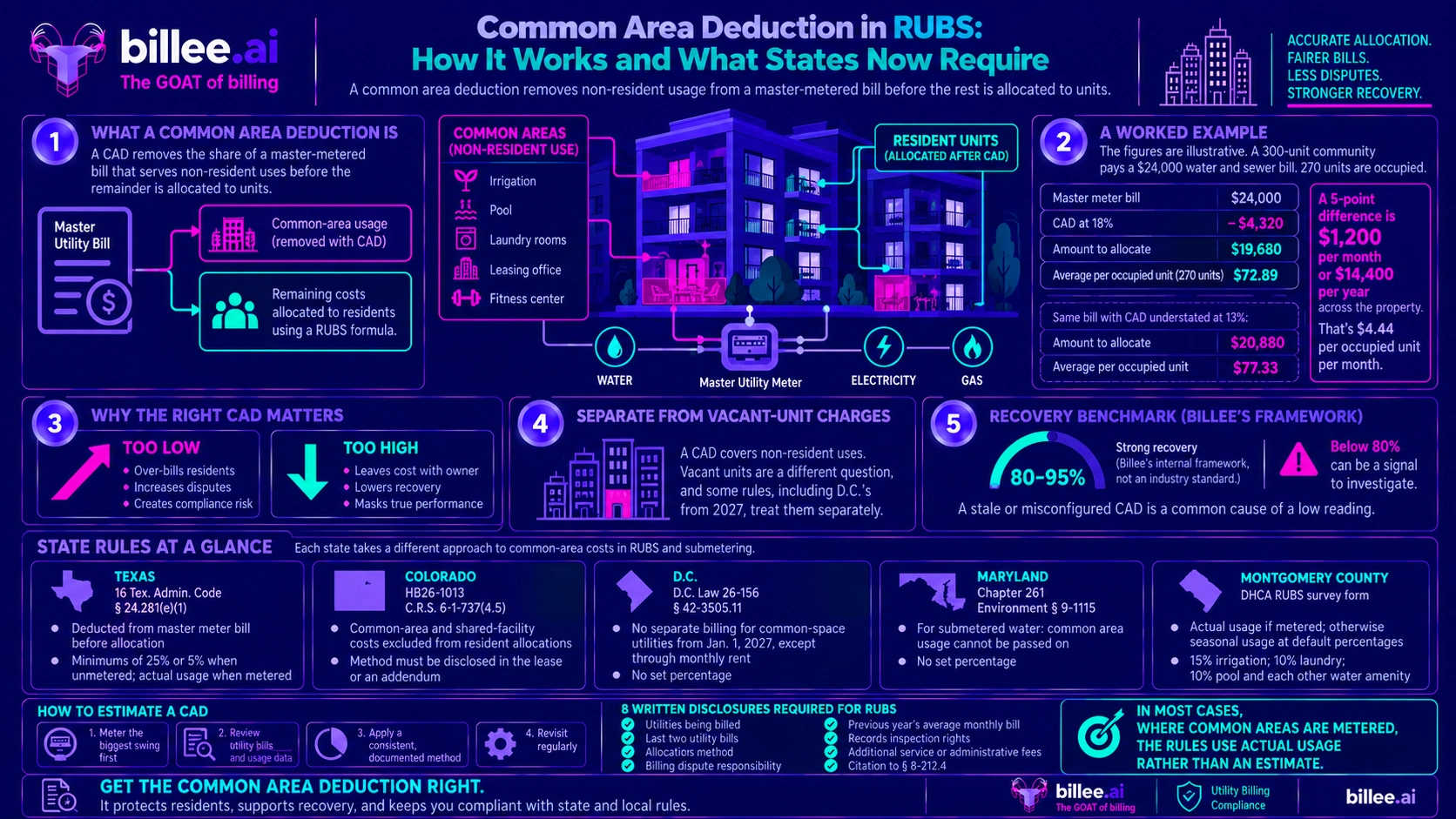
A common area deduction (CAD) removes the share of a master-metered bill that serves non-resident uses, such as irrigation, pools and laundry rooms, before the rest is split among units. Texas sets minimum percentages, Colorado excludes common-area costs and D.C. bars separate common-space billing from 2027. Billee Technologies, Inc. checks CAD settings during its billing methodology audit.
Get the deduction wrong in either direction and it costs money. Set too low, a CAD over-bills residents and invites disputes. Set too high, it lowers recovery. This guide defines the deduction, works through an example, shows how to estimate one and sets out what Texas, Colorado, D.C., Maryland and Montgomery County say.
Key takeaways
- A CAD is the share of a master-metered bill deducted for non-resident use before RUBS allocates the remainder to units.
- In this guide's example, a $24,000 monthly bill with an 18% CAD leaves $19,680 to allocate. Understating the CAD by five points moves $1,200 a month, or $14,400 a year, onto residents. The figures are illustrative, not a benchmark.
- Texas, under 16 Tex. Admin. Code § 24.281(e)(1), requires deducting actual common-area usage when all common areas are metered, and at least 25% or 5% of the master meter bill when they are not, depending on the case.
- Colorado HB26-1013, approved March 26, 2026, requires RUBS allocations to exclude utility costs for common areas or shared facilities and the method to be disclosed in the lease or an addendum.
- D.C. Law 26-156 bars separate billing for common-space and vacant-unit utilities from Jan. 1, 2027, except through monthly rent.
- Maryland's new water law bars passing on common area usage for submetered water. Montgomery County's RUBS form sets defaults of 15% for irrigation and 10% each for laundry rooms and pools or other water amenities.
- Where common areas are metered, the rules that speak to the point use actual usage rather than an estimate.
- Billee treats 80–95% recovery as strong and a reading below 80% as a signal to investigate. That range is Billee's own framework, and a stale CAD is one common cause of a low reading.
Common area deduction rules at a glance
| Jurisdiction | Source | Treatment of common-area costs | Percentage set? |
|---|---|---|---|
| Texas | 16 Tex. Admin. Code § 24.281(e)(1) | Deducted from the master meter bill before allocation | Minimums of 25% or 5% when unmetered; actual usage when metered |
| Colorado | HB26-1013, C.R.S. 6-1-737(4.5) | Common-area and shared-facility costs excluded from resident allocations | None |
| D.C. | D.C. Law 26-156, § 42-3505.11 | No separate billing for common-space utilities from Jan. 1, 2027, except through monthly rent | None |
| Maryland, submetered water | Chapter 261, Environment § 9-1115 | Common area usage cannot be passed on | None |
| Maryland, RUBS | Real Property § 8-212.4 | Allocation method must be disclosed; no deduction rule | None |
| Montgomery County | DHCA RUBS survey form | Actual usage if metered; otherwise seasonal usage at default percentages | 15% irrigation; 10% laundry; 10% pool and each other water amenity |
What a common area deduction is
A common area deduction adjusts allocated utility costs to account for common-area, non-resident consumption. A RUBS property pays one master-metered bill. The CAD takes out what the leasing office, pool, irrigation and laundry rooms used, so residents split only the part residents could plausibly have used. Billee's guide to how RUBS allocates utility costs shows where the deduction sits in the formula.
A CAD set too high leaves cost with the owner that residents could fairly carry. A CAD set too low shifts cost onto residents, which lifts recovery on paper and raises dispute and compliance risk. Billee's glossary calls misconfigured or stale CAD deductions a common cause of below-benchmark recovery. Billee's guide to what 80–95% effective recovery means explains why a recovery number should be read next to the formula behind it.
A CAD is also separate from the vacant-unit share. The CAD covers non-resident uses. Vacant units are a different question, and some rules, including D.C.'s from 2027, treat them separately.
A worked example
The figures below are illustrative. A 300-unit community pays a $24,000 water and sewer bill for the month. Irrigation, a pool and two laundry rooms are unmetered, and the operator documents an 18% deduction. 270 units are occupied.
| Step | Amount |
|---|---|
| Master meter bill | $24,000 |
| CAD at 18% | −$4,320 |
| Amount to allocate | $19,680 |
| Average per occupied unit (270 units) | $72.89 |
| Same bill with the CAD understated at 13%: amount to allocate | $20,880 |
| Same bill with the CAD understated at 13%: average per occupied unit | $77.33 |
Five points of CAD is $1,200 a month across the property, or $14,400 a year. Per occupied unit, that is $4.44 a month: small enough to miss and large enough to read as an overcharge when a resident compares bills.
The example splits the amount equally to keep the math visible. Real formulas weigh occupants, bedrooms or square footage. Texas also takes dwelling unit base charges or the customer service charge off first, which the example ignores.
How to estimate a CAD
No rule read for this guide prescribes one estimating method. Several set outcomes, such as Texas's minimums or Montgomery County's defaults. The steps below are practical suggestions, not legal standards.
- Meter the biggest swing first. Texas and Montgomery County both give irrigation the highest default, so it is the first use worth metering. A dedicated meter or submeter turns an estimate into a measured number.
- Use the jurisdiction's default as a starting point. Where a rule sets a percentage, begin there. In Texas, the percentages are minimums.
- Document what is left. For unmetered uses, record the inputs: irrigation zones and run times, pool size and refill pattern, laundry machine counts and cycles. Date the file.
- Decide whether the CAD is seasonal. Montgomery County's form speaks of seasonal common-area usage. Write down whether your CAD is fixed or changes by season.
- Put the method in the lease. Colorado requires the allocation method to be disclosed, and Maryland's RUBS statute requires it by utility. Billee's lease addendum guide covers what to write.
What Texas and Colorado require
Texas. 16 Tex. Admin. Code § 24.281 tells an owner who allocates a master meter bill to deduct, before allocating to residents, dwelling unit base charges or the customer service charge where applicable, then common-area usage. How much depends on metering:
- All common areas metered or submetered: deduct actual common-area usage.
- Unmetered common areas and an installed irrigation system: deduct at least 25% of the master meter bill.
- All irrigation metered or submetered, but other areas such as pools or laundry rooms not: deduct at least 5%.
- Unmetered common areas and no installed irrigation system: deduct at least 5%.
The percentages are minimums. The rule page does not define an installed irrigation system or say how to measure unmetered use, and its adoption note dates to 2018, so confirm the current text before relying on it. Billee's Texas PUC Chapter 24 guide covers the wider rule.
Colorado. HB26-1013, approved March 26, 2026, allows ratio utility billing only when four conditions hold. The total billed to residents cannot exceed the provider's charge for the whole premises. No markup, surcharge, administrative fee or other amount may be added beyond actual charges, except as otherwise permitted by law. Utility costs for common areas or shared facilities must be excluded from resident allocations. And the allocation method must be disclosed clearly and conspicuously in the lease or an addendum.
Colorado sets no percentage, so the operator must be able to show what was excluded and how. For residential premises with permits applied for on or after July 1, 2027, the act requires direct metering or submetering instead. Billee's Colorado RUBS guide covers the rest.
What D.C., Maryland and Montgomery County say
D.C. D.C. Law 26-156 adds § 42-3505.11. Beginning Jan. 1, 2027, a housing provider, or a third party it contracts, may not bill residents separately for common-space or vacant-unit utilities, except through monthly rent. Common space includes lobbies, leasing offices, business centers, pools and fitness centers. RUBS stays available for master-metered charges, subject to the section's limits.
The section does not say how a formula should treat those shares. A formula that spreads the whole master-meter bill across occupied units, with nothing taken out, is the design most worth showing counsel.
Maryland. Two rules give two answers. Chapter 261 bars passing on common area usage when billing submetered water and sewer, and requires charges to follow each unit's actual usage. The RUBS statute, § 8-212.4, requires disclosure of the allocation method for each utility but sets no deduction rule or percentage.
Montgomery County. The county's RUBS survey form covers WSSC water and sewer only. It deducts actual usage where common areas are metered or submetered. Where they are not, it deducts seasonal common-area usage at defaults: 15% for an installed irrigation system, 10% for laundry rooms and 10% for a swimming pool and for each other water amenity. The form gives no way to document a different percentage. Its alternative is metering.
Where a state is silent, the lease disclosure and your own documentation carry the weight. Check the rule for every state where you bill. Billee's state-by-state RUBS guide is a starting map.
When to revisit your CAD
No rule read here sets a review schedule. These events are reasons to look again:
- An amenity opens, closes or changes. A new pool, laundry room or irrigation zone moves the deduction.
- A meter is added or replaced. Metered usage replaces an estimate.
- A property is acquired. The seller's CAD may rest on a unit mix or amenity set that no longer exists.
- The season turns. Irrigation use swings with the weather.
- A rule changes. Colorado, D.C. and Maryland all acted in 2026, and D.C.'s main bar starts in January.
- A lease form is refreshed. The addendum should match the method.
- Recovery falls or complaints repeat. A reading below 80% is a signal to investigate, and Billee's guide to common resident complaints about RUBS shows the patterns.
How to get ready
- List every property's CAD. Record the percentage or measured basis, who set it and when.
- Match each CAD to its jurisdiction. Texas minimums, Colorado's exclusion, D.C.'s 2027 bar, Maryland's water rule and Montgomery County's defaults each ask something different.
- Meter what you can. Start with irrigation.
- Document what you cannot meter. Keep dated inputs for each estimate.
- Compare the lease addendum to the method. The words should match the math.
- Ask your billing vendor in writing. Get the CAD basis for each property and the date it was last reviewed.
- Set a review date. Tie it to the season and to rule changes.
How Billee Technologies helps
Billee Technologies pairs a platform with a named, dedicated account team. Your people review and approve. Billee's team does the work. For a setting that drifts quietly, that means a deduction checked against the rule and watched against the data.
Check the CAD and the formula
Billee's Regulatory & Compliance service covers billing methodology audits, access to legal support and ongoing monitoring for rule changes. Access to legal support is not legal advice. Billee's guide to its regulatory and compliance support explains the scope.
A Billee audit reviews four required document categories for the same billing period: the current billing provider's reports, master meter invoices, lease agreements, and the property's W-9 and legal entity name. It surfaces methodology gaps, allocation drift and reconciliation problems. Allocation drift includes RUBS formulas that have not kept pace with unit-mix changes and CAD deduction errors.
Billee's guide to preparing a billing methodology audit lists what reviewers ask for. Billee's 45-day standard implementation includes a methodology audit of formulas, submeter configuration and allocation logic, which is where a CAD gets its first check.
Watch the data behind it
Billee's Meter Monitoring raises alerts when a reading spikes, drops or flatlines, and the team acts on them. Read more in Billee's guide to meter monitoring and proactive alerts. Monitoring works on portfolios that already have submetering infrastructure. Whether it covers common-area meters such as irrigation is a question for Billee in writing.
Vacant Cost Recovery is a separate tool for a separate question. It compares occupancy data from the property management system with actual meter usage and routes exceptions above a configurable threshold, within the same week, to a named Billee account team member.
Review every cycle
Each month Billee assembles utility data and produces a preliminary bill. Your billing administrator reviews it in the Billee portal next to Biller Highlights, the team's notes on exceptions, and can download a Detail Resident Report or an Itemized Report. Billee replies to comments within 1–2 business days, and an administrator can request a new report, which takes 1–2 business days.
After approval, Billee locks the report and charges post to the property management system's resident ledger on the set date. The activity log records every billing action, who performed it and when. Whether a CAD change appears in that log is a question for Billee in writing.
What to ask Billee for in writing
- How the CAD is set and documented for each property at implementation, and who approves a change.
- Whether the audit tests the CAD against Texas, Colorado, D.C., Maryland and Montgomery County rules.
- How a CAD change reaches the lease addendum and the resident.
- How seasonal adjustments are handled, if a property uses them.
- Whether Meter Monitoring covers common-area meters.
- How often each property's CAD is reviewed.
- How rule changes reach your account team.
Who Billee is not for
- Portfolios under about 300 units, where Billee's full-service model is usually more than the job needs.
- Anyone looking for a legal opinion on how a state's rule applies to a formula or lease. Billee gives access to legal support, not legal advice, so involve counsel.
- Operators who want to run billing themselves with software alone. Billee's portal exists for review and approval, not self-service operation.
FAQ
What is a common area deduction in RUBS?
A common area deduction removes the share of a master-metered utility bill that serves non-resident uses, such as irrigation, pools and laundry rooms, before the remainder is allocated to units. It keeps residents from paying for consumption they did not cause.
How do you calculate a common area deduction?
Measure or estimate the share of the master bill used by common areas, subtract it, and allocate the remainder to units. Metered irrigation or pools give actual usage. Otherwise a documented estimate or a jurisdiction default applies. For example, 18% of a $24,000 bill is $4,320, leaving $19,680.
What does Texas require for a common area deduction?
Under 16 Tex. Admin. Code § 24.281(e)(1), an owner deducts actual common-area usage when all common areas are metered or submetered. Otherwise the deduction is at least 25% of the master meter bill with an installed irrigation system, and at least 5% in the other cases the rule lists.
Does Colorado allow common-area costs in RUBS?
No. HB26-1013 requires utility costs for common areas or shared facilities to be excluded from resident allocations. The act also requires the allocation method to be disclosed in the lease or an addendum.
Can a D.C. landlord bill residents for common-area utilities?
Not separately from Jan. 1, 2027. D.C. Law 26-156 bars a housing provider, or a third party it contracts, from billing residents separately for common-space or vacant-unit utilities, except through monthly rent.
What are Montgomery County's default common-area percentages?
For unmetered common areas, the county's RUBS survey form deducts 15% for an installed irrigation system, 10% for laundry rooms and 10% for a swimming pool and for each other water amenity. Metered or submetered areas use actual usage.
How often should a CAD be reviewed?
No rule read for this guide sets a schedule. Review it when an amenity, meter, lease form or rule changes, and with the seasons if irrigation is a large share. A recovery reading below 80% is also a reason to look.
Is a common area deduction the same as vacant-unit cost recovery?
No. A CAD removes non-resident uses from the bill before allocation. Vacant-unit cost recovery deals with usage in units flagged as vacant. Some rules, including D.C.'s from 2027, treat the two separately.
Billee handles utility billing, vacant cost recovery and vendor management for multifamily operators who want a dedicated team behind the software. If you run RUBS in more than one state, talk to the team about your portfolio.
Sources
- Legal Information Institute, Cornell Law School, "16 Tex. Admin. Code § 24.281, Charges and Calculations," accessed October 2026.
- Colorado General Assembly, "Session Laws, Chapter 11 (House Bill 26-1013, Ratio Utility Billing Systems)," accessed October 2026.
- Council of the District of Columbia, "D.C. Law 26-156. Fair Housing Practices Amendment Act of 2026," accessed October 2026.
- Maryland General Assembly, "Chapter 261 (Senate Bill 130), 2026 Regular Session," accessed October 2026.
- Maryland General Assembly, "Real Property Article, Section 8-212.4," accessed October 2026.
- Montgomery County Department of Housing and Community Affairs, "Multi-Family Apartment Complex Ratio Utility Billing System Survey," accessed October 2026.
Insights and Industry Trends