
How RUBS Allocates Utility Costs in Multifamily Properties
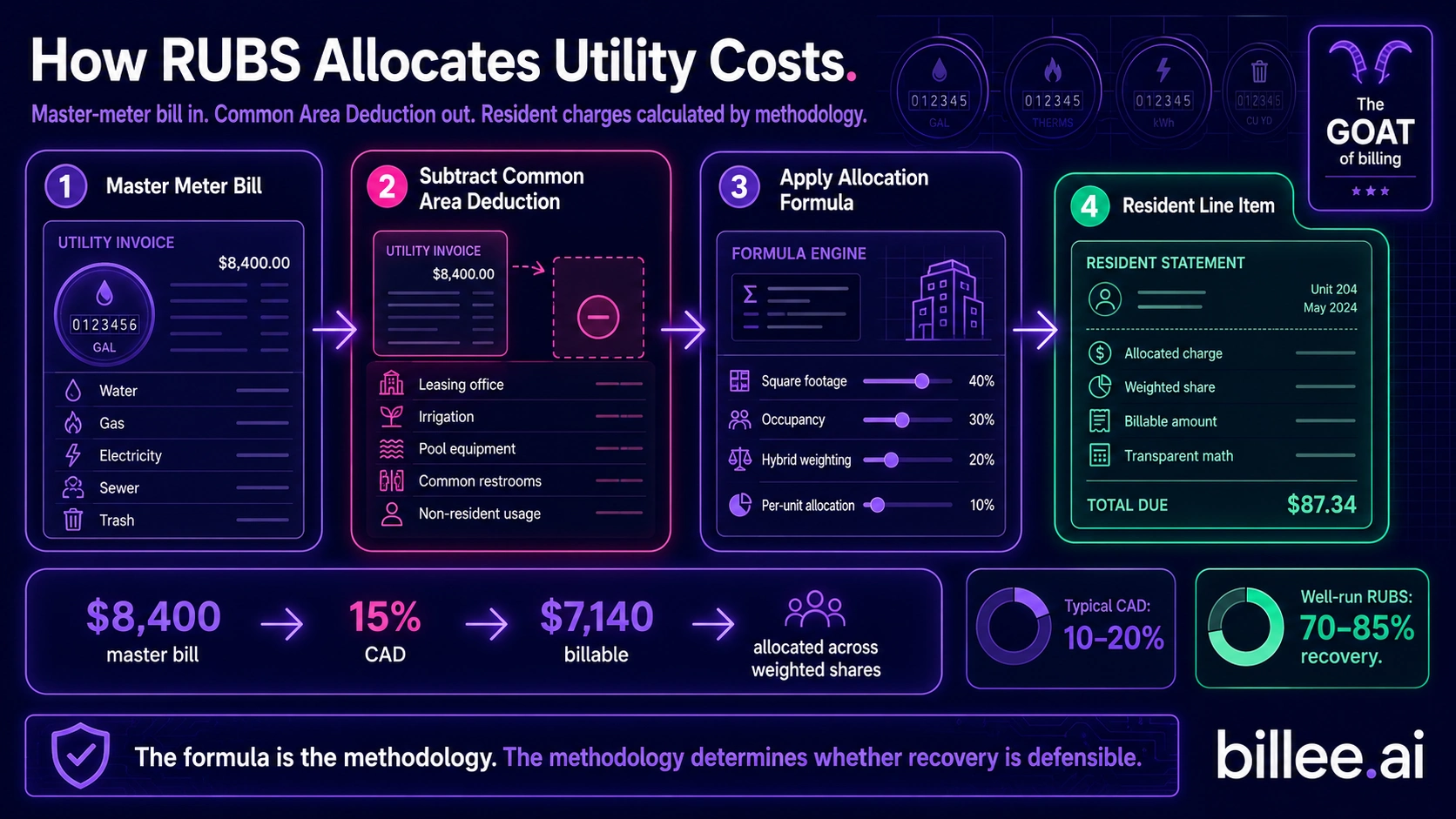
TL;DR: RUBS (Ratio Utility Billing System) takes a property's master-meter utility bill, subtracts a Common Area Deduction for non-resident usage, and divides the remainder across resident units using a defined formula. The most common modern approach weights square footage and occupancy together. Properly run, RUBS recovers 70 to 85 percent of recoverable utility costs without installing individual meters.
RUBS allocation runs in three steps every month. First, the master meter bill arrives for the property's full water, gas, or electricity usage. Second, a Common Area Deduction (CAD) is subtracted to account for non-resident consumption, including leasing office, irrigation, pool equipment, and common-area restrooms. Third, the remaining billable amount is allocated to each unit using a formula that combines square footage, occupancy, or both. The unit-level charge appears as a line item on the resident's monthly statement.
The formula is the methodology. The methodology is what determines whether the property recovers a defensible share of utility costs or quietly leaks recovery to a stale allocation.
Why this matters for multifamily operators
RUBS is the default allocation method for multifamily properties without unit-level submeters. For a 100-unit property with $8,400 monthly water costs, the difference between a well-calibrated RUBS formula and a stale one is meaningful. A 10 percent recovery gap is $840 a month, $10,080 a year, on water alone. Stack that across gas, sewer, and trash, and the same gap moves into the high four figures monthly for a single mid-sized property.
The mechanics of RUBS are simple. The execution is where most operators leak NOI. The CAD gets set during onboarding and then never reviewed. The allocation formula is built around a unit mix that has since shifted from ADA conversions or unit combinations. Resident occupancy data drifts because the PMS sync runs monthly instead of daily. None of these are visible until an audit catches them, and by then the recovery rate has been below benchmark for quarters.
The three components of a RUBS allocation
Every RUBS calculation has three moving parts.
The master meter bill. This is what the utility provider charges the property each month. A 100-unit property might receive an $8,400 water bill in July. That total includes resident usage, common-area usage, irrigation, pool equipment, and any system leaks not yet detected.
The Common Area Deduction (CAD). This is the portion of the master bill that gets removed before allocation, because it does not represent resident consumption. Typical CAD ranges run 10 to 20 percent of the bill, depending on what the property actually has (a property with a large pool and extensive irrigation will sit at the high end; a property with no amenities will sit at the low end). For the $8,400 bill, a 15 percent CAD removes $1,260, leaving $7,140 billable to residents.
The allocation formula. This determines how the $7,140 gets distributed across resident units. The formula choice is where methodology matters most.
The four allocation methods used in multifamily RUBS
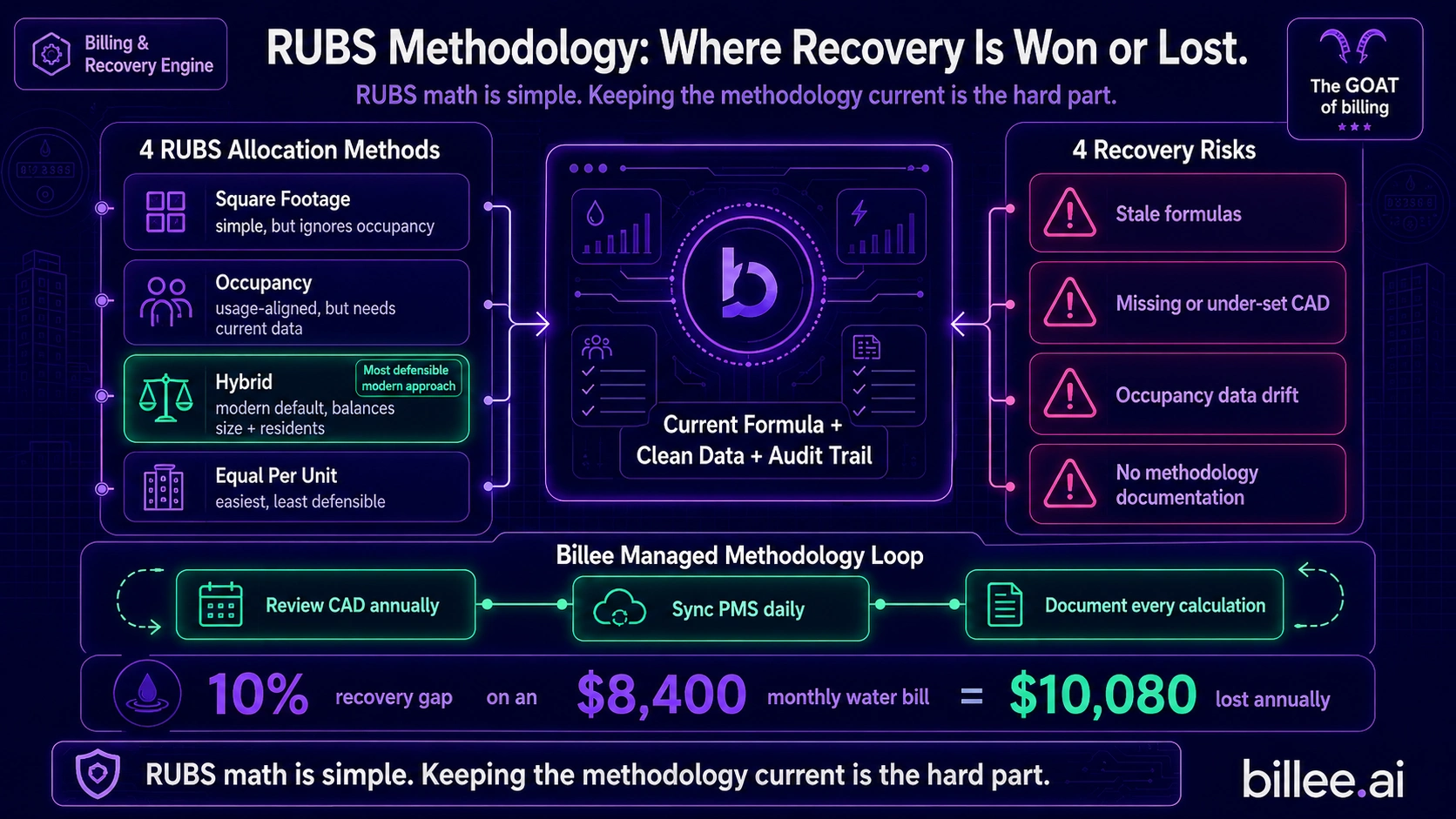
Most properties use one of these four methods.
Square footage allocation. Each unit's share equals its square footage divided by total billable square footage. A 600 sqft studio pays a smaller share than a 1,200 sqft two-bedroom. Simple to administer, but ignores actual occupancy differences. A vacant unit and a four-person unit pay the same.
Occupancy allocation. Each unit's share is based on the number of residents listed on the lease. More aligned with actual usage, especially for water, but harder to keep current when occupancy changes mid-month.
Hybrid (square footage plus occupancy). The most common modern approach, weighting both factors. A 600 sqft studio with two residents drives more water usage than a 1,200 sqft one-bedroom with one resident. The hybrid formula captures that. Hybrid is the default for new RUBS implementations in 2026 because it produces the most defensible alignment between resident impact and cost share.
Per-unit equal allocation. Every unit pays the same share. Rare in modern multifamily; still appears in older buildings or smaller portfolios. Generally produces the most resident pushback because the math is least defensible.
A worked example
A 100-unit property with a $8,400 monthly water bill, 15 percent CAD, and hybrid allocation.
StepCalculationResultMaster meter bill$8,400$8,400Less Common Area Deduction (15%)$8,400 × 0.85$7,140 billableAllocate to units (hybrid formula)$7,140 / 100 weighted sharesvaries by unitSample unit: 900 sqft, 2 residents, weighted share 1.2%$7,140 × 0.012$85.68Sample unit: 600 sqft, 1 resident, weighted share 0.7%$7,140 × 0.007$49.98
The methodology produces a defensible allocation that residents can understand. The 900 sqft unit with two residents pays meaningfully more than the 600 sqft single-resident unit. That is the design intent.
Common allocation mistakes
The four mistakes that quietly erode RUBS recovery in real portfolios.
1. Stale formulas. The allocation was set up two years ago and never revisited. Since then, three units were combined into two larger units, an ADA conversion changed two unit footprints, and the leasing office moved. The math is now off, and no one has noticed.
2. Missing or under-set CAD. The CAD was set at 10 percent during onboarding without measurement, when actual non-resident usage is closer to 18 percent. The property is overcharging residents and exposed to dispute.
3. Occupancy data drift. The PMS sync runs monthly. A unit that moved out on day 3 gets billed as occupied for the full month. The unit that moved in mid-month does not appear in the allocation until the next cycle.
4. No methodology documentation. When a resident disputes a charge or a buyer's due-diligence team asks how charges are calculated, the property cannot produce a reproducible methodology. The methodology is in someone's head, or worse, in a spreadsheet no one can find.
For the full operator's guide to running RUBS as a compliant program, see RUBS Billing for Multifamily: What Operators Need to Know.
When to handle RUBS allocation in-house versus bring in a partner
Running RUBS in-house works for operators with three things: an internal billing team that can audit allocation monthly, daily occupancy sync between the PMS and the billing tool, and the bandwidth to recalibrate the CAD and formula annually. Most operators below the top-50 by unit count lack at least one.
A partner is the right answer when the work is continuous, the portfolio spans multiple states with different PUC rules, or the operator is preparing for refinancing or disposition and needs documented methodology. The trade-off is finding a partner who actually owns the methodology rather than running yesterday's formula on autopilot.
How Billee can help
Billee runs RUBS billing as part of the Billing & Recovery Engine. The platform handles allocation, charge posting, and resident billing, while a named dedicated account team manages methodology reviews, CAD calibration, vendor exceptions, and the audit trail. The portfolio benchmark Billee tracks on the customer dashboard is 80 to 95 percent effective recovery, per Billee's standard portfolio benchmark. Anything below 80 percent triggers a review for stale formulas, CAD drift, or other recoverable gaps.
Implementations typically go live in 45 days, per Billee's standard implementation timeline, including PMS integration with Yardi Voyager, Yardi Breeze, RealPage, or Entrata. For operators currently running RUBS in-house or with a legacy provider, the first step is a billing methodology audit that surfaces exactly where the current program is leaving money on the table.
FAQ
What does RUBS stand for in multifamily billing?
RUBS stands for Ratio Utility Billing System. It is a methodology that allocates a property's master-meter utility costs across resident units using a defined formula, without requiring individual unit meters.
How does RUBS allocate water versus electricity?
The allocation logic is the same; the formula weighting often differs. Water allocation typically weights occupancy more heavily because residents drive usage. Electricity often weights square footage more heavily because larger units run more HVAC. Properties should run separate formulas per utility for the most defensible allocation.
What is a Common Area Deduction in RUBS?
The Common Area Deduction (CAD) is the portion of the master meter bill that is removed before resident allocation, to account for non-resident usage. Typical CADs run 10 to 20 percent, depending on what the property has (pool, irrigation, leasing office, common-area restrooms).
Can residents dispute a RUBS charge?
Yes. Residents can dispute RUBS charges if they believe the allocation is incorrect or the methodology is not disclosed in the lease. Operators should respond with the documented methodology and the calculation that produced the charge. A defensible RUBS program produces a reproducible answer for every line item.
How often should a RUBS formula be reviewed?
Annually, at minimum. The formula should also be reviewed after any material unit-mix change (ADA conversions, unit combinations, common-area expansions). Unit-mix changes shift the math, and a formula that was right two years ago can be materially off today.
Is RUBS legal in every state?
No. State Public Utility Commission rules vary. Texas is the most permissive; California is tightly regulated under California Civil Code §1954.201–204; Connecticut prohibits RUBS for residential multifamily entirely. Multi-state operators need state-specific methodology and lease disclosure.
What is the typical RUBS recovery rate?
Industry analysis suggests RUBS recovers 70 to 85 percent of recoverable utility costs when run well. Submetering achieves 85 to 95 percent. The gap reflects the inherent difference between formula allocation and direct measurement.
Billee handles RUBS billing for multifamily operators who want accurate allocation, current methodology, and a clean audit trail without operating the system themselves. Talk to the team.
Sources
1. Simple Sub Water, "RUBS vs. Submetering: Financial Impact on NOI, Costs and Tenant Satisfaction," accessed 2026.
2. California Legislative Information, "California Civil Code §1954.201–204," accessed 2026.
3. Dune Labs, "Things You Need to Know About RUBS Regulations Across States," November 7, 2022.
Insights and Industry Trends