
Common Resident Complaints About RUBS and How to Handle Them
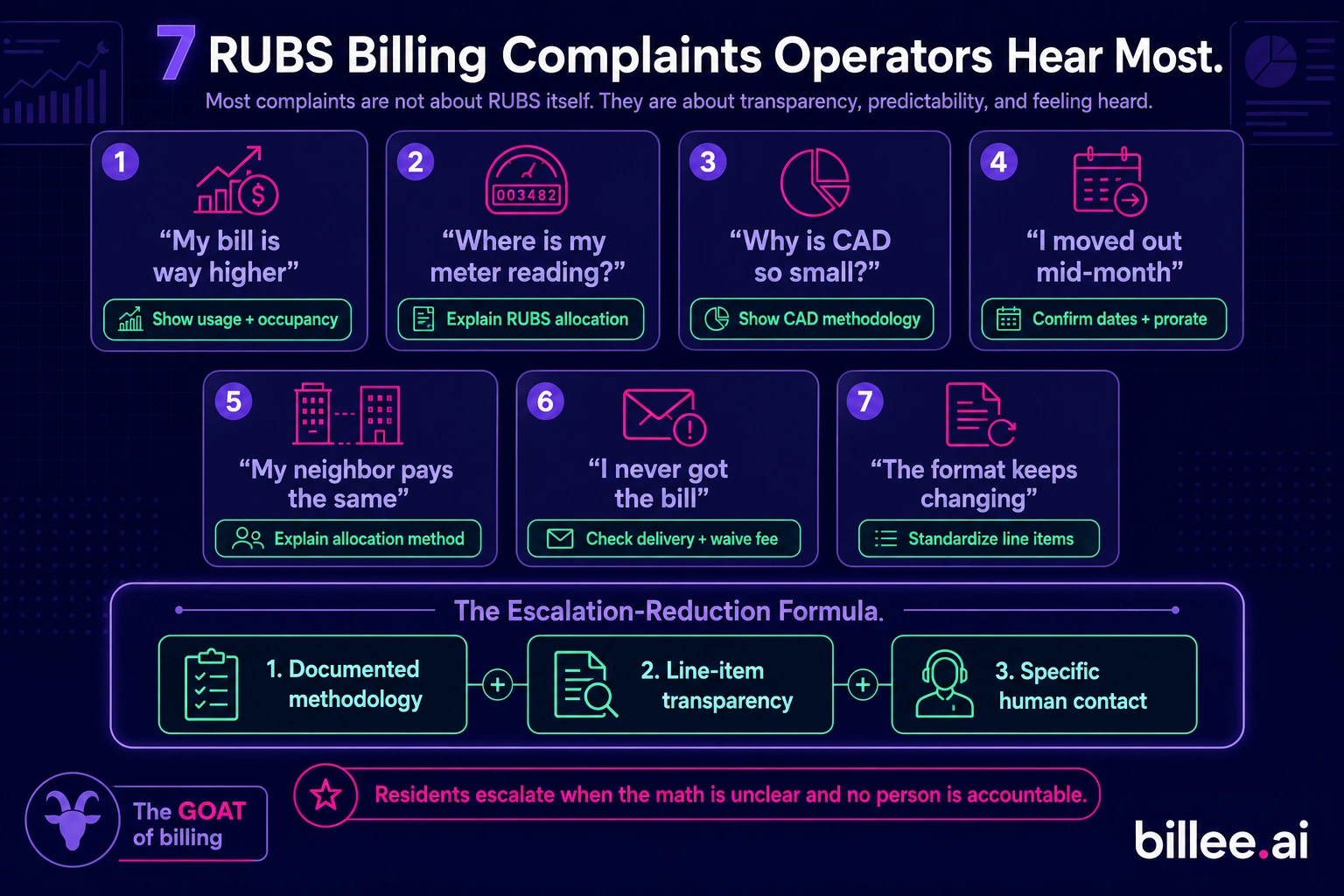
TL;DR: Most resident complaints about RUBS billing trace back to seven recurring issues: charge size relative to expectation, missing line-item detail, confusion about the Common Area Deduction, prorated move-out math, perceived unfairness versus a neighbor, late or missing bills, and inconsistent communication across the portfolio. The operator response that closes each complaint is the same in shape: documented methodology, line-item transparency, and a specific human contact. Properties that operationalize all three see resident escalations fall materially without changing the underlying billing methodology.
Resident complaints about RUBS are rarely about RUBS itself. They are about transparency, predictability, and feeling heard. A resident who understands how the charge was calculated, can see the math on their statement, and knows who to call when the math looks wrong is unlikely to escalate. A resident who cannot get past a generic billing portal to a person is the one who calls the leasing office, the property manager, the state PUC, or all three.
The seven complaints below are the ones property managers field most often. Each one has an underlying operational cause and a response pattern that actually closes the loop.
Why this matters for multifamily operators
Resident complaints about utility billing are operationally expensive in three ways. First, the property manager spends time on the call instead of on leasing, maintenance, or renewals. Second, an escalated complaint can move to the state PUC, a local rent-board, or a regulatory body, where the cost of compliance defense dwarfs the original billed amount. Third, unresolved complaints surface in resident reviews on apartment-rating sites, depreciating leasing velocity for the property.
Operators who run RUBS billing with documented methodology, transparent line items on every bill, and a named billing contact for residents see materially fewer escalations. The methodology itself does not change; the experience around it does.
The seven recurring complaints
1. "My bill is way higher this month than last month"
The most common complaint, and usually the easiest to resolve. Resident utility charges move with master-meter consumption (driven by seasonal load, irrigation cycles, and weather), occupancy mix (more occupied units lower the per-unit share; fewer raise it), and rate changes at the utility provider. A 30 percent jump in July from June is normal in a hot climate. A 50 percent jump is not normal and points to a master-meter spike worth investigating.
How to handle it: acknowledge the increase. Provide the master-meter consumption number for the prior and current cycle, and the occupancy count. If the increase reflects seasonal load, say so. If it reflects an unexpected master-meter spike (a leak, a malfunctioning irrigation valve), commit to investigating and following up. Do not stop at "your bill went up because the master bill went up."
2. "Why don't I see my meter reading on the bill?"
RUBS is allocation, not measurement. There is no individual meter reading because the property has no individual meters. This is often a surprise to residents whose previous apartment was submetered.
How to handle it: explain the difference plainly. The property uses a formula (square footage, occupancy, or both) to allocate the master bill. The resident's bill shows the unit's weighted share of the property's total usage, not an individual meter reading. If the resident objects to the methodology, point them to the lease language that disclosed it and offer the operator's documented methodology. For an operator-facing walkthrough of how the formula actually works, see How RUBS Allocates Utility Costs in Multifamily Properties.
3. "What is this Common Area Deduction, and why is it so small?"
The Common Area Deduction (CAD) removes non-resident usage from the master bill before allocation to residents. The number on the bill is the portion deducted, expressed either as a dollar amount or a percentage. Residents sometimes assume the CAD should cover the pool, the leasing office, irrigation, and any common space, and that it should be much larger than the 10 to 20 percent typical range.
How to handle it: explain what the CAD is calibrated to, with the actual components. A property with a large pool and extensive irrigation typically sits at 15 to 20 percent; a property with minimal amenities sits at 10 to 12. If a resident pushes back on the percentage, the operator should be able to produce the underlying CAD documentation, which is part of a defensible RUBS methodology. Operators who cannot document the CAD calibration are exposed to dispute and should run a methodology audit.
4. "I moved out mid-month and got charged for the whole month"
Final-bill math is the second most common complaint after monthly bill size. The complaint takes two forms. Either the resident believes the move-out date was wrong (lease end date used instead of actual move-out) or believes the proration math is wrong (full-month charge for a 5-day occupancy).
How to handle it: confirm the move-out date the billing system used. If it was the lease end date and the actual move-out was earlier, correct the bill. The corrected charge should land in the deposit reconciliation window. If the proration math was wrong (full month instead of partial), recalculate with the correct days and issue a corrected bill. The resident is usually satisfied once they see the math. A defensible RUBS program produces a reproducible answer for every line item.
5. "My neighbor has more people in their unit but they pay the same as me"
This complaint targets the methodology directly. If the property uses square footage allocation alone, two units with the same square footage do pay the same regardless of occupancy. Residents in 600 sqft units with one occupant pay the same as residents in 600 sqft units with four occupants. The resident's point is reasonable.
How to handle it: explain the allocation method honestly. If the property uses square-footage-only allocation, acknowledge that the methodology does not differentiate by occupancy. If the property uses hybrid allocation (square footage plus occupancy), the bills should differ between units with different occupant counts; if they do not, the methodology is misconfigured and warrants review. Operators considering a switch from square-footage to hybrid allocation should expect smaller-occupancy households to see decreases and larger-occupancy households to see increases. The change is fairer; the rollout requires communication.
6. "I never got the bill. Why am I getting a late fee?"
Email deliverability, portal access issues, and address changes after move-out all produce missed bills. The complaint sounds procedural but it has a real financial dimension: the late fee is the visible cost, and the resident's credit can be affected.
How to handle it: confirm the bill delivery channel and timestamp. If the bill was sent but not received (filter, bounce, address change), waive the late fee and resend. If the bill was not generated on time (a Billee billing exception, a PMS sync failure, a vendor invoice arriving late), waive the late fee and apologize. Late fees on a missed bill the resident did not see is a complaint that escalates fast; the right policy is generous.
7. "Last month's bill said something different. Why does the format keep changing?"
Inconsistent bill formats across the portfolio (different line items, different labels, different math shown) confuse residents and reduce trust in the methodology. This is common when a property changes billing providers, when a property gets acquired and the new owner uses a different platform, or when a property's billing tool is updated mid-cycle.
How to handle it: standardize the bill format. The bill should show: the resident's allocated charge, the master-meter total for the billing period, the Common Area Deduction (dollar or percentage), the allocation method (square footage, hybrid, etc.), and the resident's weighted share. Every month should look the same. Residents notice format changes and read them as instability.
How operators can reduce RUBS complaints structurally
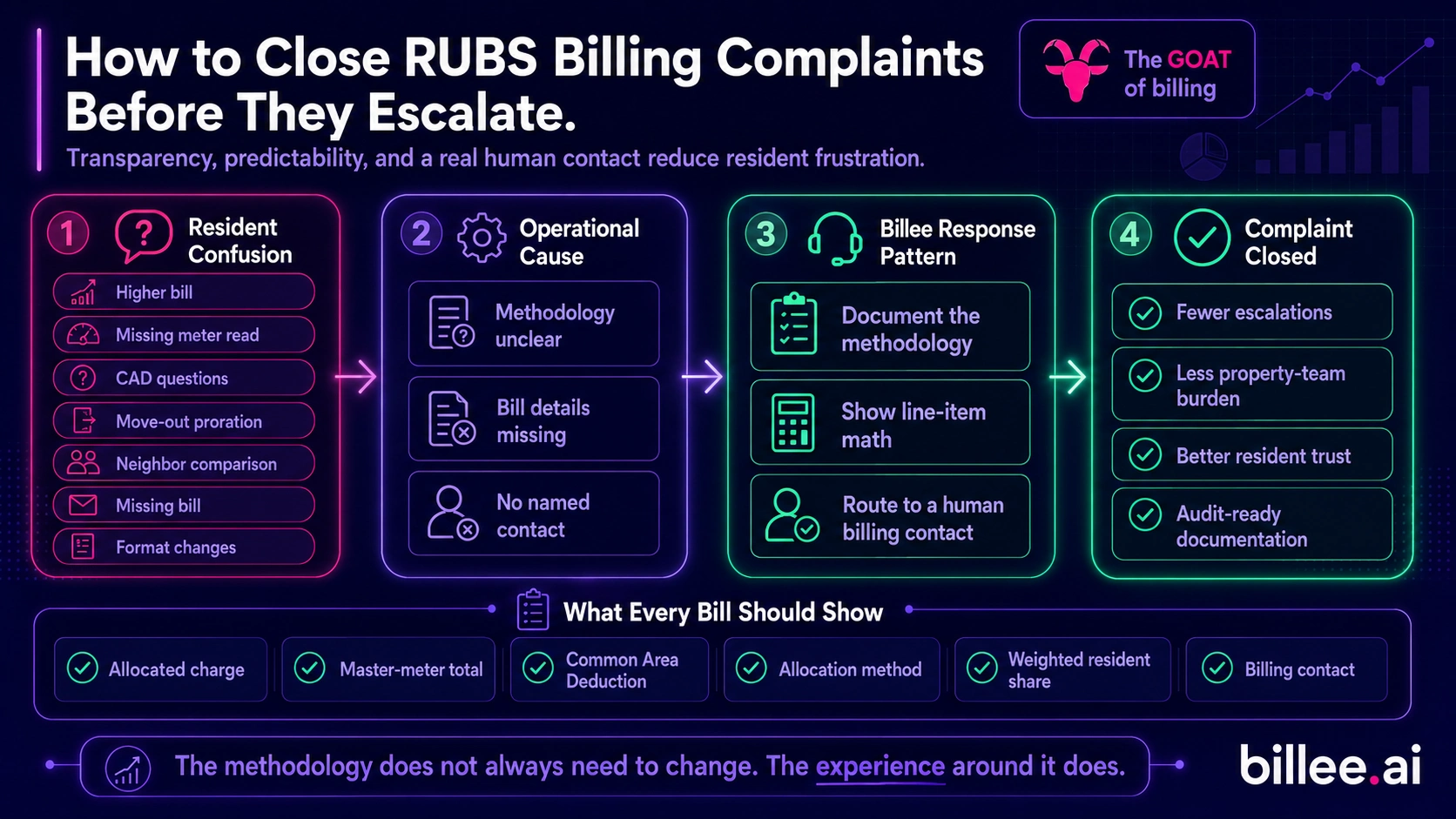
Three structural moves cut complaint volume without changing the underlying methodology.
Lease disclosure that residents actually read. Standard lease language about RUBS is usually a one-paragraph block in a 20-page document. Add a separate one-page utility billing addendum that explains the methodology in plain English. Residents who sign the addendum cannot later claim they did not know.
A billing FAQ and a named contact on every bill. The bill itself should include a short FAQ link and a billing contact (email and phone). Residents call the leasing office because the bill does not tell them who else to call. Billee's resident support line (residentsupport@billee.ai, (214) 983-8060) is the dedicated channel for Billee customers; operators running RUBS in-house should set up an equivalent dedicated channel.
A defensible methodology audit, on the shelf, ready to share. When a resident escalates, the operator should be able to produce a methodology document within the same business day. Operators who cannot produce it lose the dispute on procedure. Billee runs methodology audits as part of the regulatory and compliance workflow, and the audit deliverable is the document operators hand to disputing residents.
How Billee can help
Billee handles resident communications for Billee customers through a dedicated resident support line, separate from the operator's property management team. Property staff do not field utility billing questions; the Billee team does. The platform also produces consistent bill formatting across the portfolio (same line items, same labels, same math shown), which reduces the format-change complaints that compound when operators switch billing systems.
For the underlying methodology, Billee's Billing & Recovery Engine handles RUBS allocation, charge posting, and resident billing, while a named account team manages methodology reviews and CAD calibration. The benchmark Billee tracks is 80 to 95 percent effective recovery, per Billee's standard portfolio benchmark. Implementations typically complete in 45 days, per Billee's standard implementation timeline.
FAQ
Are RUBS charges legal under state law?
RUBS is legal in most states with the right lease disclosure and methodology. Texas is the most permissive; California permits RUBS but treats it as part of rent for rent-control purposes under California Civil Code §1954.201–204; Connecticut prohibits RUBS for residential multifamily entirely. Multi-state operators should confirm their disclosure and methodology meet each state's requirements.
Can a resident refuse to pay a RUBS charge?
A resident can dispute a RUBS charge but cannot unilaterally refuse to pay one disclosed in the lease. Operators should respond to disputes with the documented methodology and the line-item math. If the resident continues to refuse after a documented response, the standard lease enforcement and collection processes apply.
What is the difference between RUBS and submetering for the resident?
For the resident, RUBS produces a charge based on a property-wide allocation formula; submetering produces a charge based on the resident's own unit usage. Submetering is more direct; RUBS is more cost-effective for the property. Residents in submetered units generally have more individual control over their bill.
Should operators offer residents a way to see the methodology?
Yes. The methodology should be available on request, ideally as a one-page document. Operators who treat the methodology as proprietary or refuse to share it raise dispute risk and can attract regulatory attention. The methodology is meant to be defensible, which means it is meant to withstand scrutiny.
How often does a resident complaint escalate to a regulator?
Most complaints close at the property level. Escalations to the state PUC, a local rent-control board, or a class-action plaintiff's attorney are rare but materially expensive when they happen. The pattern in those cases is consistent: the property cannot produce a defensible methodology document, the bill format has changed multiple times, and the resident has not been able to reach a named billing contact. Avoiding the escalation pattern is largely procedural.
Can the Common Area Deduction change mid-year?
Yes, and it should be reviewed annually. A property that has added a pool, extended common-area hours, or converted units to ADA standards has shifted its non-resident usage. The CAD should be recalibrated accordingly. Mid-year CAD changes should be disclosed to residents in advance and explained on the first bill that reflects the change.
How does Billee handle resident disputes for its customers?
Billee operates a dedicated resident support line that handles billing questions from residents on Billee-managed properties. Property staff are not the first line of resident billing support; the Billee team is. Complex disputes that require methodology review are routed back to the operator's account team for resolution.
Billee handles RUBS billing for multifamily operators who want accurate allocation, documented methodology, and a billing experience that residents do not escalate. Talk to the team.
Sources
1. California Legislative Information, "California Civil Code §1954.201–204," accessed 2026.
2. Dune Labs, "Things You Need to Know About RUBS Regulations Across States," November 7, 2022.
Insights and Industry Trends