
Water Submetering Explained for Apartments
Water submetering installs an individual meter on the water line serving each apartment, so residents are billed for the water they actually use instead of a formula-based share of the building's master water bill.
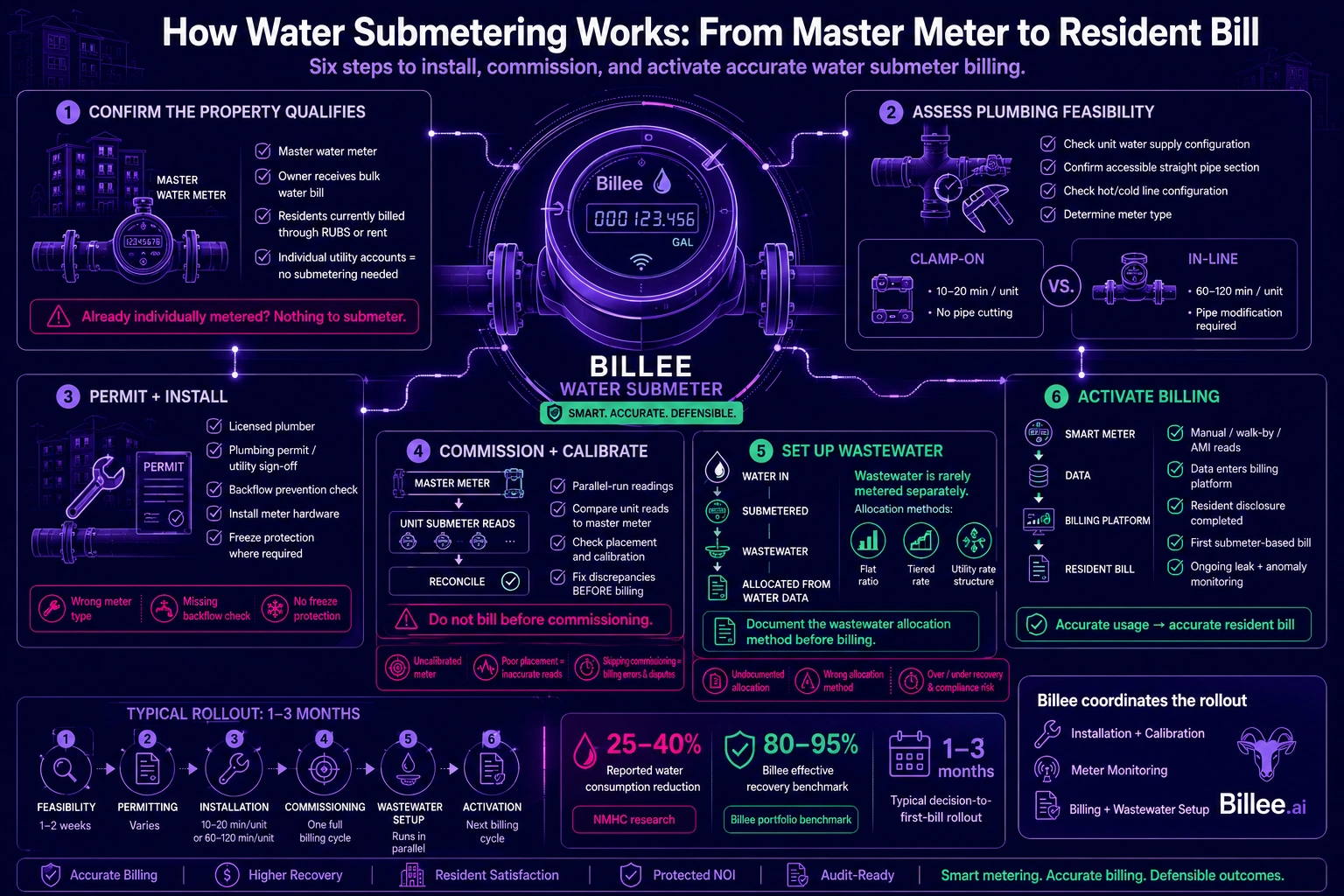
Getting from that decision to a resident's first submeter-based water bill runs through six steps: confirming the property qualifies, a plumbing feasibility assessment, permitting and installation, commissioning, setting up how wastewater gets billed, and activating billing with resident disclosure. That last item, wastewater, is where water submetering diverges from electric or gas: sewer usage is almost never measured directly, so it has to be calculated from the water data instead. Billee coordinates that entire process for operators who want a dedicated team running it.
Quick answer
Water submetering only makes sense on a property billed through a master water meter, where the water utility bills the owner for the whole building's consumption and the operator currently allocates that cost to residents through RUBS or absorbs it in rent. If residents already have individual water accounts with the utility, there is nothing to submeter.
A water submeter measures the volume passing through each unit's supply line, in gallons or cubic feet, and reports that reading either manually, via a walk-by radio read, or automatically through an AMI network. Getting accurate bills out of that data depends on three things working correctly: the meter itself, a commissioning period that checks the new readings against the master meter, and a wastewater allocation method, since sewer cost typically rides on top of the water reading rather than being measured on its own.
Key takeaways
- Water submetering only applies when a property has a master water meter; if residents already have individual water accounts, there is nothing to submeter.
- Installation type drives both cost and disruption: clamp-on meters that mount around the outside of the pipe install in 10 to 20 minutes per unit with no water shutoff, while in-line mechanical meters require cutting the pipe and take 60 to 120 minutes per unit.
- Wastewater is the step electric and gas submetering do not have. Because sewer usage is essentially never measured directly, most jurisdictions bill residential wastewater based on metered water intake, so an operator has to decide and document that allocation method before billing starts.
- Properties that submeter water report consumption reductions of 25 to 40 percent once residents are billed for what they actually use, per National Multifamily Housing Council research.
- Commissioning, checking new submeter reads against the master meter before billing starts, is the step most likely to get skipped, and skipping it is what causes billing disputes later.
- Billee's Hardware & Maintenance Support coordinates installation and calibration, and its account team handles billing activation, including the wastewater allocation setup, once meters are live.
Why this matters for multifamily operators
A property on a master water meter absorbs 100% of the building's water and sewer cost with no mechanism to bill residents individually. Every long shower, every dripping fixture nobody reports, and every unit watering a balcony garden comes straight out of the operating budget instead of a resident's account.
Water and sewer together are frequently the largest recoverable utility line in a multifamily budget, since sewer cost typically adds on top of water rather than standing separately. Submetering changes resident behavior once billing reflects actual use: properties that submeter water report consumption reductions of 25 to 40 percent, according to National Multifamily Housing Council research on user charges in multifamily rental housing.
Billee's own portfolio benchmark for submetered properties is 80 to 95% effective recovery of billable utility costs (Billee's standard portfolio benchmark). The actual figure for any property depends on occupancy, rate structure, and how the wastewater allocation is set.
Water submetering is also a compliance question in a growing number of states, with specific requirements around disclosure and billing methodology documentation, covered in full in Utility Management Compliance for Multifamily Properties.
How water submetering works, step by step
Step 1: Confirm the property needs water submetering
Water submetering only makes sense on a property with a master water meter, where the operator currently allocates one bulk water and sewer bill across residents through RUBS or absorbs it entirely in rent. If residents already have individual water accounts with the utility, there is nothing to submeter, since the utility already bills each unit directly.
A quick call to the water utility confirms which situation applies, and it's worth making before any budgeting conversation starts. For a full comparison of whether RUBS or submetering fits a given property better, see When to Switch from RUBS to Submetering.
Step 2: Assess plumbing feasibility
A feasibility assessment checks how each unit's water supply line is configured, whether a single cold-water line serves the unit or separate hot and cold lines need separate meters, and whether the supply line is accessible or buried behind finished walls. Properties need a straight, clean section of pipe with adequate clearance before any fittings or tees for a meter to read accurately, and a shutoff valve accessible to the resident on the supply line entering each apartment.
The feasibility assessment also determines which installation type fits the property. Clamp-on meters that mount around the outside of an existing pipe need only a short accessible straight run and no pipe modification. In-line mechanical meters, which measure flow directly inside the pipe, require enough room to cut the line and reassemble it, which is a bigger job in a finished, occupied building. For a full comparison of water meter hardware types, including ultrasonic, magnetic flow, and mechanical pulse meters, see Best Submetering Systems for Apartment Buildings in 2026.
Step 3: Get permitted and installed
Water submeter installation typically requires a licensed plumber and, in most jurisdictions, sign-off from the local water utility or a plumbing permit, since the work involves the property's potable water supply. Many jurisdictions also require a backflow prevention device at or near the new meter connection to keep water from flowing backward into the public supply, a plumbing-code consideration with no equivalent in electric or gas submetering. An operator should confirm the exact requirement with the local water utility and plumbing code before installation, since it varies by jurisdiction.
Installation time depends heavily on meter type. Clamp-on meters install in 10 to 20 minutes per unit with no water shutoff required, while in-line mechanical meters require notifying residents of a temporary shutoff and take 60 to 120 minutes per unit to cut in, drain, and reassemble. Meters installed in unheated spaces, crawl spaces, exterior meter pits, or parking garages also need freeze protection in cold climates, since a frozen and cracked meter is both a billing gap and a water-damage risk.
Step 4: Commission and calibrate before anyone gets billed
Commissioning is the step most likely to get skipped, and skipping it is what causes billing disputes months later. Before a submeter goes live for billing, its readings need to be checked against the master meter over a parallel-run period, comparing the sum of all unit-level reads to what the master meter shows for the same period. A meter installed backward or misread during setup still produces a number, and nothing about that number looks obviously wrong until it is checked against the master meter.
The fix mirrors what a careful electric submetering rollout does: track the new submeter readings alongside whatever billing method the property currently uses for at least one full cycle before the new charges take effect. If unit-level reads do not reconcile sensibly against the master meter, that is a placement or calibration problem to fix before a resident sees a bill built on it.
Step 5: Set up wastewater and sewer billing
Wastewater allocation has no equivalent in electric or gas submetering. Sewer usage is almost never measured with its own meter, since there is no practical way to meter what goes down a drain the way a water meter measures what comes in. Instead, most jurisdictions bill residential wastewater based on metered water intake, on the assumption that most water entering a unit eventually leaves it as wastewater.
An operator installing water submeters has to decide and document how that allocation works: whether wastewater is billed at a flat ratio of metered water volume, a tiered rate structure, or the same rate structure the water utility itself uses for the property's master account. Getting this decision documented matters for the same reason a defensible RUBS formula matters, covered in How RUBS Allocates Utility Costs in Multifamily Properties.
Step 6: Get data into a billing platform and activate billing
Once meters are commissioned and the wastewater allocation is set, readings need a path from the hardware to a resident's bill, through either a manual or walk-by read or an AMI network that reports automatically.
Continuous meter monitoring starts to matter as soon as water submeters are reporting data, since a spike or a sudden drop is often the first sign of a leak, not just a billing anomaly. Billee's meter monitoring and proactive alerts flags exactly that kind of pattern and routes it to a team that takes action, not just a notification, covered in full in What Is Meter Monitoring & Proactive Alerts?
Most states require lease disclosure before a resident can be billed on submetered water usage, with requirements that vary by state, as covered in the compliance article linked above. Once disclosure requirements are met, the first billing cycle runs on the new submeter data and the documented wastewater allocation, with the commissioning-period comparison on hand if a resident disputes an early charge.
How long the whole rollout takes
Per Billee's Hardware & Maintenance Support and account teams, who coordinate water submetering rollouts across multiple properties, the table below reflects a typical timeline. Actual timing depends most on meter type, permitting speed, and how quickly the wastewater allocation method gets decided and documented.
| Step | What happens | Typical duration |
|---|---|---|
| Feasibility assessment | Confirm master meter status and plumbing configuration | About one to two weeks |
| Permitting | Plumbing permit and water utility sign-off | Varies by jurisdiction |
| Installation | Meter installation per unit | 10 to 20 minutes for clamp-on meters; 60 to 120 minutes for in-line mechanical meters |
| Commissioning | Parallel-run readings against the master meter | One full billing cycle |
| Wastewater setup | Decide and document the sewer allocation method | Runs in parallel with commissioning |
| Activation | Resident disclosure and first submeter-based bill | Next scheduled billing cycle |
Start to finish, most rollouts move from decision to first submeter-based bill in one to three months, similar to electric submetering, with meter type and permitting speed as the biggest variables.
Common mistakes
- Skipping the wastewater decision until billing is about to start. An undocumented or inconsistent sewer allocation method creates the same compliance and dispute exposure as an undocumented RUBS formula.
- Choosing meter hardware without checking the building's plumbing configuration. An in-line mechanical meter priced and scheduled like a clamp-on installation blows the project timeline once pipes actually need to be cut.
- Skipping commissioning to get to the first bill faster. An uncommissioned meter with a placement or calibration error still produces a number, and residents dispute the bill built on it.
- Ignoring freeze protection for meters in unheated spaces. A cracked meter in a cold snap is a water-damage claim and a billing gap at the same time.
- Activating billing before confirming state and lease disclosure requirements. Billing on submetered water usage without the required disclosure creates dispute and compliance exposure that is expensive to unwind later.
- Treating the backflow prevention requirement as optional. Requirements vary by jurisdiction, but skipping this check when it does apply can stall a final inspection or utility sign-off.
When to handle this in-house vs. bring in a partner
A single property with straightforward plumbing and an in-house facilities team that already manages plumber relationships can often run this process directly: get a feasibility assessment, pull the permit, and coordinate installation like any other capital project.
The calculus changes across a multi-property portfolio, especially one with a mix of plumbing configurations, several jurisdictions with different permitting and backflow requirements, and a wastewater allocation decision that needs to be made and documented consistently across properties. At that point, the work shifts from a single capital project to an ongoing vendor management, compliance documentation, and data integration problem, which is the case where a dedicated partner earns its cost.
How Billee can help
Billee's Hardware & Maintenance Support handles procurement, installation coordination, and ongoing calibration and lifecycle management for a water submetering rollout, so the property team is not chasing plumbers and permit offices alone across a portfolio. Once meters are live, meter monitoring and proactive alerts covers the data side, flagging leaks and anomalies to a team that takes action rather than just notifying, and Billee's dedicated account team handles billing activation, the wastewater allocation setup, and resident communication when questions come up.
FAQ
How much does water submetering cost per unit?
Cost depends heavily on meter type and building plumbing. Clamp-on meters that do not require cutting the pipe are the lower-cost, lower-disruption option; in-line mechanical meters cost more to install because the work involves cutting, draining, and reassembling the line.
Do I need a licensed plumber to install water submeters?
In most jurisdictions, yes. Installation involves the property's potable water supply, so it typically requires a licensed plumber and, depending on the jurisdiction, a plumbing permit or water utility sign-off.
How is wastewater billed if sewer usage isn't separately metered?
Most jurisdictions bill residential wastewater based on metered water intake, since outflow is essentially never measured directly. An operator installing water submeters needs to decide and document the specific allocation method, whether that is a flat ratio of metered water or the rate structure the water utility uses on the property's master account.
How long does a water submetering rollout take?
Installation itself ranges from minutes per unit for clamp-on meters to roughly an hour or two for in-line mechanical meters. The full process, from feasibility assessment through commissioning and activation, usually takes one to three months across a portfolio, similar to electric submetering.
Will installing water submeters require shutting off water to residents?
Meter type determines whether a shutoff is required. Clamp-on meters generally do not need one, but in-line mechanical meters do, since installation involves cutting into the existing pipe. Residents typically need advance notice of a temporary outage when an in-line meter is being installed.
Do I need a backflow prevention device for a water submeter?
Many jurisdictions require a backflow prevention device on a new water service connection to protect the public water supply, though the exact requirement varies by jurisdiction and plumbing code. Confirming this with the local water utility during the feasibility assessment avoids a surprise at final inspection.
Does water submetering reduce consumption, not just improve billing accuracy?
Yes. Properties that submeter water report consumption reductions of 25 to 40 percent once residents are billed for actual usage, according to National Multifamily Housing Council research, since metering and billing behavior changes how residents use a resource they previously paid a flat or formula-based share for.
Does Billee handle water submetering billing and the wastewater allocation?
Yes. Billee integrates submeter data into resident billing, documents the wastewater allocation method, monitors readings for leaks and anomalies through meter monitoring and proactive alerts, and its account team manages activation and resident communication.
Related reading
- How Submetering Works in Multifamily Properties: the broader economics and recovery-rate case across all utility types.
- How Electric Submetering Works, Step by Step: the equivalent process walkthrough for electric.
- Submetering ROI for Multifamily: the full payback math before investing in hardware.
If coordinating a water submetering rollout, including the wastewater allocation decision, is on your list, Billee's Hardware & Maintenance Support and account team coordinate that process from installation through billing activation. Talk to the team if you want to see how.
Sources
- National Multifamily Housing Council, "Water Conservation From User Charges in Multifamily Rental Housing," accessed August 2026.
- SimpleSubWater, "How to Install a Water Submeter (of any type)," accessed August 2026.
- Synergy Utility Billing, "Water Submeter Installation Guide for Multifamily Property Owners," accessed August 2026.
- H2O Degree, "Water Submetering Building Requirements," accessed August 2026.
Insights and Industry Trends