
When to Switch from RUBS to Submetering: A Decision Framework for Multifamily Operators
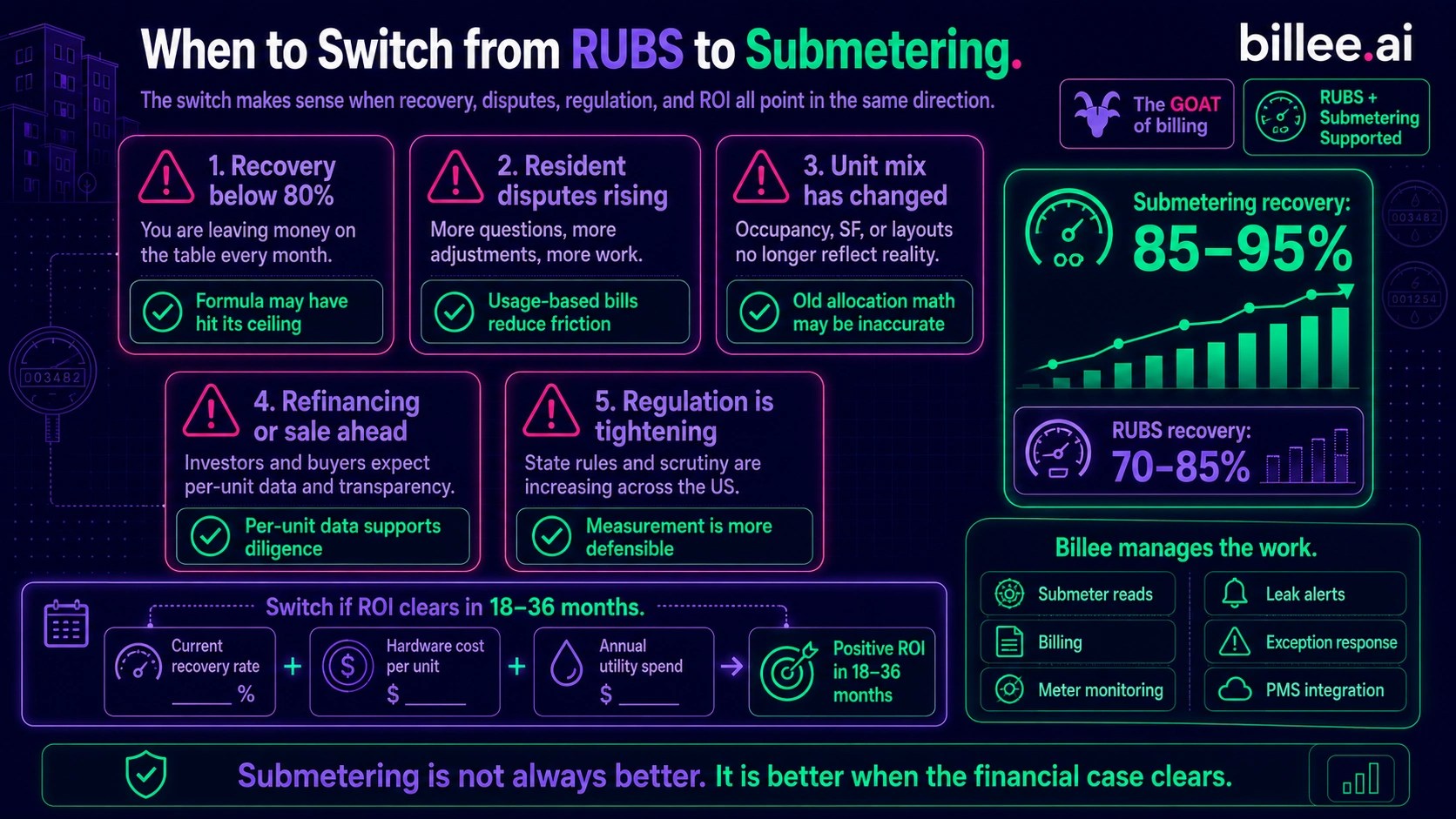
Switching from RUBS to submetering is financially justified when your current recovery rate sits below 80%, resident disputes over allocation are rising, or state regulations are tightening around formula-based billing. Submetering typically recovers 85–95% of utility costs versus 70–85% for RUBS, but requires hardware investment per unit and ongoing maintenance. The decision hinges on your property's age, unit-mix complexity, hold horizon, and the size of the gap between your current recovery and your submetering potential.
Key Takeaways
• RUBS allocates master-meter costs by formula (square footage, occupancy, or a hybrid); submetering bills each resident for their actual measured consumption
• Submetering typically recovers 85–95% of utility costs; RUBS typically recovers 70–85%
• The switch is usually cost-justified when hardware ROI clears in 18–36 months from improved recovery
• A two-year EPA study found submetering cut water consumption by 15.3% per unit; RUBS produced no statistically significant savings
• Regulatory pressure in California and Texas is making submetering the expected standard for new multifamily construction
• Billee supports both RUBS and submetering in the same portfolio, and can model the financial case before an operator commits to hardware
RUBS vs. Submetering: What Actually Changes
RUBS and submetering are not just two billing methods. They represent two different operating models for how utility costs move from the utility company to the resident.
With RUBS, the property receives one master meter bill. That bill gets allocated across occupied units by formula — square footage, occupancy count, or a combination of both. With submetering, each unit has its own meter, and the resident is billed for what they actually consumed.
The downstream effects compound over time. Recovery rates differ materially. Resident dispute patterns differ. Capital requirements differ. The table below shows how the two methods compare across the dimensions that matter most to a multifamily operator.
DimensionRUBSSubmeteringBilling basisAllocated formulaActual consumptionHardware requiredNoneMeters per unit (water, electric, or gas)Typical recovery rate70–85%85–95%Resident dispute rateHigher (formula perceived as unfair)Lower (usage is verifiable)Upfront cost per unitMinimal$230–$700 (water); $250–$500 (electric)Ongoing maintenanceLowModerate (hardware calibration, monitoring)Regulatory exposureIncreasing disclosure requirementsHigher compliance burden; more defensible in disputesWater consumption impactNo statistically significant savings15–30% reduction documented by EPA research
Properties that make the switch from RUBS to submetering routinely improve recovery by 10–25 percentage points, per industry benchmarks.
Five Signs Your RUBS Setup Is Ready for Submetering
Not every portfolio should make the switch. But these five signals, taken together, indicate that submetering will deliver positive ROI.
Recovery rate has plateaued below 80%. Billee's portfolio benchmark treats anything below 80% as a problem requiring a methodology review. If you have already audited your RUBS formula, corrected your Common Area Deduction (CAD), and updated occupancy ratios — and recovery is still stuck — the formula itself may be the ceiling.
Resident billing disputes are rising. RUBS creates friction in properties with high usage variation. A resident who showers twice a day and runs laundry three times a week will dispute paying the same allocated rate as their neighbor who travels ten days a month. Submetering eliminates that argument because the bill reflects actual consumption.
Unit-mix changes have made your formula inaccurate. Renovations, ADU additions, and unit consolidations change the square footage ratios that underpin RUBS allocations. If your unit mix has changed materially in the past two to three years and your formula has not been updated to match, your current allocation may be systemically over-billing some residents and under-billing others.
The property is being prepared for institutional sale or refinancing. Institutional buyers increasingly require per-unit consumption data for ESG reporting and ENERGY STAR benchmarking. RUBS does not produce that data. Submetering does, and that data becomes a real asset at disposition.
State or local regulation is moving against RUBS. California's disclosure requirements under Civil Code §1954.201 and Texas PUC Chapter 24's allocated billing rules are not moving in the direction of less scrutiny. If your market is already trending toward metering mandates for new construction, planning a submetering retrofit on your own timeline is better than being compelled to do it later.
When RUBS Still Makes Sense
RUBS is not a problem to be solved in every portfolio. There are legitimate reasons to keep it.
A short hold horizon is the clearest case. If you plan to sell within three to five years, hardware ROI is unlikely to clear before disposition. That capital is better deployed elsewhere.
Older building infrastructure can make submetering cost-prohibitive. Single-stack plumbing — common in pre-1970s construction — makes individual water meter installation physically difficult and expensive. In those buildings, RUBS is not a compromise; it is the right tool for the asset.
RUBS also holds up well when your unit mix is simple and stable. A property with uniform unit sizes, consistent occupancy, and low resident turnover produces an allocation close enough to actual usage that disputes are rare and recovery stays within an acceptable range.
Affordable housing with HUD utility allowance structures is a distinct case. RUBS interacts with utility allowances in ways that submetering does not, and the compliance framework requires separate analysis before any methodology change.
The Financial Model: How to Calculate Your Switch ROI
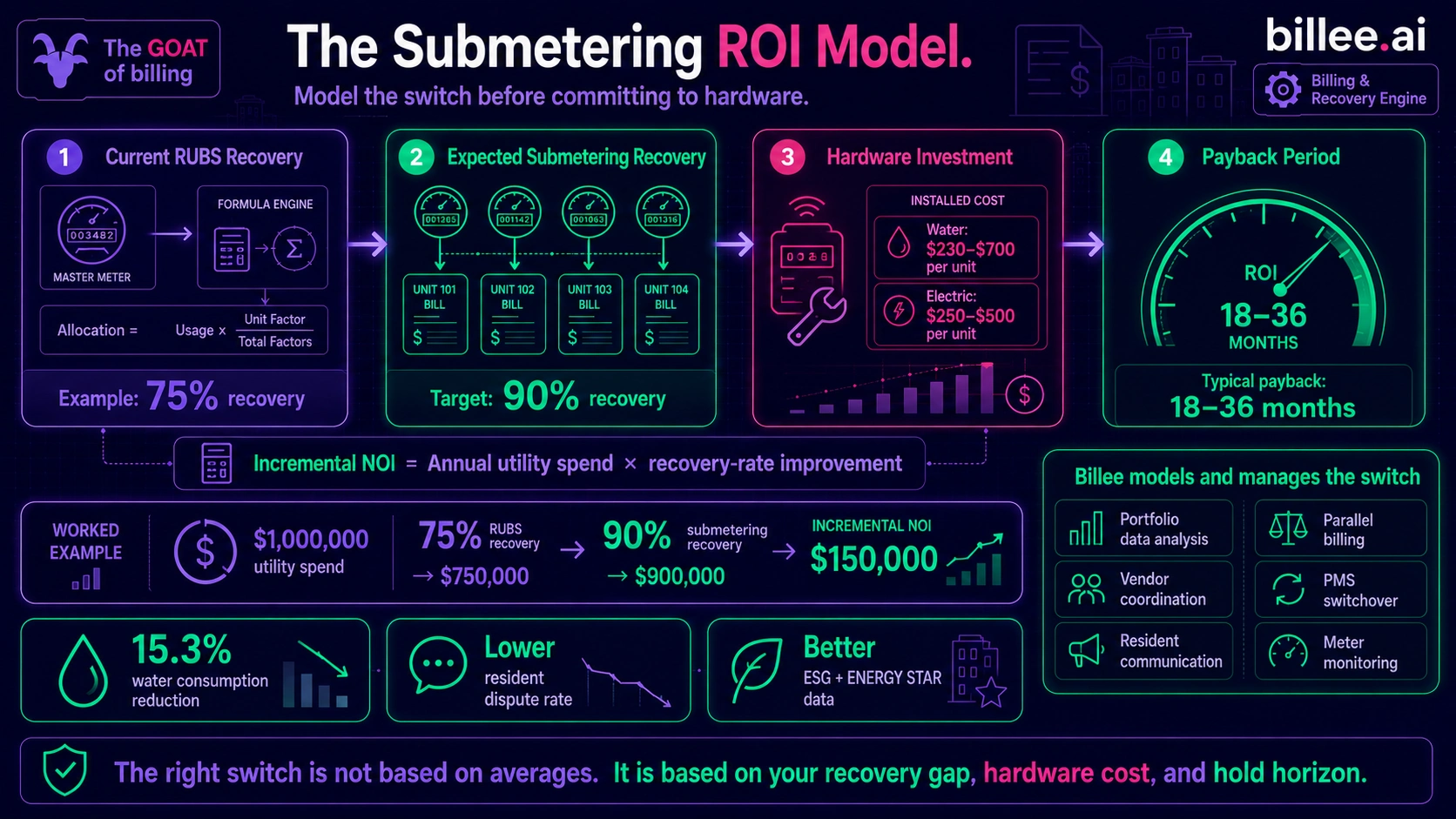
The math for a submetering transition is straightforward once you have four numbers: current recovery rate, expected post-switch recovery rate, hardware cost per unit, and annual utility spend.
Step 1: Calculate the incremental recovery value. If your portfolio's annual master meter bill is $1,000,000 and your current RUBS recovery rate is 75%, you are recovering $750,000 per year. If submetering brings that to 90%, you recover $900,000 — an additional $150,000 per year in NOI.
Step 2: Estimate hardware cost. Water submeter installation in a retrofit setting typically costs $230–$700 per unit, depending on plumbing access and meter type. Electric submeter installation runs $250–$500 per unit. A 200-unit property could face $50,000–$140,000 in hardware and installation costs at the low to mid range.
Step 3: Calculate payback. Divide the hardware cost by the annual incremental recovery. At $100,000 in hardware and $150,000 in annual incremental recovery, payback clears in under eight months. In tighter scenarios, payback periods of 18–36 months are typical for well-run retrofit projects.
Step 4: Factor in consumption reduction. Submetering does not just improve recovery — it reduces consumption. Per a two-year EPA study, properties that switch to individual billing see water usage drop by an average of 15.3% per unit, or roughly 21.8 gallons per day. That reduction flows through to the master meter bill, improving the financial picture further.
Billee can model this analysis against your actual portfolio data — current recovery rate, master meter spend, and unit count — before you commit to hardware.
Regulatory Factors That Should Accelerate Your Timeline
RUBS faces increasing regulatory scrutiny in several major markets. Understanding where your properties sit in the regulatory environment is part of the financial decision.
California. Senate Bill 7 (2016), now codified as Civil Code §1954.201–1954.205, requires that any new multifamily construction with water service after January 1, 2018 include individual water meters or submeters. For existing buildings, the law establishes disclosure requirements and billing standards for submetered properties. California RUBS billing remains legal for existing stock but is subject to strict disclosure rules under the California Public Utilities Commission.
Texas. Texas PUC Chapter 24, Subchapter I, governs both submetered and allocated utility service in multifamily properties. For RUBS billing, the rules require owners to make available to residents the full allocation calculation methodology, occupancy and square footage data, and monthly totals billed and collected. Submetered billing is treated as the more legally defensible option in dispute resolution under Chapter 24.
ENERGY STAR and ESG requirements. The EPA's ENERGY STAR Multifamily program and institutional ESG reporting frameworks increasingly require per-unit consumption data that RUBS cannot produce. As institutional ownership of multifamily grows, this requirement filters down to acquisition criteria and loan covenants. Operators ahead of that curve are in a materially stronger position at refinancing and disposition.
How to Execute the Switch Without Disrupting Residents
A submetering transition is an operational project, not just a billing change. Managing it well requires coordination across four workstreams.
Timeline. Hardware installation in a standard multifamily property typically takes 90–180 days. That window includes sequencing unit access to minimize disruption and coordinating with the utility company for meter approvals where required.
Resident notification. Most states require advance notice before switching from RUBS or flat-fee billing to submetered billing. California requires written disclosure before lease execution for new residents and written notice before a methodology change for existing residents. Texas requires similar notification under PUC Chapter 24. A 30–60 day advance notice period is standard in most markets.
Parallel billing. Running RUBS and submetered billing simultaneously for 30–60 days during the transition allows you to catch calibration errors before they become resident disputes. Operators who skip this step to save time typically spend months unwinding the problems that follow.
PMS integration. The submetered data needs to flow accurately into your property management software. That means configuring the billing methodology in Yardi, RealPage, or Entrata to reflect the new metering setup, and ensuring resident ledgers are updated on the same cycle as the meter reads.
How Billee Helps Operators Make and Execute This Decision
Billee's Billing & Recovery Engine supports RUBS, submetering, and hybrid methodologies in the same portfolio. An operator with 20 RUBS properties and 5 submetered properties manages all of them through one platform and one account team, without maintaining separate billing workflows.
When an operator is evaluating whether to switch, Billee models the financial case against actual portfolio data — current recovery rate, master meter spend, and unit count. That means the decision is made with real numbers, not industry averages.
When the operator decides to move, Billee manages the transition: vendor coordination for meter installation, resident communications, parallel billing periods, and the methodology switchover in the PMS. The Billee account team handles exceptions, dispute resolution, and the ongoing meter monitoring required to maintain recovery rates after the switch.
FAQ
Is submetering always better than RUBS for multifamily?
Submetering produces higher recovery rates and lower resident dispute rates than RUBS, but it is not the right choice for every property. Properties with short hold horizons, complex older plumbing infrastructure, or simple unit mixes where RUBS allocation is accurate may not recoup the hardware cost within a reasonable timeframe. The decision is always portfolio-specific and should be modeled against actual data before committing to hardware.
How much does it cost to install submeters in an apartment building?
Water submeter installation in a retrofit setting typically costs $230–$700 per unit, depending on plumbing access and meter type. Electric submeter installation runs $250–$500 per unit. New construction installs cost materially less because the infrastructure is designed for metering from the start.
Does switching to submetering require notifying residents in advance?
Yes. Most states require written notice to residents before a billing methodology change takes effect. California requires disclosure before lease execution for new residents and written notice before a methodology change for existing residents. Texas requires similar notification under PUC Chapter 24. A 30–60 day advance notice period is standard in most markets.
Can I use both RUBS and submetering in the same portfolio?
Yes. Many operators run a mix of RUBS and submetered properties depending on building age, infrastructure, and local regulation. Billee supports both methodologies on the same platform, so properties with different billing methods are managed through a single account team and reporting dashboard.
Which states are moving toward mandatory submetering in multifamily?
California was among the first with SB 7 (2016), which requires individual water meters or submeters for new multifamily construction. Colorado and several western states have adopted or are evaluating water submetering requirements for new construction as part of broader conservation frameworks. Texas, which already has detailed rules under PUC Chapter 24, treats submetering as the more legally defensible billing methodology in dispute resolution.
How long does it take to recoup the cost of submeter hardware?
Payback periods of 18–36 months are typical for well-run retrofit submetering projects. Properties with higher master meter costs, lower current RUBS recovery rates, or access to utility rebate programs see faster payback. The consumption reduction effect — properties with submetering see water usage drop by an average of 15.3% per unit per EPA research — accelerates the financial case further.
Does Billee support both RUBS and submetered billing on the same platform?
Billee's Billing & Recovery Engine supports RUBS, submetering, and hybrid methodologies in the same portfolio. Every Billee account includes both the platform and a dedicated account team, so the operational work of managing billing methodology differences across a portfolio stays with Billee, not the property management team.
If the switch from RUBS to submetering is on your operational list, Billee can model the financial case against your actual portfolio data and manage the transition once you decide to move. Talk to the team.
Sources
1. United States Environmental Protection Agency, "Learn About Submetering," EPA WaterSense Program, accessed June 2026.
2. Synergy Utility Billing, "Submetering Benchmarks for 2026," 2026.
3. Synergy Utility Billing, "Apartment Submetering vs RUBS: A Guide for Landlords," accessed June 2026.
4. Synergy Utility Billing, "When Electric Submeter Systems Make Sense for Multifamily," accessed June 2026.
5. Dune Labs, "How Much Does It Cost to Install a Water Submeter," accessed June 2026.
6. California Legislative Information, "SB-7: Housing: Water Meters: Multiunit Structures," enacted September 2016.
7. Texas Public Utility Commission, "Chapter 24: Substantive Rules Applicable to Water and Sewer Service," updated 2024.
Insights and Industry Trends