
Best Submetering Systems for Apartment Buildings in 2026
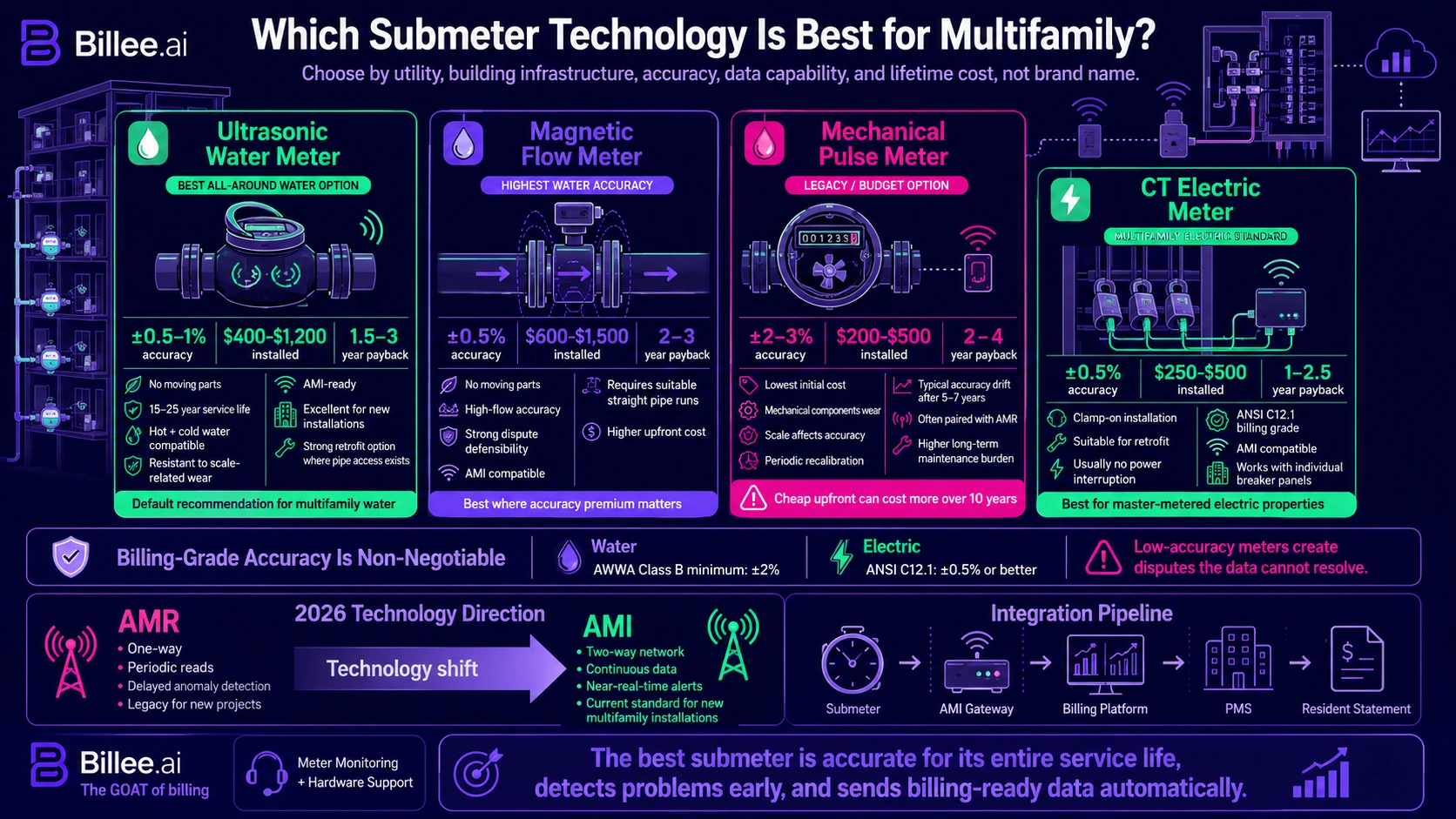
The best submeter for a multifamily building depends on the utility being metered, the building's plumbing and electrical infrastructure, and whether real-time data or cost matters more at installation. For water, ultrasonic and magnetic flow meters outperform mechanical pulse meters on accuracy and service life. For electric, current transformer (CT) meters are the standard for both new construction and retrofits. Any system worth installing has three non-negotiable features: AWWA Class B accuracy or better for water (ANSI C12.1 for electric), wireless AMI data transmission, and a direct integration path to your billing platform. Installation costs range from $300–$1,500 per unit for water and $250–$500 per unit for electric, with payback typically under three years.
Key takeaways:
- Submeter technology type matters more than brand: ultrasonic meters outperform mechanical meters on water; CT meters are the standard for electric submetering
- AMI (two-way, real-time data) is now the baseline for new multifamily installations; AMR (one-way, periodic reads) is legacy technology that limits anomaly detection and billing speed
- AWWA Class B accuracy (±2%) is the minimum acceptable standard for billing-grade water meters; anything lower generates disputes you cannot resolve
- A Guidehouse study of 1,500 submetered units found 40% reduction in electricity consumption in the first year; the EPA's WaterSense program documents 15–40% water reduction post-submetering
- Total cost of ownership matters more than per-unit install cost: a cheap mechanical meter that drifts in accuracy within five years costs more over a 10-year horizon than a quality AMI ultrasonic system
- The submeter system must integrate with your billing platform and PMS; a meter that produces data your billing software cannot ingest is an expensive dead end
Submeter Technologies at a Glance
| Utility | Technology | Accuracy | Typical Cost/Unit Installed | Payback |
|---|---|---|---|---|
| Water | Ultrasonic (AMI) | ±0.5–1% | $400–$1,200 | 1.5–3 years |
| Water | Magnetic flow (AMI) | ±0.5% | $600–$1,500 | 2–3 years |
| Water | Mechanical pulse (AMR) | ±2–3% | $200–$500 | 2–4 years |
| Electric | CT meter (AMI) | ±0.5% | $250–$500 | 1–2.5 years |
| Gas | Diaphragm (AMR) | ±1–2% | $300–$800 | 2–4 years |
What to Evaluate Before Choosing a Submeter System
Start with the Utility That Costs You Most
Water submetering delivers the largest ROI for most multifamily operators because water is the utility most commonly absorbed at the master meter level. In most garden-style and mid-rise multifamily properties, water is master-metered and the operator absorbs the full cost. That's the highest-value target for submetering.
Electric submetering applies when the property has a master electric meter. Many properties with individual breaker panels per unit already have utility-direct billing per unit, which means the utility, not the operator, handles billing. Confirm with your utility company whether your property has a master meter or individual meters before budgeting for electric submeters.
Gas submetering ROI is property-specific. Many multifamily properties have individual gas accounts per unit. Where gas is master-metered, submetering ROI depends on the size of the shared gas cost and the complexity of the riser system.
Building Infrastructure Determines What's Physically Installable
The building's plumbing and electrical configuration determines which meter technologies can actually be installed. A site assessment is not optional; it is the first step.
For water submetering, single-riser buildings (one vertical pipe per unit) are the most straightforward. Shared horizontal distribution systems may limit where individual meters can be placed. Buildings constructed before 1985 often require plumbing modifications before meter installation; the cost of those modifications should be included in the ROI calculation.
For electric submetering, properties with individual breaker panels per unit can install CT meters at each panel. Properties with shared distribution panels require more complex engineering and may need an electrician to assess feasibility before procurement.
AMI vs. AMR: Why the Difference Matters Operationally
AMI (Advanced Metering Infrastructure) meters transmit data continuously to a central gateway. Operators see real-time consumption, anomalies flag within hours, and billing data is always current.
AMR (Automated Meter Reading) meters store reads and transmit when a reader passes by or drives past. Data is periodic, not real-time. An AMR system that detects a toilet leak at the next scheduled read, 30 days later, delivers far less value than an AMI system that flags the same leak within 24 hours.
A running toilet loses 200 or more gallons per day. Early detection through AMI reduces both water costs and water damage claims. A single avoided water damage incident typically exceeds the annual cost of the submeter system for the affected unit.
AMI is the standard for new multifamily installations in 2026. AMR is legacy technology that remains in the field but should not be specified for new projects.
Water Submetering: Technology Comparison
Ultrasonic Meters: The Current Standard
Ultrasonic meters are the leading technology for multifamily water submetering in 2026. They have no moving parts, maintain AWWA Class B accuracy or better across their service life, and typically last 15–25 years without degradation from mineral deposits or scale buildup.
How they work: ultrasonic meters measure flow velocity using sound waves. Because nothing physically contacts the water stream, there is nothing to wear, clog, or calibrate over time.
Ultrasonic meters are compatible with AMI transmission, support both hot and cold water measurement, and produce accuracy at ±0.5–1% across the full flow range. Installation cost runs $400–$1,200 per unit depending on pipe size, access, and building configuration.
Ultrasonic meters are appropriate for new installations and for retrofits where pipe access is available. They are the default recommendation for operators making a first-time investment in water submetering.
Magnetic Flow Meters: Highest Accuracy at Higher Cost
Magnetic meters offer the highest accuracy of any water meter technology at ±0.5%, making them the preferred choice for high-flow applications or properties where accuracy disputes are a concern.
How they work: magnetic meters measure flow using electromagnetic fields. Like ultrasonic meters, they have no moving parts and are unaffected by turbulence or debris in the water stream.
The limitation is installation geometry. Magnetic meters require straight pipe runs on both sides of the meter, which not all buildings can accommodate. Cost runs $600–$1,500 per unit installed, which makes them most appropriate for high-value applications where the accuracy premium justifies the cost.
Mechanical Pulse Meters: Legacy Technology Still in Wide Use
Mechanical pulse meters are the lowest-cost water submeter option at $200–$500 per unit installed. They remain widely deployed but carry real long-term risks.
How they work: an impeller or turbine spins with water flow and emits a pulse output per unit of flow. The mechanical components wear over time. Scale buildup on the impeller reduces accuracy. Most mechanical meters drift meaningfully in accuracy within five to seven years and require recalibration or replacement.
Mechanical meters remain appropriate for properties with very limited capital budgets, short-term installations, or situations where plumbing access constraints rule out ultrasonic or magnetic options. For a 10-year or longer installation horizon, the total cost of ownership of a mechanical meter (including recalibration and eventual replacement) typically exceeds that of an ultrasonic AMI system.
Electric Submetering: CT Meters and Configuration
Current Transformer Meters: The Multifamily Standard
CT meters are the standard electric submetering solution for multifamily properties because they clamp around existing wiring without interrupting power. Retrofit installations are practical without requiring a full electrical panel shutdown.
How they work: clamp-on current transformers measure current flow at each unit's circuit breakers. Combined with voltage measurement, the system calculates kilowatt-hours consumed per unit. Accuracy runs ±0.5% or better, meeting ANSI C12.1 billing-grade standards.
CT meter installation typically takes two to four hours per unit and requires electrical panel access. No power interruption is required in most retrofit installations. Cost runs $250–$500 per unit installed, with payback typically in 1–2.5 years when applied to master-metered electric costs.
Confirm Your Meter Configuration Before Budgeting
Before allocating capital for electric submeters, confirm with your utility whether the property has a master electric meter or individual utility accounts per unit. If the utility already meters each unit directly, there is no electric submetering installation needed; the utility handles billing.
Electric submetering is required when the property has a master electric meter covering in-unit consumption, common areas, or both. This is common in older properties, high-rises built before individual panel configuration became standard, and properties where the operator pays a single bulk electric bill.
Features That Separate Good Systems from Poor Ones
Data Integration: The Feature That Determines Operational Value
A submeter that cannot send data to your billing platform is operationally worthless. Integration is not optional.
The system must have an API or direct data feed to your billing software. It should also integrate with your PMS for occupancy data, so reads are matched to the right resident account automatically. Proprietary data formats that require manual export and import between systems are a red flag; they create lag, introduce errors, and typically require ongoing staff time that erodes the program's ROI.
Billee's Billing and Recovery Engine integrates with submeter data feeds to run the full billing cycle: read ingestion, validation, per-unit allocation, statement generation, PMS posting, and dispute management. The combination of quality submeter hardware and a professional billing layer is where the 80–95% recovery rate Billee holds as a portfolio benchmark is actually achieved.
Anomaly Detection and Leak Alerting
Real-time anomaly detection is one of the highest-ROI features of AMI submetering. The AMI gateway monitors consumption patterns and triggers an alert when sustained high flow exceeds a configurable threshold.
A running toilet loses 200 or more gallons per day. In a 200-unit property, two or three undetected running toilets represent significant monthly water costs and substantial water damage risk. AMI-based detection typically identifies anomalies within 24 hours of onset. AMR systems discover the same problem at the next scheduled read, 30 days later.
The financial case is straightforward. A single avoided water damage event, which can easily run $10,000–$50,000 in remediation and lost rent, exceeds the annual data subscription cost of an AMI network many times over.
Accuracy Standards and Warranty Minimums
For water meters, AWWA Class B (±2%) is the minimum acceptable standard for billing-grade installation. Class C (±5%) is not appropriate for billing and will generate disputes that cannot be resolved with the data the meter produces. Ultrasonic and magnetic meters typically achieve Class A (±1.5%) or better.
For electric meters, the applicable standard is ANSI C12.1. Billing-grade electric submeters should achieve ±0.5% or better.
On warranty: a minimum of five years parts and labor is the floor. Quality AMI systems now come with 10-year manufacturer warranties. Ultrasonic and magnetic meters do not require periodic calibration under normal operating conditions. Mechanical meters should be tested every five to seven years.
Installation Cost and 10-Year Total Cost of Ownership
What Installation Actually Costs
Water installation cost drivers include the number of risers, pipe accessibility, building age, and whether isolation valves are already in place. Electric installation cost drivers include panel access, number of circuits per unit, and the presence of three-phase power.
Budget 15–25% above hardware cost for a complete professional installation. That covers project management, data commissioning, AMI network configuration, and commissioning validation. Operators who budget only for meter hardware and are surprised by the integration and commissioning costs are the rule, not the exception.
The 10-Year TCO Calculation
Year 1 costs include hardware and installation: $300–$1,500 per unit for water, $250–$500 for electric. Ongoing costs include AMI network data subscription fees, typically $2–$8 per unit per month, and maintenance (zero for ultrasonic and CT meters under warranty; periodic recalibration for mechanical meters).
A conservative 10-year model for a 300-unit property, using Vitality IO's benchmarks, shows approximately $45,000 per year in water conservation savings plus $21,600 per year in recovery improvement, totaling approximately $666,000 in combined benefit over 10 years. Payback on the installation cost runs 1.5–3 years for water and 1–2 years for electric.
What to Ask Before Signing a Contract
Any reputable submetering vendor should answer these questions clearly and in writing:
Does the system integrate with your billing platform and PMS, and how? Who owns the data, and can you export it in full at any time? What AWWA accuracy class does the water meter meet, or what ANSI standard does the electric meter meet? What is the manufacturer warranty period, and what does it cover? Is the AMI network infrastructure included in the installation price or billed as a subscription? What does anomaly detection look like, how are alerts delivered, and who is responsible for responding?
A vendor that cannot answer these questions with specifics before signing is not the right partner for a long-term capital investment.
How the Billing Layer Captures the Return
Submeter technology is the hardware layer. The financial return is captured in the billing layer, where meter data is translated into accurate per-unit resident charges.
Billee integrates with submeter data feeds to run the full billing cycle: read ingestion, validation, per-unit allocation, statement generation, PMS posting, and dispute management. Billee's portfolio benchmark is 80–95% effective recovery. Recovery below 80% triggers a methodology review.
The right submeter hardware gets the data. A professional billing program turns that data into recovered revenue.
Talk to the Billee team about submetering integration for your portfolio.
Frequently Asked Questions
What is the best water submeter for apartment buildings in 2026?
Ultrasonic AMI meters are the current standard for multifamily water submetering. They offer no-moving-parts reliability, AWWA Class B or better accuracy (±0.5–1%), and 15–25 year service lives without calibration. For high-accuracy applications or high-flow properties, magnetic flow meters offer ±0.5% accuracy at higher per-unit cost. Mechanical pulse meters are the lowest-cost option but carry accuracy drift and recalibration costs that erode the savings over time.
How much does it cost to install submeters in an apartment building?
Water submetering runs $300–$1,500 per unit installed, depending on technology (ultrasonic vs. mechanical), building plumbing configuration, pipe accessibility, and whether isolation valves are already in place. Electric submetering with CT meters runs $250–$500 per unit. Budget an additional 15–25% above hardware cost for project management, network commissioning, and data integration.
What's the difference between AMI and AMR submetering?
AMI (Advanced Metering Infrastructure) transmits meter data continuously to a central gateway, enabling real-time consumption dashboards, near-immediate anomaly detection, and always-current billing data. AMR (Automated Meter Reading) stores reads and transmits periodically when a reader passes by; data is available at intervals, not in real time. AMI is now the standard for new multifamily installations; the operational gap between the two systems is most visible in leak detection, where AMI identifies anomalies within 24 hours and AMR at the next scheduled read.
Do I need submeters if my utility company meters each unit individually?
No. If the utility already has individual accounts per unit and bills each resident directly, the utility is handling that function. Electric and gas submetering is needed only when the property has a master meter covering in-unit consumption. Confirm your meter configuration with the utility company before budgeting for any electric or gas submeter installation.
How accurate do submeters need to be for billing?
For water submetering, AWWA Class B (±2%) is the minimum acceptable standard for billing-grade use. Class C (±5%) produces readings too imprecise to defend in a billing dispute. Ultrasonic and magnetic meters typically achieve Class A (±1.5%) or better. For electric submetering, ANSI C12.1 applies; billing-grade CT meters achieve ±0.5% or better.
What is the payback period on multifamily submetering?
Payback typically runs 1.5–3 years for water submetering and 1–2.5 years for electric, depending on the cost of the absorbed utility, the property's current recovery rate, and installation cost per unit. A conservative 300-unit model using Vitality IO benchmarks shows approximately $666,000 in combined conservation and recovery benefit over 10 years against installation costs of $90,000–$450,000, depending on technology selected.
Can submeters detect leaks?
Yes, and this is one of the highest-value capabilities of AMI submetering. AMI gateways monitor consumption continuously; when flow exceeds a configurable threshold for a sustained period, the system flags an anomaly and sends an alert. A running toilet that loses 200 or more gallons per day is typically detected within 24 hours on an AMI system. The financial impact of early detection, in avoided water costs and water damage remediation, often exceeds the annual AMI network subscription cost.
What should I look for in a submetering contract?
Data ownership, integration terms, accuracy certification, warranty coverage, and AMI network pricing are the five non-negotiable items. Verify you can export all meter data in full at any time, in a format compatible with your billing platform. Confirm the specific AWWA or ANSI accuracy class the meter is certified to, not just a vendor's marketing claim. Get clarity on whether the AMI network infrastructure is included in the installation price or structured as a separate ongoing subscription, and at what per-unit rate.
Billee integrates with submeter data feeds to run the full billing cycle for multifamily operators: read ingestion, validation, per-unit allocation, statement generation, PMS posting, and dispute management. See how Billee handles the billing layer for portfolios like yours.
Sources
- U.S. Environmental Protection Agency, "WaterSense: Multifamily Submetering," accessed 2026.
- Guidehouse, "Electricity Submetering Study: 1,500-Unit Analysis," accessed 2026.
- Vitality IO, "Benefits of Multifamily Submetering," accessed 2026.
- Vitality IO, "Benefits of Water Submetering for Multifamily," accessed 2026.
- LeakSense, "Top 7 Water Metering Solutions for Apartments in 2026," 2026.
- Simple Sub Water, "The Complete Apartment Water Submetering Guide," accessed 2026.
- Mainlink, "Multifamily Water Submetering Guide," accessed 2026.
- Utility Metering Hub, "Water vs. Electric vs. Gas Submetering: Complete Comparison," accessed 2026.
- Synergy Utility Billing, "How to Choose a Water Submeter System for Multifamily," accessed 2026.
Insights and Industry Trends